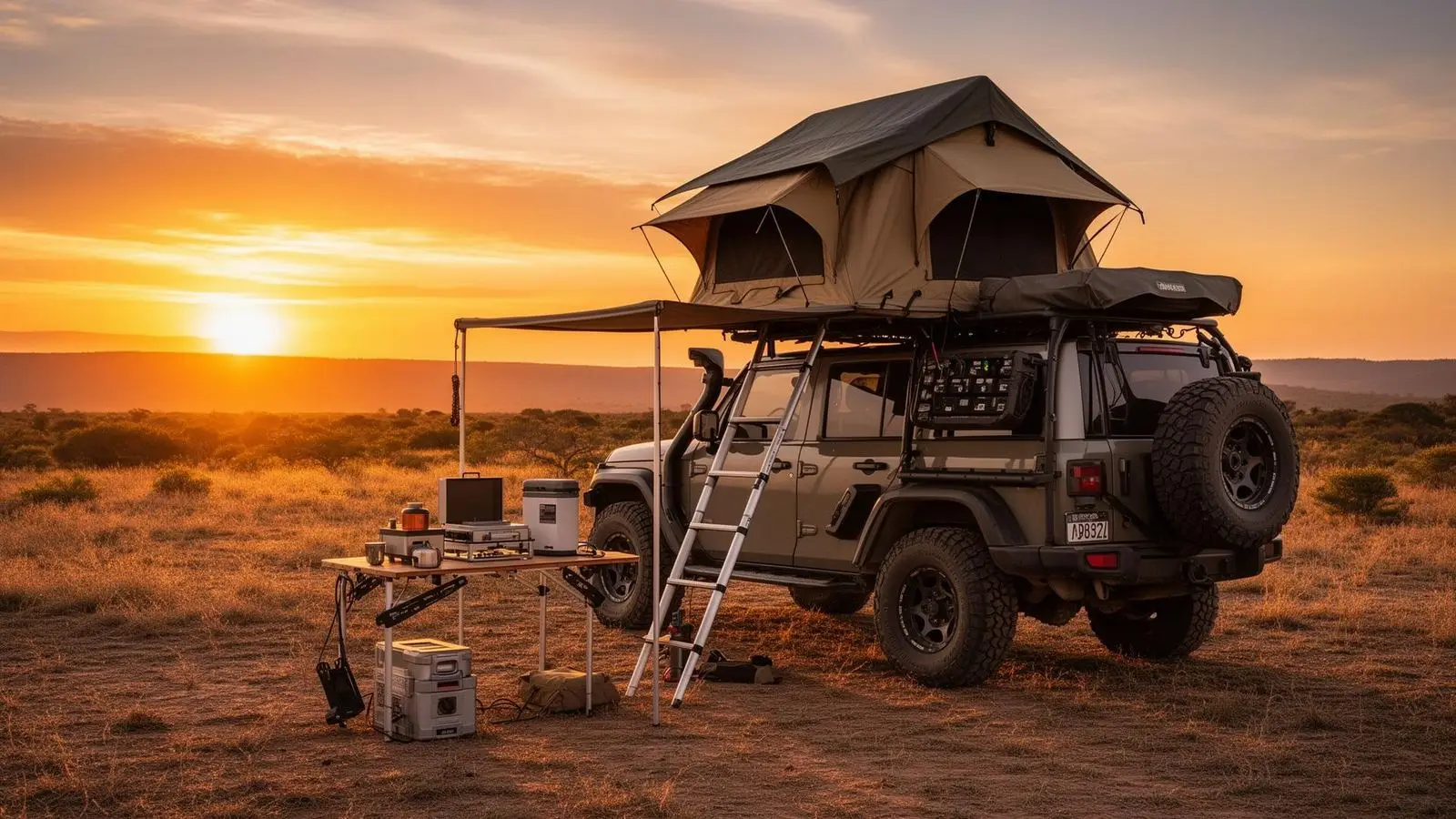
Night two, 40 miles of washboard past the last gas station. The fridge reads 43°F and climbing, the power station says 11 percent, and the 100-watt panel every gear list promised would run the fridge "indefinitely" spent the afternoon in the shade of the juniper you parked under. The truck sits lower than it did in the driveway. It should. It was over its payload rating before you left town.
None of that is bad luck. It is arithmetic the checkout page never shows you. This guide covers what each piece of essential overlanding gear actually draws, weighs, and costs in 2026, and the order to buy it.
What changed in overlanding gear for 2026?
Three things changed the list. LiFePO4 is now the default chemistry in portable power stations. The Jackery Explorer 1000 v2 and EcoFlow Delta 3 Plus both use it, and EcoFlow rates the Delta 3 Plus for 4,000 cycles to 80 percent capacity. Skip the older lithium-ion (NMC) units still sitting in gear lists and on clearance tables.
Your phone can probably text by satellite. iPhone 14 and later have Emergency SOS via satellite, T-Mobile's Starlink-based T-Satellite handles texts and a short list of apps for $10 a month on most plans, and satellite 911 texting is free on compatible phones on any carrier.
Fridges got better and cheaper at the same time. Dometic's new CFX5 45 lists at $1,049.99, while OutdoorGearLab's tested budget picks list at $320 to $500.
Meanwhile the crowd grew to more than 12 million Americans in 2025, up from 8 million the year before, per Overland Expo's industry report. More buyers means more marketing, which is why this guide starts with weight.
Can your rig carry all this essential overlanding gear?
Often, no. Not all of it, and not with two adults inside.
Payload is what your vehicle can carry above its curb weight: people, gear, water, and every aftermarket part. It is printed on the driver's door jamb. Owners of 2025 Toyota 4Runners report 895 pounds on the sticker across several trims, Trailhunter included. Edmunds lists 1,525 pounds for a 2025 Tacoma TRD Off-Road. Similar trail credentials, 630 pounds apart.
Here is a one-week, two-person load built from this list, with a ground tent:
| Item | Approx. weight | Basis |
|---|---|---|
| Two adults | 350 lb | Typical estimate |
| Water, 14 gallons | 117 lb | 8.34 lb per gallon |
| 45 L fridge plus food | 75 lb | Dometic CFX5 45 is 36.2 lb empty (OutdoorGearLab) |
| 1,000Wh station plus folding solar | 55 lb | Delta 3 Plus 27.6 lb, Renogy 200W suitcase 28.5 lb |
| Recovery kit | 50 lb | MAXTRAX MKII pair is 15 lb, plus rope, shackles, shovel, compressor |
| Stove, fuel, cookware | 40 lb | Estimate |
| Tent, sleep gear, chairs, clothing | 90 lb | Estimate; a four-person ground tent is about 20 lb |
| Total | 777 lb | |
| Add a hard-shell rooftop tent and rack | +215 lb | iKamper Skycamp 3.0 is 165 lb, plus about 50 lb of rack |
| Add a bed drawer system | +168 lb | DECKED midsize |
On the 4Runner, the essentials leave 118 pounds of margin. Add the rooftop tent and you are 97 pounds over before a bumper, a skid plate, or the dog. The Tacoma carries everything, tent and drawers included, at 1,160 pounds, with 365 pounds left for armor. Same gear, sensible on one rig and over the rating on the other.
The roof has its own limit. 4Runner owners report that Toyota's factory rack on the sixth generation is rated for 165 pounds dynamic, exactly what a Skycamp 3.0 weighs by itself. A rack rating is not a roof rating either, as our roof load capacity guide explains. Run your own build through the payload calculator, then weigh the loaded rig once at a truck-stop scale.
Recovery gear: what do you need before anything else?
A way to get unstuck and a way to air back up, because you need both on easy roads, not just hard ones. The core kit:
- Two traction boards. MAXTRAX MKII are $279.99 a pair and weigh 15 pounds together. They work when you are alone, which a strap does not.
- A kinetic rope or strap, sized to the lighter vehicle. Factor 55 recommends a breaking strength of 4 to 6 times that vehicle's loaded weight, which lands at 7/8-inch rope for midsize trucks and half-tons. Other makers use different multipliers, sorted out in our kinetic recovery rope guide. Never snatch with a tow strap. It doesn't stretch, so the shock goes straight into the recovery points.
- Soft shackles and rated bow shackles. Never a hitch ball, which can shear off under kinetic load and become a projectile.
- A full-size shovel, a tire plug kit, and leather gloves.
- A 12V compressor. Airing down is the cheapest traction upgrade there is: roughly 16 to 20 psi on rock for a light rig, higher for a heavy one, lower in soft sand, per our air-down PSI guide. A compressor in the 2.5 to 4 CFM class refills four 35s from trail pressure in about 8 to 12 minutes. A cheap pump takes 30 to 40.
Budget $300 to $500 for rope, shackles, tree saver, gloves, shovel, and plug kit, and $800 to $1,200 once you add boards, a compressor, and a jack. The overlanding recovery gear guide ranks each piece. Mount a fire extinguisher within reach of the driver's seat, carry a first aid kit sized for your group, and take a wilderness first aid course. Then practice every recovery once in a forgiving spot. Recovery gear you have never deployed is cargo.
How much water should you carry overlanding?
At least 1 gallon per person per day, and 2 in heat or on hard physical days. At 8.34 pounds a gallon, water is the heaviest thing you consume. Two people on a one-week trip need 14 gallons (117 pounds) at the minimum and 28 gallons (234 pounds) in desert heat. Know which of those you packed for.
Four WaterBricks hold 14 gallons, weigh 10 pounds empty, stack into odd gaps, and cost $109 at the maker's 2-pack price. RotopaX containers mount outside; a built-in tank with a pump is the most convenient and most permanent. Keep full water low and between the axles, never on the roof or a rear swing-out.
Carry treatment so stored water is not your only supply. A Sawyer Squeeze filters bacteria and protozoa and turns streams into refills. For viruses, which matter most near heavy human use or outside North America, use a purifier like the Grayl GeoPress.
Which 12V fridge is worth buying?
A compressor fridge, 45 to 55 liters for two people, and usually not the most expensive one. Thermoelectric coolers cool relative to the outside air, so on a 100-degree day they cannot hold food-safe temperatures. A compressor unit holds a set temperature in desert heat. Go 60 liters or dual-zone for a family or a real freezer compartment.
OutdoorGearLab lists the Euhomy 59-quart at $320 and the Renogy 53-quart dual zone at $500, against $1,049.99 for Dometic's CFX5 45. In OutdoorGearLab's six-hour power test the Dometic used 41Wh against 53 to 55Wh for the other two. That 20 to 25 percent efficiency edge, plus build quality and warranty, is what the premium buys.
In a 24-hour trail test, Trail4Runner measured three Dometic fridges, from a CFX50 up to a CFX3 75DZ, using 21.7 to 31.1 amp-hours. That is roughly 280 to 400Wh a day. Plan on 300 to 400Wh in summer.
For two-night trips, a good cooler and ice still work. The fridge earns its price at three nights and up, or when you go out most months.
How much power do you need to run a 12V fridge?
About 1,000Wh of LiFePO4 storage plus 200 watts of solar, if you want to stay out past a weekend without watching the battery. Here is how that adds up.
Daily load. Fridge, 300 to 400Wh. Two phones, about 30Wh. Camp lights, 5 to 20Wh. One laptop charge, 30 to 50Wh. Call it 400 to 450Wh a day.
Storage. A 1,000Wh station delivers roughly 85 to 90 percent of its rating after conversion losses, so about 900Wh usable, or two days with no charging at all. The Jackery Explorer 1000 v2 (1,070Wh, 23.8 pounds) lists at $799 and has sold for $449. The EcoFlow Delta 3 Plus (1,024Wh, 27.6 pounds) is $669 on sale, $799 list.
Solar. One 100-watt panel is a break-even panel, not a surplus panel. GridWright puts its real-world yield around 400Wh on an average day, about 500Wh in full summer sun, and 200 to 300Wh in winter or cloud, and that assumes you aim it and keep it out of the shade. Against a 400 to 450Wh daily load, you tread water on good days and lose ground on the rest. Two hundred watts is the size that gets ahead. Folding panels run from $229.99 for a Renogy 100W suitcase kit to $699 for a Jackery SolarSaga 200W.
Driving. A 12V socket usually tops out around 100 to 120 watts, so a three-hour drive puts back roughly 300 to 350Wh, about one day of fridge.
If you go out four or more times a year, a house battery charged through a DC-DC charger is the grown-up version. It takes 25 to 50 amps from the alternator while you drive instead of 8 to 10 through a socket, and it never touches the battery that starts the engine. Our dual battery vs power station breakdown and overlanding solar setup guide cover both paths.
Rooftop tent or ground tent: which shelter should you buy first?
A ground tent, for most people in their first year.
The iKamper Skycamp 3.0, a benchmark hard shell, weighs 165 pounds and lists at $4,895, on sale for $3,425 as of this update. Soft shells are cheaper but not lighter: Smittybilt's Gen2 Overlander XL is $1,949.99 and 170 pounds. A four-person car camping tent like the REI Co-op Wonderland 4 packs at about 22 pounds and costs a fraction of either.
That is roughly 145 pounds of payload back, none of it on the roof, where weight raises your center of gravity on off-camber trail and in crosswinds. A ground tent also lets you leave camp standing while you drive to the trailhead.
Rooftop tents earn their place when you move camp every day: iKamper claims 60-second setup, and you sleep flat and off wet or rocky ground. If that is your style and the payload still works, our best rooftop tents of 2026 roundup compares the field. After shelter, a side awning is the next comfort buy.
Navigation and comms: is your phone's satellite texting enough?
For a group of rigs on mapped forest roads, often yes. For solo travel or truly remote country, no, and the difference is the battery.
Download offline maps before you lose signal: Gaia GPS for topo layers, onX Offroad for land boundaries and trail reports, both compared in our overlanding apps and maps guide. Carry a paper map too. A Garmin Tread 2 Overland Edition is a nice-to-have, not a requirement.
Phone satellite texting runs on the same phone that is your map, your camera, and your flashlight. It needs a clear view of the sky, so trees and canyon walls get in the way, and phone batteries fade in the cold. A dedicated messenger has its own battery and a 24/7 staffed SOS response center. Garmin's inReach Mini 3 launched in December 2025 at $449, or $499 for the Mini 3 Plus with voice and photo messages, plus a $39 activation fee and plans from about $15 a month. If you travel solo, or anywhere a walk out takes more than a day, carry one.
For rig-to-rig talk, GMRS beats CB on range and clarity. A Midland MXT275 is $199.99 with a magnetic antenna, and the FCC license costs $35, needs no exam, lasts 10 years, and covers your immediate family. Our GMRS vs CB guide covers antennas and channels.
Camp kitchen and storage: where should the money go?
A two-burner propane stove from Coleman, Camp Chef, or Partner Steel is still the cornerstone. Pressurized gas stoves with a shutoff valve are usually still allowed when campfires are banned, but the local order decides, as our fire restrictions explainer lays out. An induction burner on a big power station works during bans, and it costs energy: 1,500 watts for 10 minutes is 250Wh, most of a day's fridge budget. The camp kitchen setup guide covers the rest of the galley.
Start storage with bins. A DECKED midsize drawer system is excellent, lists at $1,699.99, and weighs 168 pounds, nearly a fifth of an 895-pound payload. On a truck with payload to spare, drawers make sense sooner, and our truck bed drawers guide compares them. Keep heavy items low and inside, and save the roof for bulky, light gear like traction boards and empty cans.
Essential overlanding gear checklist: 2026 costs and weights
| Buy order | System | What to buy | 2026 price | Approx. weight |
|---|---|---|---|---|
| 1 | Recovery and air | Traction boards, kinetic rope, soft shackles, shovel, plug kit, 12V compressor | $800 to $1,200 | 50 lb |
| 2 | Comms | Offline maps, GMRS radio and license, satellite messenger or phone satellite plan | $235 to $775, plus $10 to $15 a month | Under 5 lb |
| 3 | Water | 14 gallons of storage (four WaterBricks) plus a filter | About $110 plus the filter | 127 lb full |
| 4 | Fridge | 45 to 55 L compressor fridge | $320 to $1,050 | 29 to 41 lb empty |
| 5 | Power | 1,000Wh LiFePO4 station, 100 to 200W folding solar | $680 to $1,500 | Up to 55 lb |
| 6 | Shelter | Ground tent first, rooftop tent later | A few hundred dollars; rooftop $1,950 to $4,895 | 20 lb; rooftop 165 to 170 lb plus rack |
| 7 | Storage | Bins first, drawers later | Drawers about $1,700 | Drawers 168 lb |
Rows one through five plus a ground tent come to roughly $2,500 to $5,000. For a tick-box version to print and take to the garage, use the ultimate overlanding gear checklist.
What order should you buy overlanding gear in?
Tires, then recovery, comms, water, the fridge and the power to run it, then shelter upgrades, storage, and armor last. That order fixes the problems you hit every trip before the ones you hit twice a year. Tires lead because they carry everything else, so match the load range to your loaded weight with our tire load rating guide. Then adjust the order to how you travel:
- Weekend dirt-road campers: boards, a compressor, offline maps, a ground tent, and a good cooler. Hold off on the fridge and power system until trips run three nights.
- Payload-limited SUVs (under about 1,000 pounds on the sticker): ground tent, bins, aluminum over steel, and no winch until you have weighed the loaded rig.
- Solo or remote travelers: the satellite messenger moves to the top of the list, and budget for a winch, since no second vehicle is coming to pull you.
- Full-size trucks with payload to spare: drawers, a rooftop tent, and a dual battery make sense sooner.
Use everything once in the driveway before you trust it 80 miles past the last fence post. The best overlanding setup is not the one in the photo. It is the one your payload can carry and you actually use.
What changed in this September 2026 update
We rechecked the numbers against manufacturer specs and published tests and fixed three from the February version: fridge draw (was 500 to 800Wh a day; measured draw is 280 to 400Wh), solar (one 100-watt panel breaks even in good sun, it does not run a fridge indefinitely), and water (the 28-gallon figure now states its 2-gallon-per-person assumption). Power station picks are now LiFePO4, and comms covers phone satellite texting and the inReach Mini 3.