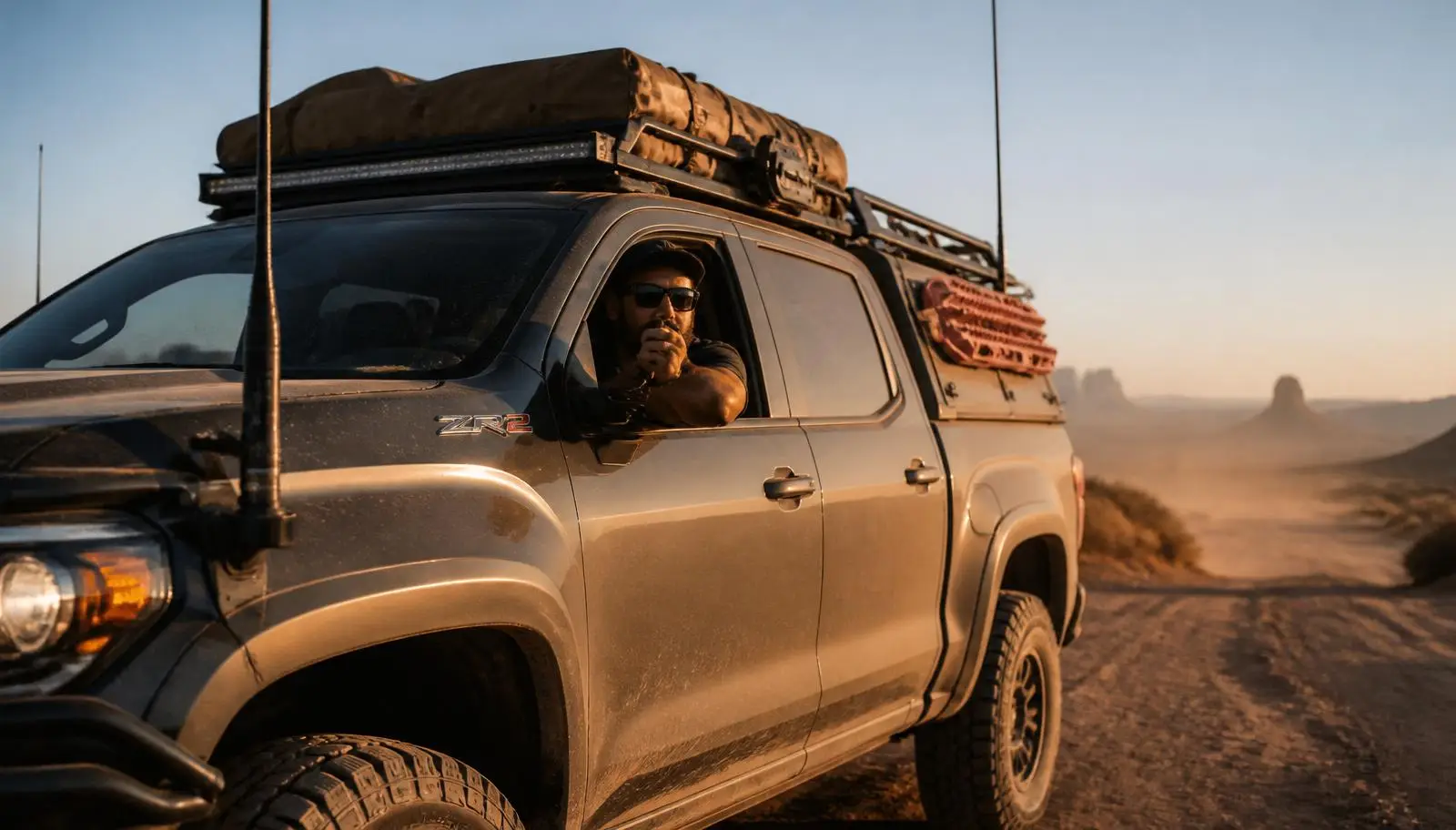
If you wheel with a group, you need a way to talk that does not depend on cell service, because the trailhead is usually the last place your phone works. The two radios most off-roaders reach for are CB and GMRS, and the choice between them decides how far your voice carries, how clear it sounds, and whether the truck behind you actually hears the callout before the ledge.
This guide breaks down GMRS vs CB radio on the things that matter on the trail: range, power, audio, licensing, cost, and which setup to buy in 2026. The short version: for most people building a trail rig today, GMRS is the better radio. CB still has a place, and there are real reasons a club might standardize on it. But if you are starting from scratch, the case for GMRS is strong enough that it is worth understanding exactly why.
The 30-Second Answer
CB (Citizens Band) is a no-license, 4-watt radio on the 27 MHz band. It has been the off-road standard for decades, almost every trail veteran has one, and it costs nothing to operate. Its weaknesses are low power, a long antenna, and AM audio that hisses and pops.
GMRS (General Mobile Radio Service) runs up to 50 watts, uses FM for clear audio, works with repeaters for extended range, and needs a $35 FCC license that covers your whole family for 10 years with no test. Its weaknesses are the license requirement and, in dense timber or tight canyons, a higher frequency that does not bend around terrain quite as well as CB.
If you want the simplest possible answer: buy GMRS unless your regular group already runs CB. Standardizing with the people you actually wheel with beats every spec on paper.
Power and Range: Where GMRS Pulls Ahead
This is the headline difference and the reason GMRS has taken over so many trail groups.
CB is legally capped at 4 watts of transmit power on AM. GMRS mobile units can push up to 50 watts on the main channels. That is more than twelve times the power, and while watts do not translate directly into miles, the gap is large enough to feel in the real world. On open terrain, a 50-watt GMRS radio with a decent antenna will reach vehicles that a CB simply cannot.
Range for both radios is line of sight in practice. Neither one reaches over a mountain on its own. In a typical trail convoy where trucks are spread over a mile or two of winding road, both radios usually get the job done for vehicle-to-vehicle chatter. The difference shows up when the group stretches out, when a rig drops back to help someone, or when terrain gets in the way.
CB does have one genuine advantage here. The 27 MHz band is a lower frequency that bends around hills and pushes through trees slightly better than the higher frequencies GMRS uses. In thick forest or deep canyons at short range, some drivers find CB holds a usable signal where GMRS gets choppy. It is a real effect, but for most people the raw power and repeater access of GMRS more than make up for it.
Repeaters: The GMRS Trump Card
Repeaters are the feature that changes the math entirely, and CB has no equivalent.
A GMRS repeater is a radio sitting on a high point, a mountaintop, a tower, a ridge, that listens on one channel and rebroadcasts everything it hears at high power. Instead of your signal needing to travel truck to truck, it travels truck to repeater to truck. That can turn a few miles of usable range into tens of miles, sometimes far more depending on terrain and repeater placement.
Anyone with a GMRS license can use the eight repeater channel pairs, though many repeater owners set access tones (CTCSS or DCS) so you need the right tone programmed to key up. There are public and club repeaters across most of the country, and plenty of overlanders run GMRS partly for the peace of mind that a repeater might be in reach when things go sideways in the backcountry.
CB has nothing like this. What you transmit is what the next vehicle receives, full stop. For a tight convoy that is fine. For staying in touch across a spread-out group or reaching help from a remote trail, it is a hard limit.
Audio Quality: FM Beats AM
CB runs on AM, which is why it has that famous static hiss and why weak signals dissolve into noise and squeal. You learn to talk through it, and experienced CB users are good at pulling words out of a scratchy transmission, but it is genuinely tiring on a long day.
GMRS runs on FM. FM stays clean until the signal gets weak, then drops off more abruptly rather than fading into a wall of hiss. For most of its usable range, GMRS just sounds clearer and crisper. When you are trying to relay a spotting instruction over a running engine and a lifted diesel idling behind you, that clarity matters.
Licensing and Cost
This is the one area where CB wins outright, and for some people it is decisive.
CB requires no license at all. Buy the radio, mount it, start talking. There is nothing to file and no fee ever.
GMRS requires an FCC license, but the barrier is low. It costs $35 for 10 years, there is no test or exam, and a single license covers your entire immediate family: spouse, kids, parents, siblings, and more. You apply online through the FCC's licensing system and usually have your call sign quickly. Averaged out, that is $3.50 a year to run legal high-power radio for the whole household. For most people that is not a real obstacle, but it is a step, and it is worth knowing the whole family is covered by one license before you assume everyone needs their own.
On hardware, the two are roughly comparable at the entry level. A basic CB and a basic GMRS mobile land in a similar price range. GMRS scales up further if you want 50 watts and a quality antenna, but you can also start small and cheap.
Antennas: A Practical Difference
Antenna length is a quietly important factor because it affects mounting and clearance, something off-roaders think about constantly.
CB's 27 MHz band wants a long antenna. A proper CB antenna is tall, often 3 to 4 feet, and the taller it is the better it works. That is a snag risk on tight, tree-lined trails and one more thing to catch on branches. Shorter CB antennas exist but they compromise performance.
GMRS uses a much shorter antenna because of its higher frequency. A capable GMRS antenna can be well under a foot to a couple of feet, which mounts cleanly and clears obstacles more easily. For a rig that sees tight trails, the smaller GMRS antenna is a genuine convenience.
Quick Comparison
| Factor | CB Radio | GMRS Radio |
|---|---|---|
| Max power | 4 watts (AM) | 50 watts (mobile) |
| Audio mode | AM (more static) | FM (clearer) |
| License | None | $35, 10 years, no test, covers family |
| Repeaters | No | Yes, extends range greatly |
| Antenna | Long (3 to 4 ft ideal) | Short (under 1 to 2 ft) |
| Terrain penetration | Slightly better at short range | Slightly worse, offset by power |
| Best for | Legacy clubs, zero-cost setups | Most new trail and overland rigs |
What About Ham Radio and FRS?
Two other options come up often, so it is worth placing them quickly.
Ham (amateur) radio is the most capable of all, with the most power, the widest frequency access, and the best long-distance potential. The catch is that it requires passing a licensing exam, and you cannot legally let unlicensed friends key up your ham radio. That makes it a poor fit for a mixed group where not everyone wants to study for a test. Serious backcountry travelers often add ham on top of GMRS rather than instead of it.
FRS (Family Radio Service) is the walkie-talkie band you already own if you have bubble-pack handhelds. FRS and GMRS share channels, so an FRS handheld can talk to a GMRS radio on the shared frequencies. FRS is capped at low power with fixed antennas and no repeater access, which makes it fine for camp-to-camp chatter and short spotting distances but not a substitute for a real mobile GMRS setup.
Which Should You Buy in 2026?
Start with the group you actually wheel with. If your club, your buddies, or the trail runs you join have standardized on CB, buy a CB. Talking to the people around you is the entire point, and being the one rig nobody can hear helps no one. This is the single most important factor and it overrides everything below.
If you are building fresh or your group is switching, choose GMRS. The power advantage, the clearer FM audio, the shorter antenna, and repeater access make it the stronger all-around trail radio. The $35 license is a small price for what you get.
For a GMRS mobile setup, the Midland MXT575 has become the popular high-power pick. It puts out the full legal 50 watts, uses an integrated control microphone so the base unit can hide out of the way in a cramped cab, supports the eight repeater channel pairs, and includes NOAA weather alerts, which are genuinely useful when a storm is building over a remote trail. Pair it with a good gain antenna on a bull bar or fender mount and you have serious reach.
If your budget is tighter, the Midland MXT275 is a proven entry-level GMRS mobile that is easy to run, and the Radioddity DB20-G is a strong value option for people comfortable programming a slightly more technical radio. Any of these will outperform a stock CB on audio clarity and, with a proper antenna, on range.
Whatever you choose, mount it properly and run a quality antenna. The radio matters less than the antenna and the install. A cheap GMRS with a well-tuned antenna will beat an expensive one flopped on a magnet mount with a pinched cable every time.
The Bottom Line
CB radio is not dead, and if that is what your people run, it is the right answer for you. But for a new off-road or overland build in 2026, GMRS is the smarter default: more power, cleaner audio, a shorter antenna, and repeater access that CB cannot match, all for a $35 license that covers the whole family. Sort out communication before your next group run, because the middle of a tricky obstacle is the worst possible time to discover nobody can hear you.
Affiliate disclosure: this article mentions products by name for reader guidance. 4x4 Playground may earn a commission on qualifying purchases made through partner links elsewhere on the site.