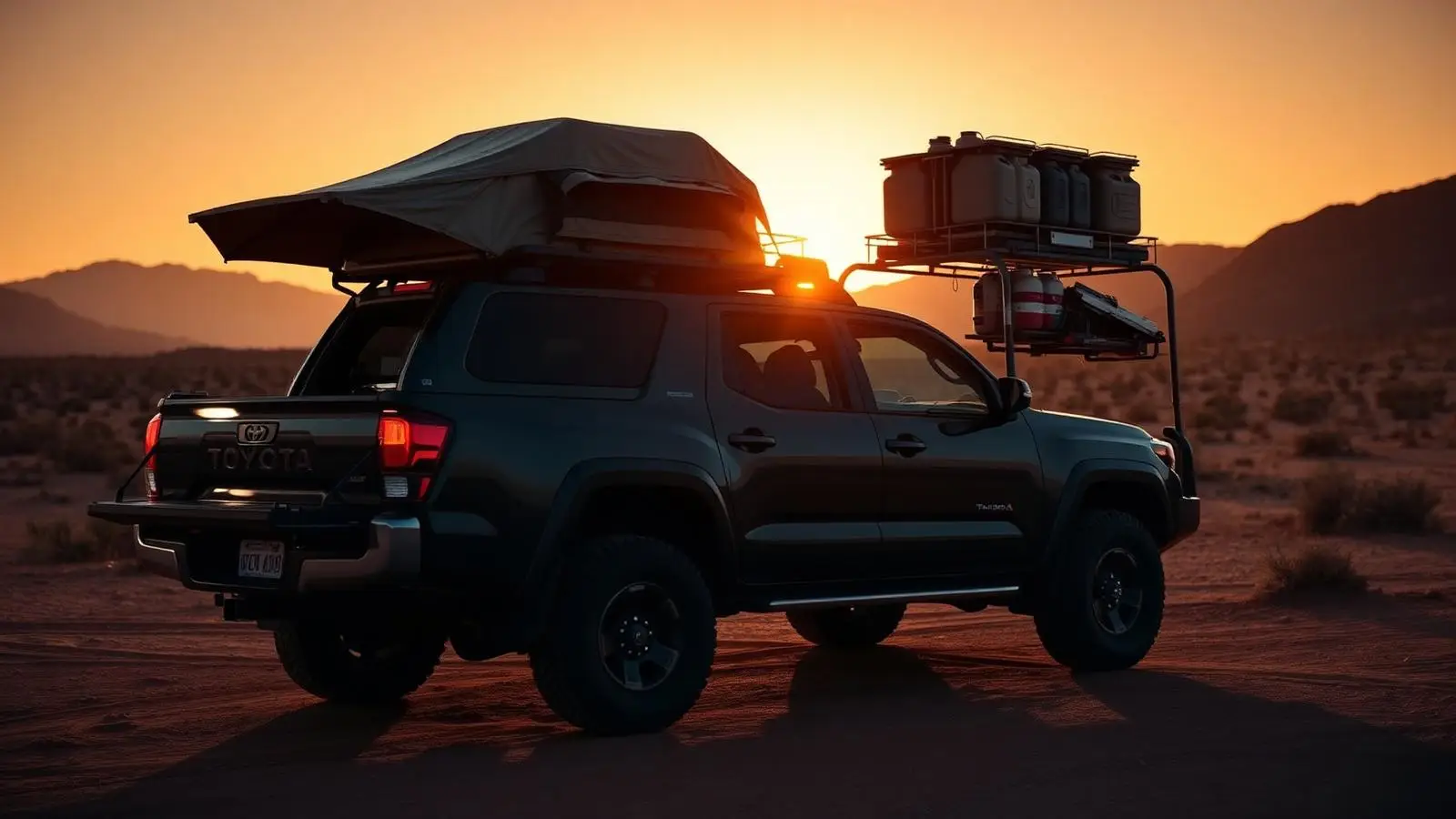
The truck looked perfect in the driveway. Rooftop tent folded tight, bed rack bolted down, drawer system packed, fridge humming, recovery boards mounted where Instagram said they belonged. Then it hit the first washboard road and started driving like a moving storage unit with headlights. That is the part the build list does not show you.
Quick answer: overlanding payload is the total weight your vehicle carries, including people, pets, fuel, water, food, tools, recovery gear, racks, tents, bumpers, winches, batteries, drawers, and anything else added to the vehicle. To calculate it, find the payload number on your door sticker, add every pound you put in or on the rig, then subtract that total from the door-sticker payload. If the number goes negative, you are overloaded. If it is barely positive, the trail will probably tell you before the scale does.
This guide is the unromantic math that saves expensive mistakes. Not because payload is exciting. It is not. Payload is the spreadsheet sitting between you and the fantasy build. But it is also the thing that decides whether your overland rig feels composed, safe, and useful, or heavy, vague, and tired before the trip even starts.
Run the numbers in 30 seconds
Pick your rig, toggle your build mods, add passengers, fuel, and tongue weight. See total loaded weight, payload remaining, per-axle load, and a GVWR verdict.
Open the Payload CalculatorThe Quick Overlanding Payload Calculator
The simple formula is: door-sticker payload minus everything you add equals remaining payload.
Here is the basic math:
Remaining payload = vehicle payload rating - total loaded weight addedTotal loaded weight added includes:
People + pets + cargo + accessories + fuel/water/food + tools + recovery gear + camping gear + tongue weight, if towingThe number that matters most is not the brochure maximum. It is the payload number printed on your actual vehicle's driver-side door jamb label. Options, trim, engine, drivetrain, tire package, roof, bumper, hybrid system, and factory accessories can all change the real number.
If your door sticker says your vehicle can carry 1,150 pounds, that is your budget. Not your gear budget. Your everything budget. Your body is in that number. So is your passenger. So is the dog. So is water. So is the rooftop tent. So is the fridge. So is the front bumper you convinced yourself did not count because it was bolted on six months ago. It counts.
| Payload item | Typical weight range |
|---|---|
| Driver | 150 to 250 lb |
| Passenger | 150 to 250 lb |
| Dog | 30 to 100 lb |
| Water, 5 gallons | about 42 lb |
| Food and kitchen box | 25 to 80 lb |
| Fridge | 30 to 60 lb |
| Auxiliary battery or power station | 25 to 100 lb |
| Solar panel and wiring | 15 to 60 lb |
| Rooftop tent | 110 to 220 lb |
| Bed rack or roof rack | 50 to 150 lb |
| Awning | 25 to 70 lb |
| Drawer system | 100 to 250 lb |
| Recovery boards | 15 to 35 lb |
| Recovery kit, straps, shackles, gloves | 25 to 60 lb |
| Hi-Lift jack or bottle jack kit | 20 to 40 lb |
| Air compressor | 10 to 30 lb |
| Tools and spares | 40 to 150 lb |
| Front bumper | 80 to 180 lb |
| Winch | 60 to 100 lb |
| Rear bumper or tire carrier | 100 to 250 lb |
| Larger spare tire | 10 to 40 lb over stock |
| Firewood | 20 to 80 lb |
| Miscellaneous things you forgot | 50 to 150 lb |
That last row is not a joke. Every overloaded rig has a miscellaneous category. It is usually heavier than anyone wants to admit. If you would rather have the calculator do this math for you with realistic mod weights baked in, use the Overlanding Payload Calculator.
The Honest Truth About Overlanding Payload
Most overland builds do not fail because the tires were too small. They fail because the vehicle got too heavy.
Weight is quiet at first. A rooftop tent adds convenience. A drawer system adds organization. A bumper adds protection. A winch adds confidence. A second battery adds camp comfort. Five gallons of water is responsible. Recovery gear is smart. Tools are prudent. A full-size spare is non-negotiable. None of those decisions are dumb by themselves.
The problem is that your suspension, brakes, tires, axles, frame, cooling system, and handling do not experience those choices one at a time. They experience the final number. That final number changes everything:
- Braking distance gets longer.
- Steering gets slower.
- Suspension rides lower in its travel.
- Shocks work harder and heat faster.
- Tires carry more load and build more heat.
- Rear springs sag.
- Headlights point at the trees.
- Approach and departure angles get worse.
- Fuel economy drops.
- Recovery gets harder because a heavier stuck vehicle is more work to move.
This is not anti-gear. Gear is useful. The right gear makes trips safer and easier. This is anti-pretending. Payload is the part of the build that tells the truth when the spec sheet, the forum thread, and the product photo all want to keep selling the dream.
What GVWR, Payload, Curb Weight, and GAWR Actually Mean
GVWR is the maximum loaded weight the manufacturer says the vehicle is designed to carry. Payload is how much room you have between the empty vehicle and that maximum.
GVWR: Gross Vehicle Weight Rating
GVWR is the maximum loaded weight of the vehicle as specified by the manufacturer. In plain English: GVWR is the ceiling. If your vehicle has a GVWR of 6,100 pounds, that is the maximum loaded vehicle weight. Not the maximum cargo weight. The maximum vehicle weight with people, cargo, fuel, accessories, and everything else on board.
Curb weight
Curb weight is what the vehicle weighs before you start loading it for a trip. The exact definition can vary slightly by manufacturer, especially around fuel and fluids, which is another reason the door sticker and a real scale matter more than internet numbers. The useful concept is simple:
Payload = GVWR - curb weightBut for your real vehicle, skip the brochure math and read the door sticker.
Payload
Payload is how much weight your vehicle can carry. That includes people, pets, luggage, water, food, tools, recovery gear, camping gear, accessories, aftermarket parts, and anything in the cabin, bed, cargo area, roof, hitch, or rack. The payload sticker is usually on the driver-side door jamb and says something like:
The combined weight of occupants and cargo should never exceed XXXX lb.That is the number you build around.
GAWR: Gross Axle Weight Rating
GAWR is the maximum weight each axle is rated to carry. There is usually a front axle rating and rear axle rating. This matters because you can be under total GVWR and still overload the rear axle if most of your weight is behind the seats. A midsize truck with a bed rack, rooftop tent, drawer system, water, fridge, tools, rear bumper, tire carrier, and spare can run out of rear axle margin before the total number looks terrifying.
That is why a public scale is better than a spreadsheet. A spreadsheet estimates total weight. A scale can tell you front axle, rear axle, and total vehicle weight. The payload calculator at least gives you a per-axle estimate so you know which end is bearing the brunt.
The Door Sticker Beats the Internet
The payload number on your actual vehicle is more important than any maximum rating in a press release or comparison chart.
This is where people get burned. They search for the model, find the maximum payload, and build around that number. But maximum payload usually belongs to a very specific configuration. Often it is not the trim overlanders actually buy.
A 2026 Jeep Gladiator utility page lists an available maximum 4x4 payload of 1,720 pounds. That does not mean every Gladiator sitting in a driveway can carry 1,720 pounds. A Rubicon, Mojave, steel bumper package, bigger tires, hardtop, winch, and accessories all change the real number. Search results for the 2026 Toyota Tacoma show maximum payload figures around 1,705 to 1,710 pounds depending on configuration. Again, useful context, not permission. Your Tacoma's sticker is the answer.
The 2025 and 2026 4Runner conversation is even messier because payload varies heavily by trim and hybrid hardware. Some published third-party spec listings show payload around the mid-1,000-pound range for certain trims, while owner door-sticker discussions around heavier Trailhunter-style builds have reported much lower numbers. That is exactly why you do not build from a generic article number. The door sticker wins. Every time.
Example: How a 1,150-Pound Payload Disappears
A payload number that looks fine on paper can vanish before the cooler is packed.
Let us say your SUV has a door-sticker payload of 1,150 pounds. Now load it for a normal overland weekend:
| Item | Weight |
|---|---|
| Driver | 190 lb |
| Passenger | 170 lb |
| Dog | 60 lb |
| Rooftop tent | 160 lb |
| Roof rack | 80 lb |
| Fridge | 45 lb |
| Power station | 45 lb |
| Water, 7 gallons | 58 lb |
| Food and kitchen gear | 60 lb |
| Recovery gear | 50 lb |
| Air compressor and tire tools | 25 lb |
| Tool roll and spares | 80 lb |
| Camp chairs, table, bedding | 70 lb |
| Miscellaneous bags | 60 lb |
| Total added weight | 1,153 lb |
You are already three pounds over, and this example did not include steel bumpers, a winch, drawer system, skid plates, a rear tire carrier, firewood, extra fuel, kids, camera gear, bikes, or tongue weight from a trailer. This is why overlanding payload feels unfair. The gear that makes the vehicle useful is the same gear that eats the number that makes the vehicle work.
The Rooftop Tent Trap
A rooftop tent counts against payload, roof load, rack load, and handling. It is not just a camping decision.
Rooftop tents are great when they match the trip. But payload is where the rooftop tent dream gets expensive. A rooftop tent might weigh 110 to 220 pounds. Add a rack and mounting hardware, and the real system can easily land between 170 and 350 pounds before anyone climbs the ladder.
There are three separate numbers to understand:
Static roof load
Static roof load is what the roof or rack can support when the vehicle is parked. This is the number people love because it is big. It is also the least relevant number when you are driving down a rutted road.
Dynamic roof load
Dynamic roof load is what the roof or rack can support while the vehicle is moving. This is the number that matters on pavement, washboard, trails, emergency braking, and off-camber terrain. It is usually much lower than static load.
Vehicle payload
Even if the rack and roof can safely carry the tent, the tent still counts against vehicle payload. A 180-pound tent does not become weightless because it is above your head. It raises the center of gravity, adds wind drag, affects handling, and consumes payload.
That does not mean rooftop tents are bad. It means rooftop tents are not free. If your rig has generous payload and your trip pattern involves frequent camp moves, a rooftop tent may make perfect sense. If your vehicle is already close to its limit, a ground tent might be the smartest suspension upgrade you never bought.
The Drawer System Trap
Drawer systems are wonderfully convenient and brutally heavy.
This is the one nobody wants to say out loud because drawers feel like organization, and organization feels responsible. A drawer system can weigh 100 to 250 pounds empty. Then you put tools, parts, stove gear, recovery gear, cookware, food, and all the small dense things inside it. Now the back of the vehicle carries a permanent cabinet full of metal.
That weight is usually behind the rear seats. In trucks, it is often behind the cab. In SUVs, it sits near or behind the rear axle. That can hammer rear axle load, sag the suspension, and make the vehicle feel heavy in exactly the place you do not want it. Again, this is not drawer-system slander. Drawers can be excellent if you use the rig often and need fast access. But if you camp six weekends a year, a few labeled soft bags may do the same job while saving a shocking amount of weight.
The smartest upgrade is specificity. Build for your actual trips, not the version of yourself who apparently runs a mobile search-and-rescue warehouse every Friday.
How Much Do Common Overland Vehicles Actually Carry?
Popular overland platforms vary widely, and the off-road trims people want often have less payload than the simple trims people ignore.
Use this table as context only. Use your door sticker for the real number, or plug your rig into the payload calculator to see how a typical overland build eats into it.
| Vehicle or platform | Real-world payload takeaway |
|---|---|
| Toyota Tacoma | Newer Tacomas can show max payload around 1,700 lb in some configurations, but trim, cab, drivetrain, hybrid hardware, accessories, and tire packages change the real door-sticker number. |
| Toyota 4Runner | Great overland shape, but payload can tighten quickly with passengers, drawers, tent, water, and armor. Heavier trims deserve extra attention. |
| Jeep Gladiator | One of the better Jeep-family answers for overlanding because it has a bed and available payload around 1,700 lb in some configurations, but Rubicon-style builds still need door-sticker math. |
| Jeep Wrangler | Extremely capable off-road, but not a payload hero. Add people, hardtop, roof system, armor, and camping gear carefully. |
| Ford Bronco | Strong trail platform, but trim, door count, roof, Sasquatch package, and accessories affect payload. Watch roof systems and rear cargo weight. |
| Half-ton truck | Usually the easiest platform for people who want a tent, drawers, fridge, water, family, bikes, and comfort. Still not unlimited. Luxury trims can lose payload fast. |
| Full-size van | Big interior volume can hide weight problems. Cabinets, water, batteries, bed platforms, insulation, and passengers add up quickly. |
The lesson is not that one platform wins everything. The lesson is that payload is part of vehicle choice. If your dream trip includes four people, a dog, bikes, a rooftop tent, a fridge, 15 gallons of water, a full camp kitchen, recovery gear, and two weeks of food, a midsize SUV may not be the honest answer. That is not gatekeeping. That is math. The full platform breakdown lives in our Jeep vs. Bronco vs. Gladiator vs. truck vs. SUV vs. van guide.
How to Weigh Your Overland Rig the Right Way
The best payload calculator is a public scale with your vehicle loaded exactly how you travel.
A spreadsheet is a good start. A scale is the truth. Here is the simple method:
- Load the vehicle exactly like a real trip.
- Fill the fuel tank.
- Add people or account for their actual weight.
- Add water, food, tools, recovery gear, pets, camp gear, and trailer tongue weight if towing.
- Drive to a CAT scale, gravel yard, dump, feed store, truck stop, or local public scale.
- Get total weight.
- If possible, get front axle and rear axle weights separately.
- Compare total weight to GVWR.
- Compare axle weights to front and rear GAWR.
- Compare tire load capacity to real loaded axle weights.
If you are under GVWR but the rear axle is close to its limit, move weight forward or remove weight. If you are over GVWR, remove weight. Upgraded springs may improve ride height, but they do not magically change the manufacturer's GVWR. That last sentence matters. Suspension can help a loaded vehicle control weight better. It does not make the vehicle a different class of truck.
What Happens If You Exceed Payload?
An overloaded rig may still move, but it will not behave the way the engineers intended.
People exceed payload all the time and nothing explodes in the driveway. That is part of why the problem gets ignored. But trails punish margins. Over payload can mean:
- Longer stopping distances
- More brake heat
- More tire heat
- More suspension bottoming
- Worse emergency handling
- More body roll
- More wear on wheel bearings, bushings, shocks, springs, and tires
- Increased recovery difficulty
- Reduced reliability over rough roads
- Insurance and liability questions after a crash
The scary part is not that the vehicle instantly fails. The scary part is that it gets worse at the exact moments you need it to be predictable. A heavy rig on a smooth highway may feel fine. A heavy rig descending a rocky shelf road, dodging a washout, or braking hard for a deer at dusk is a different conversation. And aired-down tires at the wrong pressure for the load make all of it worse. Our air-down PSI guide covers what loaded tires need.
How to Build Lighter Without Hating Camp
The goal is not to suffer. The goal is to stop carrying things that solve problems you do not actually have.
Lightweight overlanding does not mean sleeping under a poncho and eating cold beans unless that is your thing. It means spending payload where it improves the trip most. Start here.
Choose tires before armor
Tires change where you can go, how the vehicle rides, how it brakes, and how much traction you have. Armor protects you when things go wrong, but armor also adds permanent weight. If you are choosing between good all-terrain tires and a full catalog of steel armor for mild forest roads, buy the tires first.
Use soft storage before drawers
Soft bags are lighter, cheaper, removable, and easier to reconfigure. Drawers make sense when you use the vehicle often enough to justify permanent weight. If you are still learning your system, bags teach you what you actually use.
Carry the water you need, not the water that sounds expedition-grade
Water is about 8.34 pounds per gallon. Five gallons is roughly 42 pounds. Ten gallons is roughly 83 pounds. Twenty gallons is roughly 167 pounds before the container. Water is life, so do not underpack it. But do not pretend it is light.
Be honest about fuel
Extra fuel is useful in remote country. It is also heavy, awkward, and dangerous when carried casually. If your route has fuel every 80 miles, four extra jerry cans may be cosplay. If your route crosses empty desert with no services, extra fuel may be responsible. The route decides.
Skip permanent weight when removable weight works
A removable compressor, soft recovery bag, folding table, and ground tent can leave the vehicle during the week. Permanent accessories are always there. The truck carries them to work, to the grocery store, and to every trail whether the trip needs them or not.
Build around the boring trips first
Most people are not crossing continents. They are doing two-night trips, long weekends, forest roads, desert loops, trailheads, ski lots, beach camps, and family campouts. Build for that first. The fantasy trip can rent a trailer, borrow gear, or justify a different setup when it becomes real.
When You Need a Bigger Vehicle
If the payload math only works by pretending passengers, water, and tools weigh nothing, you do not need another accessory. You need less gear or more truck.
This is the expensive truth. Sometimes the right answer is not lighter drawers. It is no drawers. Sometimes the answer is not a lighter rooftop tent. It is a ground tent. Sometimes the answer is not upgraded springs. It is a half-ton truck instead of a midsize SUV. Sometimes the answer is not a bigger truck. It is taking fewer things.
There is no moral victory in being overloaded. The trail does not care that the build looked clean online. The vehicle either has margin or it does not. And margin is what lets you enjoy the trip instead of managing the consequences of your own shopping cart.
A Simple Payload Plan for a First Overland Build
If you are building your first rig, spend payload slowly and make every permanent pound defend itself.
Here is the sane order:
| Priority | What to do | Why |
|---|---|---|
| 1 | Read your door-sticker payload | This is the budget. |
| 2 | Weigh your normal passengers and trip gear honestly | People and water are not optional. |
| 3 | Buy good tires | They improve the whole vehicle. |
| 4 | Add recovery basics | Shovel, traction boards, strap, shackles, gloves, compressor, tire repair. |
| 5 | Camp with simple storage | Learn what you use before adding permanent weight. |
| 6 | Add power only if your trips need it | A fridge and battery are great, but they add weight. |
| 7 | Choose shelter based on trip pattern | Rooftop tent for fast camp moves, ground tent for lightness and flexibility. |
| 8 | Weigh the rig loaded | Replace guessing with numbers. |
| 9 | Upgrade suspension for control, not denial | Better springs and shocks can help manage legal weight. They do not erase GVWR. |
| 10 | Remove what you do not use | The cheapest payload upgrade is taking stuff out. |
Most people learn this backwards. They buy the permanent stuff first, then discover what the vehicle hates. You just learned it for free.
Run the numbers in 30 seconds
Pick your rig, toggle your build mods, add passengers, fuel, and tongue weight. See total loaded weight, payload remaining, per-axle load, and a GVWR verdict.
Open the Payload Calculator