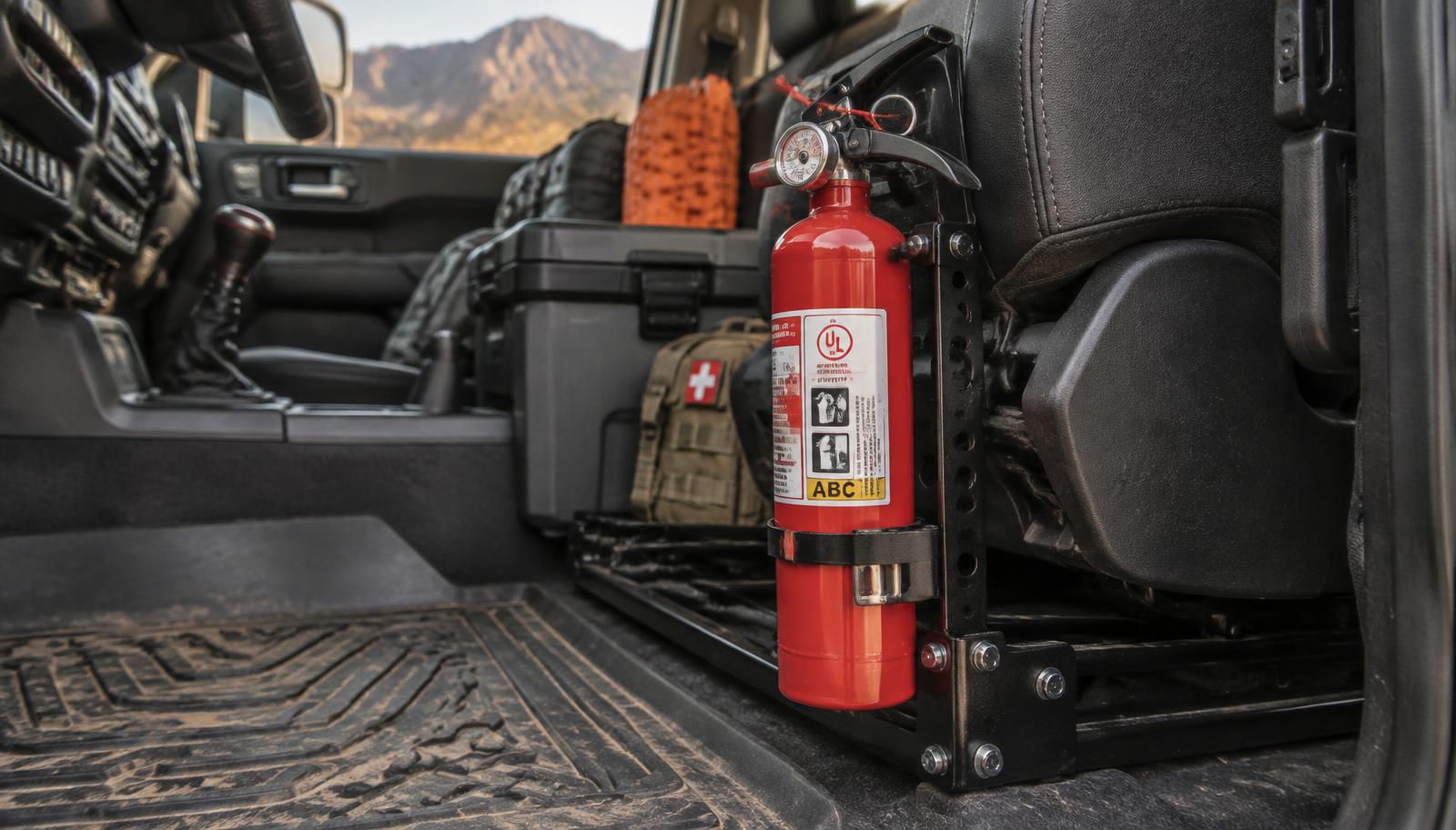
Independent buying guide for an overlanding fire extinguisher and a simple vehicle fire kit. Not a parts cart, not a brand podium, not a lithium kill-switch fantasy.
Picture a Saturday trailhead. You smell hot plastic under the dash, or a spark from a trailer chain hits dry grass next to the exhaust. Your first move is not a forum debate. It is reach, pull pin, aim at the base, sweep. That only works if the bottle is in the cab, charged, and rated for the fire you actually have.
Now picture the same truck with a dual-battery LiFePO4 house bank and a jump starter under the seat. Smoke starts from that corner. The Instagram fix is a sleek "lithium" stick that promises clean discharge and zero mess. Fire service guidance is colder: an established lithium-ion thermal runaway (a cell heating itself into a chain reaction that can keep reigniting) is a cooling and evacuate problem. A handheld bottle may knock down flames around the pack. It does not reliably stop the chemistry inside.
That is the difference. Most overlanding fires a private person can still win are Class A camp stuff, Class B fuel and grease, and Class C wiring. Lithium packs raise a different bill. Buy for the fires you can still fight. Be honest about the one you mostly walk away from.
Why an Overlanding Fire Extinguisher Belongs Next to Your Power Stack
Overlanders just finished stacking dual batteries, inverters, jump starters, and fridges. More stored energy means more ways for heat and short circuits to show up far from a hydrant. The live site already covers Labor Day overlanding fire restrictions: Stage rules, stove math, and why your fire pan does not count. That piece is about starting a legal campfire. This one is about stopping an accidental one.
Class letters are not secret code. Per NFPA's fire extinguisher types explainer:
- Class A: ordinary combustibles (wood, cloth, paper, rubber, many plastics)
- Class B: flammable liquids and gases (gasoline, diesel, oil, solvents, grease, propane)
- Class C: energized electrical equipment
- Class D: combustible metals (magnesium, titanium, sodium, lithium metal, and similar)
- Class K: cooking oils and fats in commercial kitchen appliances
A multipurpose ABC dry-chemical extinguisher (usually monoammonium phosphate powder) is the common answer because it covers the three fires most trucks actually see. Class D metal powder is a specialty agent for burning metal, not a pocket fix for a sealed LiFePO4 pack.
Disclosure, said once: 4x4 Playground is independent. We do not sell extinguishers, we do not rank sponsored products, and this is safety discussion, not a cart.
Your ABC Dry Chem Will Not Stop Lithium Thermal Runaway
This is the sentence the product page softens.
A charged ABC bottle is excellent at smothering an early fuel fire, a small wiring short, or a trash-and-upholstery flare. Multipurpose dry chem sticks to hot Class A surfaces and isolates fuel from air. It has little cooling effect deep inside a burning mass, and NFPA notes that deep-seated fires may need agent below the surface or the material broken apart.
Lithium-ion cells (including the LiFePO4 chemistry popular in overland house banks) store a lot of energy in a small package. When that energy dumps in an uncontrolled way, heat and flammable gases follow. NFPA's lithium-ion battery safety page is blunt for firefighters: water is the medium they use on these fires because the lithium in these cells is a lithium salt electrolyte, not pure reactive lithium metal. Portable dry chem, CO2, clean agents, and many specialty sticks can suppress visible flame around a pack. They generally do not provide the sustained cooling that stops an established thermal runaway or guarantees no reignition.
So what does "lithium-rated" marketing usually mean in the overland aisle? At best, a device that can knock down flames and cool nearby combustibles while you get people clear and call for help. At worst, a magic kill-switch story. For a venting, smoking, or swelling pack: if it is safe, move the device away from anything that can catch fire, then get distance and call 9-1-1. NFPA's consumer tip sheet lists the stop-using signs: odor, color change, too much heat, shape change, leaking, odd noises.
Buy the ABC for the engine bay drip, the wiring loom, the propane flare, and the grass fire next to the muffler. Treat lithium honesty as separate risk control: listed batteries, correct chargers, no overnight charge buried in bedding, and no "it'll be fine" use of a swollen cell.
Extinguisher Types Translated to a Real Overland Week
UL-listed ABC dry chemical (smart default)
Look for an Underwriters Laboratories listing, a readable gauge, and a mount that actually bolts down. Kidde and similar makers publish the rating language on the can: a number with A (Class A power), a number with B (square-foot Class B coverage when swept correctly), and a C that only means the agent is electrically nonconductive, not a size score.
Common vehicle sizes: about 2.5 lb (often around 1-A:10-B:C class) and about 5 lb (often around 2-A:10-B:C or better). For a solo truck or SUV, a solid 2.5 lb ABC is a workable floor. For a truck that tows, carries jerry cans, or runs a kitchen out of the bed, a 5 lb ABC (or a cab 2.5 plus a second bottle near camp) is the smarter napkin pick.
Trade you accept: powder mess. Monoammonium phosphate can be mildly corrosive with moisture, so plan a thorough cleanup after any discharge if the truck survives. That mess is still cheaper than a total loss.
BC, CO2, and clean agents
BC dry chem skips Class A sticking. Fine if fuel and electrics are your only worry and you already carry water and a shovel for wood. Weaker default for overlanding.
CO2 leaves no residue and is listed for B and C. NFPA notes a short range (about 3 to 8 ft) and poor outdoor performance in wind. Bad sole choice for a trailhead.
Halotron and similar clean agents stay low residue and pricey. Useful as a cab companion for a finished interior. Still not a lithium runaway cure, and still not the first bottle for most budgets.
Aerosol sticks (Element E50 class)
Element markets the E50 at about $89.95, about 50 seconds of discharge, roughly 0.5 lb, compact, and maintenance-light, with an explicit carve-out that it is not recommended for outdoor live coal fires. Clean discharge is the real pitch.
Take it with trail skepticism. Long discharge helps on a shielded, small, early fire. Proximity and wind matter. These units are often sold on international certifications rather than a US UL portable extinguisher listing; Hagerty's vehicle extinguisher coverage still steers enthusiasts toward UL-listed cans as the baseline. Treat an aerosol stick as a compact supplement, not the only fire plan for a loaded overland truck.
Specialty "lithium" water additives
Water-enhancing agents show up in commercial and fire-service talk because cooling is the job. A handheld specialty can is still not a structural firetruck. Do not let it replace the ABC you will actually use on fuel and wiring.
Size, Ratings, and What DOT Actually Requires
Private overlanders are usually not under Federal Motor Carrier Safety Administration rules. Still, 49 CFR 393.95 is useful napkin math:
- Non-hazmat commercial power unit: one extinguisher rated 5 B:C or more, or two rated 4 B:C or more
- Placarded hazmat: one rated 10 B:C or more
- Must show the UL rating, allow a visual charge check, stay filled, stay readily accessible, and stay securely mounted
Translation for a Tacoma or 4Runner: aim at least at the commercial 5 B:C floor, then bump size if you haul fuel or cook a lot. A 10 B:C bottle under a mountain of recovery boards is a paperweight.
USFS and BLM Stage orders regulate wood fires, not a national private extinguisher mandate. Pack the bottle anyway.
Mount It Where Your Hand Already Goes
Owner practice on Expedition Portal threads and in Hagerty's car-people comments converges on one boring truth: cab, within seated reach, on a real bracket.
Seat-base and seat-rail mounts keep the bottle where a belted driver can grab it without opening the canopy. Rear-of-cab mounts work if they clear seats, airbags, and pedals. Bed or rooftop box storage fails the accident test: after a tip-over or a bed fire, the thing you need is the thing you cannot reach.
Do not mount under the hood as the primary bottle. Do not leave it rolling under a seat. Check the gauge on a schedule, shake dry-chem cans so powder does not cake, and replace or recharge after any use.
The Rest of the Vehicle Fire Kit
An extinguisher is one tool. The Saturday kit that matches how overlanders actually camp looks like this:
- UL-listed ABC extinguisher in the cab (2.5 to 5 lb class)
- Shovel that can dig a control line or bury coals
- Dedicated water (at least a gallon you will not drink away) plus a collapsible bucket
- Shut-off propane or white-gas stove as the legal cooking default under Stage rules
- Optional second extinguisher or aerosol stick near the kitchen space
Wood and charcoal are the Stage problem. Your fire restrictions guide already covers why a personal fire pan usually does not count. The extinguisher does not legalize a wood fire. It gives you a chance when a stove flare, converter grass start, or wiring fault happens anyway.
Pair fire discipline with the same reach-first mindset in the overlanding recovery gear guide. For the wider pack list, see the essential overlanding gear guide.
Honest Warts
Powder ruins interiors and can encourage corrosion if you skip cleanup. Small ABC cans empty fast. CO2 and clean agents hate wind. Aerosol sticks want you close and are a weak answer on open wood coals. Specialty lithium cans are expensive comfort objects if you skip charging hygiene. No handheld product replaces calling for help on a pack that is already in runaway.
Also: an extinguisher does not make you a firefighter. If the fire is bigger than a trash can, if toxic smoke fills the cab, or if a battery is jetting flame, people first, truck second.
Overlanding Fire Extinguisher Verdict
| Job | Smart pick | Trap | Verdict |
|---|---|---|---|
| Primary vehicle bottle | UL-listed 2.5 to 5 lb ABC, cab-mounted | Bed storage, expired gauge, no mount | Buy this first |
| Fuel / wiring emphasis | ABC (or BC) dry chem; optional CO2 second | CO2 alone in wind | ABC still wins |
| Camp / Class A | ABC + shovel + water | Bottle as wood-fire permission slip | Kit, not bottle alone |
| Lithium pack emergency | Evacuate, cool surroundings if safe, call 9-1-1 | "Lithium-rated" as a kill switch | Honesty over marketing |
| Compact supplement | Aerosol stick in a tight cab | Stick as your only plan | Optional second layer |
| Size napkin | Meet or beat 5 B:C spirit; go bigger with fuel onboard | Tiny toy can for a loaded truck | Size to the risk |
Smart default: one UL-listed ABC in driver reach, plus shovel and water. Trap: spending the budget on lithium marketing while the only ABC lives under a cargo shelf.
Who Should Buy What (and Who Should Wait)
Buy the cab ABC now if you already run a fridge, dual battery, or jerry cans, if you tow, or if you camp where a converter or chain spark can light grass. Mount it before the next trip.
Add a second bottle or clean-agent / aerosol supplement if you cook out of the bed a lot or want low residue for a finished interior. Keep the primary ABC anyway.
Skip the lithium specialty spend (for now) if your house bank is still small, and put that money into a listed charger, correct cable, and a real ABC mount. Prevention beats a fancy can.
Do not treat this guide as EV structure-fire training. Traction battery events are a fire-service problem with huge water demand. Your overland LiFePO4 house box is smaller, but the runaway honesty is the same shape: cooling and distance, not heroics.
Bottom Line
Buy a UL-listed ABC overlanding fire extinguisher for fuel, wiring, and camp fires, mount it where a belted driver can grab it, and add a shovel plus water for the rest of the kit. Treat lithium marketing as suppression and cooling of surroundings, not a thermal-runaway kill switch. Prevention (listed batteries, correct chargers, no damaged cells) still beats any handheld can.
Keep building the kit
- Labor Day Overlanding Fire Restrictions (stove rules and Stage honesty)
- Overlanding Recovery Gear Guide (tools you can actually reach)
- Essential Overlanding Gear Guide 2026 (cluster hub for the pack list)
Use first-party tools on 4x4playground.com when you are planning the next trip. No cart required.