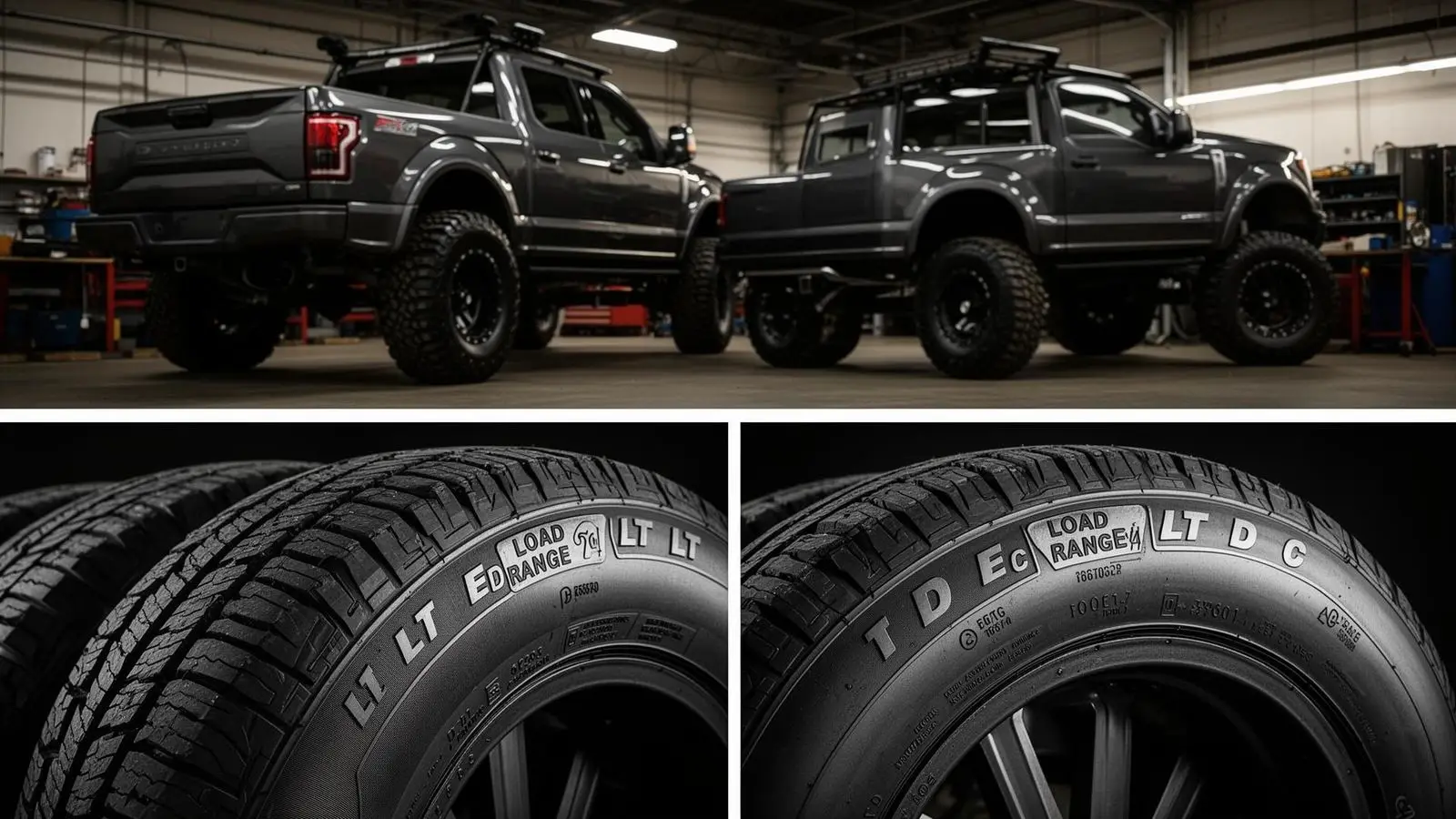
You spent $2,000 on tires. They look amazing. Three months later, you've got a sidewall blowout on the highway because you bought the wrong load rating for your lifted truck. This happens more than anyone wants to admit.
Load ratings aren't sexy. They don't get Instagram likes. But they're the difference between a tire that handles your build and a tire that's quietly failing every time you hit a pothole.
Here's everything you need to know about E, D, and C load ratings, and why picking wrong can turn your lifted truck into a ticking time bomb.
What Are Load Ratings, Actually?
Load ratings (also called load range or ply ratings) tell you how much weight a tire can safely carry at a specific inflation pressure. They're not about how tough the tire looks, they're about internal construction, sidewall strength, and pressure capacity.
The rating system uses letters. Higher letters = more plies = stiffer construction = higher load capacity = higher pressure requirements.
| Load Range | Ply Rating | Max PSI | Best For |
|---|---|---|---|
| C | 6-ply | 50 PSI | Light trucks, daily drivers, comfort priority |
| D | 8-ply | 65 PSI | Half-tons, moderate loads, balanced builds |
| E | 10-ply | 80 PSI | 3/4-ton+, heavy loads, towing, commercial |
| F | 12-ply | 95 PSI | 1-ton trucks, max towing, heavy commercial |
The Ply Rating Myth
Why Lifted Trucks Need Different Load Ratings
When you lift a truck and add bigger tires, you're changing the physics of your entire setup:
- Increased leverage: Bigger tires create more stress on sidewalls during turns and impacts
- Added weight: Lift kits, bumpers, winches, and accessories add hundreds of pounds
- Different geometry: Altered suspension angles put new forces on tires
- Reduced tire count for load: Same truck weight, but now on taller, often wider contact patches
The tire that worked fine on your stock truck might be dangerously underrated for your built truck.
Load Range C: The Comfort Pick
What C-Rated Means
C-rated (6-ply equivalent) tires are the lightest-duty option for LT (Light Truck) tires. They're designed for lighter loads, prioritize ride comfort, and work at lower pressures.
When C-Rated Works
- Stock or mildly lifted half-ton trucks (2" level or less)
- Daily drivers with no added weight
- Commuter trucks that rarely see trails or heavy loads
- When ride quality is your #1 priority
When C-Rated Fails
- Trucks with 3"+ lifts and heavy accessories
- Any significant towing or hauling
- Off-road use with rock hazards
- Trucks running 35"+ tires (sidewall stress increases)
The C-Rated Secret
Load Range D: The Middle Ground
What D-Rated Means
D-rated (8-ply equivalent) tires offer a balance between load capacity and ride quality. They handle moderate builds well without the harshness of E-rated tires.
When D-Rated Works
- Half-ton trucks with 3-4" lifts
- 35" tires on 1500-class trucks
- Light-to-moderate towing (under 7,000 lbs)
- Builds with steel bumpers but not fully armored
- Weekend warriors who want comfort + capability
When D-Rated Fails
- 3/4-ton and 1-ton trucks (underrated for GVWR)
- Heavy towing over 7,000 lbs
- Fully armored rigs with multiple accessories
- 37"+ tires (sidewall stress exceeds D-rated design)
Load Range E: The Heavy-Duty Standard
What E-Rated Means
E-rated (10-ply equivalent) tires are the default for 3/4-ton and 1-ton trucks. They're built for maximum load capacity, towing, and abuse, but they ride harder and weigh more.
When E-Rated Works
- 2500/3500-class trucks (required for GVWR compliance)
- Heavy towing over 7,000 lbs
- Fully armored builds with winches, bumpers, sliders, roof racks
- 37"+ tires where sidewall stress is extreme
- Commercial use, work trucks, fleet vehicles
- Serious off-road with rock crawling exposure
When E-Rated Is Overkill
- Stock half-tons used for commuting
- Trucks that never tow or haul
- Builds prioritizing ride comfort over capability
- Daily drivers who hate road noise
The E-Rated Trade-Off
The Real Problems with Wrong Load Ratings
Problem #1: Underrated Tires on Heavy Trucks
This is the dangerous one. Running C or D-rated tires on a fully built truck creates:
- Sidewall flex: Excessive movement under load, especially in corners
- Heat buildup: Overworked sidewalls generate heat that breaks down rubber
- Blowout risk: Sudden failure under highway speeds, especially in summer heat
- Premature wear: Tires wear unevenly and fail before their tread life
- Poor handling: Vague steering, body roll, wandering at speed
Problem #2: Overrated Tires on Light Trucks
Running E-rated on a stock half-ton isn't dangerous, but it creates other issues:
- Harsh ride: Stiff sidewalls transmit every bump to the cab
- Reduced traction: Stiffer sidewalls don't conform to terrain as well
- Worse fuel economy: Heavier tires require more energy to accelerate
- Faster suspension wear: Stiffer tires transfer more impact to components
- Overkill cost: E-rated often costs more with no real benefit
Problem #3: Wrong Pressure for the Rating
Every load rating has an optimal pressure range. Running E-rated tires at 35 PSI (common for D-rated) means you're not using the tire's full capacity. Running C-rated at 65 PSI risks blowing the bead off the wheel.
| Load Range | Street PSI Range | Off-Road PSI | Towing PSI |
|---|---|---|---|
| C | 30-40 PSI | 15-25 PSI | 40-50 PSI (max) |
| D | 35-50 PSI | 18-28 PSI | 50-65 PSI (max) |
| E | 40-60 PSI | 20-35 PSI | 65-80 PSI (max) |
Load Rating by Truck Type: Quick Reference
Stock Half-Ton (F-150, Silverado 1500, Ram 1500)
- Stock or leveled: C or D-rated, either works
- 3-4" lift with 33-35" tires: D-rated recommended
- 6"+ lift with 35" tires + armor: E-rated for safety margin
3/4-Ton (F-250, Silverado 2500, Ram 2500)
- Stock: E-rated (factory spec)
- Lifted with 35-37" tires: E-rated required
- Heavy towing setup: E-rated, consider F-rated for 37"+
1-Ton (F-350, Silverado 3500, Ram 3500)
- Stock SRW: E-rated minimum
- Dually: E or F-rated depending on use
- Commercial/hotshot: F-rated for max capacity
Jeep Wrangler / Gladiator
- Stock or 2" lift with 33" tires: C-rated is fine
- 3-4" lift with 35" tires: D-rated recommended
- 37"+ with armor and winch: E-rated for sidewall protection
Toyota Tacoma / 4Runner
- Stock or leveled with 33" tires: C-rated works
- 3" lift with 33-34" tires: C or D-rated
- Fully built overland rig: D-rated minimum, E if armored
How to Check Your Current Load Rating
Look at your tire sidewall. The load range is marked as "Load Range C," "LR D," "Load Range E," or similar. It's usually near the size designation.
Example sidewall reading:
The numbers 121/118 are load index ratings (another layer of load capacity info). The "Q" is speed rating. But for lifted truck purposes, the Load Range letter is what matters most for sidewall strength.
The Bottom Line
The Rule for Lifted Trucks
Load ratings aren't about looking tough. They're about physics. Get them right, and your truck drives predictably and safely. Get them wrong, and you're gambling with every highway mile.
When in doubt, go one rating higher than you think you need. The slight ride quality trade-off is worth the peace of mind.
Frequently Asked Questions
Can I mix load ratings on the same truck?
Technically yes, but it's not recommended. Mixed ratings create uneven handling and wear. If you must mix, put the higher-rated tires on the rear for stability.
Do I need to adjust my TPMS for different load ratings?
Yes. Different load ratings require different optimal pressures. Reprogram your TPMS thresholds to match your new tire's recommended pressure range, or you'll get constant false alarms.
Will E-rated tires hurt my fuel economy?
Yes, typically 1-3 MPG compared to equivalent C-rated. The added weight and rolling resistance matter. If you don't need E-rated capacity, don't pay the fuel penalty.
Are load ratings the same across all tire brands?
The rating system is standardized, but construction quality varies. An E-rated tire from a premium brand may outperform an E-rated from a budget brand. The rating is a minimum standard, not a guarantee of quality.