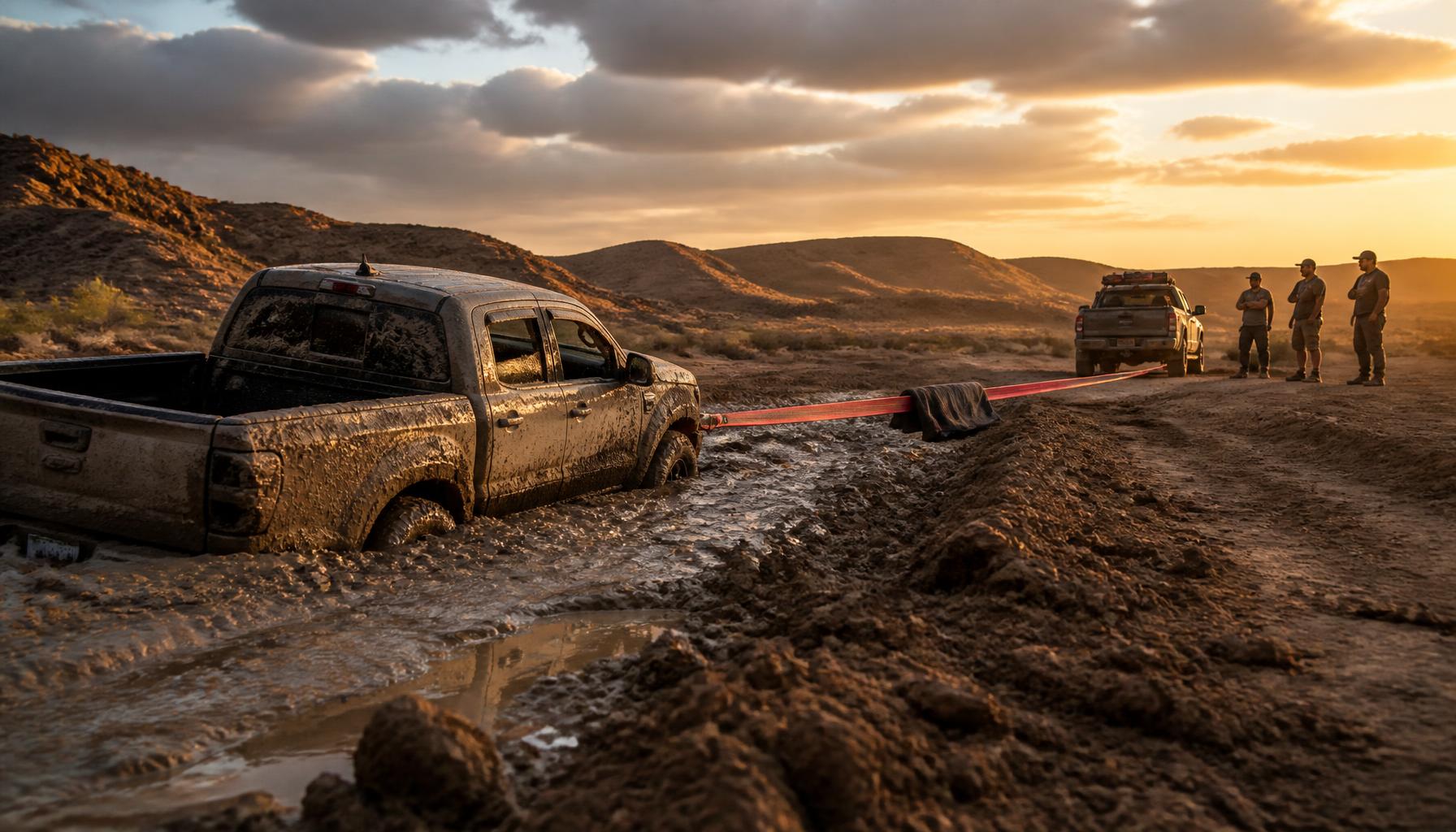
The stuck truck is axle deep in clay. The other rig is on firm ground thirty feet back. Somebody digs a flat polyester strap out from under the seat and starts talking about a running start. This is the moment where a kinetic recovery rope earns its bag, and where a tow strap becomes the most dangerous object on the trail.
Quick Answer: For a loaded midsize truck or SUV traveling with a partner, a 7/8 inch by 30 foot double braid nylon kinetic recovery rope in the 28,000 lb breaking strength class, plus two to four rated soft shackles and a couple of steel screw pin shackles, covers most overlanders. Size to the lighter vehicle's loaded weight, attach only to rated recovery points, keep the pull under 5 mph, and never snatch with a static tow strap. If you mostly travel solo, buy boards, a shovel, a compressor, and a winch before the rope.
Where the Rope Sits in the Buy Order
A kinetic rope stores energy in stretch, then releases it as a progressive pull. It is the cleanest recovery there is when the stuck vehicle is bogged rather than high centered and a second vehicle can get traction nearby. Both have to be true. That is why the overlanding recovery gear guide keeps boards, shovel, and compressor in Tier 1 and puts kinetic ropes in the group recovery tier. Solo travelers get more use out of a winch, covered in the winch buying guide. This piece is the deep dive that guide does not have room for: sizing, why the brands contradict each other, what soft shackles do and do not fix, and a pull sequence that keeps spectators out of the ER.
The Sizing Rules the Brands Sell You Do Not Agree
Pull up the sizing pages for the three ropes most overlanders end up buying and you get three different answers.
Factor 55 says a properly sized rope for typical trucks and SUVs has a breaking strength of 4 to 6 times GVWR, and that the rope must be sized to the lighter of the two vehicles. Bubba Rope says breaking strength should be 3 to 4 times the weight of the vehicle being recovered. Yankum says 2 to 3 times GVWR, and adds in bold that ropes are rated to the vehicle doing the recovery, not the vehicle that is stuck.
So the multiplier runs from 2x to 6x depending on whose bag it comes in, and two of the three disagree on which truck you are even measuring. None of this is a scandal. Each brand is describing a different stretch target. An undersized rope risks a break. An oversized rope barely stretches under a light vehicle, so the pull turns into a near static yank and the energy goes into the mounts instead of the nylon.
What reconciles them is real numbers. A loaded midsize at 6,000 lb gets a 28,600 lb rope at 4.8x under Factor 55's rule, and that same rope sits inside Bubba's window and Yankum's 5,000 to 7,200 lb range for the Python. The rules overlap for the vehicles most people own and only diverge at the edges: very light rigs, very heavy vans, and mismatched pairs.
The rule that survives all three: size to the lighter loaded vehicle in the pair. That is the one whose recovery point and frame take the hit if the rope is too stiff, and the one that decides how much the rope actually stretches. When a 9,000 lb full size pulls a 6,000 lb midsize, the rope matches the midsize. Reverse the pairing and the rope still matches the midsize. That is why 7/8" is the overlanding default even for people who own a heavier truck. They keep pulling out their friends' Tacomas.
Kinetic Rope vs Tow Strap: Stretch Is the Whole Product
A flat tow strap is polyester. It stretches a few percent under load and stops, which is what you want for slow, controlled towing on a surface with traction. Double braid nylon kinetic rope stretches up to about 30 percent. A 30' rope can grow close to 9 feet at full load, and every inch of that is stored energy applied progressively to the stuck vehicle.
Take a running start into a static strap and there is nowhere for that energy to go. It arrives at the recovery points as a shock load, all at once. Something bends, tears, or lets go, and whatever let go is now moving at the speed of the pull with a steel shackle on the end. Kinetic rope versus tow strap is not a brand question. It is stretch versus shock.
Some straps sold as "recovery straps" are nylon and do stretch, so the label is not the tell. If the packaging does not say nylon and give a stretch figure, it is a tow strap.
Kinetic Recovery Rope Size Chart
Prices are manufacturer list or typical street as of September 2026. Check the SKU's published MBS before buying, not the marketing copy.
| Rope | Size | MBS | Maker's fit | Price |
|---|---|---|---|---|
| Yankum Rubber Boa | 3/4" x 20-30' | 19,000 lb | 3,000-5,000 lb (Crosstrek, stock 2-door Wrangler) | check maker |
| Factor 55 Extreme Duty | 7/8" x 30' | 28,300 lb | 4,000-6,500 lb GVWR | $225 |
| Bubba Rope (standard) | 7/8" x 20-30' | 28,600 lb | SUVs, half tons, lifted Jeeps | ~$150-230 street |
| Yankum Python | 7/8" x 20-30' | 28,600 lb | 5,000-7,200 lb | $199-219 |
| Factor 55 Extreme Duty | 1" x 30' | 33,500 lb | 6,500-8,500 lb GVWR | $265 |
| Yankum Rattler | 1" x 20-30' | 33,500 lb | 7,200-10,250 lb | ~$118 (sale) |
| Big Bubba | 1-1/4" x 20-30' | 52,300 lb | Large SUVs, 3/4 ton, 1 ton | premium |
| Yankum Mamba | 1-1/4" x 20-30' | 52,300 lb | 10,250-14,500 lb (vans, diesel HD) | $370-407 |
Notice that every 7/8" rope from a reputable maker lands at 28,300 to 28,600 lb. That is not a coincidence. It is the same class of double braid nylon in different coatings and bags. Pay for coating quality, eye protection, published test data, and the warranty. Do not pay for a story about a proprietary fiber.
Running the numbers on real trip weight
Curb weight is the wrong input. Use the truck as it leaves on a trip: tent, fridge, water, gear, two people, and the dog. Most midsize builds land between 5,500 and 6,500 lb loaded, full size builds 7,500 to 9,000, a built Sprinter or Transit 9,000 to 11,000, and a one ton diesel with a camper 12,000 plus.
- 6,000 lb loaded midsize. 7/8" at 28,300 to 28,600 lb is 4.7 to 4.8x. Right in the pocket.
- 8,000 lb loaded full size. 1" at 33,500 lb is 4.2x. Still inside the 4 to 6x window and it stretches properly under a full size.
- 10,500 lb loaded van. 1-1/4" at 52,300 lb is 5x. A 7/8" rope on a van is under 2.8x, which is below every brand's floor except Yankum's, and a van is not the vehicle to test the floor with.
- Mismatched pair. A 10,500 lb van pulling a 6,000 lb Tacoma out of sand runs the 7/8" rope. The van's weight is not what matters. The Tacoma's recovery point is. Reverse it, a midsize trying to snatch a stuck van, and the answer is a winch or another heavy vehicle, not a bigger rope on a small truck.
Soft Shackles: What They Fix and What They Do Not
A soft shackle is a loop of UHMWPE rope, the same fiber family as a synthetic winch line, with a spliced button that locks through its own eye. The pitch is real. Factor 55's Extreme Duty 3/8" x 10" is rated at 43,500 lb MBS and 8,700 lb WLL and weighs 6.5 ounces. A steel 3/4" screw pin shackle in the same strength class weighs about 2.5 lb. If either lets go under a stretched rope, one is a 6 ounce projectile and the other is a 2.5 lb one. That gap is the entire safety case for soft shackles, and it is a good one.
What soft shackles do not do is make a bad anchor point good. A soft shackle through a sharp edged, unrated bumper hole fails two ways. The hole tears out of the sheet metal and the bumper becomes the projectile. Or the edge cuts the shackle, except it rarely looks like a cut. UHMWPE melts around 300 degrees Fahrenheit, low for a load bearing fiber. Under load on a sharp edge, tiny movement makes friction heat, the fibers at the contact point soften, and the shackle lets go well below its rating. Afterward it looks like a knife did it. Heat did it.
So the working rule is soft on smooth, steel on sharp. Soft shackles go through the rope eyes and onto rated recovery points with a large, smooth radius. Steel screw pin shackles go on square edges, thin plate, and bolt on tabs you are not sure about. If the truck's only front attachment is a factory tie down loop, neither shackle fixes that. The recovery points vs tow hooks guide covers what a rated point is and what a bolt on upgrade costs.
| Soft shackle | Size | MBS / WLL | Weight | Price |
|---|---|---|---|---|
| Factor 55 Extreme Duty | 3/8" x 10" | 43,500 / 8,700 lb | 6.5 oz | $95 |
| ARB Soft Connect (ARB2018) | 1/2" x 12 strand | 14.5 tonne (~32,000 lb) | not published | $69 |
| Generic Amazon 1/2" | 1/2" | claimed 30,000-45,000 lb | varies | $15-30 |
The cheap row is the interesting one. Some are decent rope with a sloppy splice. Some are undersized fiber with a rating copied from a better product. There is no way to tell from the listing. For the two connections that see the full kinetic load, the rope eyes, buy from a maker that publishes test data. Fill out the bag with cheaper ones for tree savers and static jobs if the budget is tight.
Treat all of them as consumables. Inspect the contact zone after every hard pull, and keep them in the bag. The shackle that lives on the bumper as decoration is weaker than the one that does not.
How to Use a Kinetic Recovery Rope
Both drivers agree on the plan before anyone touches a shackle: direction of pull, how many attempts, who calls abort, and the hand signals. One person runs the scene. Everyone else moves at least 1.5 times the rope length away, 45 feet for a 30' rope, and never stands in line with the rope. That includes the person with the phone.
Dig first. Clear mud or sand from in front of all four tires and from under the belly if the frame is touching, and air down. A kinetic pull on a high centered truck is a test of the frame, not the rope. Boards and a jack come before the rope when the belly is down.
Attach soft shackles through the rope eyes and onto rated recovery points on both vehicles. Never a hitch ball, never an open hook, never an unrated bumper hole. If the pulling vehicle's only rear point is a receiver, use a rated receiver shackle mount, not the ball.
Lay a damper over the midpoint. A recovery blanket, a heavy floor mat, or a loaded backpack all work. Take up slack until the rope is off the ground and just barely taut. The pulling vehicle rolls forward on firm ground with steady throttle, reaching no more than 5 mph before the rope comes tight. The rope stretches, the stuck driver feeds in throttle as the truck starts to move, and both keep rolling until the stuck one is on solid ground. The stuck driver never floors it before the rope loads. Spinning tires dig deeper and put the truck sideways.
If the first pull does not move the truck, stop. Do not add speed. Dig more, add boards, or switch to the winch. Adding speed to a pull that did not work is how recovery points come out of frames.
Inspect the rope and every shackle afterward, coil the rope loosely, and dry it before it goes back in the bag. A wet nylon rope in a hot truck grows mildew that weakens it.
Honest Warts
It needs a second vehicle. Every time. A rope in a solo truck is dead weight until a stranger with a rated recovery point shows up, and the stranger's point is the part you cannot control.
Nylon loses strength wet. Wet nylon can drop 10 to 15 percent of its dry breaking strength. A 28,600 lb rope pulling a truck out of a river crossing is closer to 25,000 lb. The sizing multipliers have headroom for this, which is one reason 2x is not enough.
Published ratings are new rope, dry, at a test lab. Every full stretch cycle fatigues the fiber, and there is no gauge for it. Add mud, UV, a wet rope, and a soft shackle over an edge and you are a long way from the label. That is what the 4 to 6x multiplier is buying you. Retire the rope when the jacket is cooked or an eye is cut.
Steel is not obsolete. A screw pin shackle is still the right tool for a receiver mount, a square edged plate, and any point where the geometry is unknown.
Verdict Table
| Situation | What to buy | The trap |
|---|---|---|
| Loaded midsize, travels with friends | 7/8" x 30' nylon, ~28,300-28,600 lb MBS | Sizing to the heavier truck in the group |
| Loaded full size, 7,500-9,000 lb | 1" x 30', 33,500 lb MBS | Using a Jeep sized 7/8" on both trucks |
| Van or HD truck, 10,000 lb plus | 1-1/4", ~52,300 lb MBS | Any 7/8" rope, whatever the brand says |
| Light crossover, under 5,000 lb | 3/4", ~19,000 lb MBS | A 1" rope that never stretches |
| Mostly solo | Boards, shovel, compressor, then winch | Rope bag as the primary self rescue tool |
| Rope eye connections | Soft shackles with published MBS, ~$70-95 each | $18 soft shackles with copied ratings |
| Sharp or unknown recovery points | Steel screw pin shackle | Soft shackle on a square edge |
| Pull speed | Under 5 mph, steady throttle | Running start into slack |
| Static polyester tow strap | Flat ground tows only | Snatching with it |
Who Should Buy What
Buy the 7/8" x 30' rope and two to four quality soft shackles if you run a midsize truck or SUV, go out with other vehicles more often than not, and already own boards, a shovel, and a way to air down and back up. This is most people reading this. Factor 55 Extreme Duty, Bubba, and Yankum Python are the same rope class at different prices. Pick on price and eye protection.
Buy the 1" or 1-1/4" rope if your loaded weight is over 7,000 or 10,000 lb and the vehicles you recover most often are the same class. If you are the heavy rig in a group of midsizes, the 7/8" is still the rope you will actually use, and nobody else's rope is sized for you. A winch with a good anchor is your real recovery plan.
Buy a winch first if you travel alone most of the time.
Do not buy the biggest rope in the catalog on the theory that stronger is safer. Past the sizing window, stronger is just stiffer.
The Rope That Makes Sense
A kinetic recovery rope is a partner tool that turns a slow roll on firm ground into a progressive pull on the stuck truck. For most overlanders that is a 7/8" x 30' nylon rope in the 28,000 lb class, a few soft shackles with published test data, steel for the sharp points, and a hard line against hitch balls and static straps. Size to the lighter loaded vehicle. Keep the pull slow. Check the shackles for heat after every hard pull. Then put the tow strap back under the seat, where the worst it can do is get lost.