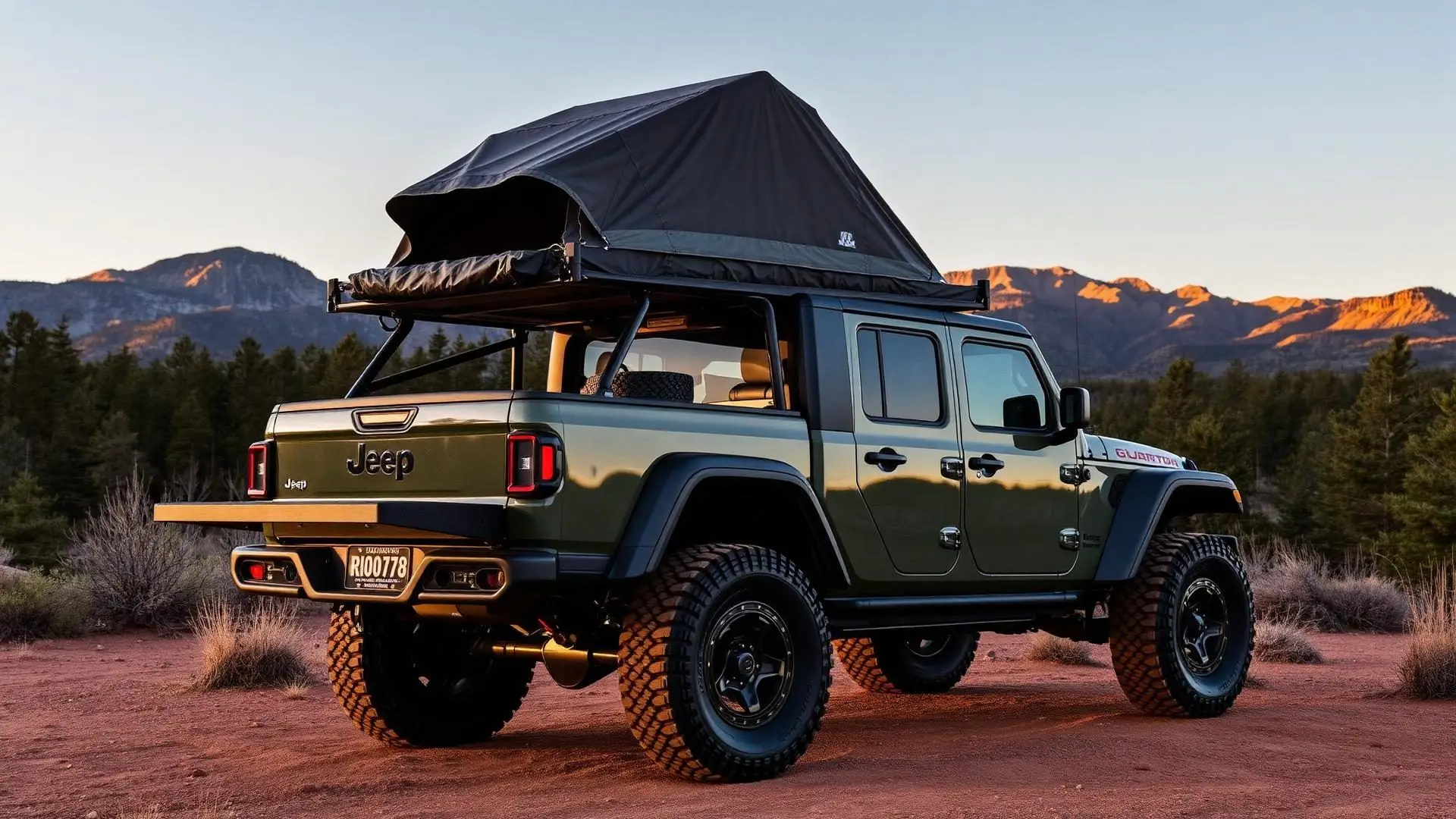
You're forty minutes up a forest road in Colorado, the last bar of signal died at the cattle guard, and the trail just narrowed to the width of your tires. You stop. Not because you're stuck, but because you want to. You drop the tailgate, pull a cold drink out of the fridge bolted into the bed, and look back at the truck that got you here. A Gladiator Rubicon riding on 35s, lockers front and rear, a tent folded on the bed rack waiting for dark.
Total spent to build the whole thing, truck and all? Fifty thousand dollars.
That number is achievable, but only if you stop listening to the people building eighty-thousand-dollar trailer queens on YouTube. So here's exactly how I'd spend fifty grand on a Jeep Gladiator Rubicon build that sleeps two, crawls real trails, and still drives to work on Monday. Every dollar accounted for. Including the one honest problem nobody warns you about before you bolt on a winch.
Why the Gladiator Rubicon, and Why Used
Buy used. This is the entire reason the build works.
A new Gladiator Rubicon stickers north of fifty grand before you add a single bolt, which means a new one leaves you exactly zero dollars to actually build it. A used one changes the whole equation. As of spring 2026, clean 2021 and 2022 Gladiator Rubicons are trading in the low-to-mid thirties, with solid examples landing around $34,000 to $38,000 depending on miles and options. Hunt for one near the bottom of that range, a clean 2021 Rubicon around $34,000 with roughly 50,000 miles, a hardtop, and a clean Carfax. Shopping hard on the truck is exactly what frees up the budget for a premium tent later. That leaves you a real $16,000 to build with, which is plenty if you spend it like it's yours instead of like it's a sponsor's.
Why the Rubicon trim specifically, and not a Sport or Sahara you could buy cheaper? Three reasons, and they all save you money later. The Rubicon comes with Dana 44 solid axles front and rear, electronic lockers at both ends, an electronic front sway-bar disconnect, a Rock-Trac transfer case with a 4:1 low range, and factory 4.10 gears. Try to add lockers, a disconnect, and a 4:1 case to a cheaper trim and you'll spend more than the price gap. The Rubicon is the value play hiding inside the premium badge.
And the factory numbers are not for show. Stock, a Gladiator Rubicon gives you 11.6 inches of ground clearance, a 44.7-degree approach angle, and 31.5 inches of water fording. For reference, a stock Tacoma TRD Pro clears about 9.4 inches and a 4Runner sits around 9.6. The Gladiator walks off the lot more capable than most rigs are after a lift.
The Honest Problem: Payload
Here's the thing the build videos skip, and it's the single most important sentence in this article. The Gladiator Rubicon has a factory payload of roughly 1,720 pounds, and that number includes you, your passenger, fuel, the tent, the rack, the bumper, the winch, the fridge, the recovery gear, and the cooler full of regret.
That sounds like a lot until you start adding. A steel front bumper and winch run 150 to 200 pounds. A hardshell tent like the Tuff Stuff Alpha weighs 176 pounds by itself, and the bed rack under it adds another hundred or so. Skid plates, sliders, a fridge, water, and recovery gear pile on a few hundred more. Two adults and a tank of gas eat another 500. Do the math honestly and a fully built Gladiator overlander can flirt with its payload ceiling before you've packed a single shirt.
This is not a reason to skip the Gladiator. It's a reason to build it smart. Every choice below is made with weight in mind, which is why you won't see a half-ton steel bed system or a winch the size of a microwave. Build light, stay under the number, and the truck rewards you. Ignore payload and you'll be replacing wheel bearings and brakes a lot sooner than you planned. Most people learn this the expensive way. You just learned it for free.
The Build: Where the $14,000 Goes
Sequence matters when the money is real. Here's the order I'd buy in, and why.
Suspension: 2.5-Inch Lift, Done Right ($1,800 installed)
You want a 2.5-inch lift, and you want quality shocks, not spacers. An Old Man Emu or a Teraflex kit running Falcon shocks lands in the right range and rides like the truck should have come from the factory. The 2.5-inch height is the sweet spot: it clears 35-inch tires, keeps your driveline angles sane, and doesn't turn freeway on-ramps into an adventure. Skip the 4-inch dreams. They look great in photos and ruin the ride everywhere that isn't a photo.
Two details people forget. You need bump-stop extensions, roughly an inch in the rear and two up front, or your 35s will rub the fenders at full stuff. And budget the alignment into the install. A lifted Gladiator that isn't aligned eats tires and tracks like a shopping cart.
The Gearing Hack That Saves You $2,000
Here's where buying the Rubicon pays for itself again. Most owners going to 35-inch tires need to regear their axles, a job that runs $1,500 to $2,500 with parts and labor. You don't, or at least not right away. Why? Because the Rubicon already left the factory with 4.10 gears, the deepest ratio Jeep offered. On 35s, a Rubicon's 4.10s land in a usable place for trail and overland driving. You'll feel it a little on steep highway grades, and if you ever jump to 37s you'll want to revisit it, but for a 35-inch overland build you can run the factory gears and keep that two grand for fuel and trails. Sport and Sahara owners with 3.73 gears don't get this option. You do.
Tires: 35s That Get You Home ($1,800 mounted, set of five)
Falken Wildpeak A/T4W in 35x12.50R17. Five of them, because your spare needs to match when you're a hundred miles from a tire shop. The Falkens land around $300 a tire, carry a real severe-snow rating, and give up almost nothing to the famous BFGoodrich KO2 and KO3 on the trail while costing meaningfully less. With mounting, balancing, and a new valve in the spare, call it $1,800 for all five.
If your heart is set on BFGs, the KO3 is the newer compound and worth it, but expect to pay 30 to 40 percent more for rubber that performs within a hair of the Falkens. This is an anti-hype site. Buy the Falkens and spend the difference on gas.
Wheels: Function Over Flash ($1,275, set of five)
Tuff Stuff Overland Ascent wheels in 17x8.5, gloss black, five of them at $255 each. They run the Gladiator's 5x127 (5x5) bolt pattern, carry a 2,500-pound load rating per wheel, and back it with a lifetime structural warranty, which matters when you're loading a built truck heavy. The cast A356 aluminum is the right call here. It looks right, clears the Rubicon's brakes, and won't make you cry when a rock leaves a mark.
The 0mm offset pushes the track a little wider than stock, which steadies the truck on washboard and helps the 35s clear the suspension up front. Buy five so your spare matches, because a mismatched spare a hundred miles from pavement is how a good trip turns into a tow bill. And resist the beadlock fantasy unless you're airing down to single digits regularly. Real beadlocks are expensive, heavy, and a maintenance chore most overlanders never need.
Armor: Protect the Expensive Stuff ($2,300)
Three pieces, in priority order. Rock sliders first, around $700, because they protect the rockers, the most expensive sheet metal to fix, and they double as a step. A steel front bumper that's winch-ready next, around $900, chosen for a stubby or mid-width design that keeps your approach angle and trims weight versus a full-width bruiser. Then a skid-plate package, around $700, to cover the oil pan, transfer case, and fuel tank. That's $2,300 to keep the costly parts off the rocks.
Winch: The Self-Rescue Insurance ($600)
A 12,000-pound winch with synthetic line from a reputable mid-tier brand. You don't need the thousand-dollar halo model. You need a reliable motor, synthetic rope instead of steel cable because it's lighter and safer when it fails, and a clutch that actually disengages when it's wet and cold. Six hundred dollars buys a winch that will get you, or the friend you're following, out of a bad afternoon.
Sleep and Storage: The Overland Half ($5,300)
This is what separates a built Jeep from an overland rig, and it's where the biggest single chunk of the build budget goes after the truck itself. The centerpiece is a Tuff Stuff Overland Alpha hardshell rooftop tent in black, $3,603. Yes, that is real money in a $50K build. It is also the piece you'll touch every single night you own this thing, which is exactly why it earns the spend.
The Alpha is a hybrid side-opening hardshell that pops up in under two minutes on its hydraulic struts, sleeps two to three adults on a built-in mattress, and seals into a low, sloped ABS shell that cuts wind noise and lets you leave your bedding inside when it's closed. You get a 7.5-foot telescoping ladder with angled steps, a rainfly, a skylight, three mesh windows with zip-off awnings, and interior and exterior LED lighting that runs off a USB power pack. The poly-cotton ripstop canopy handles weather, the aluminum honeycomb floor keeps it stiff, and it carries an 1,100-pound sleeping capacity.
Two honest notes, because this is that kind of site. The Alpha opens to the passenger side only, so think about how you'll orient the truck at camp. And at 176 pounds it is not light, which loops right back to the payload conversation above. Mount it on a bed rack over the bed, not on the cab, to keep that weight low and centered.
For the rack itself, a Gladiator-specific bed rack rated for a rooftop tent runs about $1,000. Add a 12-volt fridge in the 40-to-50-liter range for around $700, and you've got the core of a system you'll actually use. Cold food and a dry bed are the difference between a trip you repeat and a truck you sell.
Recovery and Lighting: The Last $900
A proper recovery kit comes in around $600: a kinetic rope rated for the Gladiator's weight, not a yank strap, a pair of soft shackles, traction boards, a tire deflator, and a portable air compressor so you can air back up at the trailhead. Then $300 for a set of ditch lights or A-pillar pods with a clean harness. A single pair of quality pods will out-throw a cheap forty-inch light bar and won't blind every oncoming driver on the dirt road home.
Adding It All Up
| Line item | Cost |
|---|---|
| 2021 Gladiator Rubicon, ~50K miles | $34,000 |
| 2.5-inch suspension, installed and aligned | $1,800 |
| 35-inch tires, set of five mounted | $1,800 |
| Tuff Stuff Ascent wheels, set of five | $1,275 |
| Armor: sliders, front bumper, skids | $2,300 |
| 12,000 lb winch, synthetic line | $600 |
| Bed rack | $1,000 |
| Tuff Stuff Alpha hardshell rooftop tent | $3,603 |
| 12V fridge | $700 |
| Recovery kit and lighting | $900 |
| Total | $47,978 |
That leaves roughly $2,000 in the budget, and you should keep it there. Call it the reality fund. New used trucks need tires rotated, fluids changed, maybe a battery or a set of brake pads in the first year. Spend every last dollar on mods and the first repair bill becomes a credit-card problem. Hold the buffer.
The Honest Warts
The Gladiator is not a Wrangler with a bed, and pretending otherwise gets people in trouble. That long 137-inch wheelbase gives you a 20.9-degree breakover angle, which means tight crested obstacles that a Wrangler skips over will try to high-center the Gladiator. Pick your lines. The departure angle of 26 degrees is also worse than a Wrangler's because the bed hangs out back, so steep ledge exits need care.
Fuel economy starts in the high teens stock and drops into the mid-teens once you add 35s, weight, and the aerodynamics of a tent. Plan around a real-world 14 to 16 miles per gallon when the truck is loaded, and carry that math into your trip planning.
And the JT, like the JL Wrangler, has a documented history of front-end death wobble, a steering shimmy triggered by worn or loose front-end components after a lift. It's manageable. Keep your track bar bolts torqued, consider an upgraded steering stabilizer, and don't ignore a developing shake. Built right and maintained, most owners never see it. Built lazy, it'll find you on the highway at sixty.
None of this is a dealbreaker. It's the honest spec sheet that makes you a better driver and a smarter builder.
Who This Build Is For
This Gladiator build is for the person who wants one vehicle that does everything. It tows the trailer, hauls the mulch, sleeps two in the backcountry, and crawls a genuine trail without a second mortgage. If you want a dedicated rock buggy, build a two-door Wrangler instead and save the weight. If you want maximum interior cargo and a roof you never remove, an SUV-based overlander like a built 4Runner makes more sense. But if you want the truck bed, the open-air doors-off summer, the factory lockers, and the ability to point at a horizon and just go, the Gladiator Rubicon is the one rig that checks every box at once.
Bottom Line