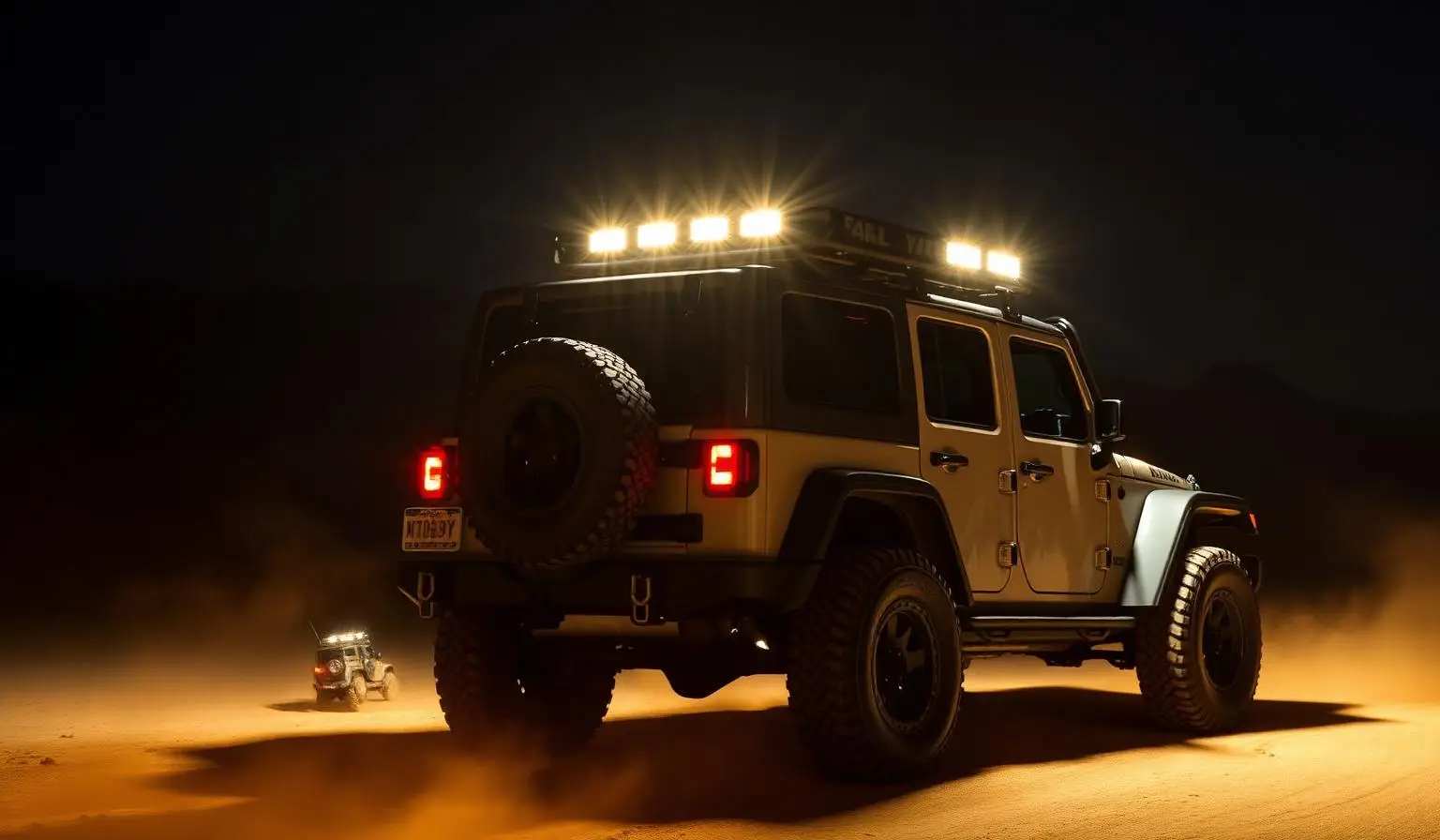
You do not realize how bad your factory headlights are until the road ends.
On pavement, they are fine. On a lit highway at sixty miles per hour, they do exactly what they were engineered to do, illuminate the lane ahead and give you enough reaction time to not hit something. But the second you turn off the pavement and the darkness gets real, the kind of rural dark that has no streetlights, no ambient glow, no helpful guardrails, your factory headlights reveal themselves for what they are: a regulatory minimum dressed up as a solution.
The trail does not care about regulatory minimums.
What happens in that darkness is what separates an overlanding rig that goes out at night with confidence from one that finds camp before sunset and stays there. Lighting is not glamorous. Nobody is buying a roof rack for the lighting story. But the driver who has been deep on a forest road at 2 AM with a good lighting setup and the driver who has done the same with factory beams are two people with permanently different opinions about what the rig actually needs.
Here is what actually works, and why the choices matter more than most builders realize until it is too late to see them.
Why the Factory Lighting Problem Is Worse Than You Think
Factory headlights are designed around a single use case: a driver on a public road, operating at legal speeds, in conditions where the assumption is that other infrastructure, lane markings, signage, guardrails, fills the gaps that the headlights do not cover.
Off-road, none of that infrastructure exists.
The trail shoulder does not have a painted line. The creek crossing does not have a warning sign. The switchback does not care how wide your beam pattern is. When you are picking a line through rocky terrain at night, or navigating a sandy wash where the sides of the trail blend into the darkness around them, or watching for the tree that fell across the two-track since the last time someone drove it, you need light that fills the scene, not just the center of what is directly in front of you.
This is not a problem you can solve by buying brighter versions of the same thing. It is a problem you solve by thinking about lighting the way you think about the rest of the rig: as a system with different components doing different jobs.
The Light Bar: Maximum Coverage, One Decision
The light bar is where most people start, and for good reason. A single bar mounted across the roof, bumper, or windshield can throw more usable light than almost any other single addition to the rig. The light bar's core advantage is spread, a good bar gives you a wide flood of illumination across the full scene rather than the narrow columns of a spot-beam setup.
The length debate matters. A longer bar throws more total light but creates more road-scattered glare when oncoming traffic is involved and adds more wind noise at highway speeds. A shorter bar is more discreet, more manageable, and still dramatically outperforms factory headlights in most off-road scenarios. For overlanding, where you are spending as much time on dirt roads and two-tracks as genuine technical terrain, a mid-length bar in the 20 to 30-inch range often hits the sweet spot better than the maximum-coverage 50-inch setup that looks impressive at SEMA and creates problems on every two-lane highway on the way to camp.
Beam pattern is the real decision inside the light bar category. Spot beams throw light far, in a narrow cone, useful for high-speed desert running where you want to see obstacles far down the road before you reach them. Flood beams spread wide and close, useful for tight technical terrain where peripheral vision matters more than distance. Combo beams do both and are the practical choice for the rig that does not know in advance which type of night it is going to have.
Round Driving Lights: The Classic That Still Makes Sense
Round driving lamps have been on off-road rigs since before anyone called it overlanding. There is a reason they have not disappeared.
A round lamp with a good reflector and a proper lens delivers a beam pattern that cuts through conditions a flood bar struggles with. The focused, long-range throw of a quality round driving light is different from what a wide-angle LED bar gives you, it is the kind of beam that picks up a deer standing in a wash at two hundred meters, or finds the reflective trail marker you need before you miss the turn.
Mounted on the roof rack, A-pillar, or bumper corners, round lights also serve a role that light bars do not cover well: they can be positioned to eliminate the specific shadow zones that create problems for your particular rig. Every truck and SUV has shadow zones that the main headlights and a forward bar do not reach. Round lights, mounted at different angles and heights, fill those zones with targeted light that the bar cannot aim.
The aesthetic case is real too, even if nobody wants to admit it is part of the decision. A roof rack with a pair of round amber driving lights on a trail rig carries a visual language that a light bar alone does not, the look of a vehicle that has been there before and knows what it needed.
LED Pods and Cubes: The Versatile Problem-Solvers
If the light bar is the main event and the round lamps are the precision instrument, LED pods are the everything else.
Small, rectangular or square, available in dozens of beam patterns and mounting configurations, LED pods are what you reach for when you have a specific lighting problem that the big pieces do not solve. Ditch lights, pods mounted on the A-pillars or hood corners pointing outward at roughly 45 degrees, eliminate the side shadows that forward-facing lighting creates when you are working around obstacles. They illuminate the space beside the rig that your main lights simply cannot reach, and once you have driven with good ditch lights, driving without them feels like operating half-blind.
Reverse lighting is another pod application that gets underestimated until you try to back a loaded rig through a tight campsite in total darkness. A pair of high-output LED pods mounted at the rear of the roof rack or bumper transforms that operation from a stressful exercise in guesswork into something a solo driver can actually do safely.
Rock lights live at the bottom of the rig and do something none of the above can: they illuminate the terrain directly under the vehicle. For slow technical terrain at night, rock crawling, navigating tight shelf roads, placing tires on specific lines, rock lights are not optional equipment. They are the difference between being able to see where your tires are going and having to get out with a flashlight every thirty feet.
The Amber Argument: Why Color Temperature Matters More Than Brightness
Here is where a lot of lighting builds go wrong by chasing the wrong number.
Raw lumen output is not the most important variable in off-road lighting. Color temperature is. Specifically, the difference between white light and amber, and why amber has been the standard for serious desert and dust-condition driving since long before LEDs existed.
White light, typically measured at 5000K to 6500K color temperature, is bright and has excellent color rendering. In clear conditions on a dark night, it is excellent. In dust, fog, rain, and smoke, the conditions that desert and forest overlanding regularly produces, white light scatters off the particles suspended in the air and throws that scatter directly back at the driver. The brighter the white light, the worse the whiteout effect becomes. More lumens, less visibility.
Amber light, at roughly 3000K, has a longer wavelength that passes through suspended particles rather than bouncing back from them. The beam penetrates. In dusty desert conditions, behind another rig kicking up a rooster tail, or in the kind of thick morning fog that sits in mountain valleys, amber driving lights give you visibility that white lights of equal output cannot match. This is why amber has been standard equipment on rally cars and Baja rigs for decades. The physics does not change because LED technology improved.
The practical answer for most builds is both: white for clear-night maximum output, amber for the conditions that require penetration over raw brightness. A dual-setup, white light bar for distance on clear nights, amber driving lights or pods for dust and weather, covers the full range without compromise.
Building the System: How the Pieces Work Together
The lighting setup that actually works is not the one with the most lights. It is the one where every light is doing a specific job with no redundancy and no gaps.
A practical overlanding lighting system works in layers. Factory headlights handle the baseline, modified if possible with upgraded bulbs or projector retrofits, but always the foundation. A main light bar or forward driving lights extend that range and fill the scene at distance. Ditch lights or A-pillar pods eliminate the shadow zones on the sides. Amber auxiliary lights handle dust and weather conditions. Rear pods cover reversing. Rock lights, if the rig goes technical, cover the terrain under the axles.
Not every rig needs all of those layers. A desert-running overland truck that stays on two-tracks and forest roads has different needs than a rock crawling Jeep that goes slow and technical in the dark. The honest first step is identifying the gap in your current setup, where, specifically, do you run out of light, and building from that answer rather than from a shopping list.
Brands that build across the full range of off-road lighting applications, like GG Lights, which covers everything from light bars to rock lights to specialized trail lighting, make that system-building approach more practical by letting you source the layers from a single catalog with consistent quality standards rather than mixing and matching from a dozen different brands and hoping the outputs make sense together.
Mounting, Wiring, and the Details That End Trips
The best lighting setup in the world fails if the mounting loosens on a vibration-heavy trail or the wiring runs through a location that sees heat and moisture and eventually fails in the field.
Solid mounting is not complicated but it requires attention. Stainless hardware on exposed mounting points. Vibration-resistant locking hardware on anything that will see sustained off-road running. Mounts that position lights without blocking radiator airflow, obstructing the hood, or creating leverage points that stress the mounting surface over time.
Wiring deserves the same seriousness. Running a relay and fuse setup for aux lighting protects both the lights and the vehicle's electrical system. Waterproof connectors at every junction that will see weather. Wire routing that avoids heat sources and has enough slack for suspension flex without creating a chafe point that eventually cuts through. This is the unglamorous part of lighting builds that distinguishes a setup that works for three years from one that fails at the worst possible moment.