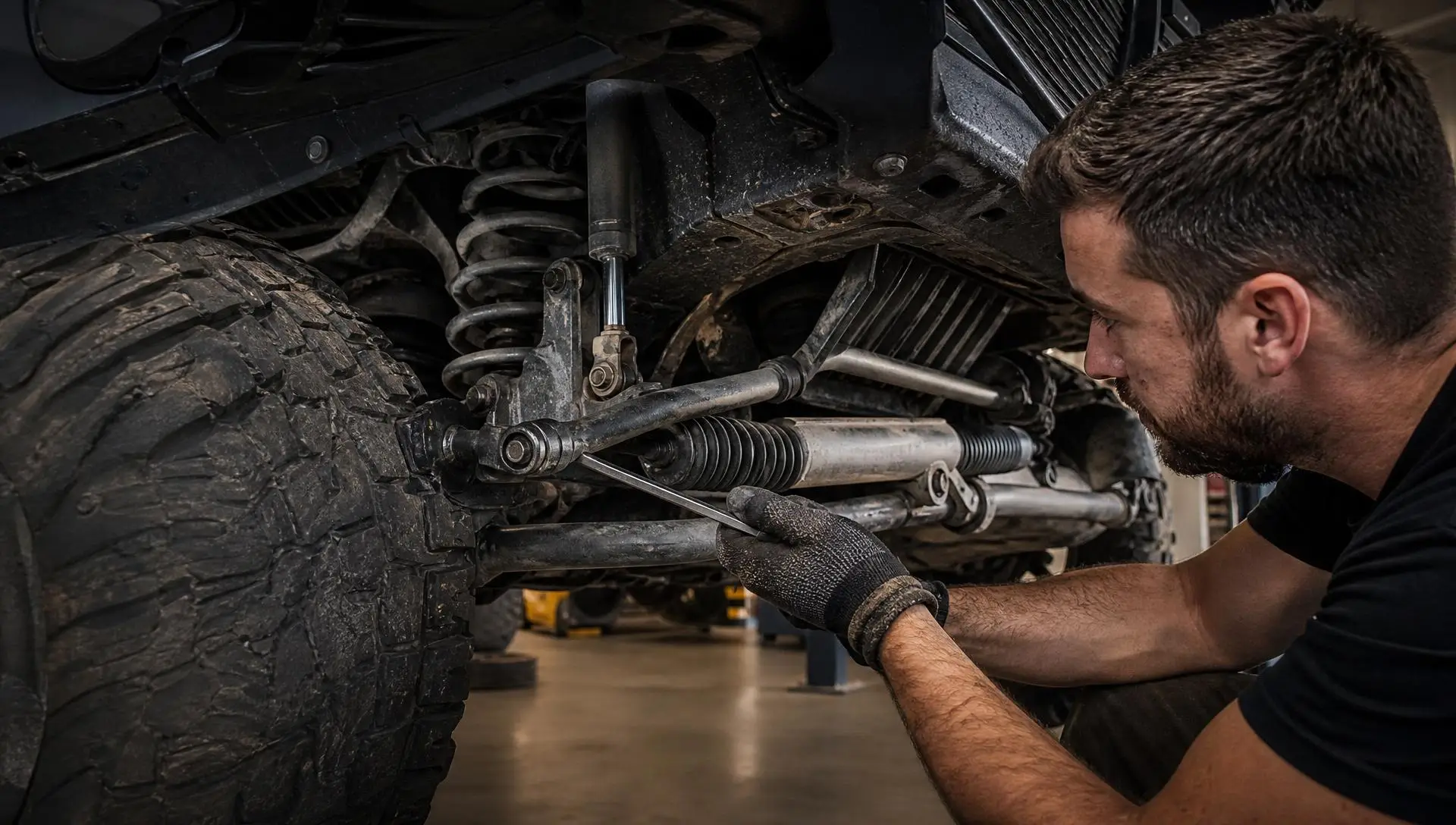
If you have ever hit a bridge seam at 55 mph and had the steering wheel rip itself back and forth hard enough that you thought the front axle was leaving the vehicle, you have met death wobble. It is not a mystery, it is not a curse, and it is not something you live with. It is a mechanical resonance caused by slop in the front end, and it is fixable in an afternoon if you diagnose it instead of guessing.
The problem is that most owners guess. They throw a steering stabilizer at it, feel better for two months, then it comes back worse. This guide is the diagnosis order that actually finds the failed part.
What Death Wobble Actually Is
Death wobble is a self-reinforcing oscillation of the front axle. It shows up almost exclusively on solid front axle vehicles: Jeep Wrangler (TJ, JK, JL), Jeep Gladiator, Ram 2500 and 3500, Ford Super Duty. Independent front suspension trucks can shake, but they do not usually build the violent resonance that solid axles do, because both front wheels on a solid axle are physically tied together.
Here is the mechanism. Any pivot point in the steering and suspension has a tiny amount of play when it wears. Hit a bump, and the axle deflects. If those pivots are tight, the deflection damps out in a fraction of a second. If they are loose, the axle overshoots, swings back, overshoots again, and each cycle feeds the next. Now the tires are steering the axle instead of the axle steering the tires.
Two things matter here:
Death Wobble Needs a Trigger
Death Wobble Needs Slop
This is why it is so common after a lift. A lift changes geometry, adds leverage, and usually gets paired with heavier tires, which accelerates wear on parts that were already marginal.
The Steering Stabilizer Myth
Let's kill this one first, because it wastes more money than any other misconception in the 4x4 world.
A steering stabilizer is a damper. It is a shock absorber for your steering, mounted between the tie rod and the axle. Its job is to smooth out road feedback and keep the wheel from tugging in your hands on rough surfaces.
A stabilizer does not tighten a worn ball joint. It does not shrink a wallowed-out track bar bracket hole. What it does is add enough damping to mask the oscillation for a while. Then the underlying slop keeps getting worse, the stabilizer blows out from working overtime, and the wobble comes back harder.
If a Stabilizer 'Fixed' It, It Did Not
Buy a good stabilizer because you want better steering feel. Do not buy one as a cure.
The Diagnosis: Find the Slop Yourself
You do not need a shop for this. You need a jack, jack stands, a pry bar, and a helper. Budget an hour.
Safety First
Step 1: The Track Bar (Start Here, Always)
The front track bar locates the axle side to side. It is the single most common cause of death wobble, and it is not close.
With the front on stands, have your helper turn the steering wheel back and forth in short, sharp motions, roughly a quarter turn each way. Put your hand and your eyes on each end of the track bar.
Look for:
- Bushing movement. The rubber or poly bushing should not visibly deflect at the axle end.
- Bolt movement inside the bracket. If the bolt is shifting in the hole, the hole is worn oval, which is called wallowing.
- A ticking or knocking you can feel through your fingers.
Also grab the track bar and try to move it up, down, fore, and aft by hand. Any perceptible movement at the joint is a failure.
Free Fix First
Step 2: Tie Rod and Drag Link Ends
Grab the tie rod near each end and try to move it vertically. There should be zero vertical play at the joints. Any clunk or vertical slop means a worn end.
Same drill for the drag link. Watch the pitman arm connection while your helper rocks the wheel.
Step 3: Ball Joints
With the tire on and the wheel off the ground, grab the tire at 12 and 6 o'clock and rock it in and out. Movement here points at ball joints or wheel bearings.
To tell them apart: have a helper press the brake pedal while you rock. If the play disappears, it is a wheel bearing. If it stays, it is a ball joint.
Big Tire Wear
Step 4: Wheel Bearings
Now grab the tire at 3 and 9 o'clock and rock it. Play here, especially with a rumbling noise on the highway, points to a bearing. Unit bearings are a common failure on JK and JL Wranglers running larger tires.
Step 5: Control Arm Bushings
Look at the bushings at both ends of each front control arm. Cracked, torn, or visibly separated rubber means the axle can move fore and aft under load. On lifted rigs, this is a real contributor.
Step 6: Tires, Balance, and Pressure
Not the root cause, but a frequent trigger. Check for:
- Uneven or cupped wear
- Wildly uneven pressures side to side
- Missing wheel weights
- Aggressive mud terrains that were never road force balanced
Tires Find the Slop
The Alignment Piece Nobody Checks: Caster
Caster is the forward or rearward tilt of the steering axis. Positive caster is what makes your steering want to return to center and makes the vehicle track straight. It is the self-correcting force that damps out oscillation before it builds.
When you lift a solid axle vehicle, the axle rotates. The pinion goes up, and the caster angle goes down. Lift 3 or 4 inches with stock control arms and you can lose enough caster that the front end simply does not want to self-center anymore. The vehicle wanders, feels vague, and becomes far more willing to wobble.
Target Caster
The Fix Order
Work in this order. Do one thing, then drive it. If you replace five parts at once and the wobble is gone, you learned nothing and you probably spent triple.
- Torque the track bar bolts. Free. Fixes it more often than anyone admits.
- Replace the track bar if the bushings are worn. If the axle bracket hole is wallowed out, you also need a bracket repair or a hole repair kit. A new bar in an oval hole will wobble again in a month.
- Replace worn tie rod or drag link ends. Look at a heavy duty steering upgrade if you are on 35s or bigger.
- Replace ball joints if they show play. Do them in pairs.
- Replace failed wheel bearings.
- Replace cracked control arm bushings.
- Get a proper alignment with caster set correctly.
- Road force balance the tires.
- Then if you want, install a quality steering stabilizer for ride feel.
What It Costs
Rough real-world numbers, parts only:
- Track bar (adjustable, quality brand): $150 to $350
- Track bar bracket or hole repair kit: $40 to $150
- Heavy duty tie rod and drag link: $400 to $900
- Ball joints (set, quality): $200 to $500
- Front unit bearings (pair): $200 to $500
- Alignment with caster correction: $100 to $200 at a shop that knows solid axles
- Road force balance: $25 to $40 per tire
Most Cases Are Cheap
What to Do When It Happens While Driving
This matters. Death wobble is genuinely dangerous at speed.
Do Not Slam the Brakes
Grip the wheel firmly, keep it straight, and get off the throttle. The wobble usually stops once you drop below roughly 40 mph. Brake gently once it settles, pull over, and check that your track bar bolts and lug nuts are tight before you continue.
It Will Happen Again
Prevention
If you run a solid front axle vehicle on larger tires, treat the front end as a wear item, not a set-and-forget system.
- Re-torque track bar and control arm bolts after any suspension work and again after 500 miles.
- Inspect steering and suspension joints every oil change. It takes five minutes.
- Rotate and balance tires on schedule. Aggressive treads need it more, not less.
- When you lift, correct the caster. Do not skip it because the vehicle "drives fine."
- Do not cheap out on the track bar. It is the part doing the most work.
Death wobble is not a defect you tolerate because you own a Jeep. It is a symptom of a specific worn part, and every one of those parts is findable in an hour on jack stands.