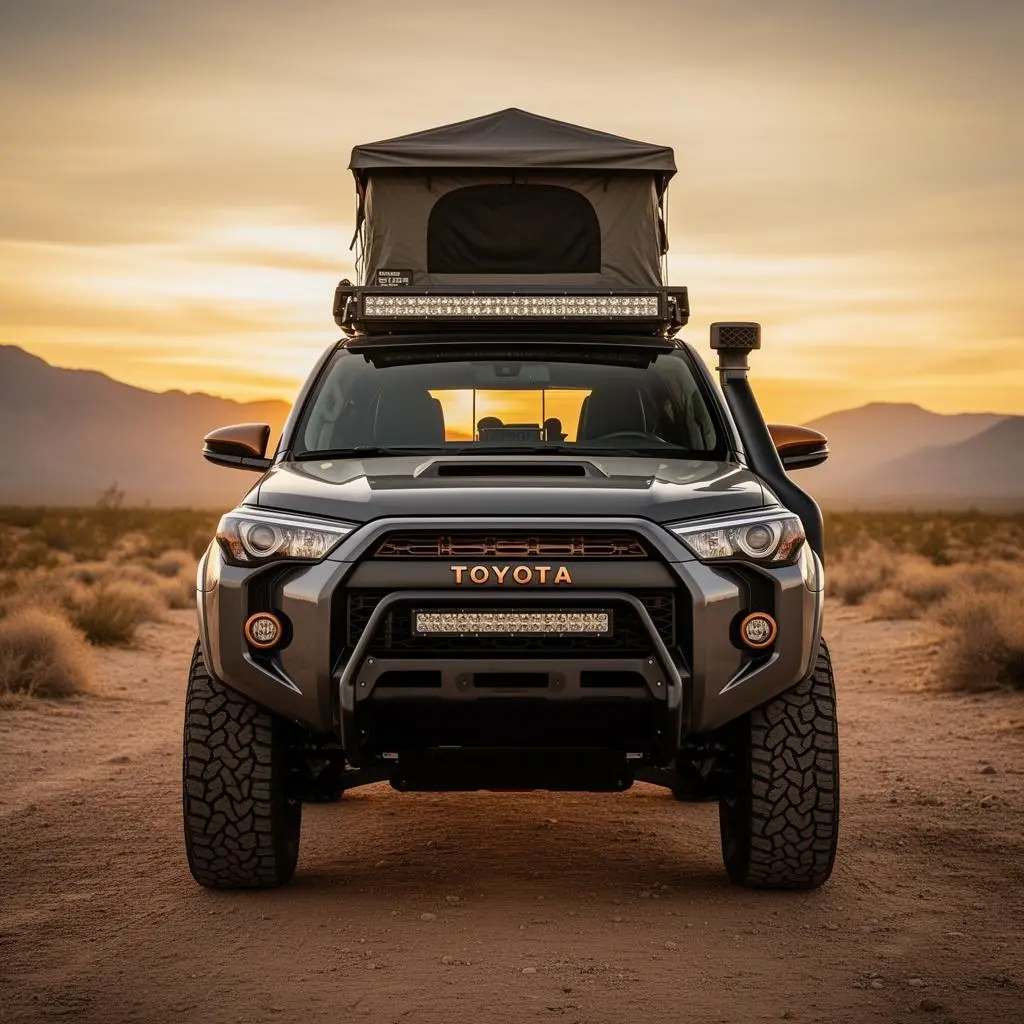
Built for the road less paved.
Toyota finally did the thing.
For years, building a 4Runner that could actually go somewhere meant buying the parts yourself: Old Man Emu shocks, an ARB roof rack, and a snorkel that required drilling holes in the fender. That was the price of admission.
Then Toyota walked into the room and built one from the factory.
The 2026 Toyota 4Runner Trailhunter rolls off the showroom floor wearing gear owners used to install themselves. Snorkel. Onboard air compressor. ARB roof rack. Old Man Emu shocks. 33-inch tires. Frame-mounted rock rails. RIGID lights. All of it. From the dealer. With a warranty. For anyone who has built one of these the hard way, that is a big shift. Read the full 4Runner Trailhunter review for the factory specs, MPG and price.
But here is the thing nobody in the glossy launch videos wants to tell you. Factory built and your build are not the same rig. They never have been. They never will be.
Toyota made the Trailhunter for the broadest possible buyer who would write the check. Your version, the one you actually drag through Moab dust and Sierra snow and that one rutted forest road a friend swears leads to the best campsite in the state, has different priorities. Better tires. Wheels that look like you picked them. A tent on top so you stop paying for motels in towns you only need to sleep in for six hours.
This post is the honest build conversation. The 2026 4Runner Trailhunter as your starting point, and three upgrades that actually move the needle. Atturo Trail Blade X/T tires. Compound 9315 wheels from The Wheel Group. A Tuff Stuff Overland rooftop tent.
No hype. No sponsored fluff. Just the parts that earn their place on a real overlander.
Let's get into it.
The Trailhunter, In Plain English
Before we talk upgrades, let's make sure we are talking about the right rig.
A lot of folks are calling this "the TRD 4Runner overlander," and they are close but not quite there. The 2026 4Runner has nine trims, and two of them sit at the top. The TRD Pro. The Trailhunter. Both wear bronze 18-inch wheels. Both run 33s. Both look like they want a fight. But they are built for very different conversations.
The TRD Pro is the desert trim. FOX QS3 internal bypass shocks. Performance air intake. Hood scoop. If your idea of fun is whooped-out fire roads at speed and you measure your weekends in air time, that is your rig.
The Trailhunter is the overlander. And that is the one we are building on.
Toyota partnered with the names that already had credibility in this space, and the spec sheet reads like a wishlist somebody actually finished. You get Old Man Emu 2.5-inch forged monotube shocks with rear piggyback reservoirs, tuned for slow-speed control and load-carrying. The lift sits about two inches up front and an inch and a half in the rear. You get a co-designed ARB roof rack. A high-mount air intake, which is just a polite way of saying snorkel. An onboard air compressor for the moment you crest the ridge, take in the view, and remember you still have to air back up. Frame-mounted steel rock rails. RIGID color-selectable LED fog lamps. A 20-inch LED light bar tucked into the bronze heritage grille.
Under the hood, the i-FORCE MAX hybrid is standard. A 2.4L turbo four paired with an electric motor for a stout 326 horsepower and 465 lb-ft of torque. That is the most torque any 4Runner has ever made, and the electric assist hits low and hits early. It is the kind of grunt that matters when you are crawling, not racing.
Push a button and the Stabilizer Disconnect Mechanism unlocks more articulation. Plug in your fridge or your laptop and the 2400W AC inverter handles it without breaking a sweat. Factory tires are 33-inch Toyo Open Country A/T IIIs on 18-inch bronze-finished alloys. Ground clearance lands at a solid 10 inches.
It is a remarkable factory build. We will say that twice if we need to. But remarkable does not mean finished, and finished is not the same thing as yours.
Upgrade One: The Atturo Trail Blade X/T
The factory Toyo is a good tire. We are not here to dunk on it.
But here is the question that keeps coming back when you actually live with a rig like this. When you are going to run this truck hard, when you are going to load it down with gear and water and fuel and people, when you are going to ask it for trail miles and snow miles and washboard miles, is "good for everyone" the same as good for you?
The Atturo Trail Blade X/T is built for a different answer.
What an X/T Tire Actually Is
Off-road tires fall into three rough buckets. On the lighter end you have all-terrains. Quiet. Smooth. Capable in the dirt but not built for the rough stuff. On the heavy end you have mud-terrains. Chunky. Loud. They eat trails for breakfast but they punish you on the long highway hauls between adventures. And right in the middle, where most overlanders actually live, you have the rugged-terrain or hybrid tire. Atturo calls theirs an X/T, and the design tells you exactly what they were thinking.
The Trail Blade X/T pulls its shoulder blocks and sidewall straight from Atturo's mud-terrain playbook. Big lugs. Real biting edges. Aggressive sidewall protection where rocks and roots want to gouge you when you are aired down to 18 psi for a crawl. The center tread leans the other way. Tighter pattern, linked center blocks for highway stability, alternating sipes that control noise and grab snow.
In other words, it bites where you need it to bite and it shuts up where you need it to shut up. That is the whole job.
The traction ratings Atturo publishes line up with the design choices. Eight out of ten in mud. Eight out of ten in wet traction. Seven for rock, seven for snow, seven for sand. Seven on the street. A 45,000-mile treadwear warranty backs the whole thing up. And the tire is PHEV-compatible, which matters more than you think on a Trailhunter, because the i-FORCE MAX is a hybrid powertrain. Plenty of older tire designs were never engineered for the weight and instant torque of a hybrid drivetrain. The X/T was.
The Real-World Difference
On the trail, the M/T-style shoulders dig where the factory A/T glides. They claw rock. They protect your sidewall when you are running low pressure. They bite into wet roots and loose dirt and sand with the kind of confidence that makes you stop checking the rearview mirror to see if your kid is still buckled in.
On the highway, the linked center blocks kill the squirm you usually get from anything this aggressive. The alternating sipes keep the cabin quiet enough to hear the radio. You are not getting an M/T's drone at 75 mph. You are getting a tire that disappears under you on the interstate and wakes up the moment the pavement does.
And at the wallet, Atturo prices the X/T well below the major-brand hybrid tires. Real-world buyers regularly save thirty to forty percent over comparable BFGs or Toyos in the same size. That is gas money. That is a fridge for the rear cargo area. That is two or three nights at a National Park before the credit card starts complaining.
Fitment for the Trailhunter
The Trailhunter rolls on 18-inch wheels with a 6x139.7 bolt pattern. The X/T has plenty of sizes that work. Here is the shortlist worth knowing:
The LT275/70R18 comes in at 33.2 inches tall and 11 inches wide. It is the cleanest one-to-one swap for the factory 33s. No rubbing concerns with the stock OME lift. Ten-ply rated. 3,638 lbs of max load. If you want the easiest upgrade that just works, this is your answer.
The LT285/65R18 runs 32.6 inches tall and 11.5 inches wide. A touch shorter, a touch chunkier, still ten-ply, still ready to work.
The 33x12.50R18LT gives you that true 33x12.50 stance, the look most overland builds chase. It is wider than factory, so check fender clearance with the OME lift, but it is a proven 4Runner fitment that has lived under a thousand builds before yours.
The LT295/70R18 pushes the size up to 34.3 inches tall and 11.8 wide. If you have the lift, the clearance, and the appetite for a bigger tire, this is the move.
For most Trailhunter owners, the LT275/70R18 or the 33x12.50R18LT is the sweet spot. Same height as the factory tire. Better trail teeth. Better value. Done.
And once you start thinking about size and stance, you start thinking about what is holding all that rubber up.
Upgrade Two: Compound 9315 Wheels from The Wheel Group
Wheels are where a build starts to look like yours instead of like the showroom photo.
The factory 18-inch bronze on the Trailhunter is fine. Plenty of folks love it. We get the appeal. It ties into the bronze grille lettering, the heritage badging, the whole package Toyota cooked up to make you feel like you bought something special. But fine is not the same as right, and bronze becomes a constraint the moment you start thinking about color matching, gear, and what your rig is going to look like five years and three sets of tires from now.
The Compound 9315 from The Wheel Group is a different answer entirely.
What You Are Looking At
The Compound 9315 is a clean, aggressive eight-spoke design in matte black. No bronze. No chrome. No try-hard. Just a wheel that looks like it means business, lets the tire do the talking, and gets out of the way of your build instead of dictating it.
Sizes run 17x9 and 18x9 in matte black, with 20x9 and 20x10 options in Crimson Candy Red if you want a louder statement. For a Trailhunter or any 6x139.7 Toyota truck or SUV (your Tacoma buddy, the older 4Runner, the FJ Cruiser hiding in the back of the garage), the two SKUs that matter are these.
The 17x9 in matte black with a 6x139.7 bolt pattern, negative 12 offset, 4.53 inches of backspace, and a 2,500 lb load rating. The 18x9 in matte black with the same bolt pattern, the same negative 12 offset, the same backspace, the same load rating. Both have a 106mm hub. Both can carry a fully loaded Trailhunter with a tent, a fridge, water, recovery gear, and four people without flinching.
Why 17 vs 18, And Why the Negative Offset
Here is something the wheel companies do not always tell you. When you are building for off-road, more sidewall is your friend.
A 17-inch wheel with a 33-inch tire gives you more rubber between the rim and the rock than an 18 with the same tire. That extra sidewall is what lets you air down to 15 or 18 psi when the sand gets soft or the snow gets deep, and it is what stands between your rim and the ledge you misjudged in the dark. The Trailhunter ships on 18s, so the 18x9 Compound is the direct swap. But if you have the option to size down to a 17, a lot of long-haul overlanders will tell you it is the more functional move.
The negative 12 offset and 4.53-inch backspace push the wheel out toward the fender. That is the wider stance you want when the truck is loaded heavy, because it lowers your effective center of gravity and gives you better stability in side-tilt situations. It also opens up clearance for the wider tire choices like the 33x12.50 Atturo X/T.
One honest note on fitment. With an aggressive offset and a 12.50-wide tire, you will want to check for rub at full lock and full suspension flex before you commit. Most Trailhunter owners with the OME lift will not have issues, and the factory fender flares give you some forgiveness, but a quick test is cheaper than learning the hard way.
Why the Compound Works With the X/T
This is the part that matters. Matte black wheels and aggressive hybrid tires belong together. The Compound 9315 in matte black with a 33-inch Atturo Trail Blade X/T is a build that looks intentional from twenty feet away.
The shoulder lugs of the X/T flow into the spoke design of the wheel without fighting it. The matte finish does not compete with the tire. It frames it. It lets the tire be the visual statement, which is exactly the way it should be on an overland rig, because the tire is the thing that is actually doing the work.
And on a Trailhunter, where the factory build is already loaded with bronze badging and bronze grille text and bronze accents, swapping to matte black wheels tones the whole package down. The rig stops looking like a Toyota brochure and starts looking like something that has actually been somewhere. Which is the difference between a truck and a build.
There is also a practical synergy worth knowing. The Wheel Group, which distributes the Compound line, is also the U.S. distributor for Tuff Stuff Overland. Same dealer network. Same catalog. Same accessibility.
Which is the perfect handoff to the third piece.
Upgrade Three: A Tuff Stuff Overland Tent on Top
You have the truck. You have the tires. You have the wheels. You are going to drive somewhere far from home, and you are going to need to sleep.
This is where most builds quietly stall out. Because overlanding sounds simple until you realize that sleeping in your rig means folding the back seat flat, wrestling with cargo geometry, and waking up at 4am with your hip on a tie-down hook. Or it means a ground tent, which means rolling it up wet at dawn and packing damp nylon into a stuff sack you will smell for the rest of the trip.
A rooftop tent solves both problems. And Tuff Stuff Overland has built one of the more accessible RTT lineups out there, which fits the philosophy we keep coming back to here. Real adventure for real people. Not a $4,000 gear bill before the first mile.
The Tuff Stuff Lineup, Briefly
Tuff Stuff makes both softshell and hardshell tents. Each has a job. Here is the cheat sheet for Trailhunter builds.
On the hardshell side, you have the Alpha. The flagship. A hybrid side-opening design with a sloped aerodynamic shell, hydraulic lift brackets, and a setup that takes about 30 seconds. It sleeps three to four. It weighs 176 lbs. It handles up to 1,100 lbs of static load. The 2.4-inch foam mattress is genuinely comfortable, the two skylight windows let you fall asleep watching the stars, and the aero shell means you barely feel it on the highway. There is also the Alpha II, the smaller two-person version. Same hardshell quality, lighter at 152 lbs, even more aerodynamic. If you camp solo or with one other person and you care about wind drag and fuel economy on long drives, the Alpha II is the smart pick.
On the softshell side, the Ranger 65 is the community favorite for a reason. It sleeps two to three adults comfortably, with room for a kid in the middle. 65 inches wide. 154 lbs. Setup takes 10 to 15 minutes, which is longer than the Alpha but still faster than fighting with a ground tent in the dark. You get a 2.75-inch mattress, a sliding ladder, a storage hammock, and a heavy-duty PVC travel cover. Add the optional annex room and you get 96 by 96 inches of enclosed space underneath, which is your changing room, your gear locker, or your dog suite, depending on the trip. If you need more room than that, the Elite scales up to four or five sleepers at 185 lbs.
Which One for the Trailhunter
Here is the advantage you do not have to think twice about. The Trailhunter ships with the factory ARB roof rack already on top. That saves you the conversation most overlanders have to have before they can even shop for a tent.
You still want to confirm the dynamic weight rating of the ARB rack, which is the weight it can safely carry while you are driving down a forest road at 30 mph. Static rating is always higher than dynamic, and that distinction matters. Tuff Stuff's mounting system is universal and fits any crossbar with a cross-section of 3.25 inches wide by 1.5 inches tall, which the factory ARB on the Trailhunter handles without issue. Crossbar spacing is the other variable. 24 to 40 inches apart for two-person tents, 32 to 48 for three-person tents, and 44 to 60 for the bigger four-person setups.
For most Trailhunter owners, the choice comes down to the Alpha or the Ranger 65.
Pick the Alpha if you are on the road a lot. You want camp set up in under a minute when you roll into the trailhead at dusk. You drive long highway stretches between adventures and care about aerodynamics. You like the idea of leaving your bedding inside the tent so packing up means closing a lid and turning the key.
Pick the Ranger 65 if you want more sleeping space per dollar. You do not mind a 10-minute setup. You camp in one spot for a few days at a time instead of moving every night. You might add an annex room down the road for a kid, a dog, or a buddy's gear.
Both will live happily on the Trailhunter's ARB rack. Both will give you a place to sleep that is elevated, dry, off the ground, and ready to deploy at the end of a long day, no matter what the weather is doing.
The Honest Limitation
A rooftop tent is not free, and we are not going to pretend otherwise. You are adding 150 to 185 lbs of permanent weight to the roof of a tall vehicle that already sits high on a lift. That raises your center of gravity. It costs you a couple of mpg. It changes how the rig handles in crosswinds and in sweeping mountain corners.
For the Trailhunter, the math works out. Toyota engineered this truck with this kind of load in mind. You will not feel it in any dramatic way on the highway, but you will notice it in tight switchbacks and parking lots. Drive accordingly.
The trade-off pays you back the first night. Sleeping off the ground, dry, in a tent you can deploy in under a minute, ten feet from whatever trailhead you parked next to. That is the whole point of building an overlander. The Tuff Stuff tents let you get there without spending Roofnest money on a name.
The Build, Stacked Up
Let's put it all together.
You start with a 2026 Toyota 4Runner Trailhunter. MSRP lands around $67,400, give or take what your dealer is doing this week. You get the snorkel, the OME shocks, the ARB rack, the rock rails, the lift, the 33-inch tires, the air compressor, the lights, the Stabilizer Disconnect Mechanism, the 326 hp hybrid powertrain, and the 2400W inverter. All under warranty. All from the dealer.
From there:
Step into a set of Atturo Trail Blade X/T tires in the LT275/70R18 or 33x12.50R18LT. Better mud. Better rock. Better wet traction. PHEV-compatible. 45K warranty. Priced well below the factory Toyo replacements.
Swap to Compound 9315 matte black wheels in 17x9 or 18x9, 6x139.7, negative 12 offset. Cleaner look. More sidewall protection if you go 17-inch. Wider stance. And you finally escape the bronze color trap that locks every other Trailhunter into looking identical at every campsite from Sedona to Montana.
Mount a Tuff Stuff Overland Alpha or Ranger 65 on the factory ARB rack. Off-the-ground sleeping. Quick setup. Universal mounting. Real overland infrastructure that pays for itself the first night you skip a motel.
What you end up with is a rig that respects the factory engineering Toyota put into the Trailhunter, but personalizes the three pieces that touch the dirt, touch the eye, and touch the experience of sleeping out. Tires. Wheels. A tent. The three things that decide whether a build is a brochure or a beast.
Total invested beyond the truck itself stays a fraction of what most full-tilt overland builds cost. And nothing on this list is fluff. Everything has a reason. Everything earns its space.
A Word About Compatibility (And Why It Matters)
There is one more thread worth pulling on, because it is the kind of detail that separates a good build from a smart one.
The Compound 9315 wheels and the Tuff Stuff Overland tents are both distributed in the U.S. by The Wheel Group. Same parent. Same dealer network. That is not a coincidence, and it is not nothing. If you are shopping at a TWG-authorized dealer, you can spec your wheels and your tent through the same channel, often on the same order, with one less shipping headache to chase. That is the kind of small detail that saves you a week of waiting for parts that all arrive on different trucks from different warehouses.
It also tells you something about the gear itself. Both lines are built with a similar ethos. Accessible price points. Real-world durability. No charging for the badge. That is the same conversation we are trying to have at 4x4Playground.
Off-roading has a hype problem, and the overland world is worse. The industry has a way of convincing first-time builders that they need $20,000 of gear before they can spend a single night in the woods. They don't. They need a capable rig. Tires that work. Wheels that hold those tires. Somewhere to sleep. Everything past that is preference, and preference is a personal conversation you should not be paying influencer prices to have.
The Trailhunter gives you the capable rig. The Atturo Trail Blade X/T gives you tires that work harder for less. The Compound 9315 gives you a wheel that frames the tire and makes the truck look like yours. The Tuff Stuff tent gives you the sleep.
That is the whole stack. That is the build that gets you out there.
The Bottom Line
The 2026 Toyota 4Runner Trailhunter is the most overland-ready truck Toyota has ever built. That is not hype. That is just true. They looked at what the community had been building in garages for the last decade, and they decided to ship it from the factory.
But factory and yours are not the same rig. They never are. They never should be.
The honest upgrades, the ones that touch every mile of every trip, are the tires under you, the wheels that hold them, and the place you sleep when the sun goes down. Atturo Trail Blade X/T for the dirt and the dollars. Compound 9315 for the look and the sidewall. Tuff Stuff Overland for the nights.
That is a build that respects what Toyota gave you and adds the parts that actually matter. No badges you did not earn. No accessories that do not pull their weight. No paying for a sticker so other people at the trailhead know your rig has a name.
Get out there. Take it slow. Air down. Pack out what you packed in. Be good to the trails so they are still here when your kids start building their own rigs.
That is the whole point.
That has always been the whole point.
Building a Trailhunter or thinking hard about pulling the trigger? Want help picking between the Alpha and the Ranger 65, or dialing in the exact tire size for your lift and offset? Drop us a line. We would rather help you get it right than watch you guess.
4x4Playground. Built for the road less paved.
Disclosure: This article contains links to brand partners. We may earn a commission on qualifying purchases. Recommendations are based on published specs, manufacturer data and owner reports. Affiliate links never change a verdict.