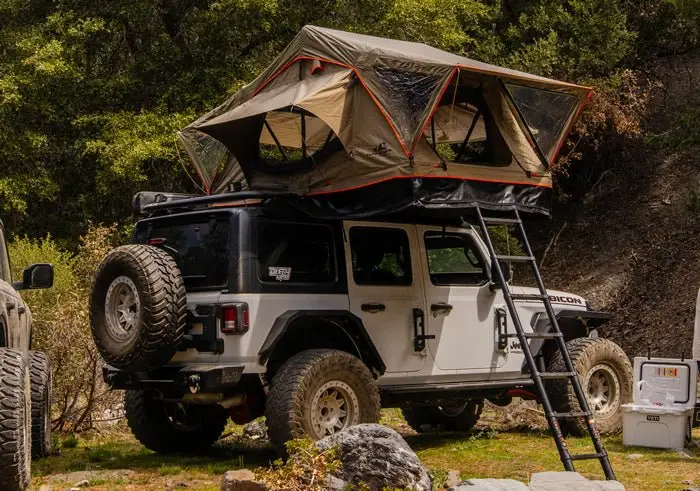
You know the exact moment a build stops being a truck and starts being an overlanding rig.
It is not when you order the suspension lift. It is not when you mount the recovery boards to the side of the bed or bolt the Hi-Lift to the roof rack. It happens earlier and later than all of that, in two separate moments that most builders do not realize are connected until they have been doing this long enough to have messed up the order.
The first moment is when you realize the factory wheels are holding you back. Not because they look wrong, though they often do. Because they were engineered to handle a suburban parking lot and a weekend road trip, not a loaded rig with two weeks of gear and an axle over a boulder that was not on the map.
The second moment is at about 11 PM, miles from the nearest town, when the temperature drops faster than forecast and you are standing next to your truck trying to figure out where exactly you are going to sleep. The sleeping bag in the back of the cab does not answer the question. It delays it.
A finished overlanding build solves both problems simultaneously. It is not about stacking the most gear. It is about making three specific decisions: wheels that can do what the terrain demands, tires that back those wheels up with real traction, and a shelter that means you never end the day without a plan for where you are sleeping. Everything else is support equipment.
Here is what that build actually looks like.
The Foundation Problem Every Overlander Ignores Too Long
Start from the ground and work up. This is not a metaphor.
The stock wheels on most trucks and SUVs are engineered to a single brief: carry the vehicle safely under normal road conditions while keeping costs controlled during manufacturing. They are not beadlock-capable. They are not sized for the wide-stance, tall-sidewall fitments that serious off-road terrain demands. They are not built to handle the lateral stress of a heavily loaded vehicle on sustained off-camber surfaces, or the sustained abuse of technical rocky terrain where every flex of the suspension loads the wheel asymmetrically.
This is not criticism. It is just the reality of what a factory wheel was designed to do versus what an overlanding rig needs it to do.
Dirty Life wheels exist because someone looked at that gap and decided to fill it properly. The brand has been building wheels from race-proven architecture since its founding, not cosmetically aggressive designs dressed up in off-road marketing, but wheels that trace every design decision back to a performance requirement. The Roadkill series, their flagship beadlock design, runs a forged 6061 aircraft-grade aluminum beadlock ring. That material specification is not a tagline. It is the same grade used in aerospace applications, chosen because it delivers maximum strength at minimum weight, and because when your beadlock ring is the only thing keeping your tire on the wheel at 8 PSI while you drag a skid plate over a ledge, the material matters.
The DUAL-TEK technology answers the question that every serious wheeler eventually has to answer: what do I do about the days between the hard trails? True beadlock wheels are not DOT-legal for street use. A street-legal simulated beadlock looks right but does not actually clamp the tire bead mechanically. Dirty Life solved it by designing a wheel that runs a street-legal ring for daily use and a genuine beadlock ring when you head somewhere the DOT has never been. One wheel. Both uses. No compromises filed in either direction.
The catalog runs deep enough to cover everything from technical rock crawling builds to trail-ready daily drivers, with finishes that hold up in the real world rather than looking good in the showroom and corroding six months later. Machined black, matte black, Crimson Candy Red: designs that are visually aggressive without the aesthetic fragility that makes some off-road wheels look great in photos and miserable after one season of actual dirt.
The right wheel is not the whole answer. It is the right question. It asks: what tire are you putting on this?
The Tire Problem Most Builds Get Wrong
Here is the sequence mistake that costs people money: they choose wheels and tires separately, from different brands with different design intentions, and then wonder why the combination underperforms.
AMP Tires was built inside the same family of off-road brands specifically to solve that problem. When the wheel is engineered for aggressive off-road use, the tire deserves to be engineered with the same intent, and AMP's Mud Terrain line is exactly that.
The tread architecture is purpose-built for the use case. Large, independent lugs with wide void channels between them. The voids are not cosmetic. They are the mechanism by which a mud terrain tire stays tractioned: they evacuate material as the tire rotates, keeping fresh lug edges biting rather than letting the tread pack full and start riding on top of the mud like a boat. At speed through soft terrain, the difference between a tire that self-cleans and one that does not is not a subtle performance delta. It is the difference between moving forward and spinning in place while the hole gets deeper.
The 3-ply sidewall construction is the detail that matters most for overlanding specifically. Rock crawlers care about sidewall protection because they are moving slowly over sharp edges. Overlanders care about it for a different reason: they are covering serious mileage in loaded vehicles over unpredictable terrain, far from help, with sidewalls that need to survive everything from rocky two-tracks to the occasional tire-rocking surprise that comes with driving places that do not have trail ratings.
A 3-ply sidewall does not make a tire indestructible. It makes a tire substantially more resistant to the puncture scenarios that end overlanding trips early: the oblique rock contact, the sharp-edged granite shelf, the embedded metal that a lighter sidewall would surrender to. For a rig that is going somewhere and needs to come back, that extra layer is not a premium feature. It is the right minimum.
The Rugged-Terrain line fills the space for the rig that splits genuine trail time with regular road use. The tread pattern sits between the aggressive mud terrain and the highway-mannered all-terrain: enough bite and void to handle loose terrain, dirt roads, and moderate mud without the highway noise and fuel economy hit of a full MT. For the rig that does three trail days a month and twenty highway days, this is the honest choice, not the aspirational one.
Pair these with Dirty Life wheels and you have a ground-up contact patch that was built for the same conditions. The sizing compatibility is not accidental. The fitments that Dirty Life engineers for overlap directly with the tire sizes AMP builds for. You are not adapting two separate product philosophies to work together. You are running a system.
The Part Everyone Gets to Last
Nobody starts a build thinking about where they are going to sleep.
This is a predictable mistake. The trail planning happens. The gear list grows. The rig gets capable. The day trips become weekend trips. The weekend trips start to extend. And at some point the limiting factor is not the truck or the tires or the gear. It is that sleeping in the back of a loaded cab on a compressed sleeping bag at 9,000 feet in October is a specific kind of miserable that no amount of good driving gets you past.
A rooftop tent does not solve the miserable night problem completely. But it comes closer than anything else you can put on the rig while still taking it off-road.
Tuff Stuff Overland built its product line around a premise that the overlanding market had been underserving: you should not need to spend $3,000 on a rooftop tent to sleep well in the field. The premium RTT brands charge premium prices because the market historically supported it. Tuff Stuff looked at that pricing gap, built a direct-to-consumer model that cuts the retail margin out of the equation, and put the savings back into the product rather than the packaging.
The result is a hard shell and soft shell tent lineup that competes on actual livability: not just Instagram-worthy setup photos, but two AM in a rainstorm, 34 degrees, you need the seams to hold and the foam to be thick enough to sleep on, and does it at a price point that leaves money in the build budget for the recovery gear you will eventually need.
The hard shell opens in seconds. This is not a trivial point. After a ten-hour drive day over mixed terrain, the difference between a tent that is ready in forty-five seconds and one that requires fifteen minutes of setup is the difference between sleeping and standing in the dark fighting poles and zippers. A hard shell Tuff Stuff tent deploys fast enough that you can set up camp after dark without a headlamp army.
The bed rack systems are the other piece that makes the setup honest. A rooftop tent without the right mounting platform is either sitting too high, blocking visibility, or creating load path problems on the mounting structure. Tuff Stuff engineers the racks alongside the tents, which means the fitment, load rating, and access angles are all calculated together rather than assembled from random parts. The rig that has a proper bed rack platform is also a rig with organized cargo space underneath: the kind of organization that becomes important on day four when you need the recovery kit and have no interest in unpacking everything else to find it.
Why These Three Things Work as a System
A lot of overlanding content is built around the idea that more is better. More gear. More capacity. More mods. The builds get heavier, the lists get longer, and somewhere in the process the whole enterprise starts to feel like logistics management rather than adventure.
The case for Dirty Life wheels, AMP tires, and a Tuff Stuff shelter is a case for building the rig that is complete without being overcomplicated.
The wheels handle the terrain. Not decoratively, structurally, with the beadlock technology that keeps rubber on the rim at the pressures overlanding demands and the construction standards that hold up under the repeated stress of loaded travel on technical surfaces. The tires give those wheels traction in the conditions that matter: mud, loose terrain, sand, gravel, the mixed surface reality of driving somewhere far from pavement. The shelter turns the rig from a vehicle into a base camp: the thing that makes it possible to stay out for three days instead of one, to go further, to push the range.
None of these brands are asking you to take their word for it. The Dirty Life beadlock technology has race provenance that predates its current popularity. The AMP Mud Terrain lineup has the sidewall construction to back up its off-road claims. The Tuff Stuff community of repeat buyers, the people who came back for the second tent or upgraded from soft shell to hard shell, is the most honest review system in the gear market.
The build that goes from the ground up to the shelter on top is the build that goes further. That is the whole point.
The Rig That Goes and Stays
A truck is a vehicle. An overlanding rig is a system.
The difference between the two is not the price tag or the length of the mod list. It is whether the decisions made at the ground level, the wheels, the rubber, the shelter, were made deliberately or by default. A rig built on the right foundation handles differently. Drives further. Stays out longer. Comes back telling a better story.
Wheels that hold their tire at pressure when it matters. Tires that bite when the terrain stops cooperating. A roof over your head that opens in the dark without drama and keeps the weather where it belongs.
That is not a complicated build. It is just the right one.