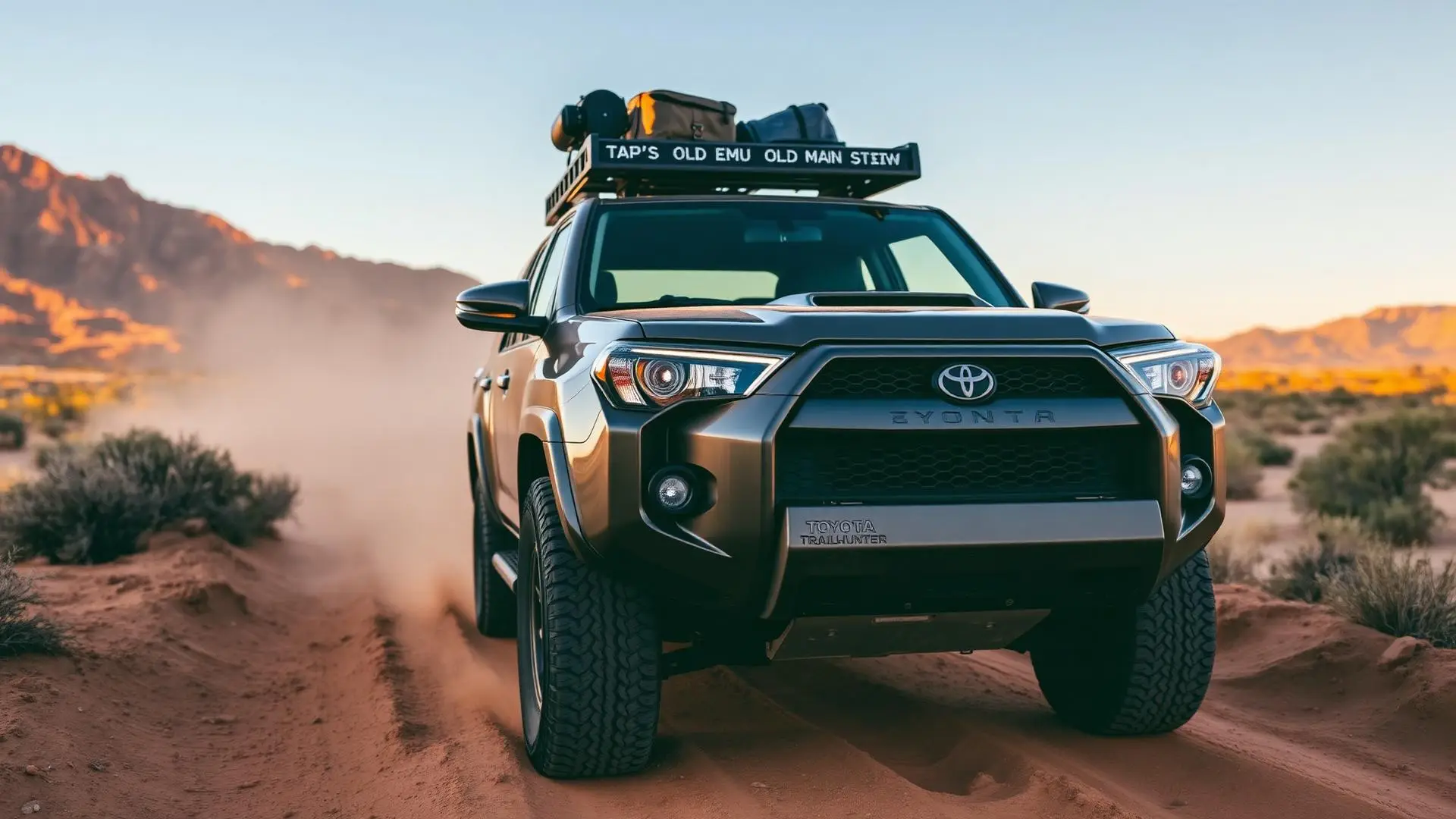
2025 4Runner Trailhunter Specs at a Glance
| Spec | 2025 4Runner Trailhunter |
|---|---|
| Engine | i-FORCE MAX 2.4L turbo hybrid, 326 hp and 465 lb-ft |
| EPA fuel economy | 23 city / 24 highway / 23 combined MPG |
| Ground clearance | 10.1 in |
| Approach / departure / breakover | 33 / 24 / 24 degrees |
| Wheels and tires | 18-in flat bronze alloy wheels, 265/70R18 |
| Roof rack | ARB roof rack, unique to this grade |
| MSRP (2025) | $66,900 before destination (same as the 2025 TRD Pro) |
Source: Toyota 2025 4Runner product information and 2024-2025 pricing (pressroom.toyota.com).
For fourteen years, overlanders who wanted a 4Runner had to do their own homework. You bought a TRD Off-Road or a TRD Pro and then you opened your wallet again. In 2025, Toyota came back with something nobody expected: a trim built by overlanders, for overlanders, before it ever left the factory floor.
The Trailhunter is not a TRD badge on a lifted truck. It is a thoughtfully assembled overlanding system, Old Man Emu suspension, ARB roof rack, onboard air compressor, real skid plate coverage, and 10.1 inches of ground clearance, all integrated at the factory level. It sits at the same $67,400 price as the TRD Pro. And for the person who sleeps in their vehicle and lives for two-tracks and forest service roads, it might be the most important 4Runner trim in the model's history.
The First Thing You Notice
The Trailhunter looks the part in a way no stock 4Runner has before it. The heritage grille, a deliberate callback to the boxy second-gen 4Runners that built this truck's reputation, wears bronze "TOYOTA" lettering that somehow manages to look tasteful rather than theatrical. The 20-inch LED light bar is integrated into the grille rather than bolted on as an afterthought, and RIGID LED fog lamps flank it at the lower corners.
The ARB roof rack runs three-quarters of the vehicle's length in black powder-coated aluminum. It handles 165 pounds of dynamic load while moving and 700-plus pounds when parked, enough for a rooftop tent, gear bags, and a spare tire if you want it up there. The rock rails running the length of the rocker panels are steel tube construction, frame-mounted, there to protect the body when you misjudge a line.
Inside, the Trailhunter is comfortable in a way that no previous 4Runner deserved to be. SofTex seats, JBL audio, the new 14-inch touchscreen that finally replaces the previous generation's infuriating interface. Heated and ventilated front seats. Wireless charging. Toyota Safety Sense 3.0.
What's Under It
The 2025 6th gen 4Runner runs Toyota's i-FORCE MAX hybrid system, a 2.4-liter turbocharged four-cylinder paired with a 48-horsepower electric motor integrated into the eight-speed automatic transmission. Total output is 326 horsepower and 465 pound-feet of torque.
Low-End Torque
The hybrid system does not offer EV-only driving in any meaningful range. The 1.87 kWh NiMH battery is a buffer, not a power source. But it enables a feature that matters enormously at camp: Generator Mode. The Trailhunter can run its 2,400W AC inverter from the hybrid battery with the engine on, powering a full campsite, refrigerator, laptop, lighting, small appliances, from a 110V outlet in the cargo area.
2,400W Inverter
The Suspension Story
Old Man Emu is not a brand that appears in press releases from car companies trying to sound adventurous. It is a brand that appears in build threads from people who have spent real time on real trails. Their 2.5-inch forged monotube shocks with remote reservoirs are engineered to stay cool and composed over extended rough-road driving.
The Trailhunter sits two inches higher than a stock 4Runner in front and 1.5 inches higher in the rear. Ground clearance is 10.1 inches. The 33-inch Toyo Open Country all-terrain tires work with the lifted suspension to create approach and departure angles of 33 and 24 degrees respectively.
Sway Bar Disconnect
Highway Behavior
The Snorkel That Is Not a Snorkel
The high-mount air intake on the Trailhunter looks like a snorkel. It is mounted like a snorkel. Every photo makes it look like a snorkel. Toyota does not call it a snorkel. They call it a "high-mount air intake," and the distinction is not semantic.
Not a Snorkel
Intake Noise
The Skid Plate Coverage
The protection package is where the biggest practical gap opens up between the Trailhunter and the TRD Pro, and it goes strongly in the Trailhunter's favor.
Trailhunter vs TRD Pro: Skid Plate Coverage
| Trailhunter | TRD Pro | |
|---|---|---|
| Front skid plate | ||
| Transfer case protector | ||
| Transmission skid plate | ||
| Rear differential protector | ||
| Fuel tank protector | ||
| Steel rock rails |
For overlanding, where you are driving loaded, often alone, sometimes far from help, comprehensive skid plate coverage is not an aesthetic choice. It is insurance. One rock strike to your transfer case, differential, or fuel tank without protection, and your weekend trip becomes a recovery operation.
The Onboard Compressor
The Trailhunter has a factory-installed, high-output onboard compressor integrated into the vehicle. It is plumbed and powered from the factory, with a dedicated outlet accessible from outside the vehicle near the rear quarter panel.
Time Savings
The Fuel Economy Reality Check
Toyota's EPA estimates are 23 city, 24 highway, 23 combined. Real-world owners are reporting significantly different numbers.
Real-World MPG
The 23-gallon fuel tank gives you a realistic highway range of around 450 miles before you need to stop.
What the Trailhunter Actually Changes
Before the Trailhunter existed, building a 4Runner into a proper overlanding rig was a multi-year project with a significant budget on top of the purchase price.
Factory vs Aftermarket Build Cost
What you'd spend building a similar setup on a TRD Off-Road or TRD Pro
| Component | Aftermarket Cost |
|---|---|
| Suspension (OME equivalent) | $1,500, $3,500 |
| Roof rack (ARB equivalent) | $800, $2,500 |
| Onboard compressor | $200, $600 |
| Skid plate system | $600, $1,500 |
| Rock rails | $400, $800 |
| Light bar + fog lamps | $300, $800 |
| Total | $3,800, $9,700 |
The Trailhunter ships with all of this from the factory at a price that matches the TRD Pro. The specific brands, OME, ARB, RIGID, are not compromises. They are the brands overlanders were already buying.
Key Specs at a Glance
| Powertrain | 2.4L i-FORCE MAX hybrid |
| Output | 326 HP / 465 lb-ft |
| Ground Clearance | 10.1 inches |
| Approach / Departure | 33° / 24° |
| Suspension | OME 2.5" monotube w/ remote reservoirs |
| Lift | +2" front / +1.5" rear |
| Tires | 33" Toyo Open Country A/T |
| Roof Rack | ARB 3/4 platform (165 lbs dynamic / 700+ lbs static) |
| Onboard Compressor | Factory-installed, high-output |
| Power Inverter | 2,400W AC (110V cargo outlet) |
| Rear E-Locker | Standard |
| Sway Bar Disconnect | Standard (front) |
| Base Price | $66,900 (2025, before destination) |
| Real-World MPG | ~16 to 20 depending on conditions |
The Honest Verdict
The Trailhunter is not perfect. The fuel economy gap between Toyota's claims and real-world results is a legitimate frustration. The high-mount intake is not a snorkel. The rear suspension can be floaty at speed. At nearly $70,000 as tested, it is expensive.
But it is also something the overlanding world has not had before from a major manufacturer: a thoughtful, expertly-specced, factory-built overlanding truck that ships ready to go. Not off-road-ready in the marketing sense. Ready in the practical sense, where an experienced overlander looks at the build list and cannot find an obvious gap.
More 4Runner Trailhunter guides: see how the trims split in 4Runner Trailhunter vs TRD Pro, how it stacks up against its pickup sibling in Tacoma Trailhunter vs 4Runner Trailhunter, what to buy next in 4Runner Trailhunter first upgrades, and how the parts work together on a real 4Runner Trailhunter build.
Bottom Line