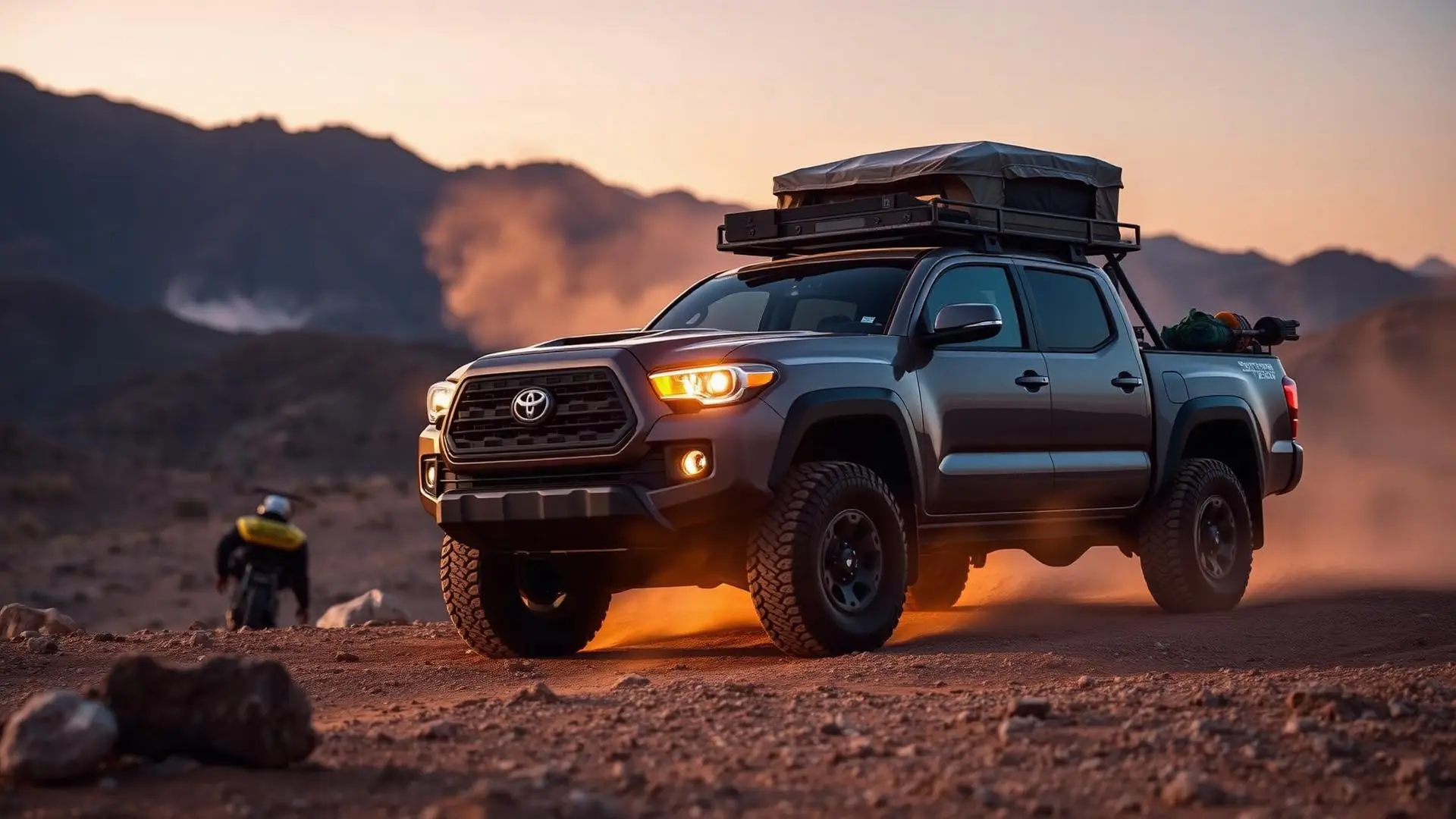
The 2023 Toyota Tacoma does not need you to explain overlanding to it.
It already knows. It has the angles, the clearance, the low-range gearing, and the trail-tested bones of a truck that has been pointed at hard terrain for decades. Buy a TRD Off-Road trim, air the tires down, and you can cover more ground than most drivers will ever push it to. That is not a small thing. The Tacoma earns its reputation at the trailhead because the stock platform is genuinely capable, not just capable for a mid-size truck, but capable, full stop.
Here is the thing about capable, though: capable has limits. And the limits of a stock Tacoma tend to find you at the worst possible moment, when you are three hours from the nearest town and the trail gets longer and the terrain gets messier and you discover which parts of the factory build were designed for a brochure and which ones were designed for actual use.
This is the build guide that starts from that moment rather than from the parts catalog.
What the Stock 2023 Tacoma Actually Gets Right
Credit where it is due.
The TRD Off-Road and TRD Pro trims of the 2023 Tacoma arrive with a foundation that a lot of trucks in this class genuinely do not have. The 3.5-liter V6 produces 278 horsepower and 265 pound-feet of torque, not class-leading numbers, but numbers that have proven themselves over hundreds of thousands of miles of real-world use by people who actually go places. The 6-speed automatic includes a proper crawl mode. The TRD Off-Road's rear electronic locking differential is the real deal, not a limited-slip masquerading as a locker. Ground clearance comes in at 9.4 inches on the trail-ready trims, which is enough to clear obstacles that would stop most unmodified competition.
The approach and departure geometry is solid. Active Traction Control works well in the kind of moderately technical terrain that most overlanders actually encounter. Multi-Terrain Select on the Pro gives you surface-specific traction modes that are more useful than they sound in the marketing materials. KDSS suspension on select trims, the Kinetic Dynamic Suspension System that disconnects the front and rear sway bars for greater axle articulation off-road while reconnecting them on-road for stability, is a genuinely clever piece of engineering that most people do not appreciate until they drive a trail that asks for it.
So the 2023 Tacoma arrives well-equipped for the terrain. The gaps are not in the drivetrain or the suspension. They are in the armor.
Where the Stock Tacoma Falls Short
The stock front bumper is plastic. That sentence is doing more work than it looks like.
A plastic front fascia is the correct choice for a truck that needs to manage pedestrian safety, pass NHTSA regulations, achieve a reasonable aerodynamics profile, and return fuel economy numbers that look defensible in a comparison chart. It is also the wrong choice for a truck pointed at rocky terrain where the approach to a trail can involve brush, embedded rock, and the kind of contact that ends the plastic bumper's career immediately.
The same logic applies to the underside of the truck. The 2023 Tacoma has factory skid protection in the TRD Pro trim, better than nothing, sized appropriately for light use. But the transfer case, fuel tank, and full underbody protection that a serious overland build requires are not in the factory package, because they were not designed to be. A factory skid solution protects against the occasional center rock at highway speed. A proper skid plate system protects against a full descent over rough rocky terrain with a loaded truck, repeated, over time. These are different design briefs.
Rock sliders, the structural steel side steps that replace the factory running boards on capable builds, are absent from every stock Tacoma trim. This matters when the trail gets narrow and the angle puts your rock sliders against a boulder rather than your rocker panels and door sills. The stock running boards are styled accessories, not structural protection. Contact with a rock ledge at any meaningful speed does not go well for them, and the body damage that follows is the expensive kind.
Rear bumper. Same story. The factory unit is designed for parking lot speeds, not for carrying a spare tire, supporting a bike rack, or taking the kind of contact that happens when you back into the terrain and misjudge the distance.
These are not criticisms of Toyota's engineering decisions. They are accurate descriptions of what factory trucks are designed to handle versus what overlanding builds get pointed at. The gap between the two is exactly where a good build begins.
Build the Protection First. Build Everything Else Second.
This is the principle that separates overlanders from people who get stranded.
Suspension lifts are visible. A new light bar is immediately satisfying. New wheels get photographed. Protection, a steel front bumper, a proper skid plate system, rock sliders along the rocker panels, is largely invisible in photos and costs real money and transforms the rig's capability in ways that only show up when something goes wrong on the trail.
The builder who put the 35s and the lift on before the skids finds out why protection comes first the first time they cross a rocky section under load and make contact they did not plan on. The builder who did the protection first drives the same section and keeps moving.
Body Armor 4x4 exists specifically for this sequence. The brand builds vehicle-specific protection and off-road accessories for the platforms that serious off-roaders actually run, and the Tacoma is one of their most thoroughly covered applications. Bumpers, skid plates, rock sliders, roof racks, bed racks, tube doors, and the hardware that connects all of it to the specific mounting points Toyota put in the Tacoma's frame, everything designed to bolt on without fabrication, without cutting, and without the guesswork that comes with universal-fit alternatives. Their full Toyota bundle lineup shows exactly how the pieces work together for the Tacoma platform specifically.
The bolt-on fitment matters more than people expect until they have dealt with the alternative. A bumper that requires cutting, grinding, and custom bracket fabrication adds time, cost, and variables that a purpose-built application eliminates. Body Armor 4x4 has already done the engineering for the Tacoma's specific frame geometry, approach angles, and mounting points. You are buying the result of that engineering, not commissioning it.
The Tacoma Protection Build, Layer by Layer
Front bumper
The front bumper replacement is the single highest-impact modification on any Tacoma overland build because it changes three things simultaneously: approach angle clearance, impact protection, and light mounting options. A steel mid-width or hi-clearance front bumper increases your effective approach angle by removing the plastic lower fascia that catches terrain first. It puts steel, not painted polypropylene, between the terrain and the radiator. And it adds mounting tabs for driving lights and winch integration that the factory bumper simply does not have.
Skid plate system
Factory skid protection on the Tacoma covers the basics. A proper system covers everything. Oil pan, transmission, transfer case, and fuel tank skids together create a continuous armor layer along the underside of the truck that lets you drive confidently over terrain that would require constant line-picking on a truck without them. The fuel tank skid specifically matters on any rocky terrain where the lowest point of the fuel tank is the first thing to make contact on a ledge crossing.
Rock sliders
Sliders are the modification that saves rocker panels and lower door sills from the kind of contact that happens on tight shelf roads, off-camber traverses, and the moments where the trail edge is closer than you estimated. Good rock sliders are welded steel, frame-mounted, and designed to take the hit and keep the body panels behind them intact. They also function as legitimate step surfaces for entering the cab, more useful on a lifted truck than the factory running boards they replace.
Rear bumper
A proper rear bumper serves as the anchor point for a spare tire carrier, recovery points, and the hitch receiver that makes a trailer or bike rack usable on the trail. The factory rear bumper has none of those mounts in the configuration a serious overland build needs. A Body Armor 4x4 rear bumper replaces the factory unit with something that handles impact, carries a real spare tire mount, and provides the recovery points that make self-recovery and assisted recovery possible.
Bed and roof rack
The bed rack is what converts a truck bed into an organized cargo system. A properly built bed rack mounts a rooftop tent above the bed, keeps recovery gear and camp equipment accessible without unpacking the whole bed to find anything, and creates the elevated platform that makes sleeping on a loaded truck actually workable. Roof racks on the cab extend the storage and mounting options for lighting, solar panels, and the gear that needs to ride above the truck rather than in it.
After the Armor: Where the Rest of the Build Goes
Protection first. Everything else earns its order in the build sequence based on what it does for your specific use case.
Suspension comes next for most Tacoma overlanders. A 2 to 3-inch lift with quality remote reservoir shocks, Bilstein 5100s, Fox 2.5, OME, transforms the ride quality on rough terrain and creates the clearance for 33 to 35-inch tires without rubbing. The stock Tacoma suspension is already decent. Upgraded suspension is noticeably, immediately better on every surface that is not a smooth paved road.
Tires are the modification that changes how the truck drives more than any single other change. Going from the stock 265/65R17 all-season to a proper off-road tire transforms the contact patch, the aired-down behavior, and the grip on every surface the stock tires were not designed for. For a 2 to 3-inch lift build on the Tacoma, the AMP Terrain Attack A/T in LT265/70R17 is a natural fit, an all-terrain that handles forest roads, dirt two-tracks, and light mud without the highway noise penalty of a full mud-terrain, sized to run cleanly on a stock-width 17-inch wheel without clearance issues. It is the tire that covers the terrain most Tacoma overlanders actually see rather than the terrain they imagine they might see someday. Size to the lift and the use case. Do not buy more tire than your setup can manage without rubbing.
Lighting, recovery gear, communication, and camp kit come in the order that makes sense for where you are going and how long you are staying. The overland build that starts with protection and builds outward from there ends up coherent. The build that starts with what looks good tends to find gaps at the worst possible times.
Why the 2023 Tacoma Is Still the Right Platform
The 2024 Tacoma arrived with a new generation, turbocharged powertrains, revised suspension, more technology. That generation deserves its own conversation. But the 2023 third-generation Tacoma is not an outdated truck. It is a mature platform with a long aftermarket ecosystem, an enormous body of real-world owner data, and support from every major accessory brand in the off-road industry.
Body Armor 4x4's full Tacoma protection lineup was built for this generation. The fitment data exists. The mounting solutions have been tested. The builders who have put serious miles on third-gen Tacoma builds with this protection setup are not rare, they are everywhere, and their feedback has shaped the product.
The 2023 Tacoma is not the newest option. It is one of the most proven ones. That distinction matters when you are three hours from pavement and everything you built needs to work.
Build your Tacoma's protection layer first: Body Armor 4x4 Toyota Bundles. This article contains affiliate or sponsored links to products we believe in. Pricing and availability subject to change.