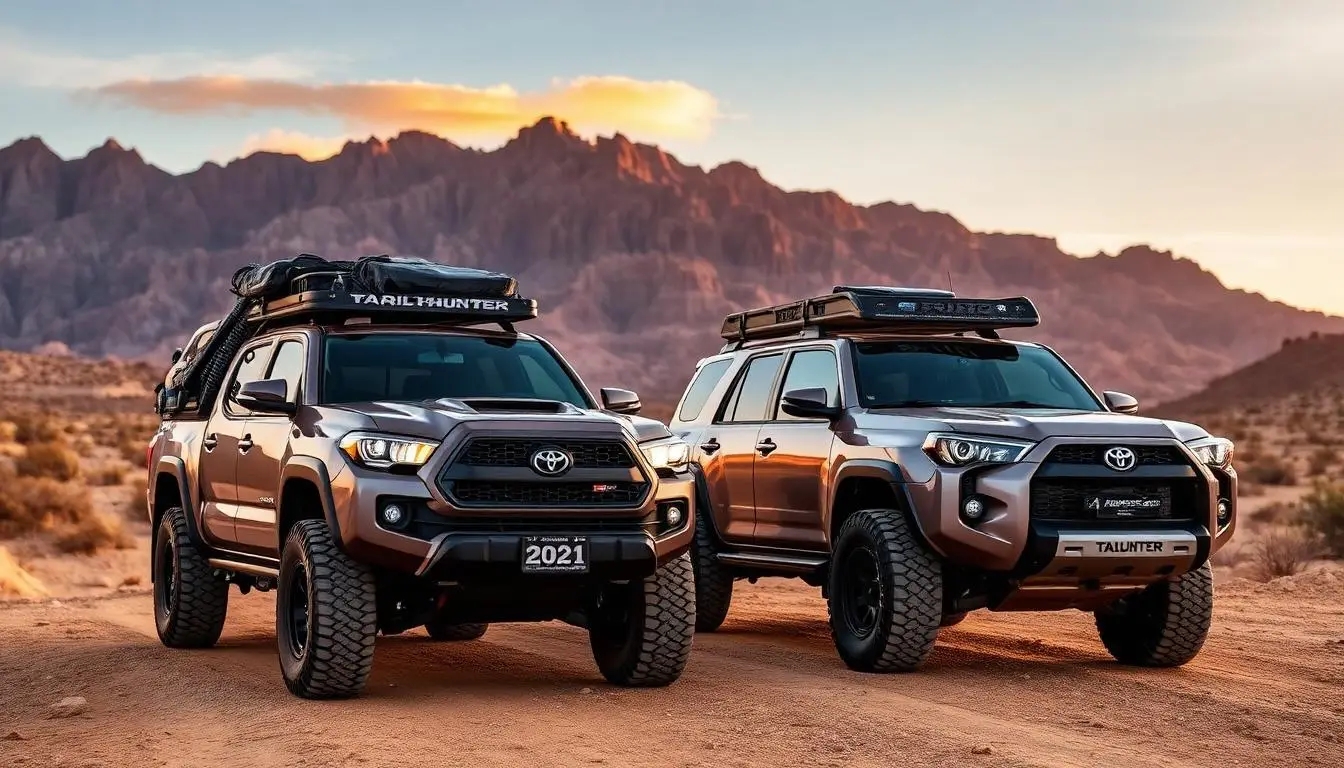
You've done the research. You know both run the i-Force MAX hybrid. You know both come with Old Man Emu shocks, ARB equipment, an onboard air compressor, and a locking rear differential from the factory. You know both start somewhere in the low-to-mid $60,000s. You're not confused about specs. You're confused about the decision.
That's the right place to be stuck. Because this isn't really a comparison between two vehicles. It's a comparison between two philosophies about how you overland.
One of them is the best truck-based overlanding platform Toyota has ever shipped at this price point. The other is the best SUV-based overlanding platform Toyota has ever shipped at this price point. They cannot both be the answer for you, and neither forum thread you've been reading will help you figure out which one is.
Start Here: The Real Question
Every "Tacoma Trailhunter vs 4Runner Trailhunter" article frames this as an off-road comparison. Who has more ground clearance? Who has better angles? Those numbers matter, and we will cover them precisely.
But that framing misses the actual decision. Because here is the honest truth: if you are choosing between these two vehicles, your off-road capability will not be the limiting factor. Both will take you further than most overlanders will ever go. Both have genuine factory overlanding credentials. Both have the same engine, similar trail geometry, and essentially identical electronic off-road systems.
The Core Decision
The Specs, Side by Side
Tacoma Trailhunter vs 4Runner Trailhunter Specs
| Feature | Tacoma Trailhunter | 4Runner Trailhunter |
|---|---|---|
| Starting MSRP | ~$62,900 | Mid-$60,000s |
| Engine | i-Force MAX 326hp / 465 lb-ft | i-Force MAX 326hp / 465 lb-ft |
| Ground Clearance | 11.0" | 10.1" |
| Approach Angle | 35.2° | 33.0° |
| Departure Angle | 22.3° | 24.0° |
| Breakover Angle | 24.0° | 24.0° |
| Towing Capacity | 6,000 lbs | 6,000 lbs |
| Payload | 1,425 to 1,475 lbs | Lower (hybrid battery) |
| Suspension | OME 2.5" forged monotube | OME forged monotube w/ reservoirs |
| Rear Locker | ||
| Sway Bar Disconnect | ||
| Factory Tires | 33" Goodyear Territory R/T | 33" Toyo Open Country AT3 |
| Interior Cargo | Truck bed (open) | 82.6 cu ft (seats folded) |
| Onboard Air Compressor | ||
| High-Mount Air Intake | Functional snorkel | Low-profile high-mount |
Ground Clearance and Angles: Where the Tacoma Wins on Paper
The Tacoma Trailhunter has 11.0 inches of ground clearance. The 4Runner Trailhunter has 10.1 inches. On paper, that 0.9-inch difference sounds small. On a rocky trail with a ledge between them, it is not.
More significant is the approach angle: 35.2 degrees on the Tacoma versus 33.0 degrees on the 4Runner. The Tacoma's front bumper rises more steeply to clear obstacles, which matters on step-up entrances and angled rock faces. The 4Runner's longer front overhang, a consequence of unibody design and more complex front-end packaging, limits that angle.
The 4Runner actually beats the Tacoma on departure angle: 24.0 degrees versus the Tacoma's 22.3 degrees. On steep exit ramps, the 4Runner clears more cleanly from the rear.
The Tacoma has the front sway bar disconnect, which the 4Runner does not. On slow technical terrain where axle articulation matters, disconnecting the front sway bar allows more wheel travel before a tire lifts. In rock crawling situations, this is a genuine advantage. In the type of overlanding most buyers actually do, fire roads, forest service routes, moderate two-track, it is rarely the deciding factor.
The i-Force MAX Hybrid on Trail
Both vehicles run the same i-Force MAX hybrid system: a 2.4-liter turbocharged engine paired with a motor-generator on the automatic transmission. Combined output is 326 horsepower and 465 lb-ft of torque. Off the line and on low-speed trail sections, the electric motor delivers full torque instantly, which is genuinely useful. Obstacle approaches, slow crawls, and sandy sections where smooth power delivery matters are where the hybrid earns its place.
Hybrid Descent Behavior
The Camping Platform Question
This is where the two vehicles separate most clearly.
The 4Runner Trailhunter has 82.6 cubic feet of cargo volume with the rear seats folded. That is a flat, weatherproofed, lockable space that works as a sleeping platform for two adults, a gear locker, a kitchen setup, and an organized basecamp. The hybrid battery pack raises the cargo floor by approximately 5 inches compared to a non-hybrid 4Runner, account for that raised floor height before ordering cut lumber or a platform kit.
The Tacoma's truck bed gives you 44.7 inches of accessible width and a 5-foot or 6-foot length (the 6-foot bed is the right call for any serious overlanding use). An overlanding truck bed setup requires weatherproofing, a bed cap or canopy, drawers or a platform, that adds cost and weight. Budget $1,500 to $4,000 for a solid canopy-and-platform setup to turn the truck bed into the interior camping space the 4Runner provides from the factory.
The other consideration: the Tacoma's rear bench or bucket seat gives passengers less room and less comfort on long approach roads than the 4Runner's dedicated rear seat. If you have regular passengers, kids, a partner, friends, the 4Runner's rear seat is materially more livable for multi-hour drives to the trailhead.
Factory Skid Plates: The Tacoma's Meaningful Edge
The Tacoma Trailhunter comes with steel skid plates covering the front underbody, transfer case, and rear differential. This is comprehensive protection for the components most vulnerable on rocky terrain. The front-to-rear factory skid plate coverage is one of its strongest arguments for serious trail use.
The 4Runner Trailhunter's factory skid plate coverage is less comprehensive. Aftermarket plates are widely available for the 6th generation 4Runner and relatively straightforward to add, but budget $500 to $1,000 for proper coverage.
The Documented Tacoma Issue Worth Knowing
Transmission Overheating
The high-mount air intake on the Tacoma is often called a "snorkel." It functions as one for moderate water crossings and keeps the intake above engine bay splash. It is not a fully sealed externally-mounted snorkel like an ARB Safari unit. Do not treat it as if you can submerge the intake. The water crossing capability is meaningful and real. The snorkel label overpromises what it is.
Total Real Cost of Entry
Both vehicles are expensive. Neither starts at the number most buyers expect when they walk into the dealer.
The Tacoma Trailhunter at ~$62,900 with no options is a truck. To turn it into a legitimate camping platform, add a canopy ($800, $2,000) and a sleeping platform or drawers ($700, $2,500). That puts your all-in camp-capable Tacoma at $65,000 to $68,000 before any additional trail mods.
The 4Runner Trailhunter in the mid-$60,000s is a camping platform from the factory. The 82.6 cubic feet of cargo volume, the lockable rear, the weatherproofed interior, all included. Add skid plates ($500, $1,000) and your total is comparable.
Cost Reality
Who Should Buy the Tacoma Trailhunter
The Tacoma Trailhunter is the right choice if you tow regularly, a trailer, a boat, a UTV. Its truck bed and 1,475-pound payload give you utility a closed SUV cannot replicate. If you work the vehicle (farm, property, construction), the bed earns its keep every day. If you want the best approach angle and highest ground clearance in this comparison, the Tacoma delivers both.
It is also the right call if you run technical trails with serious slow-speed obstacles, because the front sway bar disconnect gives you a genuine articulation advantage in rock crawling scenarios.
Just add a quality canopy and platform setup before camping season, and accept the $1,500 to $4,000 entry fee for converting the bed into interior living space.
Who Should Buy the 4Runner Trailhunter
The 4Runner Trailhunter is the right choice if passengers matter, if you want interior sleeping without a bed setup investment, and if your overlanding looks like long multi-day trips with organized gear storage and two adults or a family.
The 82.6 cubic feet of interior space, the lockable rear hatch, the more comfortable rear seat, and the weatherproofed interior are not small advantages. They are the reasons the 4Runner platform has outlasted every competing SUV in the overlanding community for two decades.
Before You Build
Both Trailhunters sit at the top of Toyota's overlanding lineup. For the full picture on the 4Runner Trailhunter specifically, see our full 4Runner Trailhunter review. If you're still deciding between trims, our Trailhunter vs TRD Pro comparison covers the trim hierarchy in detail.