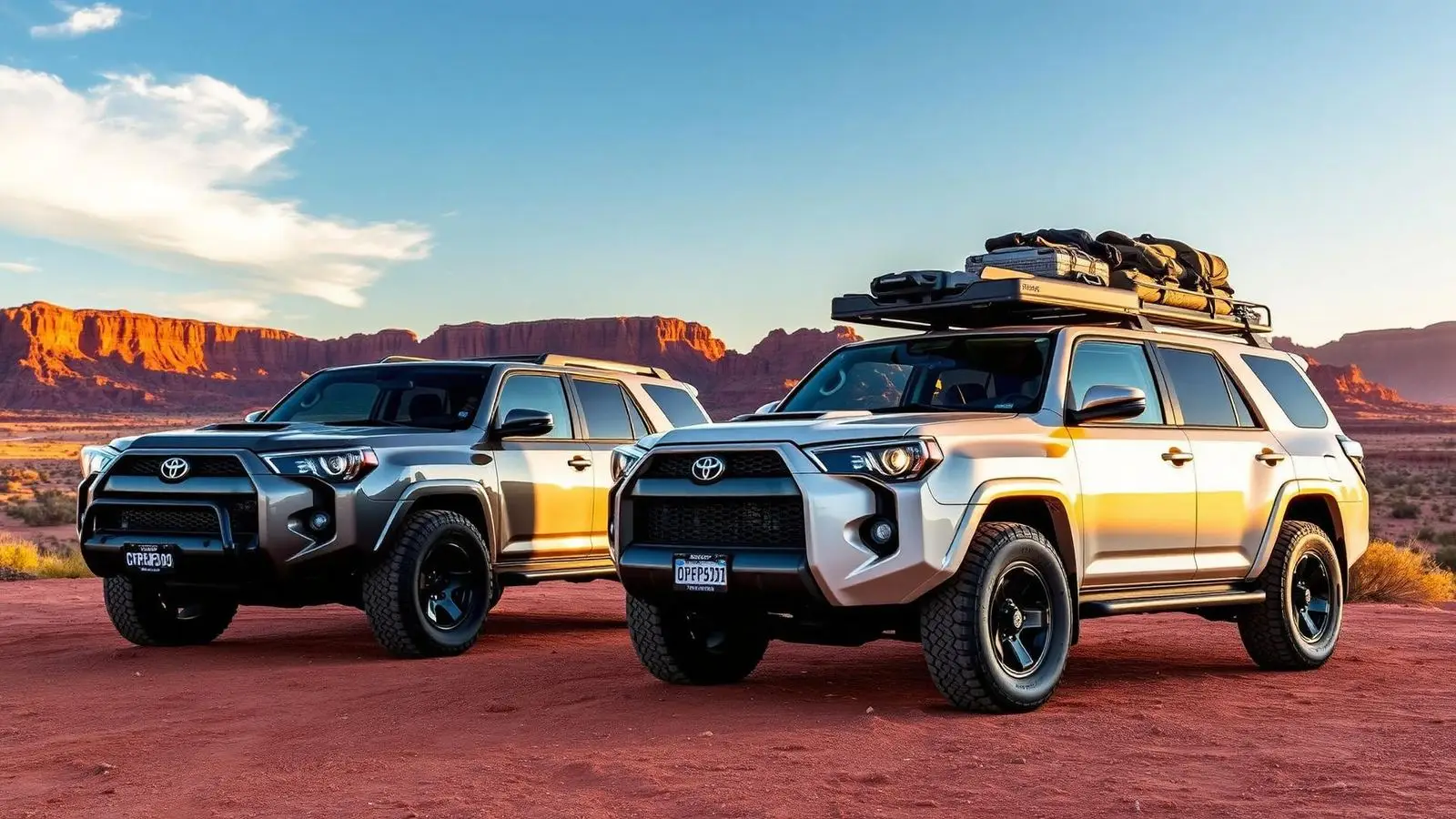
They cost exactly the same. They share the same engine, the same body, the same frame. But the 2025 Toyota 4Runner TRD Pro and the Trailhunter are not the same vehicle. They are two different answers to the same question: what does the best 4Runner look like?
The TRD Pro's answer is speed. High-speed desert runs, fast trail riding, Baja-style off-roading where momentum is your friend and your shocks need to absorb the terrain before your body does.
The Trailhunter's answer is distance (our full 4Runner Trailhunter review covers it in depth). Long-haul overland travel, loaded camping rigs, technical slow-speed crawling, and the kind of trip where you are three days from pavement and everything in your truck needs to work.
The Only Number That Matters Before We Start
$66,900 (2025 MSRP, before destination)
What They Share
Both trucks run Toyota's 2025 i-FORCE MAX hybrid powertrain: a 2.4-liter turbocharged four-cylinder paired with an integrated electric motor producing 326 horsepower and 465 pound-feet of torque. Both get the same 8-speed automatic, part-time 4WD with low range, MultiTerrain Select, rear e-locker, heritage grille with LED light bar, 33-inch Toyo Open Country A/T tires, and the new 14-inch touchscreen. Both tow 6,000 pounds.
The platform is the same. The bones are the same. Everything from here is about what each truck does differently with those bones.
The Suspension: FOX vs OME
TRD Pro: FOX 2.5" Internal Bypass QS3
FOX builds shocks for speed. Their QS3 system has three manually adjustable damping settings, firm, medium, and soft. In firm mode, the TRD Pro absorbs whoops, berms, and rough desert terrain at pace without the unsettled rear-end behavior that plagued older 4Runners. The internal bypass technology manages oil flow through multiple zones as the suspension compresses, delivering a progressive response rather than a linear one.
TRD Pro at Speed
Trailhunter: Old Man Emu 2.5" Forged Monotube w/ Remote Reservoirs
OME builds shocks for load and longevity. Their engineering tradition comes from the Australian outback, where overlanding means driving heavily loaded on corrugated dirt roads for hundreds of miles. The remote reservoir keeps fluid cooler during extended rough-road use, cooler fluid means more consistent damping over long distances.
Trailhunter Loaded
Suspension Verdict
Protection: There Is No Close Call Here
Skid Plate & Underbody Protection
| TRD Pro | Trailhunter | |
|---|---|---|
| Front skid plate | Aluminum (1) | Steel |
| Transmission protection | ||
| Transfer case protection | ||
| Rear differential protection | ||
| Fuel tank protection | Composite | |
| Rock rails | Steel tube, frame-mounted |
Why This Matters
TRD Pro buyers who overland will spend $600 to 1,500 on aftermarket skid plates. That cost on top of the identical purchase price means the Trailhunter is actually cheaper for the overlander who needs comprehensive protection.
Overlanding Features the TRD Pro Does Not Have
ARB Roof Rack
The Trailhunter's factory ARB unit is a three-quarter length platform rack rated for 165 pounds of dynamic load and over 700 pounds static. Enough for a rooftop tent, full gear load, and a spare tire. The TRD Pro has no factory rack, adding an equivalent ARB rack costs $1,000 to 2,000 plus installation.
Onboard Air Compressor
Factory-installed with a dedicated exterior outlet near the rear quarter panel. Faster than most portable units. Never needs to be packed, unpacked, charged, or found. It is just there.
2,400W AC Inverter
Powered by the hybrid battery via Generator Mode, delivering 110V AC through a cargo outlet. At 2,400 watts, it can run a refrigerator, coffee maker, and charge a laptop simultaneously. The Trailhunter is its own power station.
What the TRD Pro Offers That the Trailhunter Does Not
TRD Cat-Back Exhaust: A performance exhaust that improves breathing and gives a more assertive note. The benefit is mostly acoustic.
TRD Performance Air Intake: A high-flow intake designed to reduce restriction. The Trailhunter replaces this with the high-mount dust management intake.
For Street Driving
Head-to-Head: Every Dimension That Matters
Complete Comparison
| TRD Pro | Trailhunter | Winner | |
|---|---|---|---|
| Base price | $66,900 (2025 MSRP, before destination) | $66,900 (2025 MSRP, before destination) | Tie |
| Ground clearance | 10.1 in | 10.1 in | Tie |
| Approach / departure / breakover | 33 / 24 / 24 deg | 33 / 24 / 24 deg | Tie |
| Powertrain | 326 HP / 465 lb-ft | 326 HP / 465 lb-ft | Tie |
| Suspension | FOX QS3 (speed) | OME (load) | Depends |
| High-speed off-road | Excellent | Good | TRD Pro |
| Technical crawling | Good | Excellent | Trailhunter |
| Load-carrying | Good | Excellent | Trailhunter |
| Skid plate coverage | Aluminum front skid, transfer case and fuel tank protection | Steel front skid, transfer case and rear diff protectors, composite fuel tank protector | Trailhunter |
| Roof rack | None | ARB 3/4 | Trailhunter |
| Onboard compressor | None | Factory | Trailhunter |
| AC inverter | None | 2,400W | Trailhunter |
| Exhaust | TRD Cat-Back | Stock | TRD Pro |
| Real-world MPG | ~17 to 21 | ~16 to 20 | TRD Pro (slight) |
TRD Off-Road vs Trailhunter
If the Trailhunter's price is the sticking point, the 2025 TRD Off-Road is the next step down. It starts at $49,190 with the i-FORCE engine, or $51,990 with the i-FORCE MAX hybrid (before destination). You give up 1 inch of ground clearance (9.1 in vs 10.1 in) and a lot of approach angle (19 vs 33 degrees), plus the ARB rack, the steel underbody protection and the onboard compressor. You keep the same 265/70R18 tire size. If you plan to add a rack, skids and air anyway, price those out before you decide the TRD Off-Road is cheaper.
The Decision Framework
Ask Yourself These Questions
- Where do you drive off-road? Desert washes at speed → TRD Pro. Rocky two-tracks and forest roads → Trailhunter.
- Do you camp from your vehicle? Rooftop tent and overlanding setup → Trailhunter. Ground tent and day trips → either works.
- Were you going to modify anyway? If you budgeted $3,000 to 8,000 for rack, skids, and compressor, the Trailhunter already includes them.
- Speed or distance? This is the real question. Speed = TRD Pro. Distance = Trailhunter.
The Honest Bottom Line
The TRD Pro is an extraordinary machine for a specific kind of driver. If you run trails hard, chase speed, and the desert is your home terrain, it is the better truck.
The Trailhunter was designed for overlanding. Explicitly. Deliberately. Toyota identified what overlanders actually need and built a trim around those needs. They sourced it from the brands overlanders already trusted. They priced it identically so the choice would be honest.
Bottom Line