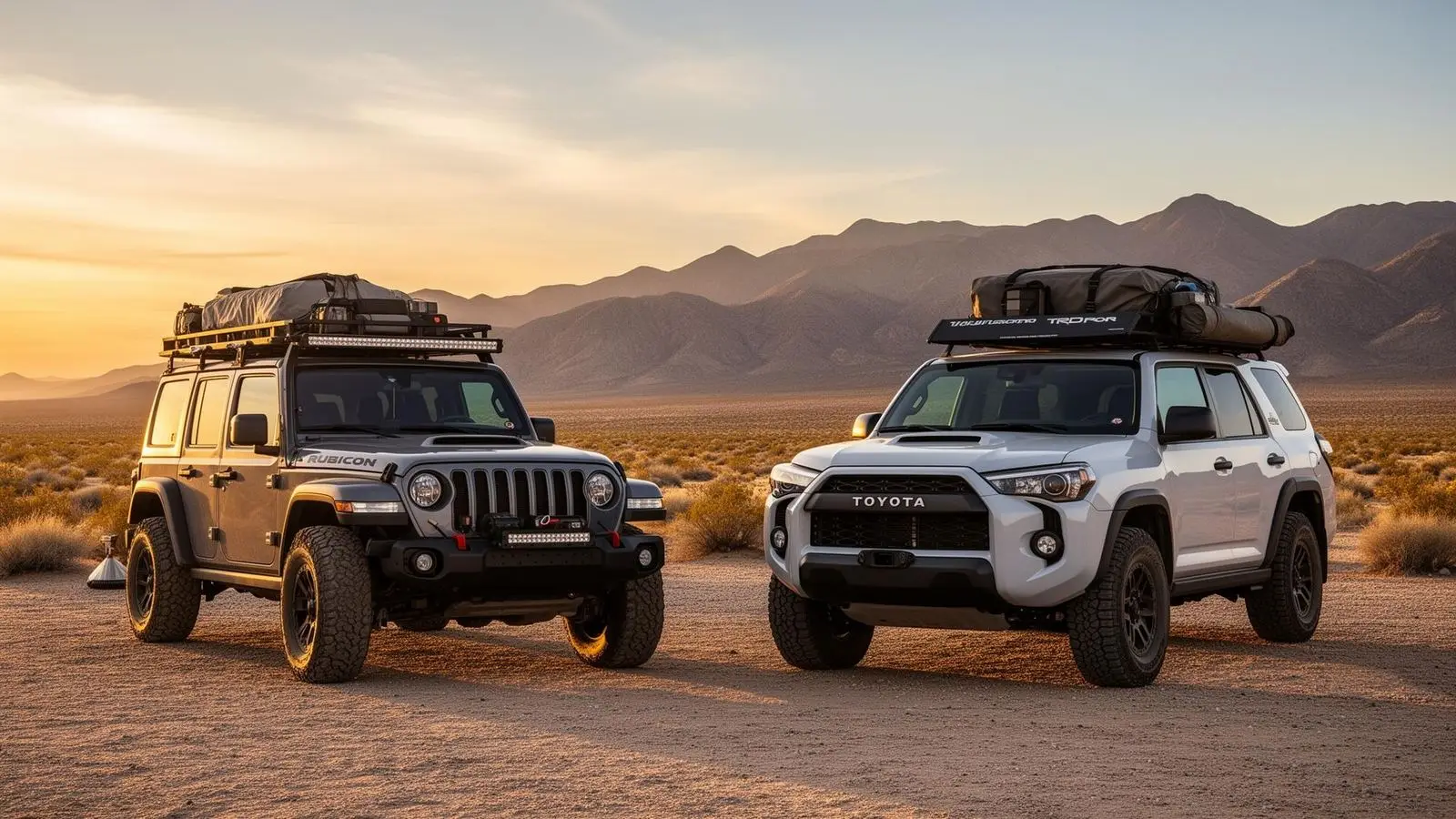
If you want to start a fight at any overland expo, just walk up to a group and loudly ask: "Wrangler or 4Runner?" Then run.
This comparison has been debated so thoroughly that there are forum threads longer than some novels. Wrangler owners swear their solid axles and removable tops make them the only real choice. 4Runner owners counter with reliability statistics and highway comfort. Both camps are utterly convinced they're right.
Here's the uncomfortable truth: they're both right. And they're both wrong. Because the real answer to "which is better for overlanding" depends entirely on what kind of overlanding you actually do.
I've spent serious time in both platforms, across multiple generations. This isn't about declaring a winner. It's about helping you figure out which one fits your life.
Let's Get the Tribalism Out of the Way
Before we dive in, let's acknowledge the elephants in the room:
The Wrangler camp says: "4Runners are just mall crawlers. IFS can't handle real trails. Might as well get a crossover."
The 4Runner camp says: "Wranglers break down constantly. Death wobble is real. Who wants to drive a washing machine on the highway?"
Reality Check
On-Road Behavior: The Daily Driver Factor
Most overlanders spend 80-90% of their driving time on pavement getting to the trail, not on the trail itself. How these vehicles behave during that 80-90% matters a lot.
| Factor | Wrangler | 4Runner |
|---|---|---|
| Wind Noise | Significant (boxy shape) | Minimal |
| MPG (realistic) | 15-18 highway | 18-21 highway |
| Highway Stability | Requires attention | Confidence-inspiring |
| Cross-wind Handling | Gets exciting | Planted |
The Real Talk
Off-Road Capability: Where Things Get Interesting
This is where the Wrangler faithful get excited, because on paper and on the trail, the Jeep has some legitimate advantages.
Wrangler Advantages
- Solid front axle: More articulation, more predictable behavior on uneven terrain, easier to lift significantly. When you're trying to keep all four tires on the ground over obstacles, solid axles flex in ways IFS simply can't match.
- Better approach/departure angles: That short wheelbase and tucked-up design means you can tackle steeper obstacles without scraping. A stock Rubicon has a 44-degree approach angle. That's not marketing fluff.
- Factory lockers (Rubicon): Front and rear lockers from the dealer, plus a sway bar disconnect. This is serious hardware that costs thousands to add aftermarket.
- Removable everything: Doors, top, windshield, you name it. This isn't just about looking cool; it's about being able to physically see your obstacles better in technical terrain.
4Runner Advantages
- KDSS (if equipped): Toyota's Kinetic Dynamic Suspension System disconnects the front sway bar automatically. It's basically a factory cheat code for IFS articulation.
- Longer wheelbase: Better stability on side slopes and more predictable handling when things get sketchy. There's a reason expedition vehicles tend to be longer.
- Crawl Control (TRD Pro): Push a button and the truck handles throttle and braking automatically while you focus on steering. It's like cruise control for rock crawling.
- More cargo space: This matters for overlanding. The 4Runner's cargo area is significantly larger and more usable than the Wrangler Unlimited.
The Honest Assessment
Reliability and Long-Term Ownership
Let's address the elephant: Toyota's reputation versus Jeep's reputation. This is where forum warriors get especially passionate.
The Data
Consumer Reports, J.D. Power, and pretty much every reliability survey consistently ranks Toyota near the top and Jeep somewhere in the middle or lower. That's not bias. That's data collected from actual owners.
But Here's the Nuance
The JK and JL Wranglers are not the same as older Jeeps. Quality has genuinely improved. The 3.6L Pentastar V6 is a proven engine with millions of reliable miles across various Fiat-Chrysler products. The 2.0T and 392 are newer but showing promise.
The 4Runner's 4.0L V6 is essentially the same engine Toyota has been refining since the 1990s. It's not exciting, but it's proven. The transmission is bulletproof. The frame is overbuilt.
The Real-World Difference
Aftermarket Support and Build Flexibility
Both platforms have massive aftermarket support, but the ecosystems feel different.
Wrangler
The aftermarket is absolutely enormous. You can build anything from a mild trail runner to a fully-caged rock bouncer to an expedition rig with sleeping quarters. Every conceivable part, in every possible configuration, from multiple manufacturers. The downside? Choice paralysis is real.
4Runner
The aftermarket is robust but more focused on overland/expedition builds rather than extreme rock crawling. Finding quality suspension, armor, and storage solutions is easy. Finding parts to convert it into a 40-inch-tired monster is harder (and arguably missing the point).
Build Type Recommendations
| Build Type | Better Choice | Why |
|---|---|---|
| Rock crawler | Wrangler | Solid axles, short wheelbase |
| Long-distance overlander | 4Runner | Comfort, cargo, reliability |
| Weekend trail rig | Either | Personal preference |
| Daily driver + trails | 4Runner | Highway manners, practicality |
| "Because I want one" | Get what you want | Life's too short |
Cost of Ownership: The Numbers Nobody Talks About
Let's get into the financial reality of owning these vehicles long-term:
Purchase Price (New, Comparable Trim)
- Wrangler Rubicon 4-door: ~$55,000-60,000
- 4Runner TRD Pro: ~$55,000-60,000
Pretty comparable at the dealer.
Depreciation
Both hold value exceptionally well. Wranglers are somewhat legendary for resale. 4Runners aren't far behind. You're not going to get crushed selling either one in a few years.
Insurance
Wranglers tend to be slightly more expensive to insure due to theft rates and rollover statistics. Not a huge difference, but it adds up.
Maintenance
The 4Runner is cheaper to maintain over time. Toyota parts are generally less expensive, and the vehicle requires less frequent attention. Wranglers need more love, but they're also easier to work on yourself if you're so inclined.
The Questions That Actually Matter
Forget the specs for a second. Ask yourself these questions:
How far do you drive to trails? If you're regularly doing 300+ mile drives to adventure, the 4Runner's highway manners will matter more than you think.
How technical are your trails? If you're regularly tackling Moab-level obstacles, the Wrangler's geometry and solid axles earn their keep.
Is this your only vehicle? The 4Runner works better as an only car. The Wrangler is a compromise you have to embrace.
How much gear do you carry? The 4Runner wins on cargo space, hands down. If you're a gear-heavy traveler, this matters.
Do you want doors and a roof? Sounds silly, but being able to go topless and doorless is a genuine lifestyle benefit some people love and others couldn't care less about.
The Bottom Line (If There Is One)
The Wrangler is a purpose-built off-road machine that you can also drive on roads. The 4Runner is a capable SUV that can also handle serious trails.
Neither is wrong. Both will take you places most vehicles can't. Both have passionate communities that will help you build and maintain them.
The right choice is the one that fits your specific needs, driving style, and the kind of overlanding you actually do, not the kind you watch on YouTube.
My Advice
Because at the end of the day, the best overlanding vehicle is the one you actually use.
And if anyone tells you there's a definitively "right" answer to this debate, they're just trying to validate their own purchase. Which is human. But not helpful.
Now go drive something.