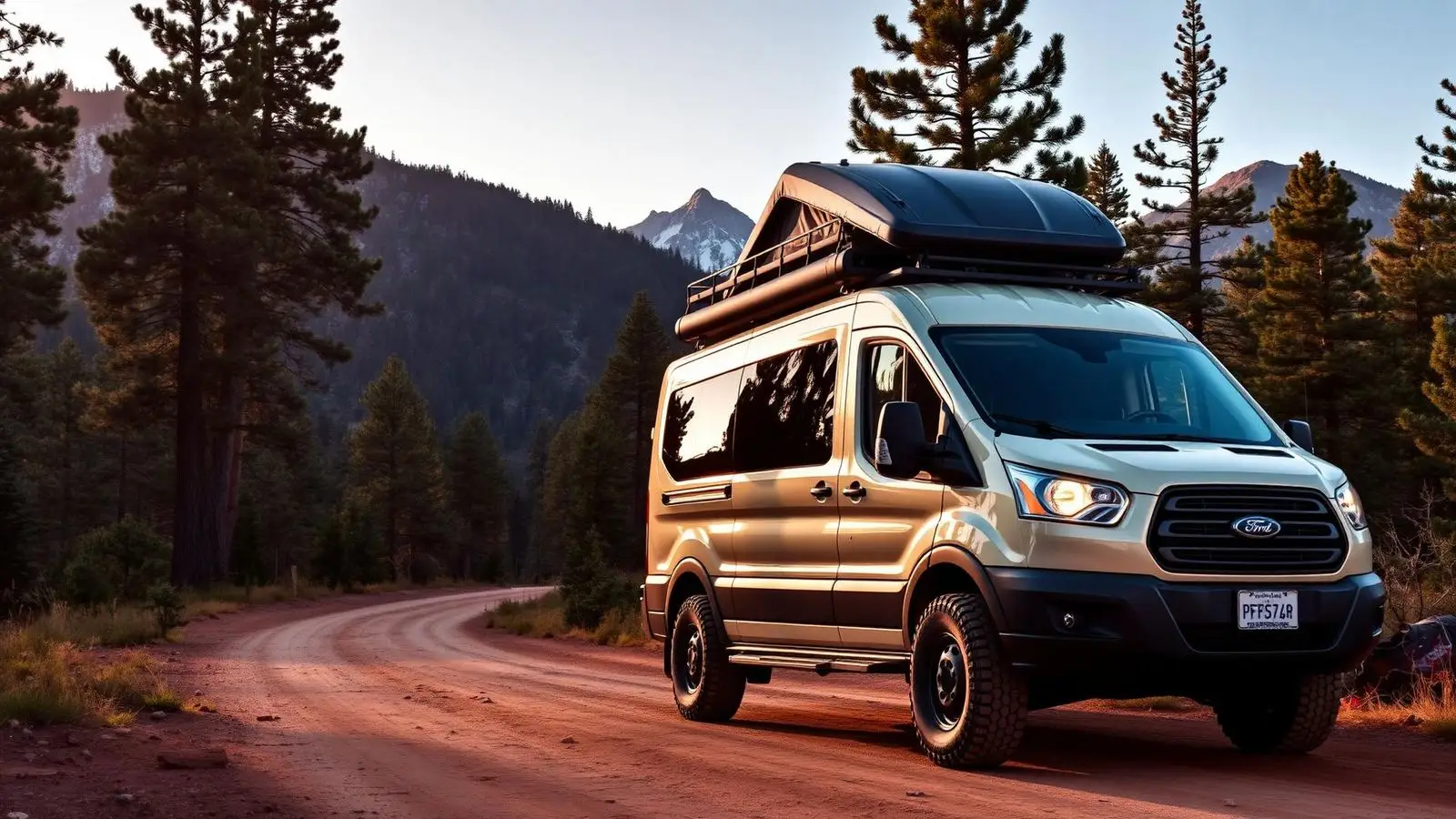
There is a certain moment that creates an overland van owner. It doesn't happen in a showroom. It doesn't happen on Instagram. It usually happens on a road that gets worse one mile at a time.
At first the road feels harmless. Hard-packed dirt. A little washboard. A few potholes. Then the asphalt memory begins to fade. The steering wheel starts talking. A branch drags across the side. Dust creeps into every gap. The map says the campsite is still thirty minutes away, but the road looks like it lost faith in civilization twenty miles back.
That is when fantasy and vehicle choice meet each other face to face. This is also why the Ford Transit AWD, and especially the Ford Transit Trail, have become such compelling answers to the question so many people ask: what is the best van for overlanding?
Not the most glamorous answer. Not the most European answer. Not the answer with the strongest luxury cachet. But for a huge percentage of American buyers, it may be the smartest one.
Because most people don't need a van that can conquer the Rubicon. They need a van that can survive real life. A van that can handle grocery runs on Tuesday, freeway miles on Friday, washboard roads on Saturday, and a dusty national forest campsite by sundown. A van that feels roomy without feeling precious. A van that can be serviced without sending you into a five-stage emotional breakdown. A van that leaves enough money in the budget to actually build the thing.
That is where the Transit shines.
Ford Transit AWD: The Spec Sheet
| Spec | Detail |
|---|---|
| Engines | 3.5L PFDi V6 (NA) or 3.5L EcoBoost V6 |
| EcoBoost output | ~310 hp / 400 lb-ft torque |
| Transmission | 10-speed SelectShift automatic |
| AWD System | Intelligent AWD (automatic, front-bias) |
| Wheelbase options | 130", 148", extended 148" |
| Roof options | Low, Medium, High |
| Max tow rating | Up to 6,900 lbs (properly equipped) |
| Payload | Varies; up to ~4,530 lbs (cargo van configs) |
| Ground clearance | ~6.8 to 7.5 inches (varies by config) |
| Starting MSRP (Cargo AWD) | ~$47,000, $53,000 (2025, before options) |
| Transit Trail MSRP | ~$47,000, $54,000 |
The EcoBoost's 400 lb-ft of torque is the number that defines the Transit AWD's character. It pulls a loaded build uphill without drama. It merges onto the freeway without requiring an apology. It does the work. And unlike the Sprinter's diesel, which requires DEF fluid management and diesel fuel availability planning in remote areas, the EcoBoost runs on regular gasoline available at every corner station in North America.
That is not a small thing when you're three states from home.
What the AWD System Actually Does
The Transit's Intelligent AWD operates front-bias, the opposite of the Sprinter's rear-bias setup. Under normal conditions the system runs with front-wheel-drive emphasis and shifts torque to the rear as traction demands increase.
Where Transit AWD Shines
What it won't do: the Transit is still a full-size van. Wheelbase, body length, width, height, and the laws of physics set the terrain ceiling regardless of drivetrain. Serious rock crawling, deep water crossings, off-camber ledges, and technical 4x4 trails are outside the category. Every van is a house with a steering wheel. Respect the physics.
The Transit Trail: Where Ford Understood the Assignment
If the standard AWD Transit is the practical quarterback of this category, the Transit Trail is the version that showed Ford was paying attention to what the adventure market actually wanted.
People didn't want a work van with the carpet removed and optimism installed. They wanted something that already leaned in the right direction. Something that felt like a factory nod to the reality that buyers were turning these vans into adventure rigs anyway.
The Transit Trail trim delivers: all-terrain tires from the factory, raised suspension, underbody skid plates, additional ground clearance, sport washes on the headlights, and tow hooks. It is not a complete overland build out of the box, no van trim is, but it starts the conversation in the right place. You're not undoing highway-optimized choices before you begin.
Even if you never buy the Trail trim specifically, its existence matters. It signaled that Ford sees the Transit not only as a contractor tool but as a launchpad for recreation, travel, camping, and rugged personal builds. That matters for the aftermarket ecosystem. That matters for buyer psychology.
The Best Atturo Tire Options for a Ford Transit Overland Build
Tires are where the Transit Trail conversation gets real. Whether you bought the Trail trim or you're upgrading from a standard AWD cargo van, the right rubber is what turns a capable platform into a confident one. Atturo has quietly become one of the most relevant tire brands for the Transit overland crowd because the lineup hits the exact sweet spot most van builders need: real all-terrain capability, heavy-duty load ratings, and prices that leave money in the build budget.
Three Atturo options stand out for AWD Transit and Transit Trail style builds.
1. Atturo Trail Blade A/T (LT245/75R16)
This is probably the best "overlander" story in the Atturo lineup for a Transit. It carries the right look, sits squarely in all-terrain positioning, and is available in 10-ply / Load Range E construction for the kind of weight a fully built van actually carries. The 30.5-inch overall diameter, 15/32 tread depth, and 3,042 lb max load per tire line up well with Transit Trail style builds and lifted AWD Transit camper vans that need real load capacity without going full mud-terrain.
2. Atturo Trail Blade X/T
The Trail Blade X/T is positioned for all-weather grip, dirt trails, a quieter ride, and is backed by a 60,000-mile warranty. For Transit owners who split time between freeway miles, grocery runs, and national forest roads, the X/T's hybrid design keeps highway noise down without giving up the off-road bite the van actually needs when the pavement ends. See the full Atturo lineup comparison for context on how the X/T stacks up against the rest of the Trail Blade family.
3. Atturo Trail Blade ATS
The Trail Blade ATS is the move for Transit builds that lean further into overlanding, extended time on unpaved surfaces, mixed-terrain travel, and heavier all-in build weights. With 3PMSF certification, deeper tread, and Load Range E and F availability, it's the right answer for AWD Transit camper vans that spend real time off the asphalt and need a tire that can handle the load without complaint.
Across all three options, the common thread is the same reason the Transit itself wins this category: you get most of the capability of the premium-brand alternative at a price that leaves more of the budget where it belongs, in the build. Full lineup details are at www.atturo.com.
The Honest Cost Breakdown: What a Transit AWD Overland Build Actually Costs
Here's the math the overlanding content world consistently avoids. Here it is clearly.
The Vehicle
A 2025 Ford Transit Cargo Van AWD in high-roof configuration starts around $47,000 to $53,000 MSRP. The Transit Trail trim adds roughly $2,000 to $4,000 over the base AWD. Factor in destination, dealer fees, and options and the realistic pre-tax cost of a properly configured Transit AWD is $50,000 to $58,000.
That is meaningfully less than the Sprinter AWD, which typically runs $68,000 to $78,000 in equivalent configuration. The $18,000 to $20,000 difference is real build budget.
The Build
| Build Tier | What You Get | Estimated Cost |
|---|---|---|
| DIY Basic | Insulation, platform bed, basic electrical, cargo floor | $4,000, $10,000 |
| DIY Mid-Level | Bed, kitchen, 100 to 200Ah lithium, 200 to 400W solar, ventilation fan | $12,000, $24,000 |
| Semi-Pro Hybrid | Partial custom cabinetry, 300 to 400Ah lithium, solar, diesel heater | $22,000, $40,000 |
| Full Professional | Custom cabinetry, 400 to 800Ah lithium, solar, full kitchen, shower | $50,000, $95,000 |
| Premium Custom Builder | Full interior design, high-end materials, turnkey delivery | $70,000, $160,000+ |
Budget Reality Check
Ongoing Costs
At current fuel prices, a loaded Transit AWD averaging 16 to 20 MPG on mixed driving spends slightly more per mile on fuel than a diesel Sprinter. The EcoBoost is not a diesel-efficiency engine. The trade is convenience, gasoline everywhere, no DEF fluid management, no diesel particulate filter anxieties on short-trip driving.
Service intervals for the Transit run 7,500 to 10,000 miles. A standard service at a Ford dealer or independent shop runs $120 to $250. Ford's commercial dealer network is the widest in the country. Finding a Ford Pro or transit-qualified dealer within reasonable distance of your travel area is almost never a problem.
Why the Transit AWD Feels Easier to Live With
The phrase "easier to live with" sounds almost too soft for the rugged-adventure crowd, but it may be the most important phrase in this whole article. The best adventure vehicle is often the one that asks the fewest emotional taxes from its owner.
The Transit makes sense for people who want to spend less time worshipping the build and more time using it. Its multiple roof heights and body lengths give buyers a level of configurability that matches how differently people actually travel. A solo surfer in California, a mountain biker in Colorado, a photographer chasing remote desert light in Utah, and a family trying to turn weekends into memories all need different things from the same basic shell.
The Transit lets you tune the answer.
Ford Service Presence: The Advantage Nobody Romanticizes
This section rarely gets the attention it deserves because service availability doesn't make a good photo.
But it is not boring when you are 900 miles from home, a warning light appears, and you suddenly remember that "brand aura" is not a roadside assistance strategy.
Ford's commercial and fleet footprint in the United States is among the widest of any automotive brand. Ford Pro continues positioning the Transit as a configurable work platform with upfit support, which means Transit-qualified service is genuinely accessible in places other van platforms are not. Small cities. Rural areas. Remote regions. States where European dealer networks don't bother.
Engine Choice: EcoBoost vs PFDi
For overlanding, the choice simplifies quickly: if your build will be heavy, and it will be heavy, because they always end up heavier than planned, the EcoBoost's 400 lb-ft of torque makes the van feel more relaxed under load. On grades, at elevation, fully loaded with gear and people, the additional output matters.
The naturally aspirated option appeals to buyers who value simplicity and predictability and are running lighter, more minimalist builds where peak torque under load isn't the primary concern.
The key point: the Transit offers the choice. Choice is power. Few platforms at this price point give you this much configuration flexibility from the factory.
Payload and Weight: The Math People Skip
Every overland build begins with optimism and ends with a payload reckoning.
Ford's properly equipped Transit cargo van can reach tow ratings of up to 6,900 pounds in certain configurations. That sounds like headroom. It is also not a license to ignore weight.
Overland builds get heavy by design. Water tanks add 8.3 pounds per gallon. A 40-gallon fresh water system is 330 pounds before you fill it. A 200Ah lithium battery bank runs 50 to 60 pounds. Four 100-watt solar panels add 40 to 50 pounds. A steel roof rack adds 80 to 150 pounds. Cabinetry, flooring, insulation, windows, ventilation, and a diesel heater add several hundred more. Before gear, passengers, and food, a serious Transit overland build commonly adds 1,500 to 2,500 pounds to the vehicle.
The smartest Transit AWD builds stay disciplined about this math from day one. Track the weight as you build. Weigh the van fully loaded before your first serious trip. The best overland van is not the one with the longest accessories invoice. It's the one that drives well after you finish building it.
What Terrain the Transit AWD Is Actually Good At
This is where honesty beats hype. The Transit AWD is genuinely excellent at:
- National forest roads and BLM access roads
- Desert tracks that are rough but not technical
- Mountain weather where AWD earns its keep
- Gravel, washboard, loose surfaces, snow and mud
- Long-distance travel where comfort matters alongside traction
- Mixed-use ownership where the van still needs to behave like a reasonable daily machine
That is not a small category. That is the category most overlanders actually live in on most trips.
Transit AWD vs Transit Trail: Which One to Buy
Buy the Transit AWD if you want the flexible, broadly sensible overland foundation and plan to choose your own modifications based on your specific build plan. Many serious builders prefer starting from a clean-slate cargo van and selecting each modification deliberately.
Buy the Transit Trail if you want a more adventure-leaning starting point and value the factory package of all-terrain tires, raised suspension, and underbody protection already installed. The Trail trim saves the cost and time of sourcing those modifications independently, and the factory warranty coverage on the included off-road components is worth something.
Either way, the bigger question isn't which badge is on the van. It's how honest you are about your use case, your build budget, and how you actually travel.
Ford Transit AWD vs Mercedes Sprinter AWD: The Honest Comparison
| Factor | Ford Transit AWD | Mercedes Sprinter AWD |
|---|---|---|
| Base price | ~$47,000, $55,000 | ~$65,000, $78,000 |
| Engine | 3.5L EcoBoost V6, 400 lb-ft | 2.0L turbo diesel, 332 lb-ft |
| Fuel type | Gasoline | Diesel |
| Fuel economy (loaded) | 16 to 20 MPG | 18 to 22 MPG |
| Service interval | 7,500 to 10,000 miles | Up to 20,000 miles |
| US dealer network | Very wide | More limited |
| AWD bias | Front-bias | Rear-bias |
| Premium feel | Practical, approachable | Aspirational, elevated |
| Build ecosystem | Large, DIY-friendly | Mature, premium-focused |
| All-in build cost (serious) | $110,000, $150,000 | $140,000, $200,000 |
The Transit wins on acquisition cost, US dealer access, gasoline convenience, and budget headroom for the build. The Sprinter wins on diesel efficiency, longer service intervals, premium brand pull, and access to the high-end conversion ecosystem.
For overlanders who need the build to feel special and are prepared to pay for what that means in full, the Sprinter earns the premium. For overlanders who want to go farther, more often, with less financial anxiety and more budget allocated to what actually changes the experience, the Transit makes a compelling case that the $20,000 difference in acquisition cost is better spent building the van.
Weaknesses Worth Knowing
No honest article pretends the Transit is flawless.
- The base interior build quality depends entirely on your execution, you're starting from a cargo shell
- The EcoBoost is not a fuel efficiency leader under heavy load, 14 to 16 MPG in mountain terrain adds up
- AWD is not a substitute for judgment about terrain, the Transit on AWD can get deeper into trouble than a FWD Transit
- If your heart wants a luxury-object experience, the Transit may not scratch that itch the way a premium European platform can
Practicality is attractive. It's just not the same thing as aspiration. For many buyers, that is exactly why the Transit wins. It's not trying to be a fantasy first. It's trying to be useful.
Final Verdict
Bottom Line
Not because it wins every category. Not because it's the most romantic. Not because it's the most premium. But because it gets the overall equation right for the largest number of people.
It can be humble. It can be built up. It can be taken seriously without becoming self-serious. It can carry the tools of work and the gear of escape. It feels less like a museum piece and more like a machine meant to be used.
Adventure is rarely waiting at the end of perfection. It is waiting at the end of a long road that starts fine, turns dusty, gets rough, and asks whether you bought a vehicle for the internet or for your actual life.
The Ford Transit AWD, and especially the Transit Trail, answers that question with unusual clarity.