The bead let go with a sound like a rifle shot.
One second my buddy's tire was hugging the rock at eight psi. The next, it had peeled off the wheel and dumped every molecule of air into the Utah afternoon. We were forty feet up a ledge called Wrecking Ball, his rig was suddenly sitting on a rim, and the only thing louder than that bead unseating was the silence that followed it. I kept airing down. My tires stayed put. Not because I am a better driver, but because I was running true beadlock wheels and he was not.
That is the entire story of beadlocks in one sentence. So let me tell you the rest of it, because the difference between a wheel that holds and a wheel that quits is the difference between finishing the trail and walking out for a tow.
What a True Beadlock Actually Does
A normal wheel is a liar that usually tells the truth. It holds your tire on through air pressure alone, squeezing the rubber bead against a lip inside the rim. Pump in thirty-five psi and that grip is iron. Drop to eight and the grip gets nervous. Hit a rock at an angle with a soft, low tire and the bead can roll right off the seat, which is the gunshot my friend heard. Engineers call it burping. You will call it words you cannot print.
A true beadlock removes the lie. Instead of trusting air to pin the tire, it bolts the outer bead in place with a separate metal ring, clamping the rubber between the ring and the rim like a vise. The tire is now mechanically locked to the wheel. You can run two psi if you want. The bead is not going anywhere, because physics, not air, is holding it.
Here is the part the parking-lot crowd does not want to hear. Most "beadlock" wheels you see are fakes. A simulated beadlock is a decorative ring bolted to the face of an ordinary wheel, all show and no clamp. The bolts hold nothing but your attention. The tire is still mounted the normal way and still relies on air pressure, which means a simulated beadlock burps at exactly the same pressure a plain wheel does. It looks like Moab. It performs like a mall.
The Wheel With a Racing Champion's Name on It
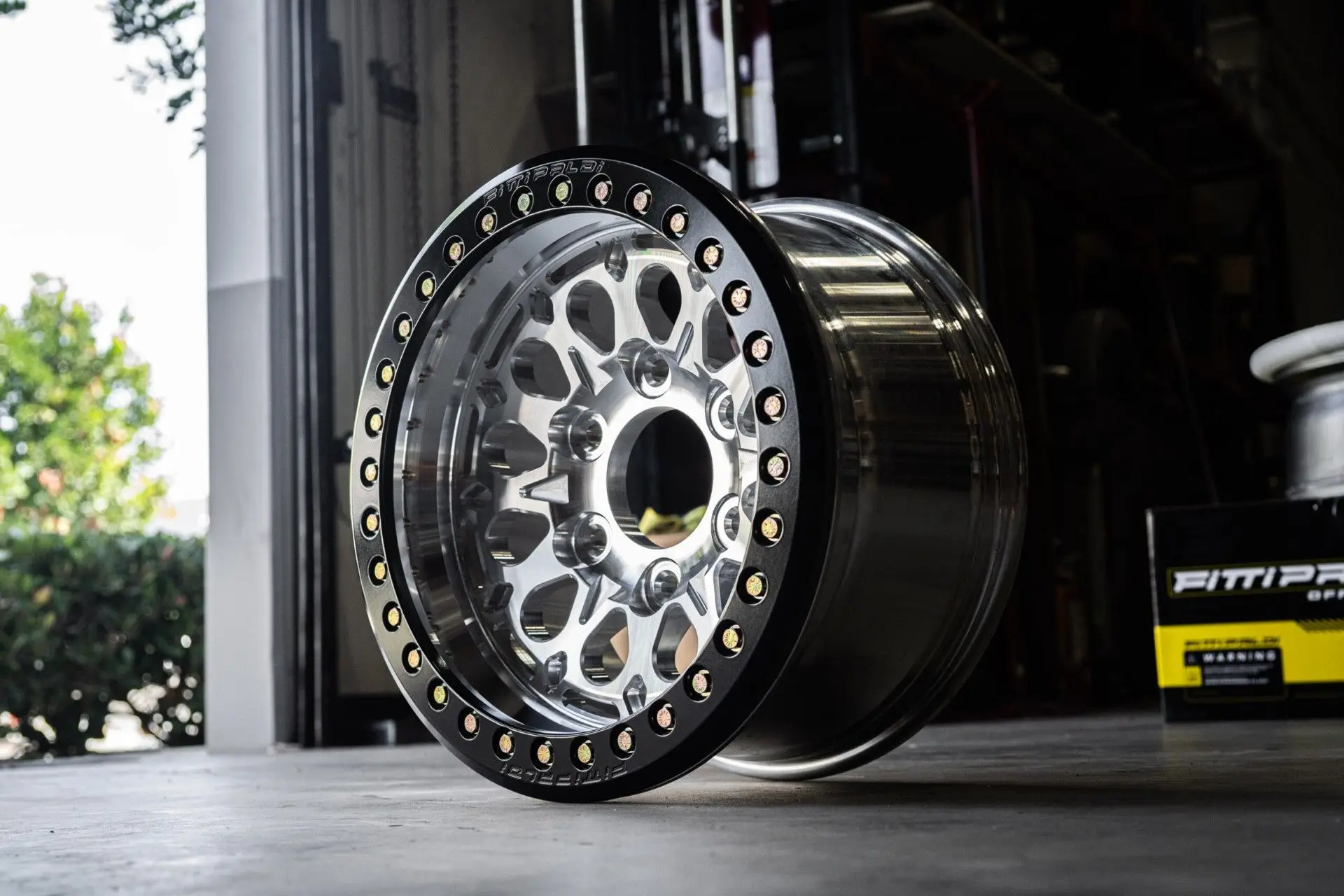
Now meet the real thing. The Fittipaldi Off Road FBF803 is a true beadlock, and it is forged, which is the wheel equivalent of forged versus folded steel. Cast wheels are poured into a mold. Forged wheels are hammered into shape from a solid billet under enormous pressure, which packs the grain structure tight and produces a wheel that is both lighter and dramatically stronger for its weight. The FBF803 is squeezed from 6061-T6 aerospace-grade aluminum, then heat treated for maximum strength, which is exactly the spec sheet you want on something that will get slammed into granite on purpose.
The details are where it earns the badge. The beadlock ring is itself forged 6061-T6 aluminum, not a stamped afterthought. The clamping surfaces use a double-helix milled pattern so the bead cannot creep under load. The hardware is high-performance 5/16-inch grade-8 bolts in yellow zinc, threading into heavy-duty steel inserts that resist the cross-threading that ruins lesser beadlocks. Load rating is a stout 3,650 pounds per wheel, it comes in 17 inch fitments in satin black or a machined finish, and it is built to order rather than stamped out by the thousand. Translation: this is a competition-grade wheel wearing street clothes.
And yes, that name on the ring is the name you are thinking of. Fittipaldi Off Road carries the bloodline of Emerson Fittipaldi, a two-time Formula One world champion and Indianapolis 500 winner. A man who once threaded a McLaren through Monaco at the absolute limit now has his name milled into a wheel built to crawl over boulders at walking pace. Racing is racing, whether the surface is polished asphalt or shattered rock, and the obsession with grip is the thread that connects both.
The Honest Truth: You Probably Do Not Need Them
I am going to talk you out of these before I talk you into them, because that is what an honest site does.
Most people who buy beadlocks never use what they paid for. The entire reason a true beadlock exists is to let you run single-digit tire pressure, somewhere in the five to seven psi range, where the tire turns into a flexible paw that wraps around rock and claws for traction. That is a real and enormous advantage in a very specific place. The problem is that almost nobody actually goes to that place.
Here is the number that settles it. On ordinary wheels, factory or aftermarket, you can safely air down to roughly twelve to twenty psi without the bead unseating. Twelve to twenty psi covers the overwhelming majority of off-road life. Forest roads, washboard, sand two-tracks, mud, gravel, the occasional rocky shelf, beginner and intermediate trails, all of it lives comfortably in that window. If you air down to fifteen psi for your weekend trail and air back up at the trailhead, a true beadlock does nothing for you except add weight, cost, maintenance, and a legal headache. You are buying a Formula One pit crew to change a lightbulb.
I said as much in our $50K Jeep Gladiator overland build, where the right move was to skip beadlocks entirely and spend that money on a tent and a fridge. Overlanders almost never need them. Daily drivers definitely do not. If your honest answer to "how low do I air down" is anything above ten psi, close this tab and keep your cash.
When You Genuinely Need True Beadlocks
Still here? Good, because there is a flip side, and it is glorious.
True beadlocks become essential the moment you need to run pressures that a normal wheel cannot survive. Competitive rock crawling lives at two to six psi, where the tire has to deform around vertical ledges and grab edges that would bounce a hard tire backward. Desert and high-speed sand work demands big flotation and very low pressure to keep the rig on top of soft ground instead of plowing through it. Technical, off-camber, ledgy terrain punishes any tire that is even slightly too firm, and the only way to get soft enough is to go lower than a standard bead will tolerate. In every one of those worlds, the beadlock is not a flex. It is the only thing standing between you and a tire in your lap.
There is a second, quieter benefit that the hardcore crowd loves. When a bead is mechanically clamped, a slashed or punctured tire on the trail does not instantly fold off the rim, so a beadlock can buy you a limp back to camp where a normal wheel would leave you stranded. That is not a reason to buy them by itself. It is a nice dividend once you already need them for pressure.
The Tire That Completes the Build: Atturo Trail Blade Boss
A beadlock is only half the system. The clamp lets you go low, but the tire is what does the work once you get there, and this is where the Atturo Trail Blade Boss earns its spot on the FBF803.
The Boss is the most aggressive tire in Atturo's lineup, and it was built for exactly the pressures a beadlock unlocks. Its tread blocks are shaped after a kukri knife, creating dozens of leading edges that bite at different angles as the tire turns. More important for this conversation, the Boss carries a full three-ply sidewall with tread blocks that spill over onto the sidewall itself. Those sidewall lugs are dead weight at highway pressure. But air the Boss down into single digits on a beadlock, and the sidewall bulges out and flattens against the rock, and suddenly those lugs become a second contact patch grabbing terrain the tread cannot reach. The beadlock makes that low pressure possible. The Boss turns it into traction. One does not work without the other.
It pairs beautifully on a 17-inch wheel, where a 37x12.50R17 Boss on the FBF803 is the kind of setup that makes obstacles look optional. Atturo has quietly become the value pick of the serious off-road world, a brand that competes on what the tire does rather than what the sidewall says, and the Boss is the sharpest tool it makes. For the deeper rundown of where it sits against its siblings, our Atturo Trail Blade lineup guide breaks down all six, and the Trail Blade M/T review covers the softer-spoken option for people airing down less.
The Catch Nobody Mentions Until After You Buy
True beadlocks ask for something back. Three things, actually, and you should know them before you spend.
First, the law. Most true beadlock wheels are not DOT-approved for highway use and are sold for off-road and competition only. Some people drive them on the street anyway, plenty of states look the other way, and others do not, so the rule is simple: check your local regulations before you bolt them on for the commute, because "the internet said it was fine" is not a defense an officer accepts.
Second, the wrench time. That clamping ring is held by a couple dozen bolts, and those bolts loosen as aluminum and steel heat up and cool at different rates. You must re-torque them in a cross pattern to the manufacturer's spec, check them after the first few outings, then before every serious trip. Skip this and you are slowly converting a true beadlock back into a very expensive simulated one.
Third, the balance. Beadlocks are mounted by hand and are famously fussy to balance, so you will not be running ninety on the freeway in buttery smoothness. That is fine, because you did not buy these for the freeway. You bought them for the place where the pavement gives up.
Beadlock Reality Check
| Wheel type | Holds bead at single digits? | Street legal | Maintenance | Who it is for |
|---|---|---|---|---|
| Standard / aftermarket | No, safe to ~12-20 psi | Yes | None special | Overlanders, daily drivers, most trail use |
| Simulated beadlock | No, performs like standard | Yes | None functional | People who want the look only |
| True beadlock (Fittipaldi FBF803) | Yes, down to ~2-7 psi | Usually off-road only | Re-torque bolts regularly | Rock crawlers, racers, sand and technical terrain |
So, Should You Run Them?
Be honest about where your tires actually go. If you spend real days at single-digit pressure, crawling ledges or floating sand or chasing a competition clock, true beadlock wheels are not a luxury, they are the equipment, and the forged Fittipaldi FBF803 is about as serious as the category gets. Wrap it in an Atturo Trail Blade Boss and you have a corner that will keep grabbing long after a normal setup has burped, slipped, or quit.
Bottom Line