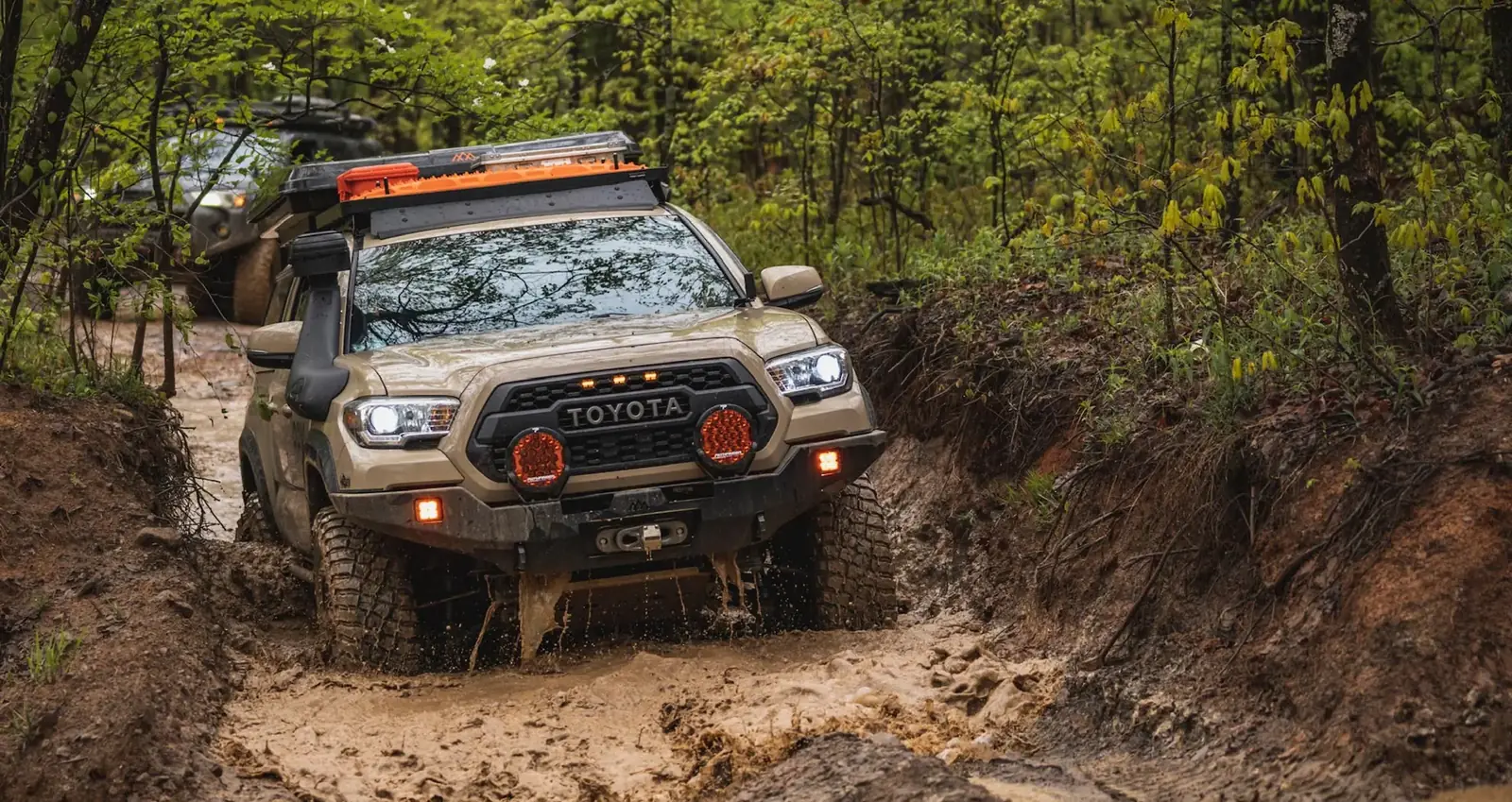
Featured by Atturo Tires
The mud was deeper than it looked. It always is.
The guy in front of you is already through it. You watched his tires bite, slip, catch, and push him out the other side with the confident slop of a tire that knows exactly what it was built for. Now it's your turn, and for a brief second you find yourself doing the mental math on the rubber under your rig and wondering if you made the right call.
If you're running the Atturo Trail Blade M/T, you made the right call.
That is not a sentence the off-road community expected to write a few years ago. Atturo is not BFGoodrich. It is not Toyo, not Mickey Thompson, not one of the names that get dropped at trailheads between sips of gas station coffee. The Trail Blade M/T came up in the conversations that happen when someone asks "what's actually worth buying if I don't want to drop $300 per tire?" And somewhere along the way, the answers started pointing to the same place.
Here is an honest look at why.
What the Trail Blade M/T Actually Is
Start with the basics, because they matter.
The Trail Blade M/T is a purpose-built mud-terrain tire. Not a hybrid. Not an all-terrain with aggressive marketing copy. A genuine mud-terrain designed around a single core problem: staying tractioned in conditions that would swallow lesser rubber and smile while doing it.
The tread pattern uses large, independent lug blocks spaced with wide voids between them. This is the defining architecture of any honest mud-terrain, and the reason is simple physics. Mud is a fluid at the right consistency. Tread that is too tight packs solid, becomes a smooth drum, and stops biting. Wide voids between blocks do two things simultaneously: they evacuate material as the tire rotates, and they create more individual lug edges that can find purchase in loose, wet, unconsolidated terrain. Every rotation is a fresh bite. That is how you move when everything wants you to stop.
Atturo builds the Trail Blade M/T with a 3-ply polyester sidewall. That detail matters more than it sounds. Sidewall cuts are the quiet killer on rocky terrain - a tire that handles mud brilliantly but surrenders to a sharp edge halfway up a scree field is a tire you will only trust on one type of terrain. The 3-ply construction is the same specification Atturo uses on the Trail Blade Boss, their most aggressive offering in the lineup. On a tire that costs what the M/T costs, that is a meaningful statement about how seriously the construction was taken.
Sizes span 15 to 22-inch rim fitments across a range of aspect ratios, which covers the overwhelming majority of overlanding rigs. If you're running a modern truck, SUV, or Jeep platform, there is almost certainly a Trail Blade M/T that fits you.
What Overlanders Actually Need From a Mud Terrain Tire
This is where most tire reviews skip a step.
Overlanders are not rock crawlers. They are also not rally drivers. They are people who drive varied terrain across long distances with a loaded vehicle, often without cell service, sometimes solo, and always with the understanding that a mechanical failure far from a paved road is a serious problem rather than a minor inconvenience. Tire selection for an overlander is a different conversation than tire selection for a weekend rock crawler who can be winched out by six friends and have pizza at the trailhead by noon.
What overlanders actually need:
- Consistent traction across multiple surfaces. A mud-terrain tire that absolutely dominates deep mud but falls apart on forest road gravel, desert hardpack, or loose sand is a specialized tool in the wrong toolbox. Overlanding terrain is unpredictable. Your tire needs to be versatile.
- Sidewall durability over long distances. You are going to cover miles. Many miles. Remote miles. A sidewall that cannot handle sustained contact with rocks, roots, and debris across hundreds of back-road miles is a liability, not an asset.
- Predictable behavior when aired down. Every experienced overlander airs down before the challenging sections. A tire that transforms unpredictably at lower pressures - suddenly squirming underfoot, generating heat unevenly, losing stability - is dangerous on loose descents. Predictable, progressive behavior when deflated is not a bonus feature. It is a requirement.
- Price that doesn't bankrupt the build. An overlanding build is a series of financial decisions made under real constraints. Spending $1,200 or more on tires means not spending that money on a recovery kit, a communication device, or the next trip. Value matters.
The Trail Blade M/T checks all four.
On the Trail: Where This Tire Earns Its Reputation
Mud performance is the obvious place to start, because it is where the Trail Blade M/T gets discussed the most and where it most consistently surprises people.
Deep, wet, heavy mud - the kind that swallows smaller tires and coats everything within six feet of your rig - is where the wide-void tread design does its best work. The M/T self-cleans aggressively. Watch the blocks emerge from a mud hole and you will see material flung outward rather than packed in. The tire comes out of each rotation ready to bite again. Owners who have run this tire back-to-back against similarly priced competitors consistently note that the Atturo grip surprises them - and more than occasionally surprises the group.
Sand traction is strong. The lug geometry that works in mud transitions well to soft sand, where the tire needs to float and dig simultaneously rather than cutting through a semi-solid material. Aired down to appropriate pressures, the Trail Blade M/T spreads well and maintains forward momentum without the tendency to dig in and sink that plagues tires with tighter tread patterns.
Rocky terrain is where the honest answer gets nuanced. The M/T handles rocks well. The 3-ply sidewall gives you confidence against sharp edges, and the lug edges bite into granite and sandstone without the slippery feel you get from less aggressive tread. But if you are spending the majority of your time on technical rock crawling - think Moab slickrock, the really sharp stuff - the BFGoodrich Mud-Terrain T/A KM3 has the rock-specific compound and proven heritage that the Trail Blade M/T cannot fully match. For mixed-terrain overlanding where rocks are part of the picture but not the whole canvas, the M/T performs well and fails at nothing critical.
Gravel and dirt roads - the actual majority of what most overlanders cover - are where the M/T spends most of its life. It is stable, predictable, and communicates terrain feedback to the driver without drama. Aired down for a long corrugated two-track, it absorbs impacts with a compliance that belies its aggressive construction. This is not a tire that punishes you for the miles between the hard parts.
The Honest Warts
No serious review buries the problems.
Road noise is real. The Trail Blade M/T is a loud tire on paved highway. This is not a flaw specific to Atturo - it is the physics of a true mud-terrain tread pattern generating noise at highway speeds. If your rig covers significant pavement between adventures, you will hear this tire constantly. It is the price of what the tire does off-road, and Atturo is transparent about it. The people who are bothered by highway noise generally belong on the Trail Blade X/T or the ATS instead.
Tread wear has drawn criticism in long-term reviews. Some owners report faster wear than they expected compared to premium mud-terrain options from BFGoodrich and Toyo. The degree to which this matters depends heavily on how much pavement you cover. If you are putting on 20,000 highway miles a year between trail trips, the wear rate is a real consideration. If you are the overlander who racks up more dirt miles than asphalt, the wear profile compares far more favorably. Atturo has refined the compound over successive production runs, but if longevity under pavement use is your primary concern, it is worth factoring into the total cost calculation.
Stone throwing on gravel is another note that appears consistently in real-world reviews. The wide voids that make this tire so effective in mud will launch small rocks with enthusiasm at highway speeds on gravel roads. Mudflaps are not optional on this setup if you share roads with other vehicles.
What Other Tires Cost You at This Price Point
Here is the comparison that matters.
A set of BFGoodrich Mud-Terrain T/A KM3 tires in a common overlanding size - LT265/70R17, for example - will run you in the range of $290 to $330 per tire at most retailers. That is $1,160 to $1,320 for a set of four, before mounting and balancing. For that premium, you are getting marginally better wet rock performance, slightly better documented wear longevity, and the brand recognition of the tire that everyone in the overland community knows by name.
The Trail Blade M/T in the same size typically runs $140 to $190 per tire, depending on retailer and timing. That delta is not $30 or $40. It is $400 to $600 for a set of four - real money that funds real things. A quality air compressor for trail airing. A decent set of traction boards. A month of backcountry camping fees. The value argument is not about settling for less. It is about what that savings buys you in the rest of the build.
The Trail Blade M/T consistently earns comparisons to tires that cost significantly more. That is the sentence that has been circulating in overlanding forums for years now, and it holds up.
Who Should Be Running This Tire
The Trail Blade M/T belongs under any rig where the terrain is genuinely varied, the budget is real, and the driver is going to use the tire's capability rather than just display it.
It is the right tire for the overlander who leaves on Friday, covers 200 miles of mixed terrain across a weekend, and returns Sunday night having slept outside every night. It is the right tire for the pickup truck owner who takes forest service roads seriously and has the recovery gear to back up the ambition. It is the right tire for anyone who has ever watched a higher-priced mud terrain perform at the trailhead and wondered if the premium was justified by results.
It is not the right tire for the daily driver who occasionally sees dirt and wants to look the part without hearing the road noise. It is not the tire for a dedicated rock crawling rig where pure rock compound matters above all else. For those use cases, the Trail Blade lineup has other answers.
For the overlander doing actual overlanding, the M/T is the pick.
The Bottom Line
Pick this tire. Not because it's the cheapest option with decent reviews, but because it earns its spot in the same conversation as tires that cost you significantly more and it does that without asking you to ignore the evidence. The Trail Blade M/T is what a mud terrain tire is supposed to be at a price that respects the reality of building an overlanding rig on an actual budget.
The mud will still be deeper than it looks. But your tires will be ready.
Atturo Trail Blade M/T Mileage and Treadwear
Atturo does not publish a treadwear mileage warranty for the Trail Blade M/T on its product page, unlike the X/T (45,000 miles) and ATS (50,000 miles). That fits what owners report: on dirt-heavy rigs it holds up fine, and on rigs that cover a lot of pavement it wears faster than a BFGoodrich KM3 or Toyo M/T. If most of your miles are highway miles, the X/T or ATS is the smarter buy.