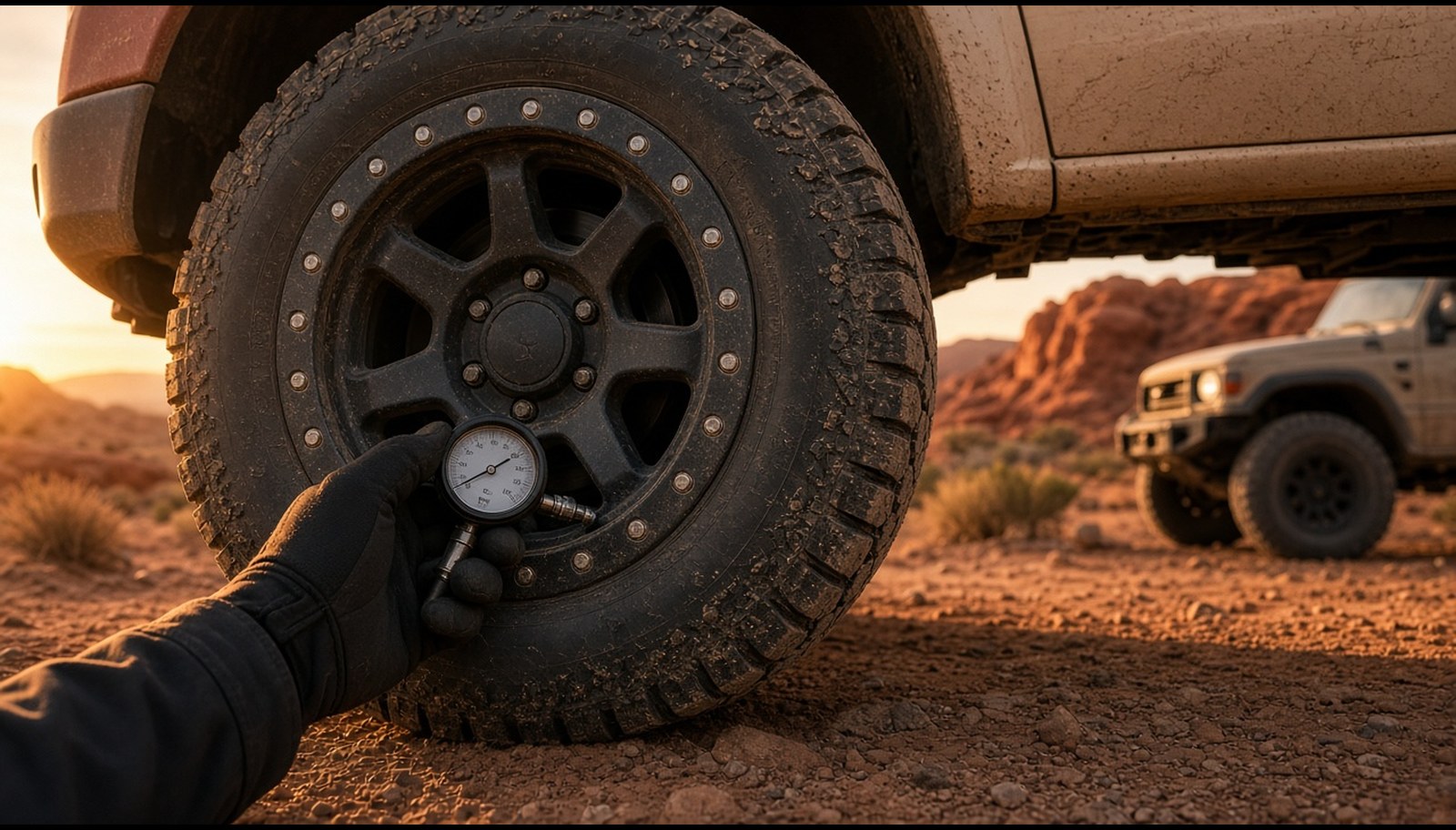
Hiss. That is the sound of the valve core coming out at the trailhead, and of four tires slowly going soft while everybody pretends not to stare at the new wheels. One rig is on Method Bead Grip wheels. The rig behind it has a ring of small bolts around each wheel lip. Both owners are about to go lower than they ever would on pavement, and both think their wheel has their back.
The bead is the stiff edge of the tire that seals against the wheel. Air pressure is normally what shoves it into place. Let enough air out, then hit a ledge sideways, and that bead can roll off its seat. A partial slip that spits air is a burp. A bead that leaves its seat entirely is a debead, and the tire goes flat in a breath. Either way, your afternoon gets longer.
The bead grip vs beadlock question is really about who holds that bead when air stops doing the job. One wheel helps the tire hold on. The other bolts it down.
Bead Grip vs Beadlock, Honestly: Grip Is Not a Clamp, and No Wheel Fixes a Tire's Limits
Method's own copy is careful. It says Bead Grip "aims to be the bridge between a conventional street wheel and a beadlock" (Method Bead Grip page). Bridge, not replacement. The tire still mounts the normal way and still depends on air pressure and the bead seat. Bead Grip adds grooves and a more aggressive safety hump that "engage the tire bead for a stronger hold under extreme side load and lower air pressures." Stronger hold, yes. Locked, no.
A beadlock is a different machine. Method describes it as clamping force from "a set of bolts that thread into the wheel and apply force to the beadlock ring which mechanically clamps and seals the tire's outer bead to the wheel" (Method beadlock page). Note the word outer. A standard single beadlock clamps one bead. Method's own beadlock guidelines PDF diagram shows the outer bead pinched between lip and ring, with the inner bead seated the conventional way.
So the second truth: neither wheel makes the tire invincible. A soft tire flexes more, runs hotter, and exposes more sidewall to rocks. NHTSA says poor tire maintenance, including not having enough air in your tires, can lead to "a flat tire, blowout, or the tread coming off your tire," and that sustained heat can cause blowouts and tread separation (NHTSA TireWise). A clamped bead does not stop a staked sidewall. It does not cancel heat from speed, load, or highway miles at trail pressure. Choosing an extreme use wheel moves one failure point. The tire still has every other one.
Five Wheels People Lump Together
Sort the hardware first; the labels get used loosely.
Conventional wheel. Smooth bead seats with standard safety humps. Air pressure holds both beads. This is what came on your truck.
Enhanced bead retention. A conventionally mounted wheel with bead seat features meant to resist debeading. Method's Bead Grip is one patented example, with grooves on both the inner and outer bead seats per Method. Method sells it as "Patented Bead Grip Technology®," so treat Bead Grip as Method's brand name for its own design, not a generic word for every non beadlock wheel. Other makers' retention features should be judged on their own documentation.
True single beadlock. A ring and bolt circle clamp the outer bead. The inner bead remains a conventional seat.
Beadlock plus inner retention. Method says its 108 Beadlock is its first wheel to combine a beadlock with Bead Grip, with "the added bead seat on the inner lip" (Method beadlock page). That is still one mechanical clamp plus a retention feature inside. If a seller says double or dual, ask exactly which bead gets clamped, and how.
Simulated or beadlock style rings. A decorative ring bolted to the face of a conventional wheel. It looks like a beadlock and clamps nothing. Read the product listing for the exact word functional or simulated, and ask the maker if the listing is vague.
How Bead Grip Works, and Whether Bead Grip Can Debead
A Bead Grip wheel has no ring or bolt circle, so the tire seats on inflation the conventional way. Method says the grooves sit on both bead seats and the safety hump gets "a more aggressive profile which further stabilizes the tire bead in the seat."
Can a Bead Grip wheel debead? Yes, it can. Method describes stronger hold and lower pressure capability. It does not describe a mechanical lock, and its technology page says Bead Grip allows "lower tire pressures similar to non-street legal beadlocks" (Method technology page). Similar is the operative word. Method publishes no minimum psi on those pages, and we will not invent one. Your floor depends on tire construction, load, terrain, speed, and how hard you load the sidewall sideways.
The useful translation: Bead Grip widens your margin. It does not remove the edge.
How a Beadlock Works, and Why the Bolts Own You Now
Mounting a true beadlock is a different job. The inner bead seats conventionally. The outer bead sits against the outer flange, the ring goes on, and a circle of bolts gets pulled down in stages. Method's guidelines spell out a procedure:
- Use only Method approved Grade 8 hardware kits
- Check for mold flash on the tire bead
- Seat the bead evenly to the outside flange
- Start bolts by hand, then tighten in a star pattern to half spec, then to full spec with a calibrated torque wrench
- Confirm the ring contacts the wheel with no visible gap
- Recheck bolt torque every 250 miles
First, Method calls the gap check safety critical: "IF GAP IS VISIBLE THE WHEEL IS NOT SAFE TO USE," and a spacer kit is likely required (guidelines PDF). Method's spacer listing says spacers are needed when a thick bead causes "bolt heads shearing off at low torque values" (Method beadlock spacer kit).
Second, Method's guidelines say "IT IS REQUIRED THAT PROFESSIONAL TIRE/WHEEL INSTALLERS ARE USED FOR THE MOUNTING PROCESS." Torque values in that sheet vary by wheel size, bolt size, cast or forged construction, and anti seize use. That is exactly why we are not printing a number here. Use the current sheet for your exact wheel, not a figure from a forum or from this article.
The payoff is real. Method says the seal "is maintained independent of inflation pressure." For the outer bead, that is the whole point of a beadlock.
Is Bead Grip a Beadlock?
No. Bead Grip is a retention design on a conventionally mounted wheel. A beadlock mechanically clamps the outer bead with a bolted ring. Method sells them as separate categories on its own site, and its technology page describes them separately: Bead Grip "engages inner and outer tire bead," while Beadlock uses "ring clamping force" that secures the tire.
Bead Grip vs Beadlock Comparison Table
| Factor | Bead Grip (Method) | True single beadlock |
|---|---|---|
| How it holds the bead | Grooves on both bead seats plus a more aggressive safety hump, per Method; air still does the work | Bolted ring clamps outer bead; inner bead conventional |
| Method's intended use | Bridge between street wheel and beadlock | "Off highway use only," per Method's guidelines |
| Mounting | No ring; tire seats on inflation | Professional installer required by Method; staged torque, gap check, possible spacer |
| Ongoing maintenance | Normal wheel and tire care | Ring bolt torque check every 250 miles per Method; hardware and ring inspection |
| Can it debead | Yes; Method claims a stronger hold, not a lock, and publishes no floor | Method says ring clamping eliminates debeading from low pressures; its diagram seats the inner bead conventionally |
| Tire limits | Unchanged: heat, load, speed, sidewall damage | Unchanged: heat, load, speed, sidewall damage |
| Warranty (Method) | Covered by Method's limited warranty terms | "Not subject to any structural or cosmetic warranty," per guidelines |
| Daily road use | Method says it stays highway legal | Not intended for it by Method |
| Best fit | Mixed street and trail rigs | Dedicated low pressure rigs, trailered or event built |
Pros and Cons, Plainly
Bead Grip pros. It drives like a normal wheel, has no ring to mount or torque, and keeps the street ready standing Method assigns it. Method says the technology helped factory race efforts and saves weight over a traditional beadlock wheel. That is Method's claim about its own racing program, so read it as such.
Bead Grip cons. It is still air dependent. No published minimum pressure means you are judging the floor yourself. And the name gets abused: a wheel from another brand with a groove is not automatically Bead Grip.
Beadlock pros. The outer bead stays clamped regardless of inflation, per Method.
Beadlock cons. More hardware means more ways to get it wrong. Torque checks every 250 miles per Method, possible spacer kits, a required professional install, and Method's structural warranty exclusion. Any tire job, roadside or in a shop, starts with the ring, and Method requires professional installers for mounting. And the inner bead is still a conventional seat.
Load, Towing, and the "Beadlock Is Stronger" Myth
A beadlock is not automatically stronger. Load capacity is a printed rating for a specific wheel, size, and bolt pattern, and the tire has its own rating. Method lists its 707 Bead Grip at 1,850 to 3,640 lb depending on fitment (Method Bead Grip page). A beadlock's ring tells you nothing about its load rating. Read the rating on the exact SKU.
Method's warranty carries the line that matters for loaded and towing rigs: "wheel and tire must meet or exceed proper vehicle load rating" (Method warranty). The same warranty excludes "tire diameters greater than 37" or used with excessive vehicle loads," along with spacers or adapters. If you tow or carry a camper, pick the wheel by load rating and fitment first, then by bead technology. Our tire load rating guide walks through the tire side of that math.
Rim width matters too. The tire maker lists approved rim widths for each size. A beadlock or Bead Grip wheel outside that range is the wrong wheel no matter how clever the bead seat is. Our tire fitment guide covers the checks.
Are Beadlocks Street Legal?
There is no single yes or no. Separate four layers.
Manufacturer intent. Method's guidelines say its beadlock wheels are "intended for off-highway use only and are not DOT approved." Its Bead Grip page calls beadlocks "often not legal for highway use." Those are Method's words about Method's products.
Federal standards. Under federal law, a manufacturer "shall certify" that its vehicle or equipment complies with applicable safety standards (49 U.S.C. 30115). FMVSS 110, which covers vehicles of 10,000 lb GVWR or less, says the DOT symbol on a rim constitutes "a certification by the manufacturer of the rim" (49 CFR 571.110). FMVSS 120 says the same for heavier vehicles (49 CFR 571.120). Neither standard mentions beadlocks. So "DOT approved" is loose wording: the DOT mark is the maker's own certification.
State and local law. We make no state by state claim here. Check your state vehicle code or DMV before you drive a beadlock on public roads.
Insurance. Ask your insurer before running off highway labeled parts on the street.
Snow, Sand, Trails, Rocks, and Racing
Snow. Airing down for deep snow is a low speed, loose surface tactic. Bead Grip suits rigs that air down at the trailhead and air up before the highway. A beadlock adds little if you never go low enough to worry about the bead.
Deep sand. Sand rewards a long footprint, which Method credits to lower pressure: it improves traction "by enlarging the tire contact patch on loose surfaces." Side loads on dune faces are where bead security earns its keep. Bead Grip handles moderate airing down with more margin. If you run very low and hard, a beadlock is the stronger hold, with the same speed and heat discipline either way.
Trails. Mixed trail days with highway miles both ways are Bead Grip territory. Our airing down guide covers the process. Treat any pressure you see there or anywhere as a starting point for your specific tire and load, not a rule.
Rock crawling. Very low pressures, sidewall against stone, and full sideways loads are the "extreme terrain" Method says its beadlock ring is for. Our true beadlock wheels guide goes deeper on that use case.
Racing. Race rules decide, not marketing. Read your class rulebook and tech inspection requirements before buying, because event rules can require or restrict wheel types.
Who Should Run What
| Rig and use | Pick | Why |
|---|---|---|
| Daily commuter, weekend trails | Bead Grip or a quality conventional wheel | Street manners, no ring to service, extra margin when aired down per Method |
| Loaded overlander, long highway days | Bead Grip, chosen by load rating first | Ring bolt checks every 250 miles per Method add work on long trips |
| Deep sand or snow regular | Bead Grip, or beadlock if you run very low on a trailered rig | Side load security vs road use trade |
| Dedicated low pressure crawler or trailer rig | True beadlock | Outer bead seal Method says holds independent of inflation pressure |
| Race entrant | Whatever your class rules require | Rulebook beats everything here |
Do overlanders need beadlocks? In our view the answer turns on miles, not terrain. A loaded overlander covers long pavement stretches, carries weight, and wants simple roadside repairs. Method's off highway only label and 250 mile torque checks make a beadlock a poor fit for that duty in our view. Bead Grip or a solid conventional wheel, sized to your load, makes more sense. Pack a plug kit and know how to use it. Our plug kit guide covers that.
Are beadlocks worth it? For a trailered crawler that lives at very low pressure, often, in our view. For a commuter that sees a trail twice a month, the maintenance, warranty terms, and road use questions outweigh the gain.
Bottom Line
The bead grip vs beadlock choice is grip versus clamp. Bead Grip, per Method, helps a normally mounted tire hold better at lower pressure and stays street ready. A true beadlock clamps the outer bead, and Method's own beadlocks pay for it with required professional installs, 250 mile torque checks, and an off highway only label. Neither one turns a tire into armor. Pick by how much of your life is pavement.
Internal Links
- True Beadlock Wheels: When You Actually Need Them
- How to Air Down Tires Off Road
- Tire Load Rating Explained
- Tire Fitment Guide
- Overlanding Tire Repair Plug Kit Guide
Sources
All pages checked Nov 6, 2026.
- Method Race Wheels, Bead Grip technology page
- Method Race Wheels, Technology overview
- Method Race Wheels, Beadlock technology page
- Method Race Wheels, Beadlock Guidelines PDF (dated 10/11/2021 in file name)
- Method Race Wheels, Beadlock Spacer Kit
- Method Race Wheels, Limited Warranty
- NHTSA, TireWise
- 49 U.S.C. 30115, Certification of compliance
- 49 CFR 571.110 (FMVSS 110), vehicles 10,000 lb GVWR or less
- 49 CFR 571.120 (FMVSS 120), vehicles over 10,000 lb GVWR