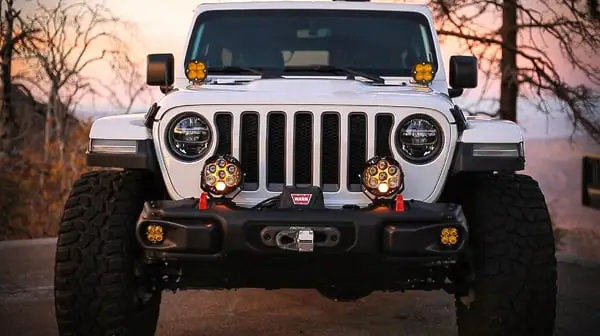
It is the last hour of light on a shelf road somewhere above 9,000 feet. The trail ahead is a staircase of rock ledges, and the trail behind you is a thousand feet of nothing. You air down to single digits, flip the sway bar disconnect, and the Jeep just walks up it. An hour later the same rig is parked at the edge of a meadow, a hardshell tent popping open on its struts while a fridge keeps dinner cold. One vehicle did both jobs without breaking a sweat.
That is the promise of a dream Jeep Wrangler Rubicon build done right. Not a trailer queen that looks violent on Instagram and never leaves the driveway, but a four-door JLU Rubicon that crawls genuine technical terrain and sleeps two in the backcountry the same weekend. This is the no-compromise parts list, the best of the best in every category, with the honest engineering truths baked in so you build it smart instead of just expensive. Including the one spec that quietly governs the entire build, and almost nobody talks about it until the rig feels tippy on a side slope.
Why the JLU Rubicon Is the Right Canvas
Start with the right platform and half your money is already well spent. The four-door JL Wrangler Rubicon leaves the factory with Dana 44 solid axles front and rear, electronic lockers at both ends, an electronic front sway bar disconnect, the Rock-Trac transfer case with a 4:1 low range, and 4.10 gears. Trying to add lockers, a disconnect, and a 4:1 case to a cheaper Sport or Sahara costs more than the price gap, so the Rubicon is the value play hiding inside the premium badge.
The factory numbers are not for show either. A stock JLU Rubicon gives you roughly 10.8 inches of ground clearance, a 43.9-degree approach angle, and about 30 inches of water fording. For reference, a stock 4Runner clears about 9.6 inches and a Tacoma TRD Pro about 9.4. The Rubicon rolls off the lot more capable than most rigs are after a lift. Our job in this build is not to fix the Jeep. It is to extend everything it already does well, and to do it with parts that will survive the abuse.
The Foundation: Suspension That Crawls and Cruises
Everything bolts to the suspension, so this is where the dream build earns or wastes its money. For a rig that has to crawl slow and rocky one day and ride loaded down a washboard forest road the next, the best-of-the-best answer is a King 2.5 coilover and reservoir shock system, professionally valved for your weight, paired with EVO Manufacturing control arms and geometry correction.
King Off-Road Racing Shocks are the same hardware lineage that wins Baja, and the 2.5 coilover conversion is the closest thing the Jeep world has to a magic trick. The coilover replaces the factory coil-and-shock setup with a single adjustable unit that gives you ride-height control, a remote reservoir to fight heat fade on long descents, and a tunable damping curve that soaks up high-speed chatter without turning to jelly on the rocks. Have it valved by a shop that tunes for your actual loaded weight rather than running an off-the-shelf curve, because a fully built JLU with a tent and a winch weighs nothing like the brochure.
Set it up for 3.5 inches of lift to clear 37-inch tires with room to flex. That puts you north of 13 inches of ground clearance, a meaningful jump from the factory 10.8. Then spend the unglamorous money that makes a tall Jeep safe: adjustable front and rear track bars to recenter the axles, a heavy-duty tie rod and drag link from Synergy or RockJock, fresh bump stops, brake line and ABS line relocation brackets, and a quality steering stabilizer. Skip those and a 3.5-inch JL will eventually introduce you to death wobble, the steering shimmy that finds lifted Wranglers with worn or loose front-end parts. Built right, most owners never see it. Built lazy, it shows up at 60 on the highway home.
Wheels: Fittipaldi FBF800 True Beadlocks
If you are going to air down to single digits on rock, you need a wheel that holds the bead mechanically instead of trusting air pressure to do it. The Fittipaldi FBF800 is a true beadlock, and it is forged, which matters more than the marketing suggests.
Cast wheels are poured into a mold. Forged wheels are squeezed from a solid billet under enormous pressure, which packs the grain structure tight and produces a wheel that is lighter and dramatically stronger for its weight. The FBF800 is forged from 6061-T6 aluminum and heat treated, with a forged 6061-T6 beadlock ring, double-helix milled clamping surfaces so the bead cannot creep under load, and a load rating in the 3,650-pound range per wheel. In 17x9, it gives a 37 the rim width it wants. A true beadlock lets you run two to seven psi safely, where a standard wheel gets nervous below about twelve, and that single-digit range is what turns a tire into a flexible paw that wraps around rock.
One honest note carried over from our true beadlock wheels guide: beadlocks ask for maintenance. You re-torque the ring bolts in a cross pattern, check them after the first few outings, and verify before every serious trip. Most are also sold for off-road use rather than DOT highway approval, so check your local rules. For a dream rock build, that trade is exactly the right call. For a mild overlander that never sees single digits, it would be money wasted.
Tires: Nitto Trail Grappler in 37x12.50R17
Mount five Nitto Trail Grapplers, because your spare needs to match when you are a hundred miles from a tire shop. The Trail Grappler is Nitto's true mud-terrain, and on a rock-and-overland dream build it is the aggressive end of the right answer. Big, deep tread blocks with a three-ply sidewall, a tread pattern that clears mud and bites on rock, and a carcass tough enough to take ledge edges at low pressure without folding.
Here is the honest fork. If your weekends lean more toward dirt roads, gravel, and quiet overland miles with the occasional technical day, the Nitto Ridge Grappler is the smarter buy. It is a hybrid that rides quieter and smoother on the highway, weighs a touch less, around 81.5 pounds versus 84.8 for the Trail Grappler in 37x12.50R17, and still handles most off-road work short of deep mud and the gnarliest rock. For a build whose whole identity is crawling hard and looking the part, the Trail Grappler is the hero. For a build that spends more time getting to the trail than on it, the Ridge Grappler is the grown-up choice. Both are correct depending on how you actually drive.
Regear: Non-Negotiable on 37s
This is not optional, and treating it as optional is the most common expensive mistake on big-tire Jeeps. The Rubicon ships with 4.10 gears, which are fine on the factory 33s and tolerable on 35s. Hang 37-inch tires on a fully loaded build with a tent on the roof and you have effectively raised the gearing into a place where the engine lugs, the transmission hunts, and you lose the top gear on the highway.
Regear both axles to 5.13 and the Jeep drives like the tires are not even there. The math is simple: bigger tire diameter multiplies the work the engine has to do to turn it, and a numerically lower (deeper) gear ratio gives that work back. For a heavy 37-inch build with an automatic and a roof load, 5.13 is the sweet spot. A lighter 37-inch rig could run 4.88, but a dream overland Rubicon is never light. Budget for quality gears from Yukon, Revolution, or Dynatrac and a competent install, because a botched gear setup whines forever.
Axles: The Optional Halo Upgrade
The Rubicon's factory Dana 44s with lockers are genuinely good, and for most 37-inch builds, fresh 5.13 gears and chromoly axle shafts from RCV are all you truly need. But this is a dream build, so the halo move is a Dynatrac ProRock 60 rear axle, and a ProRock 44 or Ultimate Dana 60 up front, with 35-spline shafts that shrug off 37-inch leverage on a ledge. It is a five-figure upgrade and overkill for the average owner, which is exactly why it belongs on the dream list and at the bottom of the priority order. Do the gears first. Add the axles when you have broken something, or when the budget simply does not care.
Lighting: Baja Designs, the Scientists of Lighting
When the road ends and the real dark begins, factory headlights reveal themselves as a regulatory minimum dressed up as a solution. For the best-of-the-best dream build, the lighting brand is Baja Designs. Founded in 1992, they built the first forward-projecting LED light bar and they have spent three decades proving the hardware under race conditions where a failed light ends a run. Their lights carry a serious warranty and, more important, a beam quality that cheaper lumens-chasing brands cannot match.
Think in layers rather than a single giant bar. A Baja Designs OnX6 or S8 combo bar on the windshield or bumper handles distance and scene fill. A pair of Squadron or LP series pods on the A-pillars, aimed outward at roughly 45 degrees, become ditch lights that kill the side shadows forward lighting leaves behind. LP6 or LP9 lights on the bumper corners cover the corners and the close ground. Add amber lights for dust and weather, because amber light at roughly 3000K has a longer wavelength that passes through suspended dust and fog instead of bouncing the glare back into your eyes. Finish with rock lights under the body so you can see exactly where your tires are landing on a technical line at night.
Winch: Warn Zeon Platinum 10-S
A built Jeep that cannot rescue itself is a liability with good tires. The dream-build winch is a Warn Zeon Platinum 10-S with synthetic rope. Warn is the name the recovery world trusts, the Zeon Platinum is its premium line with a wireless remote and an internal control pack that cleans up the install, and synthetic rope is lighter and far safer than steel cable because it does not store deadly energy when it fails.
Why 10,000 pounds and not the giant 12, given a built JLU can push past 6,000 pounds loaded? The rule of thumb is a winch rated at least 1.5 times your loaded vehicle weight, and 10,000 pounds clears that with margin while saving nose weight, which your approach angle and front suspension will thank you for. Cap the system with a Factor 55 ProLink or UltraHook closed-system rope end, which is stronger and safer than an open hook. If you want to save money without giving up much, the Warn VR EVO 10-S is the value version of the same idea, with the same 10,000-pound rating and a more basic control setup.
Armor: Protect the Expensive Parts
Steel where it counts, and in priority order. Rock sliders first, from Rock Hard 4x4 or EVO, because they protect the rocker panels, the most expensive sheet metal on the Jeep to repair, and they double as a step up to the tent. A winch-ready front bumper next, in a stubby or mid-width design from EVO, ARB, or AEV, which keeps your approach angle sharp and trims weight versus a full-width bruiser. A rear bumper with a swing-out tire carrier after that, because a 37-inch spare is heavy enough that hanging it on the factory tailgate hinge is asking for sag and rattles.
Then a full belly skid plate system from EVO, AEV, or ASFIR to cover the oil pan, transmission, transfer case, and fuel tank. And to actually use all that 37-inch flex, high-clearance steel fenders from EVO or Metalcloak, which let the tires stuff into the wells without shredding plastic. Armor is the line item people cut to afford the tent. Do not. Bent steel is a story. A holed oil pan forty miles from pavement is a tow bill.
Onboard Air and Recovery
You aired down to single digits on the FBF800 beadlocks. Now you need to air back up, run your lockers, and maybe drive an impact. The answer is an ARB Twin onboard air compressor, the CKMTA12 or the newer brushless version, which moves about 6.16 CFM and fills a 37 in roughly a minute. Hardmount it, plumb a quick connect, and you have trailhead air, locker actuation, and air-tool capability in one box.
Round out recovery with a closed-system kit: a kinetic recovery rope rated for the Jeep's loaded weight rather than a cheap yank strap, a pair of soft shackles, a snatch block to double your winch line or change its angle, a set of MAXTRAX recovery boards for sand and snow, a tire deflator, and gloves. None of it is glamorous. All of it is the difference between a good story and a long walk.
The Overland Half: Sleep, Cook, Power
This is what turns a trail Jeep into a rig you actually live out of. The centerpiece is the Tuff Stuff Overland Alpine 61 hardshell rooftop tent in black aluminum, $4,620. It pops up on four German gas struts in under a minute, sleeps two to three on a memory-foam mattress, and seals into a low aluminum shell that cuts wind noise and lets you leave bedding inside when it is closed. The canopy is a 3,200 GSM poly-cotton ripstop with a waterproof rating over 3,500mm and a blackout coating, the floor is a one-inch aluminum honeycomb panel, and the whole thing carries a 1,200-pound capacity. Closed, it is 88 by 61 by 8 inches. Open, it is 94 by 61 by 60.
Mount it on a full-length aluminum platform rack that bolts to the body and sport bars, not to the freedom panels. Add a 270-degree awning from ARB or 23Zero for instant shade and rain cover, a 12-volt fridge in the 40 to 60-liter range from ARB or Dometic so cold food stops being a luxury, and a power system to run it all: a dual-battery setup with a DC-to-DC charger from Redarc or National Luna, or a large portable power station if you want to keep it simple. A drawer and storage system from Goose Gear or Decked keeps the gear organized instead of avalanching every time you open the tailgate.
The Truth Nobody Mentions: Roof Load and Center of Gravity
Here is the spec that quietly governs this entire build, and the reason the honest section exists. The Alpine 61 weighs 274 pounds. Your roof rack adds another hundred or more. That weight does not just sit there. It sits high, and it sits there while you are moving.
Static vs. Dynamic Roof Load
Static roof load (parked) is large, often 800 pounds or more, which is why two adults can sleep up top safely. Dynamic roof load (driving) is far lower, commonly around 300 pounds for a JL rack setup, and that number has to cover the rack plus the tent. A 274-pound tent on a 100-plus-pound rack is already brushing that ceiling before you strap on a single traction board.
The second half of the problem is physics you will feel in your stomach. Lift the Jeep 3.5 inches, add 37s, then stack 375 pounds of tent and rack on the roof, and you have raised the center of gravity twice. On an off-camber shelf road, a tall, top-heavy Rubicon gets tippy in a way the brochure never mentions. This is not a reason to skip the tent. It is a reason to keep everything else low: fridge and drawers and water down in the cargo area, the heaviest gear on the floor, and a calm right foot on side slopes. Build the weight low and the rig rewards you. Pile it high and the trail eventually sends a reminder.
Don't Forget These
A few parts round out a true dream build that are easy to overlook. A snorkel from AEV or ARB Safari raises the air intake for deeper water crossings and pulls cleaner air on dusty trails. A GMRS radio like a Midland MXT575 with a good antenna keeps you talking to the rest of your group when cell signal died at the cattle guard. And quality recovery points, rated and bolted to the frame, front and rear, because a tow hook is not a recovery point and the difference matters when a kinetic rope loads up.
What the Dream Costs
These are ballpark premium 2026 prices, installed where labor applies. They move with your shop and your options, but the shape is right.
| Build category | Cost |
|---|---|
| King 2.5 suspension, EVO arms, steering, installed and aligned | $9,500 |
| Regear to 5.13, front and rear, installed | $3,000 |
| Fittipaldi FBF800 beadlocks, set of five | $3,000 |
| Nitto Trail Grappler 37s, set of five mounted | $2,500 |
| Baja Designs lighting system | $3,500 |
| Warn Zeon Platinum 10-S, synthetic, Factor 55 end | $2,300 |
| Front bumper, winch-ready | $1,400 |
| Rear bumper with swing-out carrier | $1,700 |
| Rock sliders | $1,100 |
| Full skid plate system | $2,200 |
| High-clearance steel fenders | $1,300 |
| ARB Twin onboard air | $850 |
| Recovery kit | $1,200 |
| Tuff Stuff Alpine 61 rooftop tent | $4,620 |
| Roof rack | $1,600 |
| 270 awning | $900 |
| 12V fridge | $1,200 |
| Dual battery and DC-DC power | $1,200 |
| Snorkel | $450 |
| GMRS comms | $400 |
| Build total (mods only) | $43,920 |
Add the optional Dynatrac ProRock 60 axle upgrade and you are near $51,000 in parts and labor. Stack that on a new JLU Rubicon and the dream rig clears six figures. Start with a clean used JLU Rubicon, which trades well below a new one, and the same build becomes a far more rational obsession. Either way, hold a reality fund of a couple thousand dollars after the build. Newly built Jeeps need things torqued, aligned, and re-checked in the first few hundred miles, and that buffer keeps the first shakedown from becoming a credit-card problem.
Who This Build Is For
This is for the person who refuses to own two vehicles. One Rubicon that crawls Black Bear Pass in the morning and sleeps you above treeline that night, that drives to work on Monday with the doors on and the heat working. If you only ever crawl and never camp, build a two-door on coilovers and skip the tent weight. If you only ever overland mild dirt roads, you do not need beadlocks or 5.13 gears, and our $50K Jeep Gladiator Rubicon build shows how to spend that money smarter. But if you want the rig that genuinely does both, at the highest level, this is the parts list. Build it low, gear it right, and point it at the horizon.