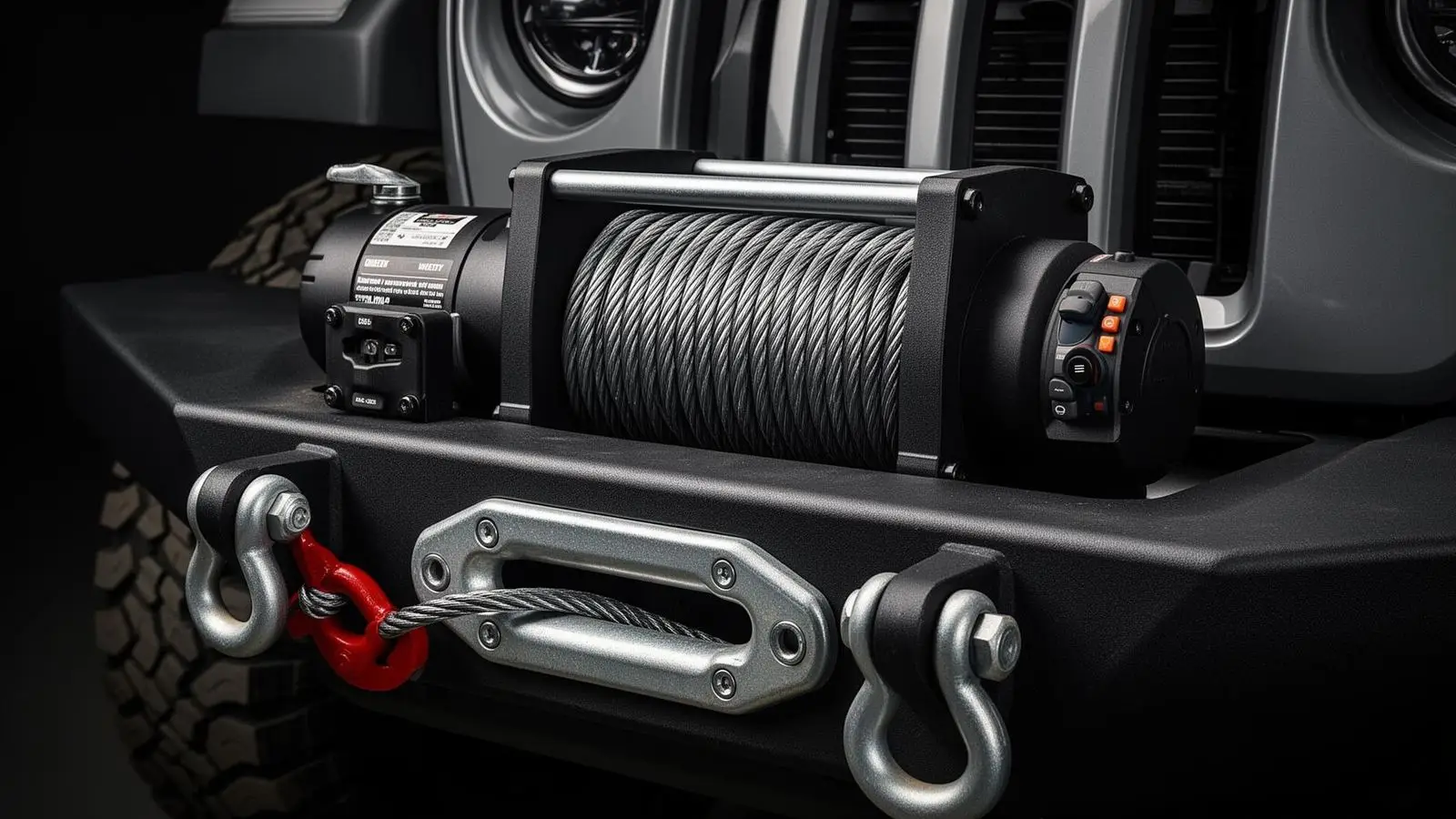
A winch is your ultimate self-recovery tool, and shopping for one is a mess. Prices run from $300 Harbor Freight specials to $2,400 Warn flagships, and every forum thread contradicts the last. This guide cuts through it: how to size the winch to your actual rig, whether to run steel or synthetic, which brands earn their price, and what the mount, wiring, and accessories add to the bill. The winch is never the whole cost. Budget the system, not the spool.
Do You Actually Need a Winch?
Honest answer: probably not right away. If you wheel with friends, a kinetic recovery rope and a pair of soft shackles handle 90 percent of stuck situations for about $200. Plenty of people wheel for years without ever spooling out a winch line.
You need a winch when:
- You wheel alone. No buddy rig means no strap recovery.
- You lead groups. The lead vehicle finds the trouble first.
- Your trails are remote or tight. No room for a second vehicle to line up a pull.
- You want self-sufficiency. For some people the peace of mind alone justifies the cost.
Buy the rope first. Before you spend winch money, put a quality kinetic rope ($150 to $200) and soft shackles in the rig. You will use them far more often than a winch, and they work whether or not you ever add one. Our recovery gear guide covers the full kit.
What Size Winch Do You Need? The 1.5x Rule
Your winch should be rated at a minimum of 1.5 times your vehicle's gross weight. Not curb weight from the brochure: gross weight, with the bumper, the gear, the fuel, and the cooler you always bring. For a JL Wrangler running around 5,000 lbs loaded, that means at least 7,500 lbs of winch. In practice you round up to the next common size, so 8,000 minimum and 10,000 recommended.
Why the margin? A pull off dry level ground takes roughly the vehicle's weight. Add mud suction, an incline, or a high-centered frame and the load climbs to 2 to 3 times vehicle weight. Going bigger on capacity is never wrong. Going smaller is how winches stall mid-pull.
| Vehicle | Approx. Weight | Minimum Winch | Recommended |
|---|---|---|---|
| Jeep Wrangler JL 2-Door | 4,200 lbs | 8,000 lbs | 10,000 lbs |
| Jeep Wrangler JL 4-Door | 4,800 lbs | 8,000 lbs | 10,000 lbs |
| Jeep Gladiator | 5,200 lbs | 10,000 lbs | 12,000 lbs |
| Toyota Tacoma | 4,500 lbs | 8,000 lbs | 10,000 lbs |
| Half-Ton Truck (F-150, Silverado) | 5,500 lbs | 10,000 lbs | 12,000 lbs |
| 3/4-Ton Truck | 7,000 lbs | 12,000 lbs | 17,500 lbs |
| Built/Armored Rigs | 6,500+ lbs | 12,000 lbs | 12,000+ lbs |
One caveat on going huge: capacity costs weight and money. A 17,500 lb winch on a Tacoma is 40 extra pounds hanging off the front axle for pulling power you will never use. Size for your rig plus margin, not for bragging rights.
Steel Cable vs Synthetic Rope
This is the most debated topic in winching, and the answer is clearer than the forums make it sound.
Steel cable is durable, heat resistant, abrasion resistant, cheap, and nearly maintenance free. It is also heavy, adding 20 to 30 lbs to the nose of your rig, it kinks permanently when damaged, it grows wire burrs that slice bare hands, and if it snaps under load it whips with enough energy to kill. Steel makes sense for budget builds and heavy industrial use in abrasive environments.
Synthetic rope weighs 5 to 8 lbs, floats, will not kink or rust, and is far easier to handle and splice in the field. When it breaks it mostly drops instead of whipping. The trade-offs: quality synthetic costs $150 to $300, UV exposure degrades it over years, heat and abrasion can damage it, and it wants to be kept clean and dry.
Our recommendation: synthetic, for almost everyone. The safety difference alone is worth the premium, and most quality winches now ship with synthetic standard. Run steel only if your budget is hard-capped or your use is genuinely industrial.
Winch Brands Compared: Warn vs Smittybilt vs Budget
Premium Tier ($1,000 to $2,500)
Warn Zeon Series (Zeon 10-S, 12-S, Platinum; $1,200 to $2,400). The industry benchmark. Fastest line speeds, excellent build quality, convertible control pack, wireless remote on the Platinum. Expensive and heavier than competitors, but if you winch often or compete, this is the standard.
Warn VR EVO Series (8-S, 10-S, 12-S; $700 to $1,100). Warn reliability at a working price. Waterproof, good line speed, synthetic options across the range. The control pack is not convertible and it is slower than a Zeon. It is also the best value in the premium segment, full stop.
Mid-Tier ($500 to $1,000)
Smittybilt XRC Gen3 (9.5K, 12K; $550 to $750). Significantly improved internals over the Gen2, waterproof, competitive warranty. Heavier than the equivalent Warn, and early units had some reliability complaints. Still the pick if you want dependable and cheap in the same sentence.
Smittybilt X2O (10K, 12K, 17.5K; $400 to $600). Waterproof, wireless remote included, proven value. Slower line speed and more mixed reliability reports than the XRC. Fine for occasional use.
Superwinch Tiger Shark (9500, 11500; $600 to $800). Solid reputation, good customer service, competitive features. Less common, so fewer accessories and less community knowledge. A legitimate alternative if the Smittybilt lineup leaves you cold.
Budget Tier ($250 to $500)
Badlands ZXR Series (9000, 12000; $300 to $450, Harbor Freight). Surprisingly capable, decent warranty, and frequent sales drop the price further. Slower, heavier, steel line only, not waterproof. As a first winch or a "better than nothing" insurance policy, it works.
Rough Country Pro Series (9500 lb, 12000 lb; $350 to $500). Affordable, synthetic rope options, mounting plate included for some applications. Limited track record and mixed durability reviews.
Budget winches get mocked online and save rigs on trails every weekend. They give up line speed, duty cycle, and longevity, not the ability to pull you out. A cheap winch that is on your bumper beats the expensive one you didn't buy.
Complete Price Comparison
| Winch | Capacity | Rope | Price | Rating |
|---|---|---|---|---|
| Warn Zeon 10-S Platinum | 10,000 lbs | Synthetic | $2,400 | 5/5 |
| Warn Zeon 10-S | 10,000 lbs | Synthetic | $1,500 | 5/5 |
| Warn VR EVO 12-S | 12,000 lbs | Synthetic | $1,100 | 4.5/5 |
| Warn VR EVO 10-S | 10,000 lbs | Synthetic | $850 | 4.5/5 |
| Smittybilt XRC Gen3 12K | 12,000 lbs | Synthetic | $750 | 4/5 |
| Superwinch Tiger Shark 11500 | 11,500 lbs | Synthetic | $700 | 4/5 |
| Smittybilt X2O 12K | 12,000 lbs | Synthetic | $550 | 3.5/5 |
| Rough Country 12000 | 12,000 lbs | Synthetic | $500 | 3/5 |
| Badlands ZXR 12000 | 12,000 lbs | Steel | $400 | 3/5 |
Mounting: The Part People Skip in the Budget
You cannot bolt a winch to a factory bumper and call it done. A 10,000 lb pull will fold sheet-metal brackets like foil. A winch that rips off its mount mid-pull is a projectile. You have three real options.
Winch-ready bumper ($600 to $2,000). Purpose-built with an integrated mounting plate and proper frame tie-ins to distribute load. Warn, ARB, Fab Fours, Smittybilt, and Rough Country all make them. The best option for most builds, and often the single biggest line item in the whole project.
Winch mounting plate ($150 to $400). Mounts behind or in place of the stock bumper. Requires a compatible bumper, and you need to verify the frame attachment points carefully before trusting them with a loaded pull.
Hidden winch mount ($300 to $600). Tucks the winch behind the factory bumper for a stock look. Usually requires cutting or trimming the bumper cover. Popular on trucks and daily drivers that want stealth recovery capability.
Wiring: The Number One Cause of Dead Winches
A 12,000 lb winch under full load pulls 400+ amps. That is more than anything else on your vehicle, and your electrical system has to deliver it through mud and vibration.
- Battery: Group 34 AGM minimum, preferably Group 31 or a dual-battery setup.
- Wiring: 2-gauge minimum for any run over 6 feet.
- Alternator: Stock is usually fine. Consider an upgrade if you winch frequently.
- Circuit breaker: Most quality winches include one. Verify the rating matches.
Undersized wiring is the most common reason a winch dies exactly when it is needed. A $50 wiring upgrade prevents a dead winch in a live situation. Do not skip it.
Installation Cost Estimates
| Installation Type | DIY | Shop Labor | Total Professional |
|---|---|---|---|
| Winch on existing winch-ready bumper | $0-50 | $150-250 | $150-250 |
| Winch + hidden mount | $50-100 | $200-350 | $500-950 |
| Winch + new bumper | $100-200 | $300-500 | $1,000-2,500+ |
| Winch + electrical upgrade | $100-200 | $200-400 | $300-600 |
Accessories That Are Not Optional
A winch without rigging gear is a heavy hood ornament. Budget another $200 to $400 for the kit:
| Accessory | Purpose | Price |
|---|---|---|
| Tree saver strap | Anchors to trees without girdling them | $30-60 |
| Snatch block or pulley ring | Doubles pulling power, changes line angle | $50-150 |
| Soft shackles (2 to 4) | Safer, lighter connections than steel | $20-40 each |
| Recovery damper or blanket | Absorbs energy if the line breaks | $25-75 |
| Heavy-duty gloves | Mandatory with steel cable | $15-40 |
| D-ring shackles | Hard attachment points | $20-40 pair |
| Winch line extension | Reaches distant anchors | $40-80 |
Serious builds add a Factor 55 UltraHook or flat link in place of the factory hook. It is a premium touch, but closed-system rigging is genuinely safer.
Operating a Winch Without Hurting Anyone
The winch is the most dangerous tool on your rig. The rules are simple and non-negotiable:
- Always use a tree saver. Never wrap the line directly around a tree.
- Never step over a line under tension. It can fail without warning.
- Drape a damper over the line on every loaded pull.
- Wear gloves, especially with steel cable.
- Keep at least 5 wraps on the drum. Fewer wraps can pull the line free.
- Spool out in free spool by hand. Do not use the motor to unspool.
- Keep the line tight and even on the drum. Loose wraps bunch and bind.
- Use a snatch block on heavy pulls. It doubles power and halves motor strain.
- Practice in your driveway before you need it on a trail.
Winching is one piece of the recovery skillset. Straps, jacks, and traction boards each have their place, and our off-road recovery techniques guide covers when to use which.
Maintenance Schedule
- After each use: Rinse off mud, inspect the rope for damage, check connections.
- Monthly: Unspool and respool under light tension to prevent line memory.
- Quarterly: Test operation, check electrical connections for corrosion.
- Annually: Full inspection, lubricate if the manufacturer recommends it.
- Synthetic rope: Keep it clean, cover it from UV, replace it every 5 to 10 years or immediately if damaged.
Our Picks
Best overall value: Warn VR EVO 10-S ($850). Warn reliability, synthetic rope, waterproof, good speed. The sweet spot for most builds, Jeep or truck.
Best budget: Badlands ZXR 12000 ($400). Surprisingly capable, and Harbor Freight sales push it lower. Ideal first winch.
Best premium: Warn Zeon 10-S ($1,500). The benchmark. If you winch often, buy it once and stop thinking about it.
Best for heavy trucks: Warn VR EVO 12-S ($1,100). Extra capacity for 3/4-tons and loaded half-tons without a huge price jump.
The Bottom Line
For most off-roaders the answer is a mid-range winch, $500 to $800, with synthetic rope and at least 10,000 lbs of capacity. Spend as much attention and money on the bumper, wiring, and rigging as on the winch itself. The mount matters as much as the motor.
And don't overthink it. A cheap winch on your bumper beats the perfect winch still sitting in your browser tab. Buy something rated for your rig, practice with it before the trail forces you to, and upgrade later if your wheeling demands it.