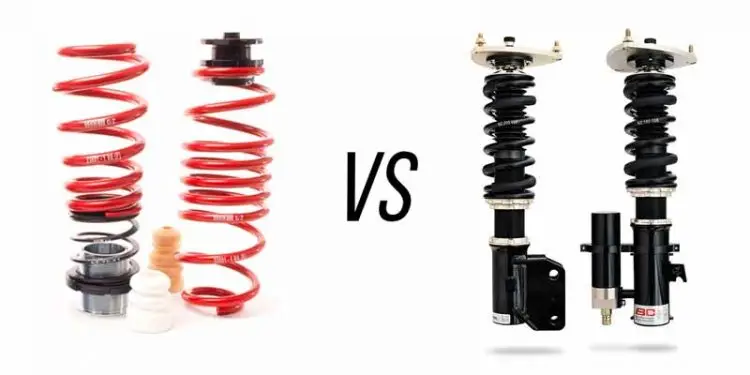
Two Philosophies
Traditional lift kits use separate springs and shocks. Coilovers integrate both into one adjustable unit. Each approach has distinct advantages.
What Is a Traditional Lift?
Traditional lifts use coil springs (or leaf springs on some vehicles) paired with separate shock absorbers. Height is determined by spring selection.
- Springs provide lift and support weight
- Shocks control motion and damping
- Components are separate and replaceable individually
- Height changes require spring replacement
What Is a Coilover System?
Coilovers combine a spring around a shock absorber with a threaded body that allows height adjustment. Many also offer damping adjustment.
- Integrated spring and shock unit
- Height adjustable via threaded collar
- Often includes damping adjustment
- More complex, more versatile
Comparison Chart
| Factor | Traditional Lift | Coilovers |
|---|---|---|
| Cost (Quality) | $1,000-3,000 | $2,500-8,000 |
| Height Adjustability | Fixed (spring swap) | Infinitely adjustable |
| Damping Adjustment | Some shocks offer it | Common feature |
| Complexity | Simple | More complex |
| Serviceability | Easy part replacement | Rebuild required |
| Tunability | Limited | Extensive |
When Traditional Lifts Win
Budget Builds
A quality traditional lift costs significantly less than a comparable coilover system. If budget is a concern, traditional is the way to go.
Simplicity
Fewer moving parts, simpler design. If a spring or shock fails, you replace that component. Coilovers require complete unit service or replacement.
Trail Repairability
You can strap a broken spring and limp home. A failed coilover is more problematic to deal with trailside.
Heavy Loads
Some applications benefit from traditional spring's ability to handle varying loads. Coilover springs have less variance tolerance.
When Coilovers Win
Tunability
The ability to adjust ride height and damping without changing parts is invaluable for dialing in your setup.
Performance
High-quality coilovers typically outperform equivalent-price traditional setups in both on-road comfort and off-road control.
Racing and Competition
Quick adjustments between stages or events make coilovers the standard for competitive use.
Desert Running
High-speed desert use demands the superior damping control that quality coilovers provide.
The Real-World Middle Ground
Many builders combine approaches:
- Front coilovers + rear traditional: Adjustability where it matters most, simplicity in the rear
- Traditional lift + high-end shocks: Fox, King, or Icon shocks on traditional springs offer excellent performance
- Full coilover systems: For those who want maximum adjustability throughout
Cost Breakdown
| Configuration | Price Range | Best For |
|---|---|---|
| Budget Traditional | $500-1,500 | Light use, budget builds |
| Quality Traditional | $1,500-3,500 | Most users, reliable performance |
| Entry Coilovers | $2,000-4,000 | Adjustability seekers |
| Premium Coilovers | $4,000-10,000+ | Serious performance, racing |
Installation Considerations
Both types require similar installation complexity. Coilovers may require more precise setup and corner balancing, but the actual install process is comparable.
Post-install tuning is where coilovers demand more time, dialing in height and damping settings can take several iterations.
Our Recommendation
For most builders: Start with a quality traditional lift with good shocks (Bilstein, Fox, etc.). This provides excellent performance at a reasonable price.
Consider coilovers if:
- You want maximum tunability
- You do high-speed desert running
- You compete or race
- Budget isn't the primary concern
- You enjoy the tuning process
The Bottom Line
Coilovers aren't inherently "better",they're different. Traditional lifts work excellently for most applications. Coilovers offer advantages for specific use cases and users who value adjustability. Choose based on your actual needs and budget, not marketing.