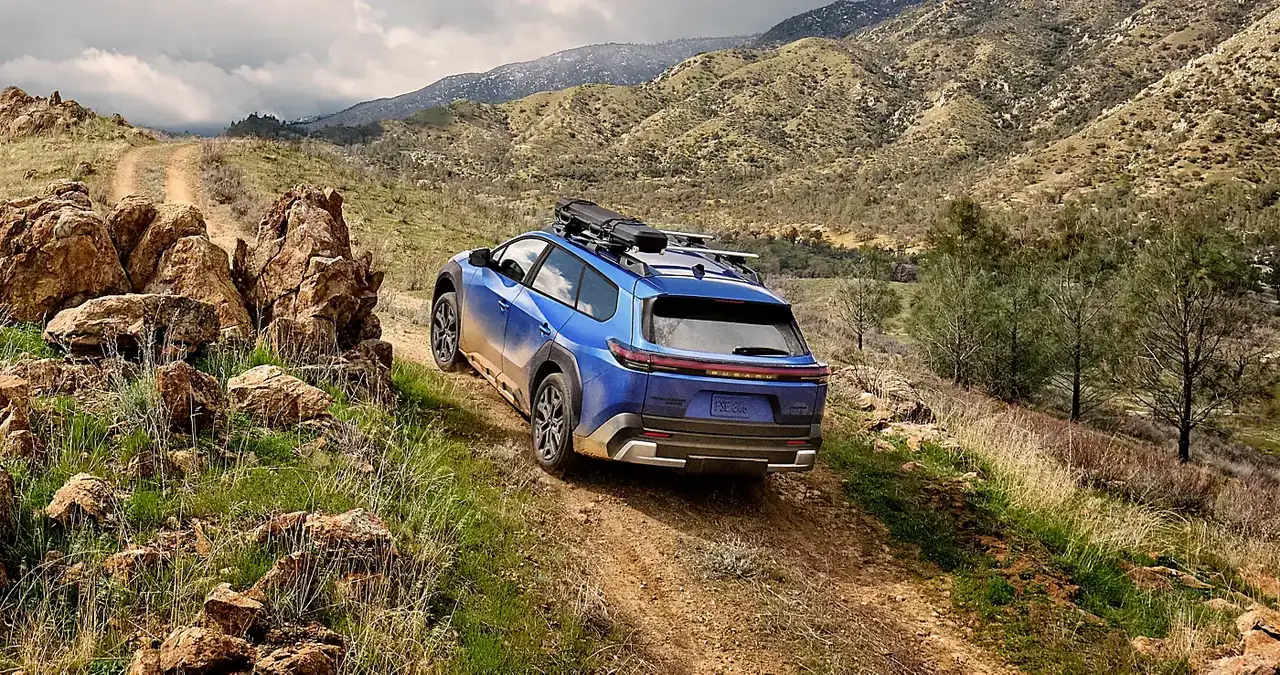
You're 47 miles down a forest road in central Oregon. The trail has been easy enough, gravel, some loose rock, one water crossing that came up to the running boards. You're camped for the night under a canopy of Douglas fir. Everything is perfect.
Except your car is at 22 percent battery, you have 47 miles of rough road between you and pavement, and the nearest DC fast charger is 94 miles away.
This is the scenario nobody is writing about when they review the 2026 Subaru Trailseeker. The press coverage has been enthusiastic. The specs look great on paper. Three hundred and seventy-five horsepower. Eight and a half inches of ground clearance. Dual X-Mode. Zero to sixty in 4.4 seconds. It starts at just under forty thousand dollars.
But trust is different from range. And range is the thing that actually determines whether you sleep well in a camp chair or in a panic.
What the Trailseeker Is (and Where It Fits)
The Trailseeker is Subaru's answer to a question a lot of people have been asking: what happens when you take the Outback formula, symmetrical AWD, reasonable ground clearance, practical wagon shape, adventure-friendly spirit, and run it entirely on electrons?
The result is a midsize electric SUV that sits between the Crosstrek and the Outback in personality. It shares its platform with Toyota, but the Trailseeker has been tuned more aggressively for off-road duty than its corporate cousin.
The powertrain is a dual-motor setup pulling from a 74.7 kWh lithium-ion battery. The front and rear motors work together through Subaru's updated Symmetrical AWD system with Dual-Mode X-Mode, the same torque vectoring and terrain management system that lives in the Wilderness lineup. Two terrain modes: Snow/Dirt and Deep Snow/Mud. Hill descent control. Grip Control for low-speed technical terrain.
Key Specs at a Glance
- Power: 375 HP dual-motor AWD
- Battery: 74.7 kWh lithium-ion
- Range: 280 miles (EPA estimated)
- Ground clearance: 8.5 inches
- 0-60: 4.4 seconds
- Towing: 3,500 lbs
- Charging: NACS port, 150 kW peak DC fast charge
- Starting price: ~$40,000
The Ground Clearance Question
Eight and a half inches is the number Subaru publishes. Let's put that in context. The Jeep Wrangler has 10.8 inches. A Toyota 4Runner TRD Pro has 9.6 inches. The Subaru Outback Wilderness has 9.5 inches. The Trailseeker is at 8.5.
That is not a bad number. It is a good number for a unibody crossover EV. It will clear the vast majority of forest roads, two-tracks, and established overlanding routes without drama.
What it is not: enough for serious rock crawling, deep ruts, or routes classified for trucks and lifted Jeeps. The Trailseeker was not built for Moab. For dirt roads, gravel passes, established forest service routes, and campsites that require a clearance bump but not a lift kit: the Trailseeker is at home.
X-Mode in the Real World
The X-Mode system on the Trailseeker is not a token feature. This is the same fundamental architecture Subaru has refined across the Forester Wilderness, Outback Wilderness, and Crosstrek Wilderness. It works.
In Snow/Dirt mode, the system optimizes throttle response, ABS thresholds, and AWD torque distribution for low-traction, variable surfaces. It is tuned to feel deliberate and controlled rather than reactive and nervous.
Deep Snow/Mud mode takes things further, lower throttle sensitivity, more aggressive rear torque bias, more permissive wheel slip before intervention. This is the mode for crossing muddy fields, climbing loose shale, and getting unstuck.
Hill descent control works as advertised. On an EV, the effect is delivered through regenerative braking, the transition is seamless and feels more natural than in older systems.
Grip Control is the low-speed mode for technical terrain. It caps wheel speed and applies torque calibrated for slow, deliberate movement over rocks and roots.
Honest Caveat
Range Anxiety Is Real. Here Is the Math.
Subaru claims 280 miles of range under standard EPA testing conditions. EPA testing happens at moderate speeds, on pavement, without significant accessories running. When you overland, none of those conditions apply.
We ran the same loaded, off-pavement range math on a smaller battery in our Slate Truck review, which is worth reading if you are weighing a cheaper EV.
What Kills EV Range in the Backcountry
- Off-road tires: AT tires have more rolling resistance. Expect 5-10% range reduction before you even leave the driveway.
- Rough terrain and low speeds: Crawling over obstacles is less efficient than highway cruising. Range estimates on rough trails can drop to 60-70% of highway figures.
- Elevation gain: Climbing costs energy. Dropping recovers some through regeneration, but not all.
- Accessories: A refrigerator running all night pulls 2-4 amps continuously. Heated seats, heat or AC in camp, all from the same battery.
- Cold weather: Below freezing, lithium-ion batteries hold and deliver less charge.
The Math in Practice
Take the 280-mile claim. Apply a 25% reduction for AT tires and trail driving. Apply a 10% reduction for accessories. Apply another 10% buffer for the unexpected. You are looking at a realistic safe working range of around 155-175 miles per charge for serious backcountry use.
That is not a disaster. Many overlanding trips operate comfortably within that radius. But it requires a fundamentally different kind of trip planning than a gas vehicle does.
Charging in the Backcountry: Your Actual Options
The Trailseeker's NACS port is the single most important feature for overlanding range management. The Tesla Supercharger network, more than 25,000 stations, is the most reliable and widespread DC fast charging network in the country.
- Level 3 DC fast chargers: Found at truck stops, some national park visitor centers, larger towns. 10 to 80% in about 28 minutes.
- Level 2 chargers (240V): Standard destination chargers at campgrounds and hotels. Full charge from near-empty takes 8-10 hours, perfect for overnight stays.
- Portable charger (120V): Roughly 3-5 miles of range per hour. Not meaningful for range recovery but useful for topping off over two camp nights.
- Solar: Reduces accessory load on the main battery but cannot meaningfully charge the traction battery in useful time frames.
What the Trailseeker Does Better Than a Gas Vehicle
- Instant torque: 375 HP with full torque from zero RPM. On a loose shale climb where momentum is everything, calling up full torque from a standstill is a genuine advantage.
- Silence: No engine idle at camp. You can sleep next to the car. No exhaust in enclosed spaces.
- Maintenance simplicity: No oil changes, fuel filters, spark plugs, or timing belts. Fewer things that can fail mechanically on extended expeditions.
- Regenerative braking on descents: Long descents recharge the battery instead of heating brakes. Meaningful for both range recovery and brake longevity.
- No fuel price gouging: No paying $6.50 a gallon at the only remote station for 80 miles.
The Verdict Table
| Category | Trailseeker | Outback Wilderness | Notes |
|---|---|---|---|
| Ground clearance | 8.5 in | 9.5 in | Outback Wilderness wins |
| Off-road capability | Strong | Very strong | Both X-Mode equipped |
| Power | 375 HP (EV) | 260 HP (turbo) | Trailseeker dominates |
| Usable backcountry range | ~155-175 mi | ~350-400 mi | Gas wins for remote trips |
| Trail charging options | Limited to infrastructure | Jerry can anywhere | Gas wins on self-sufficiency |
| Camp power for accessories | Excellent (V2L) | Generator required | EV wins |
| Maintenance simplicity | Very high | High | EV wins |
| Purchase price | ~$40,000+ | ~$37,000+ | Similar entry point |
| Best use case | Weekend overlanding, planned multi-day | Everything including week-long remote | Know your use case |
Who Should Buy It
Buy the Trailseeker if:
- Your typical trip is a Friday-to-Sunday loop covering under 150 miles of off-pavement terrain
- You're in the Pacific Northwest, Colorado, Utah, or areas where EV infrastructure near outdoor recreation has matured
- You want instant torque for towing a small overlanding trailer or teardrop (up to 3,500 lbs)
- You're already fine adding "charger location" to the planning checklist
Wait, or choose the Outback Wilderness instead, if:
- Your trips regularly push into territory where the nearest reliable charging is more than 100 miles away
- You prefer self-sufficient, unplanned adventure, the jerry can freedom
- You already own a gas Outback or Forester that works for your use case
The Bottom Line
The 2026 Subaru Trailseeker is not a gimmick and it is not the future pretending to be ready before it is. It is a genuinely capable overlanding vehicle for a specific kind of overlander.
Subaru built something honest here. They didn't stuff a luxury EV into trail clothing and call it adventure-ready. They took X-Mode seriously, kept the ride height respectable, priced it within reach, and connected it to the best charging network in North America.
The range constraint is real. The charging planning requirement is real. Anyone who tells you otherwise is selling you something.
The Trailseeker will get you to the trail. It will pull hard up the hill. It will hold its line on the descent. It will run your fridge and your lights from the same battery. It will be silent at 3am when the elk walk past your camp.
Whether it gets you back to the charger is entirely up to how well you planned.
Plan well. Go far. The road less paved doesn't care what powers you.