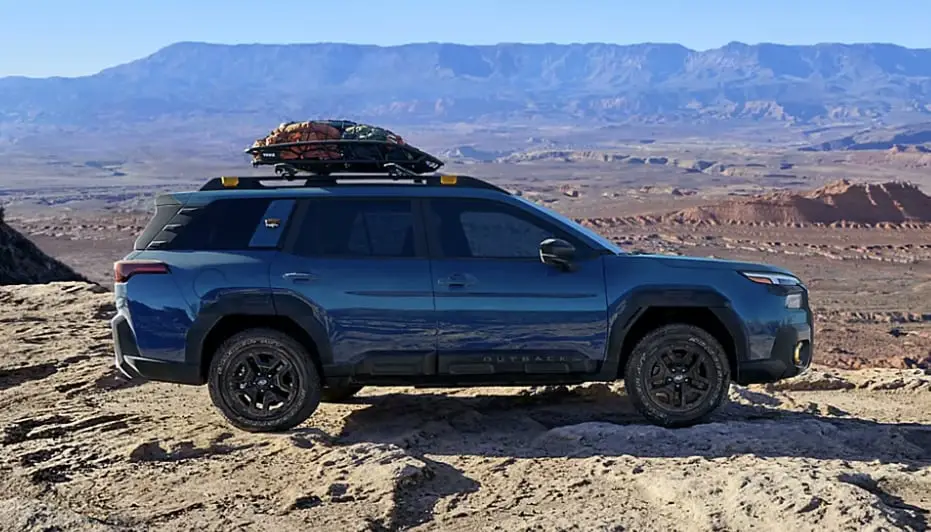
The trailhead parking lot tells you everything about who buys an Outback Wilderness. There's a Tacoma with a rooftop tent, a Wrangler with a Hi-Lift strapped to the roof, and then there are three Outback Wildernesses parked next to each other, all with bikes on the roof rack, kayaks on the rails, and mud on the fenders from a forest service road that none of the other vehicles even bothered with.
That's the Outback Wilderness buyer. Not chasing rock crawling glory. Finding the lake nobody else found.
The 2026 model is the most significant redesign in years. Taller, wider, boxier, and now equipped with something no other mainstream overlanding crossover offers at this price point: electronically controlled adaptive dampers that actually change behavior between pavement and trail. There's a lot to like here. There's also one thing Subaru quietly left off the standard equipment list at $46,445 that you need to know about before you drive one off the lot.
What's New for 2026
Subaru redesigned the Outback from the ground up for 2026. The visual change is immediate, the old wagon silhouette is gone. The new body is taller by 2 inches, wider by 1.6 inches, and just slightly longer at an additional 1.1 inches. The result looks more like a proper SUV and less like a lifted Legacy. For overlanding purposes, the taller roofline matters: more headroom for rear passengers on long approach roads, and a cargo floor that sits higher and flatter for sleeping platforms and gear packing.
Ground clearance on the Wilderness trim measures 9.5 inches, which is a meaningful 0.8-inch improvement over the base Outback's 8.7 inches. Approach angle improves to 20 degrees, breakover to 21.2 degrees, and departure to 23.6 degrees. Those numbers won't threaten a 4Runner TRD Pro or a Bronco, but they place the Outback Wilderness meaningfully ahead of competitors like the Hyundai Santa Fe XRT Pro and the Kia Sportage X-Pro.
The Wilderness trim also keeps the 2.4-liter turbocharged SUBARU BOXER engine, good for 260 horsepower and 277 lb-ft of torque. This engine is one of the strongest arguments for the Wilderness package over a base model with aftermarket mods, more on that shortly. Towing capacity holds at 3,500 pounds, which covers most overlanding trailers, small off-road teardrop setups, and mid-size boat trailers.
The Adaptive Damper Story: What It Actually Means on Trail
This is the headline feature nobody in the mainstream press has explained properly for people who actually use these vehicles off-road.
The 2026 Outback Wilderness is the first Outback to get electronically controlled adaptive dampers, and they are exclusive to the Wilderness trim. Sensors continuously read vehicle speed, steering input, acceleration, and braking, and they adjust damping force in real time. On pavement, the dampers stiffen to reduce body roll in corners and cut that floaty wagon feeling in half. Subaru claims a 50% improvement in pitch rate, meaning less dive under braking and less squat under hard acceleration.
On rough terrain, the system softens. Washboard fire roads, embedded rocks, and rutted two-tracks that used to shake your fillings loose get absorbed through a noticeably more compliant ride. This isn't just a comfort upgrade, it means your gear takes less punishment, your passengers arrive less rattled, and you can maintain better speed on loose terrain because the tires are staying in more consistent contact with the ground.
Honest Limitation
For the 95% of overlanders running forest service roads, two-track access roads to campsites, and moderate 4x4 trails with no serious obstacles, the adaptive dampers make the 2026 a materially better tool than the previous generation.
The Skid Plate Reality Check
What Subaru Didn't Tell You
At $46,445 starting price, you would reasonably assume your drivetrain is covered. It is not. If you put this vehicle on a rocky trail and clip a rock with the wrong part of the undercarriage, you are potentially looking at an unprotected engine oil pan or transmission case.
Before your first trail run, price out Subaru's genuine accessory skid plate package or an aftermarket option from Primitive Racing or Rally Armor. Budget $300 to $600 to finish what Subaru started. It is frustrating that this isn't standard at this price point, but it is a known, fixable problem, the same way the Forester Wilderness leaves the rear differential unprotected from the factory. Add the skid plates before you go anywhere rocky. Not after.
Is the Wilderness Worth It Over a Lifted Base Outback?
This is the question that every Subaru forums thread eventually lands on, and the honest answer is more nuanced than either camp admits.
A 2026 Outback Premium starts at $34,995. The Wilderness runs $46,445 including destination. That is an $11,450 premium. For that money, you get the lift, the all-terrain tires, the X-MODE Dual Mode system, the adaptive dampers, and the heavy-duty roof rails with 800-pound static capacity.
But the most important thing in that package is the engine. The base Outback runs the 2.5-liter naturally aspirated four-cylinder at 182 horsepower and 176 lb-ft of torque. The Wilderness gets the 2.4-liter turbocharged engine at 260 horsepower and 277 lb-ft. That is not a subtle difference. On a loaded two-track climb at elevation with two adults, camping gear, and a 1,500-pound trailer attached, the turbocharged engine is doing a fundamentally different job than the naturally aspirated one.
If you lift a base Outback with a 2-inch ReadyLIFT kit ($400) and add a set of Yokohama Geolandar AT tires ($700, $900), you land around $36,500 to $37,000. You have matched the Wilderness on clearance and tires. You have not matched the engine, the adaptive dampers, or the factory-calibrated X-MODE tuning. And you have voided portions of your suspension warranty.
Bottom Line
Off-Road Specs: Outback Wilderness vs. The Competition
Off-Road Specs Comparison
| Feature | 2026 Outback Wilderness | 2026 Forester Wilderness | Honda Pilot TrailSport | Hyundai Santa Fe XRT Pro |
|---|---|---|---|---|
| Ground Clearance | 9.5" | 9.3" | 8.3" | 8.5" |
| Approach Angle | 20° | 23.5° | 19.5° | 19.8° |
| Departure Angle | 23.6° | 25.5° | 22.3° | 20.4° |
| Breakover Angle | 21.2° | 21° | 19.1° | 18.7° |
| Engine | 2.4L Turbo 260hp | 2.5L NA 182hp | 3.5L V6 285hp | 2.5L Hybrid 277hp |
| Towing | 3,500 lbs | 3,000 lbs | 5,000 lbs | 3,500 lbs |
| Off-Road Mode | X-MODE Dual | X-MODE Dual | TrailWatch | Terrain AWD |
| Adaptive Dampers | Yes (new 2026) | No | No | No |
| Starting Price | $46,445 | $37,495 | $48,050 | $43,750 |
The Forester Wilderness actually beats the Outback on approach angle at 23.5 degrees vs. 20 degrees, which matters on steep rocky entrances. But the Outback wins on departure angle, towing, engine power, and now has the adaptive dampers the Forester doesn't get. If you're choosing between the two Subaru Wilderness models, the Outback is the better trail companion for loaded overlanding. The Forester wins for tighter, steeper trail entrances and a lower starting price.
Against the Pilot TrailSport and Santa Fe XRT Pro, the Outback Wilderness wins on every meaningful trail geometry number except towing (where the Pilot's 5,000-pound rating stands alone in this class). Honda's TrailWatch off-road display is genuinely useful, but it doesn't have the X-MODE depth or the suspension sophistication of the Subaru.
X-MODE Dual: How to Actually Use It
The 2026 moves the X-MODE button to the steering wheel, which sounds like a small change until you're on a steep descent and realize you don't have to dig for a console button while keeping both eyes on the trail. This is a real quality-of-life improvement.
X-MODE now re-engages automatically when your speed drops below 25 mph, which means you don't have to remember to turn it back on after stopping to scout a section. It just stays ready.
Snow/Dirt mode handles the majority of overlanding scenarios: forest service roads, hard-packed dirt, gravel washes, light mud. The system manages throttle, brakes, and torque distribution to minimize wheelspin and keep traction smooth. Deep Snow/Mud mode increases wheelspin tolerance for deeper, softer terrain where you need momentum more than precision.
Know Its Limits
Real-World Overlanding Capability
The 2026 Outback Wilderness can handle fire roads confidently. It runs forest service roads all day. It manages moderate two-track that most family vehicles would scrape through. The 260-horsepower turbo engine has enough reserve to pull a loaded trailer up a high-altitude pass without labor, which matters in the mountains.
The higher roof and improved cargo area (34.6 cubic feet behind the rear seats, up 2 cubic feet from the previous generation) make it a better dedicated overlanding vehicle. The roof rail system with an 800-pound static rating handles most overlanding setups: Rotopax mounts, a cargo basket, and a gear bag without drama.
Water crossings up to the belly of the vehicle are manageable given the 9.5 inches of clearance. The long overhangs front and rear remain the primary obstacle constraint. The 20-degree approach angle means steep step-ups require careful entry, and the departure angle at 23.6 degrees means you can exit most trails without scraping.
What it cannot do: rock crawling, serious shelf roads, anything requiring locking differentials, high-clearance obstacle navigation, sustained deep mud without momentum. Those situations call for a Wrangler, a 4Runner TRD Pro, or a Bronco. This vehicle is not pretending to be those things.
Who Should Buy the 2026 Outback Wilderness
The 2026 Outback Wilderness is the right vehicle for the overlander who uses their rig primarily as a daily driver and secondarily as a trail vehicle. If your typical weekend looks like three hours on pavement, ninety minutes on a forest service road, and two nights at a dispersed campsite you could only reach in something with actual ground clearance, this vehicle is built exactly for you.
It is the right choice if you carry bikes, kayaks, or a small trailer and need the towing capacity and roof rail system to haul gear efficiently. The cargo volume and roof load rating are class-leading for family overlanding.
It is the right choice if you want factory warranty coverage on your off-road capability rather than cobbling together aftermarket mods and voiding your powertrain warranty piece by piece.
Before Your First Trail
Who Should Look Elsewhere
If you run technical trails with serious obstacles, the Outback Wilderness ceiling will frustrate you. The lack of a locking differential, limited suspension articulation, and unibody construction mean it will hit its limit in situations where a Wrangler or a Land Cruiser would keep moving. No amount of X-MODE tuning changes the geometry.
If you spend more time on technical terrain than pavement, look at the Toyota 4Runner Trailhunter or the Jeep Wrangler Rubicon. If budget is the constraint and moderate trail access is the goal, the Forester Wilderness at $37,495 saves nearly $9,000 with comparable capability for light-to-moderate overlanding.
If you plan to build out a serious sleep system and run the vehicle as a basecamp with a rooftop tent and full overlanding rack, verify that the roof dynamic load rating at 220 pounds is sufficient for your setup before committing. It handles most light rooftop tents but will not support heavier hard-shell RTTs without aftermarket reinforcement.
The Honest Verdict
The 2026 Outback Wilderness is the best version of this vehicle Subaru has built. The adaptive dampers are a genuine innovation that makes the vehicle more capable on trail and more composed on road. The power increase from the turbo engine over the naturally aspirated base model is significant enough that the Wilderness deserves to be evaluated as a different vehicle, not just a lifted one.
The skid plate situation is the real caveat. Add full underbody protection before you use it as intended and the sticker is closer to $47,000 to $47,500. At that price, against a Honda Pilot TrailSport that tows 5,000 pounds and a Hyundai Santa Fe XRT Pro that costs $3,000 less, the Outback Wilderness has to earn its place on capability and brand reliability. Against those competitors, it does.
It is not a rock crawler. It was never meant to be. For the overlander who spends most of their life on pavement and occasional weekends on trails, it is one of the most complete and honest packages available at this price.
Build It Out