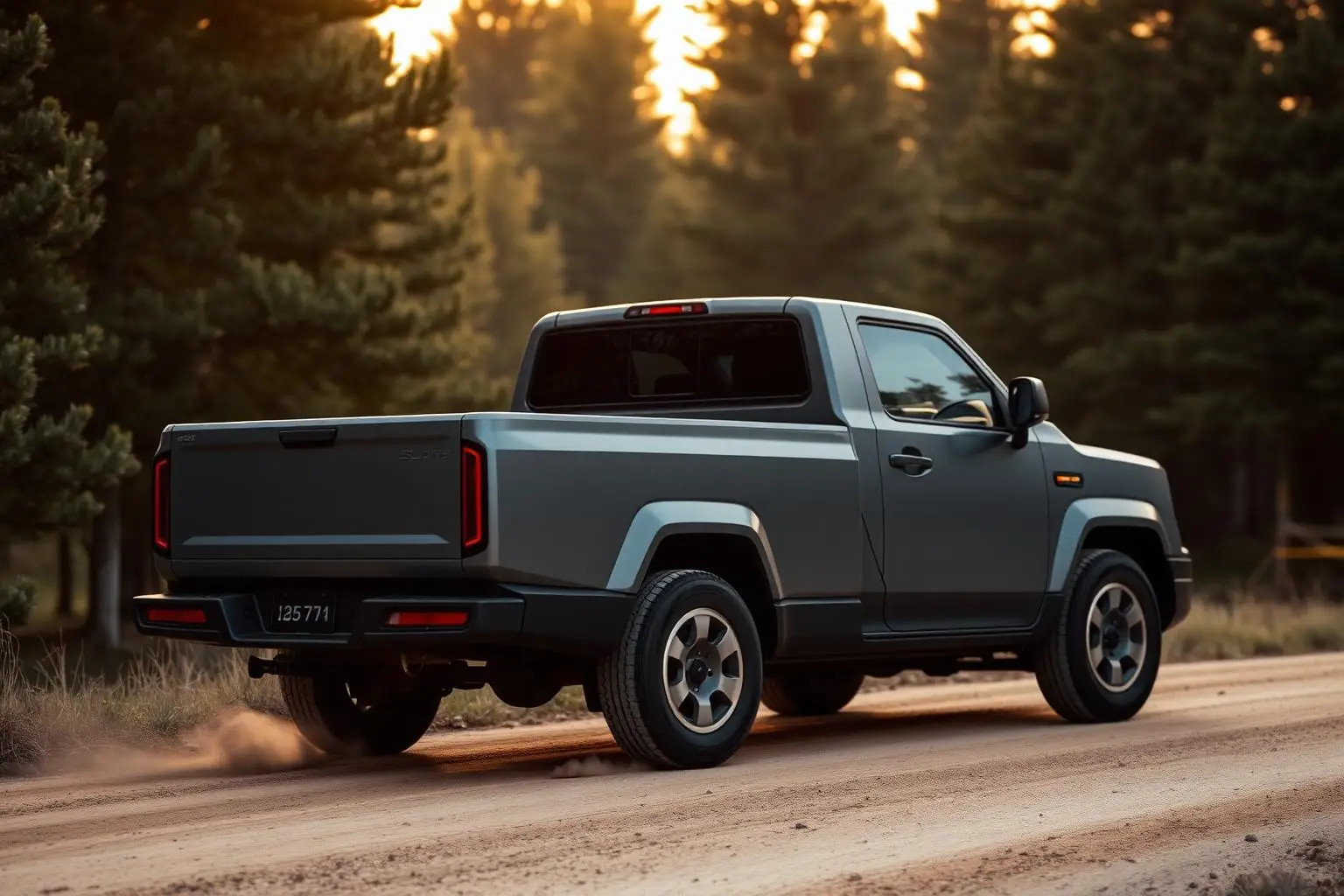
The pavement ends about a mile past the cattle guard, the way it always does on the good roads, and you watch the dust kick up behind the rig in front of you and feel the tires start to talk to the dirt. Now picture that rig is a Slate Truck. Steel wheels. Crank windows. A slate-gray plastic body that cost less than a loaded golf cart. A single motor spinning the rear axle and nothing at all going to the front. The trail tips uphill into loose decomposed granite, the back end steps out looking for grip, and the truck that the entire internet just spent a day calling the future of cheap adventure starts to understand the difference between looking the part and doing the work.
Slate dropped final pricing this morning, June 24, 2026, and the number is real: $24,950 for the pickup, $29,950 for the Squareback and Fastback SUV versions. One hundred eighty thousand people have reservations. Half the overlanding internet is already photoshopping rooftop tents onto it. So let us do the thing nobody selling you a wrap or a lift kit is going to do, and answer the actual question. Can the Slate Truck overland, or does it just look like it can?
Why this matters right now
Cheap is the whole story here, and cheap is rare in this hobby. The average new vehicle in America now transacts north of $50,000. A built overland 4Runner runs you the price of a small house down payment before you have aired down a single time. So when a Jeff Bezos-backed startup says it will sell you a brand-new electric pickup for the price of a used Tacoma with 90,000 miles on it, the dispersed-camping crowd pays attention. They should.
But $24,950 buys you a specific machine, not the machine in your head. The brochure photos and the launch hype are doing a lot of quiet work to make this look like a trail rig. The spec sheet tells a different story, and the spec sheet is what you sleep on at 9,000 feet when the temperature drops and the battery does too. Here is what Slate actually confirmed today.
The honest truth nobody is leading with: it is rear-wheel drive only
Every overlanding fantasy built on the Slate Truck dies on one line of the spec sheet. There is no all-wheel drive. There is no four-wheel drive. There is no front motor. At launch the Slate is a single rear-mounted electric motor turning the rear wheels, full stop. Slate says an AWD version is "planned." Slate has committed to exactly zero about when.
This is the part that gets buried under the price tag, and it is the part that matters most. Overlanding is not about horsepower or even ground clearance first. It is about putting power down on surfaces that do not want to cooperate: wet grass, loose sand, off-camber shale, a rutted two-track after an afternoon storm. A rear-drive vehicle with the weight of an EV battery low and centered will do better than people expect on a graded forest road. It will also get stuck on a mild sandy pull that a stock all-wheel-drive Crosstrek would walk up without the driver noticing.
The architecture is the limit
You can bolt on the optional suspension lift. You can wrap it to look like a Baja truck. None of that sends a single watt to the front wheels. The Slate is not a soft-roader with a traction deficit you can mod around. The traction deficit is the architecture.
What you actually get for $24,950
Set the trail aside for a second, because as a vehicle the Slate is genuinely interesting, and the honesty cuts both ways. This is a deliberately stripped machine, and a lot of what it leaves out is stuff overlanders strip off their own rigs anyway.
It is small. Total length is 174.6 inches on a 108.9-inch wheelbase, which makes it nearly two feet shorter than a Ford Maverick. On a tight, rocky shelf road, short and narrow is a real advantage, and the Slate has it in spades. The body panels are injection-molded plastic in a single color, so trail pinstripes from desert brush wipe off instead of ruining a paint job you paid for. There is no touchscreen, no radio, and notably no cellular modem at all, which means the truck literally cannot phone home or track you. For people who go off-grid partly to disappear, that is a feature, not a compromise.
Slate Truck (2027) at a glance
The full picture, with the numbers that actually changed between last year's prototype and today's production reveal.
| Spec | Slate Truck (2027) | What it means on the trail |
|---|---|---|
| Price | $24,950 truck / $29,950 SUV | Cheapest new EV truck in America |
| Drivetrain | Single rear motor, RWD only | The dealbreaker for real off-road traction |
| Power | ~181 hp / 195 lb-ft | Enough for the road, modest for crawling |
| 0-60 mph | 8.0 sec | Slower than most rental subcompacts |
| Top speed | 90 mph | Fine for the forest road, not the hammer lane |
| Battery | 65 kWh (63 usable), LFP | Single pack, no long-range option |
| Range | 205 mi (EPA) | Before you load it, lift it, or leave pavement |
| Tow rating | 2,000 lbs | Small teardrop or utility trailer only |
| Payload | 1,550 lbs | Genuinely good for the class |
| Curb weight | 4,048 lbs | Heavy for the size, thank the battery |
| DC fast charge | 20-80% in ~30 min | No fast chargers where you actually camp |
| Ground clearance | Not published | Telling, and we will come back to it |
| Production | Q4 2026, Warsaw, IN | You are not camping in one this summer |
Note that last spec, or rather the absence of it. Slate has published towing, payload, curb weight, even the kilowatt-hours down to the usable figure. It has not published ground clearance, approach angle, departure angle, or breakover. When a company is proud of a number, it prints it. The silence on clearance is its own quiet answer about where this truck is meant to spend its life, and that life has a curb on it.
The range math, run for real
EV range numbers are lab numbers, and overlanding is the opposite of a lab. So let us do the honest arithmetic, because this is where the Slate's mission gets defined whether the marketing likes it or not.
Start at the 205-mile EPA estimate. Now apply the real world. Load the bed with gear, water, and recovery equipment. Add a roof rack and maybe a tent, which wrecks aerodynamics and bleeds range at any speed. Climb elevation, because the good camping is up high. Run the heat at night or the A/C in the desert. Crawl slowly over rough ground, which is easier on an EV than people think, but then drag everything back out on washboard. Realistically you are looking at a 30 to 40 percent haircut once the truck is actually outfitted and working. Call it 125 to 145 usable miles.
Now hitch up even a small trailer and watch EVs routinely give back close to half their range. You could be down to 100 to 120 miles with a teardrop behind you.
The real-radius rule
Your real radius is not your range. It is roughly your usable range, minus a safety reserve, divided by two, because you have to get back to the charger you left. Take 140 honest miles, hold back 20 percent so you are not gambling on a dead pack 40 miles from cell service, and you are working with about 110 miles of round-trip budget. That is a 50 to 55 mile push from the last reliable charger before you have to turn around.
That math is not an insult. It is a mission statement. The Slate is an overnighter, a frontcountry rig, a "drive two hours, camp near pavement, come home" machine. It is not a multi-day, deep-backcountry, off-grid platform, and no battery extender is coming to fix it, because Slate quietly dropped the larger pack and made 205 miles the one and only option.
Where the Slate actually makes sense outside
Reverse all of that and a real use case appears, and it is a good one. There is an enormous population of people who want to get outside, sleep in or beside their truck, and reach a quiet spot on a maintained dirt road, and who have been priced completely out of the overlanding world. For that person, on graded forest roads, gravel, hardpack, and mild dirt within an hour or two of home, the Slate is a legitimately compelling tool.
The 1,550-pound payload is genuinely strong for the size and beats plenty of midsize trucks, so you can load it heavy without busting the rating, as long as you remember the GVWR is 5,689 pounds and a 4,048-pound curb weight already spent a big chunk of it. The compact dimensions make tight trails and trailhead parking easy. The plastic body shrugs off pinstripes. The silence of an EV at a quiet camp is its own reward, and you can run a fridge and lights off the truck without idling a gas engine all night. Pair it with the IKEA-style SUV conversion kit, which turns the pickup into an enclosed wagon with a back seat, and you have a cheap, weatherproof, sleep-inside-it adventure box for the price of a decent used commuter.
That is soft-roading and light overlanding, and there is zero shame in it. Most "overland" miles most people drive are exactly this. The Slate just needs to be sold as what it is instead of what looks good with a light bar rendered onto it. For the honest difference between this kind of travel and the hardcore stuff, our overlanding vs off-roading guide and our soft-roading guide lay out exactly which side of the line a rig like this lives on.
How it stacks up against the other cheap-EV-adventure dreams
The Slate is not the only electric rig people are mentally outfitting for the trail right now, and it helps to place it. The Rivian R2 is the actual overland EV, with dual or triple motors, real all-wheel drive, and real clearance, and it costs roughly double once you option it the way you would want. The Scout Traveler is chasing the hardcore body-on-frame buyer with an available gas range-extender, which solves the backcountry charging problem the Slate cannot. The Jeep Recon and the Cybertruck are heavier, pricier, and far more capable, and far less likely to be parked at a Forest Service campground by someone on a normal budget.
The Slate is not competing with any of them. It is competing with a used Subaru and a tent, and against that comparison it is brand new, it is a truck, and it costs about the same. That is the matchup that matters, and it is the one Slate will win or lose on.
The honest warts, all in one place
The rear-wheel-drive architecture is the headline limitation and it is structural, not a trim choice you can option away today. The 205-mile range collapses to an overnight radius the moment you load and leave pavement. There is no fast charging anywhere near where you camp, so you are tethered to town. Slate has not published a single clearance or approach figure, which tells you they are not numbers worth bragging about. Top speed is 90 mph and zero to sixty is a leisurely 8.0 seconds, so highway stretches to distant trailheads will test your patience. And you cannot buy one until late this year at the earliest, with production just starting in Q4 2026, so anyone planning a summer 2026 trip around it is planning around a press release.
None of this makes the Slate a bad vehicle. It makes it a precisely defined one, and the people who will be happiest are the ones who hear the definition before they put down the $300.
Verdict: who should buy it, who should walk
Who the Slate Truck is and is not for
| If you are... | The Slate Truck is... |
|---|---|
| A budget-first camper sticking to graded dirt and gravel near home | A genuinely smart, cheap way in |
| A first-time adventurer who wants new, simple, and trail-curious | A strong pick, eyes open about range |
| Someone who needs AWD for sand, snow, or real off-camber | The wrong truck, today, full stop |
| A multi-day, deep-backcountry, off-grid overlander | Not your rig, not even close |
| Anyone towing more than a small teardrop | Out of capacity at 2,000 lbs |
Buy it if your honest overlanding is dispersed camping down a maintained road, a fishing access two-track, a gravel pull to a quiet ridge, all within a tank, or a charge, of home. Walk away if your idea of a trip involves sand, real elevation gain off-grid, snow, or anything that asks the front wheels to do work, because on the Slate there is nothing up there to ask.
Bottom line
The Slate Truck is the most interesting cheap vehicle to hit this hobby in years, and it earns the attention. Just buy the truck Slate actually built, not the one the internet is rendering. Built for the road less paved, sure, as long as the road less paved is still a road.