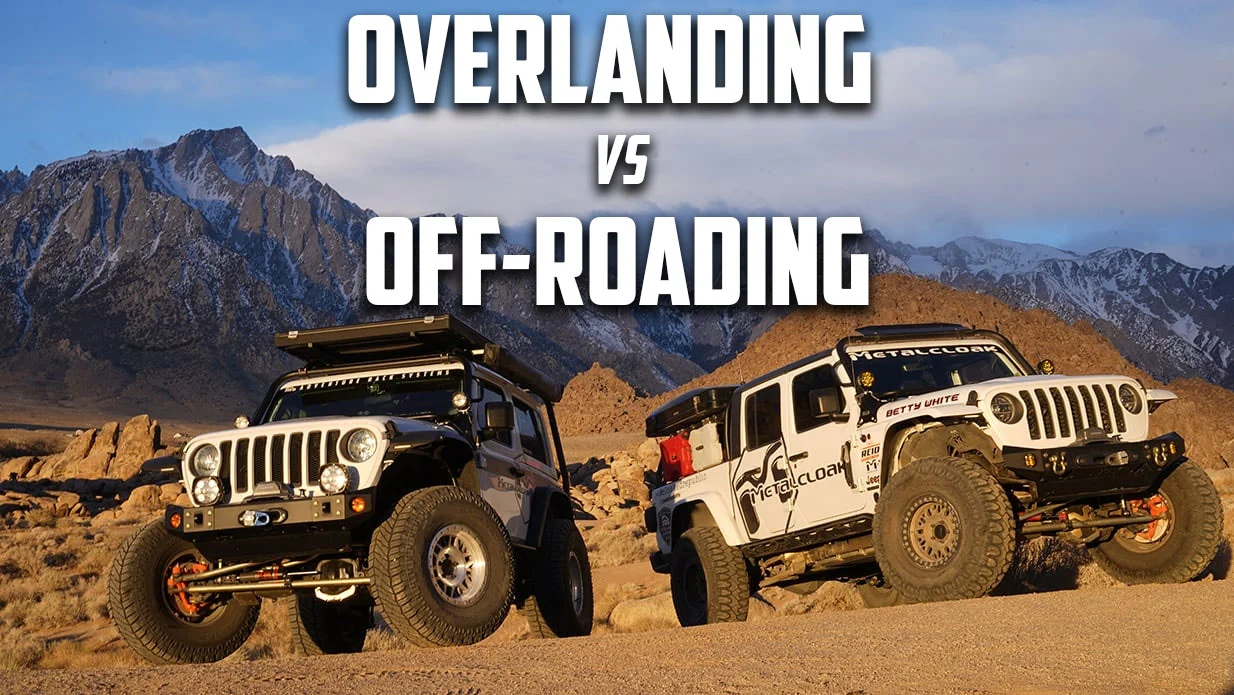
Two rigs roll up to the same trailhead outside Moab on a Friday morning. The first is a Wrangler on 37s with a winch and an empty cargo area except for a cooler and a recovery bag. The second is a Tacoma wearing a rooftop tent, a fridge on a slide, and enough water for five days. By noon, the Wrangler has turned around twice on purpose, just to run the hard line again. The Tacoma is forty miles away and won't see pavement until Tuesday.
That is overlanding vs off-roading in one trailhead. Same morning, two completely different sports. And if you are trying to decide which one you are actually doing, the answer matters more than you think. Not because anyone on the trail cares what you call it. Because the two activities spend your money in opposite directions, and buying for the wrong one is the most common four-figure mistake in this hobby.
Overlanding vs Off-Roading: The Short Answer
Off-roading is about the obstacle. Overlanding is about the distance. Off-roading happens in hours and is measured in difficulty. Overlanding happens in days and is measured in miles and self-sufficiency. An off-roader drives the hardest terrain they can find and goes home. An overlander drives the easiest terrain that still gets them somewhere remote, and stays out there.
| Off-Roading | Overlanding | |
|---|---|---|
| The point | Conquer terrain | Cover distance, camp remote |
| Duration | Hours to a day | Days to weeks |
| Pace | Crawl the hard sections, repeat them | Steady miles, avoid the hard sections |
| Terrain | Rocks, mud, sand, technical trails | Dirt roads, two-tracks, backcountry routes |
| Vehicle priority | Articulation, clearance, lockers, armor | Payload, range, storage, reliability |
| Gear priority | Recovery and protection | Water, food, shelter, power, navigation |
| Sleep | Your own bed | In or on the vehicle |
| Failure mode | Body damage, broken parts | Running out of something 80 miles from a store |
Both happen off pavement. Both reward a capable 4x4. That is roughly where the overlap ends.
What Off-Roading Actually Is
Off-roading is driving unpaved, unimproved terrain for the challenge of the terrain itself. It is a skills activity, closer to climbing than to travel. The sport splits into disciplines, and each one shapes the vehicle differently.
Trail riding is the entry point: forest roads, fire roads, rated 4x4 trails. Rock crawling is the technical extreme, low range and 100:1 crawl ratios, walking a rig over obstacles at less than walking speed. Mudding is a traction fight where the main challenge is not getting stuck and the main cost is everything mud does to your driveline. Desert running is the speed discipline, long-travel suspension soaking up whoops at 60 mph. Different disciplines, same DNA: the terrain is the opponent.
Because the obstacle is the point, off-road builds chase capability per dollar. Tires first, always. Then lockers, then suspension that prioritizes articulation, then armor: skid plates, rock sliders, bumpers that survive contact. Cargo space is an afterthought because the trip ends at dinner time. Nobody rock crawls with 600 pounds of camp gear on board if they can help it, because every pound works against you on an obstacle.
What Overlanding Actually Is
Overlanding is self-reliant, vehicle-based travel through remote country where the journey is the destination. You carry everything: food, water, shelter, fuel, tools, power. The trip is measured in days minimum, sometimes months. The core of it is this: an overlander's enemy is not the obstacle. It is the gap between what you brought and what you need.
That flips the build priorities upside down. Payload matters more than articulation, because water weighs 8.3 pounds a gallon and you need a gallon per person per day. Range matters more than crawl ratio, because fuel stops are 150 miles apart in the places worth going. Reliability beats capability every single time, because a broken rig 80 miles from cell service is not a story, it is a situation. The overlander's spec sheet reads like an expedition manifest: fridge, water storage, dual battery, recovery gear, comms. The suspension upgrade that matters is the one rated for the load, not the one with the most flex.
The Honest Part Nobody Says Out Loud
Here is the thing the gear industry will not tell you, and most of the articles ranking for this exact question are written by the gear industry: the overwhelming majority of American overlanding happens on terrain a stock Subaru could handle. Maintained forest service roads. Graded BLM two-track. The kind of driving we call soft-roading when nobody is trying to sell you a $3,000 bumper.
That is not an insult. It is the entire point. Overlanding deliberately routes around difficult terrain, because hard obstacles are where trips end. When your house is on your back and the nearest help is a day away, you take the bypass. Real overlanders are conservative drivers by design. The Instagram version, a built rig flexed out on a rock ledge with a rooftop tent deployed, is two sports photoshopped into one image. Nobody camps on the obstacle.
The off-roading world has its own version of this honesty problem. Most "off-roaders" run the same three local trails a dozen times a year, and the hardest thing their winch has ever pulled is a friend's stuck quad. That is also fine. The point of naming the two activities accurately is not gatekeeping. It is so you stop buying gear for the trip you are not taking.
And that is the real reason this comparison matters. Roughly 12 million Americans are expected to overland in some form this year, and 95 percent of them modify their vehicles. The single most common mistake we see is the new buyer who builds an off-road rig for an overlanding life: maximum tire, maximum lift, lockers, armor, and then no payload left for water, no budget left for a fridge, and a rig that rides like a lumber truck for 600 highway miles to the trailhead. They bought capability they will use twice a year and skipped the self-sufficiency they need every single night.
Where the Two Sports Genuinely Overlap
The separation is real, but it is not a wall. Every serious overlander needs a baseline of off-road skill, because even an easy route can throw you a washout, a snowdrift, or a shelf road that got ugly since the last trip report. Knowing how to pick a line, air down, and run proper recovery gear is not optional just because you avoid hard trails. Off-roading skills are the insurance policy of overlanding.
The reverse is also true. The off-roader who starts camping out to run distant trails is overlanding whether they admit it or not. A weekend wheeling trip with two nights of dispersed camping sits exactly on the border, and plenty of people live there happily. The categories describe intent, not membership cards.
Gear overlaps too, at the foundation. Both sports want all-terrain or mud-terrain tires, recovery points, traction boards, a way to air down and back up, and navigation that does not depend on cell coverage. Build that foundation first and you have not wasted a dollar no matter which direction you grow.
Which One Should You Actually Pursue First?
Answer one question: what does the perfect Saturday look like?
If it looks like an obstacle conquered, a hard line cleaned, your rig doing something it should not be able to do, you are an off-roader. Start with trail riding on rated trails, put your first money in tires and recovery gear, and learn vehicle control before you buy lockers. The trail network near you is bigger than you think.
If the perfect Saturday ends with your tailgate down at a campsite three hours past the last fence post, you are an overlander. Do not build anything yet. Take the vehicle you already own on an easy two-night route and let the trip tell you what to buy. Route-picking matters far more than the rig at this stage.
And if you genuinely want both, build in this order: tires, recovery, skills, then payload-rated suspension, then camp systems, and armor last. That sequence serves both sports without strangling either one.
| Your situation | Start with |
|---|---|
| Stock SUV or crossover, weekends free | Overlanding on easy routes, stock vehicle |
| Capable 4x4, no camping interest | Trail riding, then technical off-roading |
| Capable 4x4, want remote camping | Overlanding, add skills via day trails |
| Big budget, no experience | Skills first. Money cannot drive. |