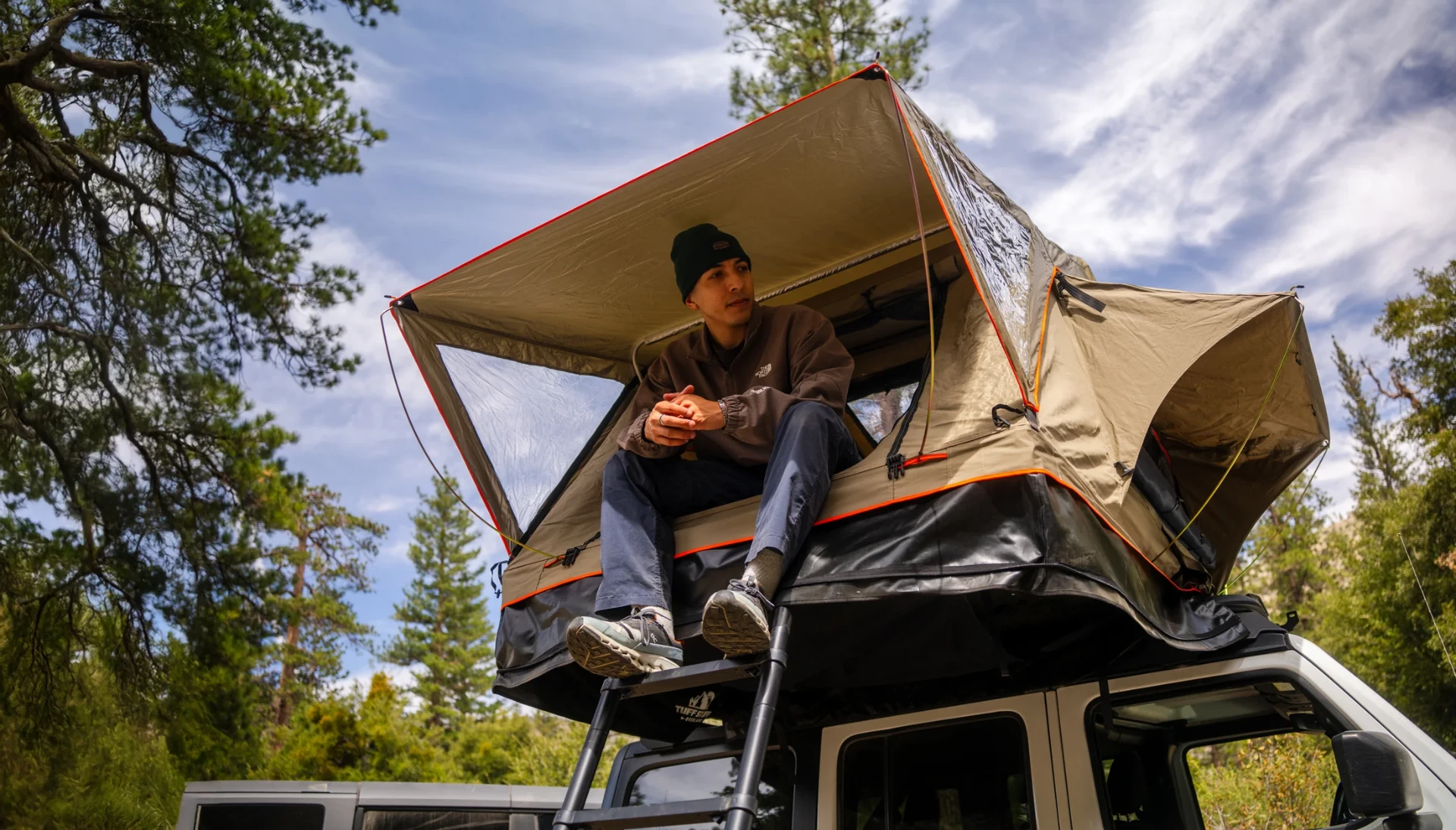
Built for the road less paved.
You've watched the videos. The aluminum hardshell unfolds in sixty seconds. The couple climbs the ladder. The drone pulls back. The desert glows. And somewhere in the back of your head, a small voice says, "Do I really need that, or am I just buying the marketing?"
It's a fair question. We get it from somebody almost every week. Rooftop tent or ground tent. Two thousand dollars or two hundred dollars. Twenty-second deployment or twenty minutes of stakes and poles. The honest answer is not what most YouTube channels will tell you, because the honest answer is not always rooftop, and not always ground. It depends on you, your rig, your trips, and how often you actually go.
So let's talk about it the way somebody who has slept in both would talk about it. Real trade-offs. Real numbers. Real recommendations.
They Solve Different Problems. That's the Whole Game.
Here's the thing nobody says out loud. Rooftop tents and ground tents are not direct competitors. They're solving different problems for different kinds of trips.
A ground tent solves the problem of sleeping outside cheaply, lightly, and flexibly. You can pitch one almost anywhere. You can pack it down small. You can buy a great one for the price of a couple of tanks of gas. If you back-pack, hike-in camp, or take one big trip a year, a ground tent is the smart tool.
A rooftop tent solves the problem of fast, comfortable, off-the-ground sleep when you're moving a lot. New camp every night. Sketchy ground. Critters. Mud. Snow. Storms. Tired bodies that don't want to wrestle with poles by headlamp at eleven o'clock. If you're chaining campsites across a long route, or you take dozens of weekend trips a year, the rooftop tent earns its weight.
Most of the "which is better" content online frames the choice as a status question. Are you a serious overlander or a tent guy? That framing is junk. The right question is, "What does my trip pattern actually look like, and which tool fits it?"
Answer that first. The rest is details.
Ground Tents: The Honest Take
Let's start where most of us started. A duffel bag in the back of the rig with a tent, a pad, and a bag inside. Nothing fancy. Just shelter.
Here's what ground tents do well.
Price. A good four-season backpacking tent costs $300 to $600. A solid family-sized car-camping tent costs $200 to $400. A premium expedition tent with a vestibule and a serious rainfly tops out around $700 for most of us. That's the whole budget. No mounting hardware. No rack upgrade. No suspension consideration. You buy the tent, you camp.
Flexibility. A ground tent doesn't care what you drive. It rides in the truck, the SUV, the trunk of a sedan, or strapped to a backpack. You can fly with it. You can lend it to a friend. You can stage it for a weekend at a base camp and explore in the rig unloaded. The tent and the vehicle are independent. That independence is real freedom.
Footprint. Ground tents pack small. A two-person tent compresses to about the size of a loaf of bread. A four-person family tent rolls into a duffel that fits behind a back seat. You're not giving up cargo space. You're not adding height to your rig. You're not dropping mileage on the highway. Nothing changes about how the truck drives.
Group flexibility. Bringing the family? Bringing a friend? Bringing a dog that sheds? Ground tents scale up and down without redesigning your rig. Buy a bigger tent for the trip that needs it. Use the small one for solo runs. Buy a second tent for the kids when they want their own space. Total cost is still less than one rooftop tent.
Site selection. A ground tent works on dirt, grass, sand, snow, slickrock, packed gravel, and most established sites. As long as you can stake or weigh down a footprint, you can pitch a tent. A rooftop tent requires you to drive the rig to where you'll sleep, with the orientation and approach angle that works. Ground tents go where the rig can't.
Now the honest trade-offs.
Setup time and effort. A good ground tent takes ten to twenty minutes to pitch the first few times. With practice, five to ten minutes. That's fine on a warm afternoon at a planned site. It's exhausting in driving rain at one in the morning when you just rolled in from a twelve-hour transit day. It's also a workout when the temperature drops to twenty degrees and your hands stop working.
Ground conditions. You're sleeping on the ground. That ground might be wet. It might be cold. It might be uneven. It might have ants, scorpions, snakes, or anything else with a pulse and an opinion about your sleeping bag. A good pad and a careful site selection solve most of this. Not all of it.
Weather exposure. Even a great four-season tent flexes in wind, drips condensation in cold rain, and floods if you pitched it wrong. Ground tents demand more from the camper. You have to read the site. You have to dig drainage channels in heavy rain. You have to weigh down the corners in wind. A rooftop tent forgives more of those decisions because the platform is already solved.
Wildlife. This is regional. Bear country, mountain lion country, javelina country, snake country. A ground tent puts a thin fabric layer between you and whatever walks by at three in the morning. Most people will tell you that's fine, and statistically it is. Psychologically, for some people, it isn't.
Trip pace. If you're moving camp every day, the cumulative time cost of ground-tent setup and breakdown adds up fast. Twenty minutes a day across seven days is a lost morning of trail time.
Ground tents are not obsolete. They are the right answer for a huge percentage of overlanders. Don't let anybody talk you out of one because it doesn't look cool in a drone shot.
Rooftop Tents: The Honest Take
Now the other side. The category Tuff Stuff Overland has built a real reputation on, with a lineup that runs from budget soft-shell to expedition-grade aluminum.
Here's what rooftop tents do well.
Deployment speed. This is the headline benefit and it's real. A soft-shell tent like the Tuff Stuff Ranger sets up in about ten minutes. A hard-shell like the Tuff Stuff Alpha deploys in under two minutes. The Tuff Stuff Stealth aluminum side-opener takes about sixty seconds. Pull into camp, pop the latches, climb the ladder. That's it. After a long transit day, that speed is not a luxury. It's the reason you take more trips.
Bedding stays in. This is the underrated feature. You load your sleeping bags, pillows, and pads into the tent once. They stay there, packed inside the closed shell, trip after trip. No rolling up a damp bag in the morning. No remembering the pillow you left at home. Pull up, pop the tent, the bed is already made.
Off the ground. Cold ground doesn't pull heat from your body. Pooling rainwater doesn't soak through your pad. Critters don't visit. Mud is somebody else's problem. You're sleeping on a 2.5-inch mattress on an aluminum honeycomb floor. The first night you sleep in one after a decade of ground tents, you understand the appeal.
Weather protection. Hard-shell rooftop tents in particular handle weather differently than ground tents. The shell takes wind without flapping. The structure shrugs off rain without flexing. The Stealth's aluminum shell can take a low-hanging branch hit or a rocky ledge bump without damage. For four-season overlanding, especially in shoulder-season storms, a hard-shell is a different category of comfort.
Built-in comfort. Most Tuff Stuff tents include a real mattress (the Elite ships with a 96 x 77-inch mattress, bigger than a California King), LED lighting inside and out, mesh windows, and a real rainfly. You're not sleeping on a yoga mat in a glorified bivy. You're sleeping in something built for repeated use by people who actually camp.
Visual presence at camp. Yes, this matters. A rooftop tent makes a rig feel like a base camp. Friends gravitate to it. Conversations happen under it. An awning off the side turns the truck into a small outdoor kitchen and living room. There's a reason these are popular. The lifestyle is real, not just photographed.
Now the honest trade-offs.
Price. This is the big one. A Tuff Stuff Trailhead soft-shell runs about $1,000. A Ranger soft-shell sits around $1,500. The Alpha hybrid hard-shell lands in the $2,500 to $3,000 range. The Stealth aluminum hard-shell pushes past $3,500 with options. The Elite, the family-sized 4-5 person tent with an included annex, runs around $2,000 to $2,500. Before you've spent a dollar on a rack, hardware, or installation, you're looking at multiples of what a great ground tent costs.
Weight and mounting. A Tuff Stuff Stealth weighs 221 pounds. The Ranger is 164 pounds. The Elite is heavier still. That weight goes on your roof, which means your roof rack better be rated for it, and your suspension better be ready. Most factory roof racks are not. You'll likely need an aftermarket rack rated for dynamic load (driving) and static load (sleeping on top), plus potentially a bed rack if you're mounting on a truck bed. Budget another $400 to $1,200 for the rack alone, depending on vehicle and brand.
Driving impact. A loaded rooftop tent adds weight up high. That changes the rig's center of gravity. You'll feel it in cornering, in wind on the highway, and in fuel economy. Most people see a 1 to 3 mpg drop with a hard-shell up top. Soft-shells with their lower profile drag a little less. None of this is dramatic. All of it is real.
Site dependence. You sleep wherever the truck parks. If the rig is on a slope, the tent is on a slope. If the only flat spot at camp is twenty feet from where the trail allows you to park, the ground tent guy wins. You'll want a small set of leveling blocks in your kit. They become standard gear.
Bathroom logistics. Climbing down a ladder in the middle of the night is a different experience than unzipping a tent door. People adapt. Older campers, kids in the middle of potty training, and anybody with a knee or back issue need to think honestly about this before they spend three grand.
Vehicle-bound. You can't pitch a rooftop tent away from the rig. You can't set up base camp and drive the rig unloaded for the day. The tent and the vehicle are the same unit. For most overlanding trips that's fine, and even preferred. For a trip where you want to leave camp standing and drive somewhere, it's a real limitation.
The Tuff Stuff Lineup, Mapped to Real Buyers
Tuff Stuff makes a lot of tents. The lineup can be confusing if you've never shopped one. Here's the cheat sheet, organized by who each model is actually for.
Tuff Stuff Trailhead. The budget entry point. Compact one-to-two-person soft-shell. Easy install on smaller SUVs and crossovers. The right choice for a buyer who wants to try rooftop camping without committing to a $3,000 build. Sets up in about three minutes.
Tuff Stuff Ranger / Ranger 65. The soft-shell that made Tuff Stuff a name in the category. Sleeps three. Real mattress, real rainfly, real materials. The 65-inch version added ten inches of width over the original. The right choice for a couple or a small family that wants premium soft-shell capability without hard-shell pricing.
Tuff Stuff Alpha II. The smaller hybrid hard-shell. Built for smaller rigs like compact SUVs and Subarus. The right choice if you have a Forester, Crosstrek, or smaller crossover and you want a hard-shell experience without overloading the roof.
Tuff Stuff Alpha. The hybrid hard-shell that opens to the side. Sets up in under two minutes. Aerodynamic profile that gives back some of the fuel economy you'd lose with a taller shell. The right choice for daily-driver overlanders who want fast deployment without going full expedition-grade.
Tuff Stuff Stealth. The aluminum hard-shell. Side-opening. Three-person capacity. Bigger-than-king mattress. Aluminum honeycomb floor. Built-in LED light strips. 221 pounds of expedition-grade structure. The right choice for serious overlanders who travel in any season, drive under branches, and want hardware that lasts a decade. This is the long-game purchase.
Tuff Stuff Elite. The family tent. Sleeps four to five. Includes a removable annex room. 96 x 77-inch mattress. Two doors, two ladders, optional split-wall for privacy. The right choice for parents who want their kids to come overlanding, and who refuse to spend their nights breaking up sibling territory disputes in a normal-sized tent.
That maps to most buyers. If you're between two models, your roof rack capacity and your trip group size are the tiebreakers.
Three Real-World Scenarios
Forget the spec sheets. Here's how we'd actually call it for three common rigs and trip patterns.
The new overlander, three trips a year, mostly weekend runs within four hours of home. Ground tent. Period. Spend $400 on a good four-season tent, $200 on a real sleeping pad, $250 on a quality bag, and put the rest of the money into a fridge, a recovery kit, or trail miles. Get a few trips in. Learn what you actually want. Upgrade later if the use case justifies it. Most people who buy a rooftop tent first end up reselling it because they didn't camp enough to need one.
The weekend warrior, ten to twenty trips a year, mixed terrain, mostly two adults. Tuff Stuff Ranger or Alpha. The Ranger is the value pick if budget is a consideration. The Alpha is the right move if you want hard-shell deployment speed and the long-term durability of a rigid shell. Either choice will get used hard and pay back the investment within a year of regular trips.
The full-send overlander with a multi-week trip on the calendar, four-season ambitions, and a build that's already serious. Tuff Stuff Stealth. The aluminum shell is built for the abuse you're going to give it. The deployment speed matters more when you're chaining campsites for two weeks straight. The bigger mattress matters more when you're sleeping in it twenty nights a month. This is where premium gear earns the premium.
The family of four or five, kids of different ages, dog included. Tuff Stuff Elite, or a great ground tent in the eight-person range. The Elite is unmatched for fast deployment with a family that big, and the included annex turns the rig into a real outdoor home. The ground-tent route is cheaper and gives you the flexibility to use multiple smaller tents for older kids who want their own space. Both are real answers. The Elite wins on speed and weather protection. The ground tent wins on cost and flexibility.
Notice we didn't pick rooftop for everybody. That's because the right tent depends on the trips you're actually taking, not the trips you imagine taking when you watch overland YouTube on a Tuesday night.
The Bigger Picture
Here's what people miss. The tent is not the build. The tent is part of the build.
A rooftop tent without a rated rack is a problem waiting to happen. A rooftop tent without an awning is half the camp experience. A rooftop tent on a rig with a tired stock suspension is going to ride rough and corner worse than it should. The tent is one piece. Plan the rest with it.
The good news is that the Tuff Stuff lineup is designed as a system, and the same distribution network (The Wheel Group handles Tuff Stuff alongside the Compound wheel line we've written about before) makes it easier to source the supporting pieces from companies that work together. Tuff Stuff makes their own adjustable truck bed rack rated to 800-plus pounds, designed specifically to support the tent lineup. They make awnings that match the tents. They make annexes for the Alpha, Stealth, Ranger, Trailhead, and Elite. The Elite includes its annex at no extra cost.
The other good news is that ground-tent overlanding is not a lesser path. Some of the most experienced overlanders we know still run ground tents because they've optimized around the flexibility. A great tent, a great pad, a great bag, a great cot, and a fast-pitch routine can rival a rooftop setup for everything except deployment speed.
Pick the system. Don't just pick the tent.
The Real Question
Here's what to ask yourself before you spend a dollar.
How many nights a year will I actually sleep in this thing? Be honest. Not aspirational. Actual.
How long are my typical trips? One night, three nights, two weeks? Does my pace involve moving camp daily, or do I park and stay?
Who's coming with me? Solo, two adults, family of five, dog, in-laws? Does the answer change trip to trip?
What does my rig handle? Roof rack capacity, suspension, ground clearance, fuel economy. What can I afford to add up top without compromising what the truck is already good at?
What's my real budget? Tent plus rack plus annex plus mattress upgrade plus install. Not the tent alone.
Answer those five questions before you watch one more product video. Then the right answer becomes obvious, because the right answer is the one that fits your trips, not somebody else's brand.
Final Word
Rooftop tent or ground tent. Both can take you somewhere worth going. Neither is the wrong answer if you pick it for the right reasons.
We are not in the business of selling fantasy. We are in the business of helping you build a rig and a trip pattern that fits your life. Better information. Better tools. Better guidance. The trail still calls, and there are more ways to answer it than the algorithm wants you to think.
The best tent is the one that gets you out more often.