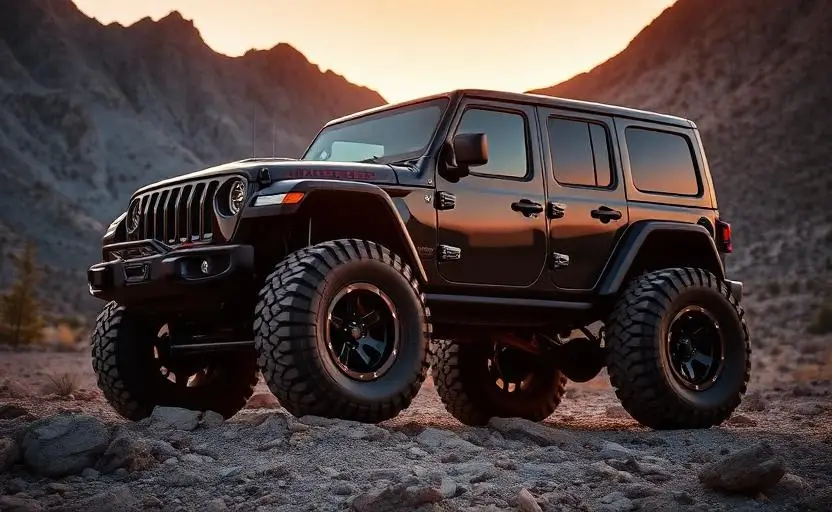
When the Stock Height Just Is Not Cutting It Anymore
Picture this: you are rolling up to your first Jeep meet, fresh off the dealership lot, tires barely worn in, and you have got that new car smell still clinging to the seats. You are feeling pretty good about yourself until a JK on 37s pulls in next to you. Suddenly your Wrangler looks like it is wearing platform shoes to a basketball game. Welcome to the Jeep world, my friend, where the only way is up.
I have been there. We all have. That moment when you realize that your factory ride height is fine for grocery runs but about as useful as a screen door on a submarine when you hit the trail. Rocks that looked like speed bumps from your buddy's lifted rig suddenly become impassable mountains when you are staring at them through a stock windshield.
Here is the thing about lift kits: they are not just about looking cool (though let us be honest, that is a nice bonus). A proper lift gives you ground clearance to clear obstacles, room for larger tires, and approach angles that will not leave you high-centered on a parking block. But choose wrong and you are looking at a death wobble that feels like driving a shopping cart downhill, or worse, a ride quality that makes you wish you had bought a Prius.
That is where this guide comes in. I have done the homework, tested the products, and talked to the mechanics who install these things daily. Whether you are looking for a budget boost to clear 33s or a long-arm kit that will have you crawling boulders like a mountain goat, we are going to find the right lift for your Jeep and your wallet.
Quick Comparison: The Lift Kit Landscape at a Glance
| Kit Name | Lift Height | Best For | Price Range | Install Difficulty | Ride Quality |
|---|---|---|---|---|---|
| Rough Country Budget Boost | 2-2.5" | Beginners, 33s | $200-$400 | Easy (DIY) | Firm, acceptable |
| Teraflex ST2 | 2.5-3.5" | Daily driver + trails | $1,200-$1,800 | Moderate | Excellent, OEM+ |
| Rock Krawler X-Factor | 3.5-4.5" | Serious off-roading | $2,500-$3,500 | Hard (pro recommended) | Outstanding, adjustable |
| Evo Mfg Double Throwdown | 4-6" | Extreme terrain, 37s+ | $4,000-$6,000 | Expert only | Premium, tunable |
| AEV DualSport SC | 2-3.5" | Overlanding, comfort | $2,000-$3,000 | Moderate | Best-in-class comfort |
| MetalCloak Game Changer | 2.5-3.5" | All-around performance | $2,200-$3,200 | Moderate | Very good, flexible |
Know Your Lift Types
Budget Boosts / Spacer Lifts
These are the training wheels of the lift world. Spacers sit on top of your factory coils to add height without changing springs. They are cheap, easy to install, and perfect if you just want to clear slightly bigger tires without diving into your savings account. Think of them as the gateway drug to lifting. You will get 2-2.5 inches of lift, which is plenty for 33-inch tires on most JLs and JKs.
The downside? You are still riding on factory springs, so if your Jeep has 80,000 miles and the coils are sagging like an old mattress, a budget boost just lifts the problem higher. Ride quality stays roughly the same as stock, which for a new Jeep is fine, but for a high-miler might be disappointing.
Short Arm Kits (0-4 inches)
This is where things get serious. Short arm kits replace your factory control arms with stronger, adjustable units and pair them with new coils and shocks. You get better articulation, improved geometry, and the ability to dial in your suspension for your specific use case. Most kits in the 2.5-3.5 inch range fall into this category.
The sweet spot for most Jeep owners is right here. You can run 35s comfortably, your ride quality actually improves over stock, and you are not sacrificing daily drivability for weekend warrior status. Brands like Teraflex and MetalCloak have dominated this space for years, and for good reason.
Long Arm Kits (4+ inches)
Now we are talking about the heavy artillery. Long arm kits relocate your control arm mounting points to fix the geometry issues that come with serious lift heights. When you start pushing past 4 inches, your factory control arm angles get steeper than a black diamond ski slope, and that is when you get into handling problems, driveline vibrations, and premature wear.
Long arms keep everything aligned properly, giving you the articulation and stability you need for extreme terrain. But here is the catch: they are expensive, require significant modifications (like cutting and welding), and usually need professional installation.
Coilovers and Bypass Shocks
The top of the food chain. These are race-inspired setups that separate the big dogs from the weekend warriors. Coilovers combine your spring and shock into one unit with threaded bodies for precise ride height adjustment. Bypass shocks add external tubes that control fluid flow, giving you incredible tuning capability for different terrain.
Know Before You Buy
Key Components to Consider
Springs vs. Spacers
Factory springs are designed for factory weight. If you have added heavy bumpers, a winch, armor, or a roof rack, your factory coils are already working overtime. A spacer lift just makes them work harder from a different angle. New springs are rated for your actual vehicle weight and will give you the ride height you paid for, not the sagging disappointment of overloaded factory coils.
Shocks: The Unsung Heroes
Here is where most lift kits cheap out, and where you should not let them. Shocks control how your suspension moves, and bad shocks will make even the best springs feel like garbage. Look for names like Fox, Bilstein, Rancho, or King. A good shock has properly valved damping that matches your spring rate and vehicle weight.
Adjustable shocks are worth the premium if you switch between daily driving and trail use. Being able to firm things up for the highway and soften them for crawling is a game changer.
Control Arms and Geometry
When you lift a Jeep, you change the angles of everything. Your control arms, track bars, and driveline all get thrown out of whack. Adjustable control arms let you dial your caster and pinion angles back to factory specs, which means better handling, less wandering on the highway, and longer driveline life.
Critical Threshold
Track Bars and Steering
Your track bar centers your axle under the vehicle. Lift without addressing the track bar and your axle shifts to one side, causing weird handling and tire wear. Adjustable track bars fix this. Some kits include them, some do not. Check before you buy.
Steering upgrades become necessary around the 3.5-inch mark as well. The factory drag link and tie rod were not designed for big tires and altered geometry. Upgraded steering components are not just about strength, they are about keeping your Jeep pointed where you want it to go.
Sizing Your Lift: How Much is Too Much?
2-2.5 inches: The Sweet Spot for Most
This is the Goldilocks zone. You clear 33-inch tires easily, 35s with some trimming. Your ride quality stays excellent, installation is straightforward, and you do not need a ton of additional upgrades. Perfect for the Jeep owner who wants capability without compromise.
3-3.5 inches: The Serious Zone
Now you are talking about clearing 35s without drama, and 37s with some work. This is where control arms become important, and you might need to address your driveshaft angles. Ride quality can still be excellent with the right components, but costs start climbing.
4+ inches: Go Big or Go Home
You are committed now. This height clears 37s and 40s, but it requires long arms, driveshaft upgrades, extended brake lines, and potentially steering corrections. This is not a bolt-on weekend project. Your Jeep will be a beast off-road but might be less pleasant on the daily commute.
Budget Reality Check
Let us talk numbers because lift kits have a way of multiplying your initial investment. That $500 budget boost turns into $1,500 real quick when you add:
- Alignment (mandatory, $100-$200)
- New shocks if you want quality ($400-$800)
- Extended brake lines ($100-$200)
- Track bar ($200-$400)
- Control arms ($300-$600)
- Tires to fill that new height ($1,200-$2,000)
- Wheels with proper backspacing ($800-$1,500)
Hidden Cost Alert
1. Rough Country Budget Boost
Price: $199-$399 | Lift Height: 2-2.5 inches | Best For: First-time lifters, budget builds, 33-inch tires
Let us get something straight right off the bat: Rough Country gets a bad rap in some circles, and honestly, it is not entirely fair. Are they the premium option? No. Do they get the job done for a fraction of the cost? Absolutely.
The Budget Boost is exactly what it sounds like: spacers that sit on top of your factory coils to add height without replacing the springs themselves. Installation is dead simple. If you can turn a wrench and have a spring compressor (or a friend with one), you can knock this out in your driveway in an afternoon.
The ride quality is... fine. You are keeping your factory springs and adding budget shocks. It is not going to feel like a Cadillac, but it is not going to rattle your teeth out either. The N3 shocks included in the kit are actually decent for the price point. They are nitrogen-charged, which means they will not fade on you during a long highway cruise.
What you get for your money is clearance. Two and a half inches is enough to clear 33-inch tires on a JL or JK without rubbing, assuming you have got the right backspacing on your wheels. That transforms your Jeep from a parking lot cruiser to something that can actually handle light trails and fire roads.
| Pros | Cons |
|---|---|
| Incredibly affordable | Relies on factory springs |
| Easy DIY installation | Ride quality is firm |
| Clears 33s without drama | Not for serious off-roading |
| N3 shocks are surprisingly decent | Shorter lifespan than premium options |
The Verdict: Perfect for new Jeep owners testing the waters or anyone who wants a mild lift without breaking the bank. Just know what you are buying and do not expect miracles.
2. Teraflex ST2 Sport System
Price: $1,199-$1,799 | Lift Height: 2.5-3.5 inches | Best For: Daily drivers who want trail capability
Teraflex has been building Jeep suspension since before half the current brands existed, and it shows. The ST2 Sport System is what happens when engineers who actually wheel their own Jeeps design a lift kit. It is not the cheapest option, but it might be the best value when you factor in quality, ride, and longevity.
The ST2 is a complete system, not just a collection of parts. You get new coil springs that are properly rated for your specific Jeep model and configuration. The springs are designed to handle the added weight of bumpers, winches, and armor without sagging.
The Falcon shock options are where this kit really shines. Teraflex offers several shock choices, from the basic 2.1 monotubes to the high-end 3.3 fast adjust piggybacks. Even the base shocks are properly valved and deliver a ride that is honestly better than stock. The 3.3s let you dial in compression and rebound settings for different terrain.
Daily Driver Pick
| Pros | Cons |
|---|---|
| Excellent ride quality | More expensive than budget options |
| High-quality components throughout | Installation requires mechanical skill |
| Multiple shock options | May need track bar for perfect alignment |
| Handles added weight well |
The Verdict: If you drive your Jeep every day but want serious trail capability on weekends, the ST2 is hard to beat. It is the do-it-all lift kit that does not force you to compromise.
3. Rock Krawler X-Factor
Price: $2,499-$3,499 | Lift Height: 3.5-4.5 inches | Best For: Serious off-roaders, rock crawlers, 37-inch tires
Rock Krawler is a name that commands respect in the hardcore wheeling community. These guys build suspension for rigs that get flopped, rolled, and dragged over terrain that would make a mountain goat nervous. The X-Factor system brings that race-bred expertise to the enthusiast market.
This is a long-arm kit, which means you are getting properly engineered geometry for serious lift heights. The X-Factor arms are massive, featuring high-clearance bends that tuck up out of harm's way and Johnny Joint-style bushings that allow full articulation without binding. The joints are rebuildable and greaseable, which means this kit will outlast your Jeep if you maintain it.
The coil springs are dual-rate designs that give you a soft initial travel for a comfortable ride around town, then firm up as they compress to prevent bottoming out on the trail.
Installation Note
| Pros | Cons |
|---|---|
| Outstanding articulation and flex | Requires significant install work |
| Long arm geometry done right | Professional install recommended |
| Rebuildable joints | Expensive |
| Clears 37s+ easily | Overkill for casual wheelers |
The Verdict: If you are serious about off-roading and want a lift that can handle anything you throw at it, the X-Factor is worth every penny. Just be prepared for the installation commitment.
4. Evo Manufacturing Double Throwdown
Price: $3,999-$5,999 | Lift Height: 4-6 inches | Best For: Extreme terrain, show builds, 40-inch tires
Evo Manufacturing has built a reputation on pushing the limits of what a Jeep suspension can do. The Double Throwdown is their flagship offering, and it is about as close to a trophy truck setup as you can get while still being street legal.
The bolt-in coilover conversion is the headline feature here. Coilovers give you threaded ride height adjustment, which means you can fine-tune your stance without swapping springs. They also offer superior heat dissipation and fade resistance compared to traditional shocks.
The long arms are works of art, with massive DOM tubing and high-misalignment spherical bearings that allow insane amounts of articulation. The bolt-in frame mounts mean you are not cutting up your Jeep, which is nice for resale value and warranty concerns.
| Pros | Cons |
|---|---|
| Massive travel and articulation | Very expensive |
| Coilover adjustability | Requires supporting modifications |
| Bolt-in installation (no welding) | Overkill for most Jeep owners |
| Clears 40-inch tires | Installation is complex |
The Verdict: If you want the absolute best and your budget allows, the Double Throwdown is the pinnacle of Jeep suspension. For the rest of us, it is aspirational eye candy.
5. AEV DualSport SC
Price: $1,999-$2,999 | Lift Height: 2-3.5 inches | Best For: Overlanding, long-distance comfort, daily driving
American Expedition Vehicles (AEV) approaches suspension design from a different angle than most companies. While others chase maximum articulation and huge lift heights, AEV focuses on geometry, ride quality, and handling. The result is a kit that makes your Jeep drive better than stock while still giving you the capability you need for adventure.
The key innovation here is the focus on caster correction. When you lift a Jeep, you lose caster angle, which makes the steering feel light and twitchy. AEV's high-mount control arms restore proper caster, giving you factory-like steering feel and highway stability.
The springs are specifically tuned for different Jeep configurations. AEV asks about your bumper setup, winch, and planned accessories, then sends you springs that will actually give you the advertised lift height under your specific load.
The Bilstein shocks included in the kit are custom-valved for AEV's spring rates. They offer excellent control without being harsh, and they have proven reliability over hundreds of thousands of miles of real-world use.
The Comfort King
| Pros | Cons |
|---|---|
| Best-in-class ride quality | Not the most articulation |
| Excellent highway manners | Conservative lift heights |
| Proper geometry correction | Premium price for mild specs |
| Custom-tuned springs |
The Verdict: For overlanders and daily drivers who want capability without compromise, the AEV DualSport SC is the gold standard. It makes your Jeep better at everything.
6. MetalCloak Game Changer
Price: $2,199-$3,199 | Lift Height: 2.5-3.5 inches | Best For: All-around performance, maximum articulation on a budget
MetalCloak burst onto the scene with their innovative DuroFlex joints and true dual-rate springs, quickly earning a reputation for delivering premium performance at mid-tier prices. The Game Changer system is their do-it-all offering, and it lives up to the name.
The secret sauce is the DuroFlex control arms. These feature a unique bushing design that combines the maintenance-free nature of rubber with the articulation of a Johnny Joint. You get massive amounts of flex without the squeaks, clunks, and greasing schedule of traditional rebuildable joints.
The True Dual Rate springs are another MetalCloak innovation. Most dual-rate springs are really just progressive springs with a soft section that quickly firms up. MetalCloak's design has two distinct spring rates with a transition point, giving you a truly soft ride for the first few inches of travel, then firming up for big hits and heavy loads.
| Pros | Cons |
|---|---|
| Outstanding articulation | Installation requires patience |
| DuroFlex joints are innovative | Some reports of spring settling |
| True dual-rate spring design | Not as highway-focused as AEV |
| Great value for the performance |
The Verdict: The Game Changer delivers premium articulation and ride quality at a price that undercuts many competitors. If you want maximum flex without breaking the bank, this is the kit to beat.
Installation Tips and Tricks
Tools You Will Actually Need
Essentials:
- Floor jack and jack stands (or a lift if you have access)
- Metric socket set (10mm-24mm)
- Torque wrench
- Spring compressors (rent these if you do not own them)
- PB Blaster or similar penetrating oil
- Shop manual or torque spec sheet
Nice to Have:
- Impact wrench
- Breaker bar
- Ball joint separator
- Pry bars
- Thread locker (Loctite blue)
- Anti-seize compound
Before You Start
Pro Tip
- Take photos. Lots of them. Before you remove anything, document how it was oriented, which way the bolts faced, and how everything connected.
- Get an alignment scheduled before you start the install so you are not scrambling to find an open bay when you are done.
- Have a plan for the old parts. If you are selling them, clean them up. If you are keeping them for spares, organize them.
During Installation
- Work on one end at a time. Do not tear apart the whole Jeep at once. Finish the front, then move to the rear.
- Torque everything to spec. Use a torque wrench and follow the specs. Suspension components deal with massive loads, and a loose bolt can ruin your day.
- Check for clearance issues. Before you lower the Jeep, cycle the suspension through its full range of travel.
- Grease everything that needs greasing. It is much easier to grease a joint when you can spin it freely than when it is bolted to the Jeep.
After Installation
Do Not Skip This
- Retorque everything after 500 miles
- Check your driveline angles for vibrations
- Be patient with spring settling (new springs settle over the first few weeks)
When to Call a Pro
There is no shame in admitting a job is beyond your skill level. Consider professional installation if:
- Your kit requires welding or cutting
- You do not have proper tools or workspace
- You need your Jeep drivable by Monday morning
- You are not comfortable with suspension work
A shop install typically runs $500-$1,500 depending on the complexity of the kit. It is money well spent if it means the job gets done right.
Final Verdict: Which Lift Kit Should You Buy?
| Category | Winner | Why |
|---|---|---|
| Best Budget | Rough Country Budget Boost | Under $400, clears 33s, perfect entry point |
| Best Daily Driver | Teraflex ST2 | Sweet spot of price, performance, and ride quality |
| Best Overlanding | AEV DualSport SC | Unbeatable long-distance comfort and highway stability |
| Best Off-Road | Rock Krawler X-Factor | Long arms, massive flex, race-proven durability |
| Best Value | MetalCloak Game Changer | Premium articulation at mid-tier pricing |
| Best Extreme | Evo Mfg Double Throwdown | Trophy truck performance, clears 40s |