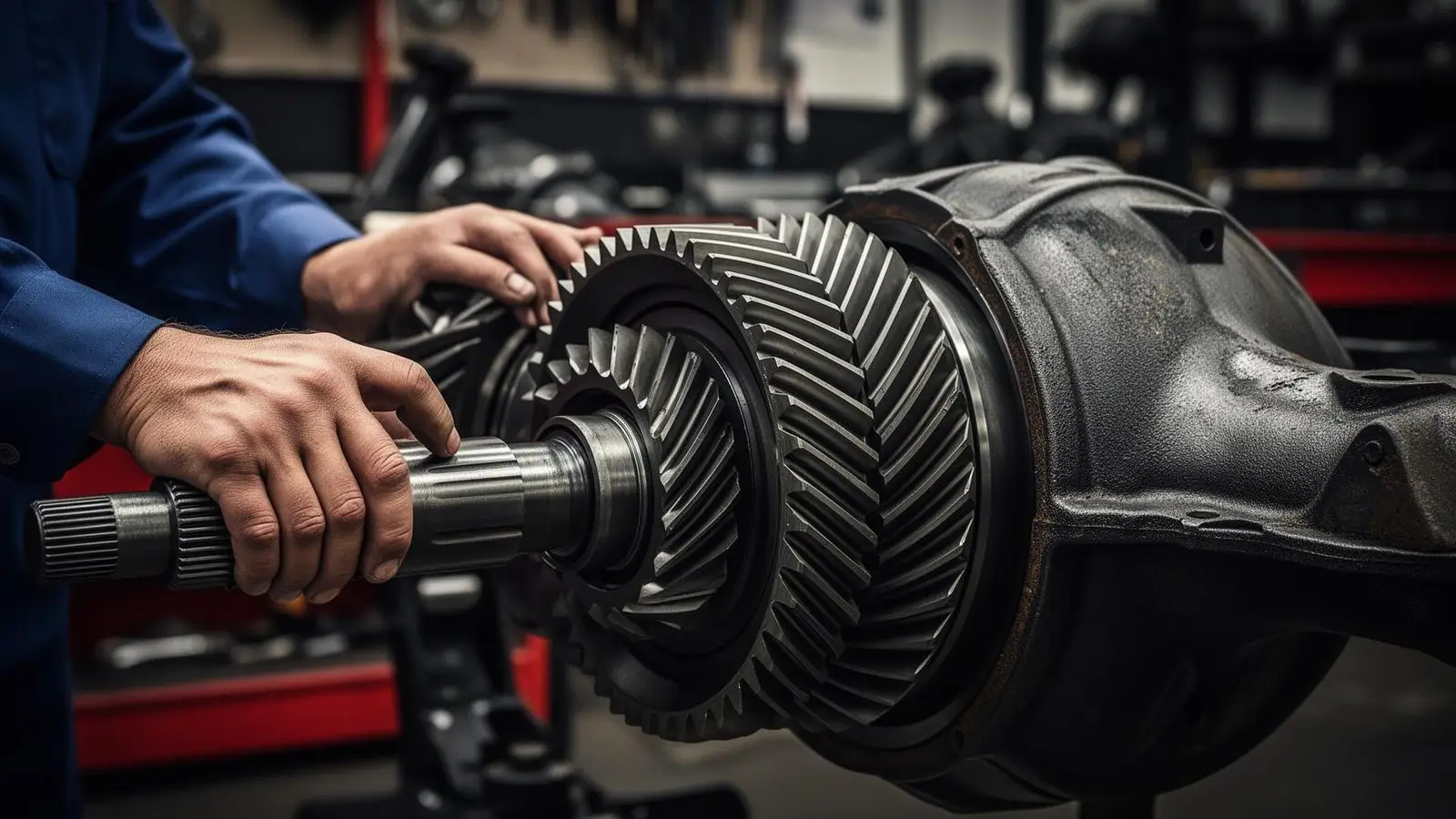
You finally got those 35s (or 37s, or 40s). The truck looks incredible. But now it feels like it's running through mud even on the highway. The transmission hunts for gears, fuel economy tanked, and your engine sounds like it's working twice as hard.
Welcome to the "I need to re-gear" realization.
Here's everything you need to know about why bigger tires kill your drivetrain's efficiency, when re-gearing is worth it, and exactly which gear ratios to choose for your tire size.
Why Bigger Tires Require Re-Gearing
Think of your tires as the final gear in your drivetrain. When you increase tire diameter, you're effectively making that final gear taller, like accidentally starting in 3rd gear instead of 1st.
The Math Behind It
Going from 32" stock tires to 35" tires is a 9.4% increase in diameter. That means:
- Your engine works 9.4% harder to move the same distance
- Your speedometer reads ~9.4% slow
- Your effective gear ratio dropped by 9.4%
- Your acceleration feels noticeably sluggish
Going to 37s? That's a 15.6% change. 40s? 25%. Now you understand why that Wrangler on 40s can barely merge onto the highway.
The Simple Formula
Effective Gear Ratio = (Original Tire Diameter ÷ New Tire Diameter) × Original Gear Ratio
Example: 3.73 gears with 32" stock tires, upgrading to 35" tires:
(32 ÷ 35) × 3.73 = 3.41 effective ratio
You just lost the equivalent of going from 3.73 to 3.42 gears, a big drop in power multiplication.
Signs You Need to Re-Gear
Not everyone needs to re-gear after bigger tires. Here's how to know if it's time:
Definite Re-Gear Territory
- Transmission constantly hunting: Can't decide between gears on slight inclines
- Can't maintain highway speed: Struggles to hold 70+ mph on grades
- Fuel economy dropped 3+ MPG: Engine working overtime
- Acceleration is dangerous: Can't merge or pass safely
- Engine lugging at low RPM: Vibrations and strain at cruising speeds
- Towing became impossible: What used to pull easy now struggles
You Might Be Fine If...
- You only went up 1-2" in tire diameter
- You already have aggressive gears (4.10+ on trucks, 4.56+ on Jeeps)
- Your vehicle has serious torque (diesel, supercharged, etc.)
- You rarely tow or drive in mountains
- You're okay with slightly lazy acceleration
Gear Ratio Recommendations by Tire Size
These recommendations assume you want to restore original driving feel,the same acceleration and RPM at highway speeds you had with stock tires.
Full-Size Trucks (F-150, Silverado, Ram 1500, Tundra)
| Tire Size | Stock 3.21 Gears | Stock 3.55 Gears | Stock 3.73 Gears |
|---|---|---|---|
| 33" Tires | 3.55 | 3.73 (optional) | Keep stock |
| 35" Tires | 3.73 | 4.10 | 4.10 |
| 37" Tires | 4.10 | 4.56 | 4.56 |
| 40" Tires | 4.56 | 4.88 | 5.13 |
Jeep Wrangler JK/JL (Stock 3.21 or 3.73)
| Tire Size | Stock 3.21 (Base) | Stock 3.73 (Rubicon) |
|---|---|---|
| 33" Tires | 3.73 | Keep stock |
| 35" Tires | 4.10 | 4.56 |
| 37" Tires | 4.56 | 4.88 |
| 40" Tires | 5.13 | 5.38 |
Toyota Tacoma / 4Runner
| Tire Size | Stock 3.73 Gears | Stock 4.10 Gears |
|---|---|---|
| 33" Tires | 4.10 (optional) | Keep stock |
| 35" Tires | 4.56 | 4.88 |
| 37" Tires | 4.88 | 5.29 |
Manual vs Automatic Considerations
The Real Cost of Re-Gearing
Parts Cost
- Ring & pinion set (per axle): $200, $400
- Master install kit (per axle): $75, $150
- Both axles total parts: $550, $1,100
Labor Cost
- Professional installation (both axles): $800, $1,500
- Total with parts: $1,500, $2,500
Quality Matters
Don't cheap out on gears. Yukon, Motive, and Nitro are solid mid-tier choices. Dana Spicer OEM replacement gears are the premium option. Avoid no-name import gears, poor heat treatment leads to premature failure.
Pro Tip: Time It Right
DIY vs Professional Installation
Why Pros Recommend Professionals
Gear setup is one of the most precision-critical jobs on a vehicle. Improper backlash, pattern, or preload settings cause:
- Gear whine: Annoying noise that never goes away
- Overheating: Leads to premature failure
- Catastrophic failure: Grenaded diff on the highway
If You're Set on DIY
- Invest in a dial indicator and magnetic base
- Get an inch-pound torque wrench for pinion preload
- Buy marking compound to check gear patterns
- Watch multiple professional setup videos
- Accept you might have to redo it (or pay a shop to fix it)
What About Electronic Speedometer Correction?
Re-gearing fixes the power problem, but your speedometer will still be off from the larger tires. Options:
- Programmer/tuner: Most can correct speedometer for tire size ($300, $600)
- Speedometer calibrator: Inline device that adjusts signal ($100, $200)
- Dealer flash: Some dealerships will recalibrate for a fee
Speedometer Matters
Alternatives to Re-Gearing
Don't want to spend $2K on gears? Here are some alternatives (with caveats):
Performance Tuning
A quality tune can adjust shift points, torque management, and throttle response to mask some of the sluggishness. Won't fully restore performance but helps. Cost: $300, $600.
Live With It
If you rarely tow, don't drive in mountains, and can accept lazy acceleration, you might just adapt. Many people run 35s on stock gears and don't mind the tradeoff.
Smaller Tire Compromise
Going from 33s to 35s is a bigger effective change than 35s to 37s in terms of percentage. If you're on the fence, sometimes staying a size smaller avoids the re-gear requirement entirely.
The Bottom Line
Re-gearing is one of those mods that doesn't look cool but makes everything else work better. If you've invested thousands in a lift and tires, spending $1,500, $2,500 to make your truck actually drive well is money well spent.
- 35" tires on stock gears: Re-gear strongly recommended
- 37" tires: Re-gear is basically mandatory
- 40" tires: You're re-gearing. You know this.
Your future self, stuck in the right lane because you can't accelerate, will thank you for doing it now.