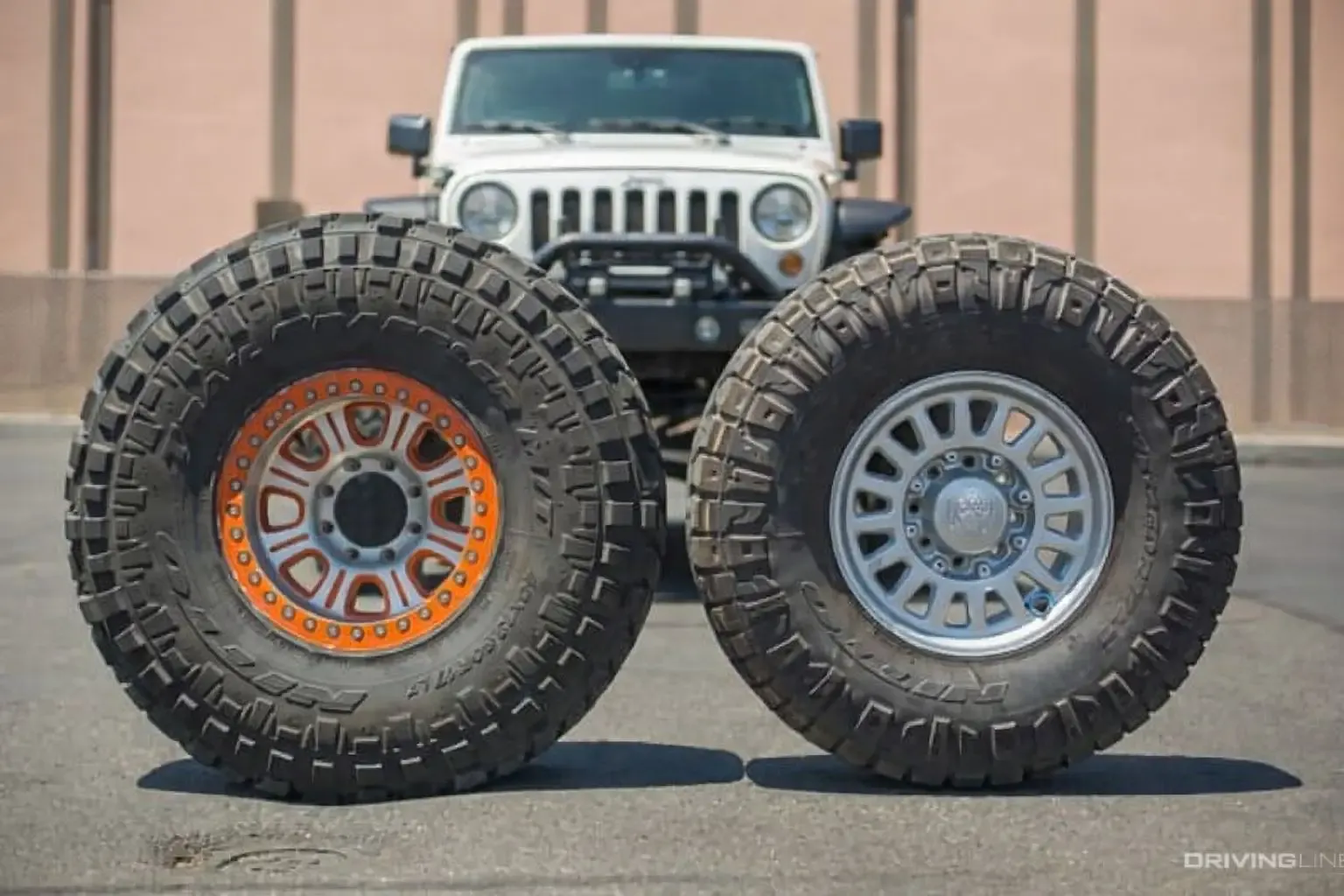
Everyone wants bigger tires. But jumping from 37s to 40s isn't just "a few more inches", it's a completely different build philosophy with exponentially higher failure rates and costs. Here's what actually happens when you go big.
The Physics Nobody Talks About
Tire size doesn't scale linearly with stress. Going from 37" to 40" tires:
- Weight increase: 15-25 lbs per tire (60-100 lbs total rotating mass)
- Leverage on components: Increases by roughly 8% per inch of diameter
- Torque requirement: Increases proportionally to tire diameter
- Stress on axles: Compound increase due to leverage AND weight
That 8% increase per inch might sound small, but it compounds across every stressed component. A 37" tire puts X stress on your ball joints. A 40" tire puts 1.25X stress. That's 25% more wear, 25% faster failure.
What Breaks First: The Failure Hierarchy
1. Dana 35 Rear Axles (JK and Older)
If you still have a Dana 35, it's living on borrowed time with anything over 33s. With 37s, it's a question of when, not if. With 40s, it might not survive the first trail ride.
- Failure mode: Broken axle shafts, stripped ring and pinion
- When it fails: Hard acceleration, rock crawling, lockers engaged
- Fix: Dana 44 or aftermarket axle swap ($2,500-6,000)
2. Ball Joints
Factory ball joints are designed for factory tire sizes. Every inch of additional tire diameter increases the moment arm, and the failure rate.
- 37" tires: Replace every 30,000-50,000 miles
- 40" tires: Replace every 15,000-30,000 miles
- Fix: Upgraded ball joints like Dynatrac or Synergy ($400-800)
3. Tie Rod Ends
Same physics as ball joints. Longer lever arm = more stress = faster wear.
- Symptoms: Wandering steering, play in the wheel, death wobble
- Fix: Heavy-duty tie rod ends and drag link ($300-700)
4. Unit Bearings / Wheel Bearings
The added rotational mass of larger tires accelerates bearing wear significantly.
- 37" tires: 50,000-80,000 mile life typical
- 40" tires: 30,000-50,000 mile life typical
- Fix: OEM replacement or Timken upgrade ($150-400 per side)
5. Front Axle Shafts (JK/JL)
Dana 30 and Dana 44 front axles handle 37s reasonably well but struggle with 40s, especially with lockers engaged.
- Failure mode: Twisted or snapped shafts, especially u-joints
- Fix: Upgraded chromoly axle shafts ($500-1,200)
6. Driveshafts
More resistance from bigger tires means more stress on driveshaft u-joints and CVs.
- Symptoms: Vibrations, clunking during acceleration
- Fix: Upgraded driveshaft with greaseable u-joints ($400-1,000)
The Real Cost Comparison
Running 37s
- Tires: $1,400-2,000
- Lift (3.5"): $2,000-4,000
- Regear (4.56 or 4.88): $1,500-2,500
- Supporting mods: $500-1,500
- Annual maintenance increase: $300-600
- Total first year: $5,400-10,000
Running 40s
- Tires: $2,000-3,000
- Lift (4-6"): $4,000-8,000
- Regear (4.88 or 5.13): $1,500-2,500
- Axle upgrades (front and rear): $2,000-6,000
- Fender modifications: $500-2,000
- Supporting mods: $1,500-3,000
- Annual maintenance increase: $800-1,500
- Total first year: $12,000-26,000
Capability Comparison: Is It Worth It?
Ground Clearance Gain
Going from 37" to 40" tires adds 1.5" of ground clearance at the axle. That's it. One and a half inches. For $10,000+ in additional build costs.
Actual Trail Difference
On 95% of trails, there's zero functional difference between 37s and 40s. The extra clearance matters on extreme rock crawling, but if you're not regularly running trails rated 8+ on the difficulty scale, you'll never use it.
Daily Driving Penalty
- 37s: Noticeable MPG loss, manageable parking, reasonable acceleration
- 40s: Severe MPG loss, many parking structures off-limits, sluggish without regear
Who Should Run 37s
- Builders who want excellent capability without extreme costs
- Daily drivers who also wheel on weekends
- Anyone who doesn't want to swap axles
- People with a budget under $10,000 for their build
Who Should Run 40s
- Dedicated rock crawlers who need every inch of clearance
- Builders with $20,000+ budgets
- Those who already have Dana 60 or equivalent axles
- Competition/sponsorship rigs where cost isn't the main factor
Our Recommendation
For 90% of Jeep owners, 37" tires are the sweet spot. They provide massive capability gains over stock, clear virtually all trail obstacles, and don't require axle swaps on JL Rubicons.
Going to 40s should be a deliberate choice made after running 37s and genuinely needing more clearance, not because it looks cool or you want to say you have 40s.
The Bottom Line
Every inch of tire diameter above factory costs exponentially more, in parts, labor, and ongoing maintenance. 37s are aggressive. 40s are extreme. Know the difference before you commit.