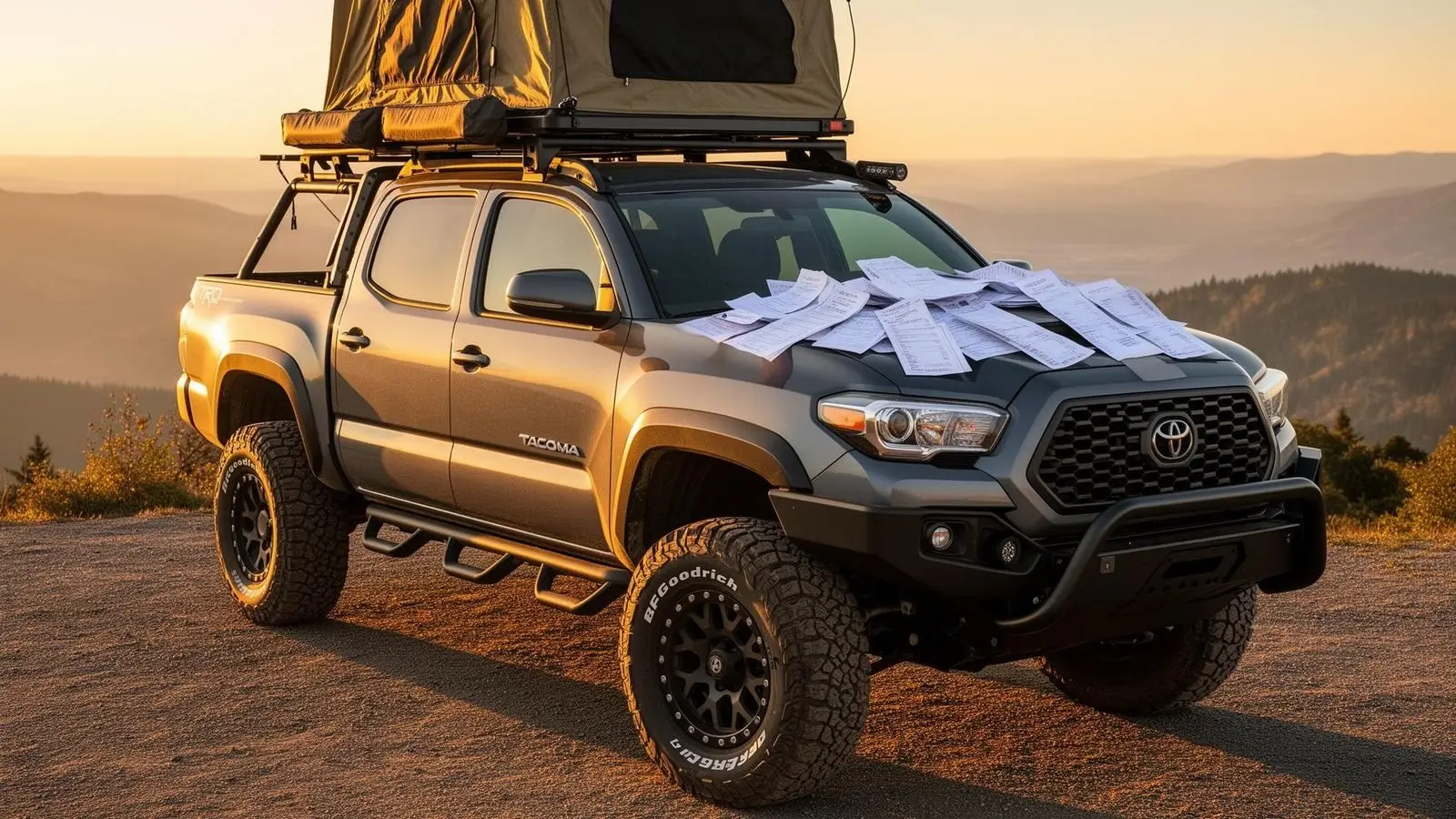
This example budget starts with a used 2018 Toyota Tacoma TRD Off-Road at $34,000 and a plan most new builders share: a few small mods, just enough to hit some trails on weekends.
Priced at typical 2026 parts and shop rates, those "few small mods" add up to $23,847 over two years.
Seeing the real numbers before you start is the best way to avoid the financial ambush that is building an off-road truck.
The budget below includes every part, every installation fee, and every "while you're in there" add-on. Your prices will vary by region, brand, and how much you install yourself.
Year One: "Just The Essentials"
The plan was simple: tires, a small lift, and recovery gear. That's it. A responsible $5,000 budget. Maximum $6,000 if things got wild.
Spoiler: things got wild.
Month 1-3: The Foundation
| Item | Cost | What It Looks Like on Paper |
|---|---|---|
| BFGoodrich KO2 285/75R16 (set of 5) | $1,450 | "Around $1,000" |
| Mounting, balancing, TPMS swap | $180 | Not mentioned |
| Icon Stage 2 suspension kit | $2,100 | "A kit" |
| Installation + alignment | $650 | "Included... mostly" |
| Recovery boards (X-Bull) | $140 | "Safety equipment" |
| Recovery kit (straps, shackles, gloves) | $185 | "More safety stuff" |
| Q1 Subtotal | $4,705 | "$2,500ish" |
That is already $705 over a $4,000 first-quarter plan, and the build is only three months in.
Month 4-6: The "While You're At It" Phase
This is where budgets usually slip. With the lift installed, stock bumpers start to look out of place, and armor moves up the list once the factory skid plate takes its first hit (33s don't add as much clearance as many builders expect).
- Aftermarket front bumper with winch mount: $1,200
- Winch (Warn VR8-S): $480
- Steel rock sliders: $650
- Installation for all of the above: $400
- UCA upgrade (because the lift caused alignment issues): $550
- Rear diff breather extension: $45
- "While you're in there" fluid changes: $120
Q2 Subtotal
Month 7-12: The Slippery Slope
By the second half of year one, the build shifts from trail capability to trip comfort: power, lighting, storage, and camp gear.
- Roof rack: $550
- LED light bar + pods: $380
- Dual battery system: $620
- On-board air compressor: $280
- Portable fridge: $450
- Upgraded head unit with off-road GPS: $400
- ARB awning: $350
- Various mounts, brackets, and wiring: $290
H2 Subtotal
Year One Total
Year Two: "Just A Few More Things"
Year two brings the drivetrain work that bigger tires eventually demand, plus the first round of wear items.
| Item | Cost | Category |
|---|---|---|
| Regear (4.88) front and rear | $2,200 | Drivetrain |
| Rear locker installation | $1,400 | Drivetrain |
| New set of tires (first set worn out) | $1,350 | Maintenance |
| Rooftop tent | $1,800 | Camping |
| Bed storage system | $1,100 | Storage |
| Skid plates (full set) | $850 | Armor |
| Transmission cooler + install | $380 | Drivetrain |
| Trail repair kit, first aid, misc gear | $420 | Safety |
| Maintenance (fluids, filters, etc.) | $480 | Maintenance |
| "Oops" repairs (bent tie rod, etc.) | $650 | Repairs |
| Misc accessories and camp gear | $747 | Misc |
| Year Two Total | $12,377 |
The Grand Total (And Where to Save)
Two-Year Build Total
Before you close this tab in horror, here is some perspective.
Spending That Usually Pays Off
- Quality suspension from the start. Replacing a cheap kit later costs more than buying once.
- Recovery gear early. You need it on your first trail, not your tenth.
- Regearing. On 33s and up, it restores the acceleration and gearing the bigger tires take away.
- Proper armor. Skid plates and sliders are cheaper than an oil pan or rocker panel.
Where to Save
- Wait on the roof rack. Buy it when you have a specific load to carry, not before.
- Skip the light bar upgrade. Factory fogs are enough for most daylight weekend trails.
- Buy the locker before the bumper. More capability beats more Instagram appeal.
- Budget for tires as a recurring cost. KO2s on trails last about 25,000 miles. Plan for that.
The Hidden Costs Nobody Mentions
Beyond the parts and labor, there are costs that don't show up on any build sheet:
The Invisible Expenses
- Increased fuel consumption: If highway mpg drops from 22 to 17, two years and 30,000 miles adds roughly $2,000 in extra gas.
- Trip costs: Permit fees, camping fees, the occasional Airbnb when you just can't sleep in the truck again. Figure $200-400 per trip.
- Tool accumulation: Budget at least $500 for tools you'll want for maintenance and trail repairs.
- The "might as well" trap: Every time the truck was in the shop, there was something else to add or upgrade. Those $50-200 additions are death by a thousand cuts.
A More Realistic Budget for New Builders
If you're starting a build now, plan around these ranges:
| Build Level | Budget Range |
|---|---|
| Minimal Setup (trails, camping, light off-road) | $4,000-6,000 |
| Capable Weekender (most trails, extended trips) | $10,000-15,000 |
| Serious Build (technical trails, true overlanding) | $20,000+ |
The 30% Rule
Was It Worth It?
$24,000 could buy a boat, a lot of nice vacations, or a few years of investment growth.
A build instead gets you a truck that reaches places most people never see, plus the stories and community that come with it.
Is it financially responsible? No. Whether it is worth it depends on how often you'll use it.
Just go in with your eyes open. Know what you're getting into. And maybe start a separate savings account labeled "truck stuff" before you install that first mod.
Your future self will thank you. Or curse you. Probably both.