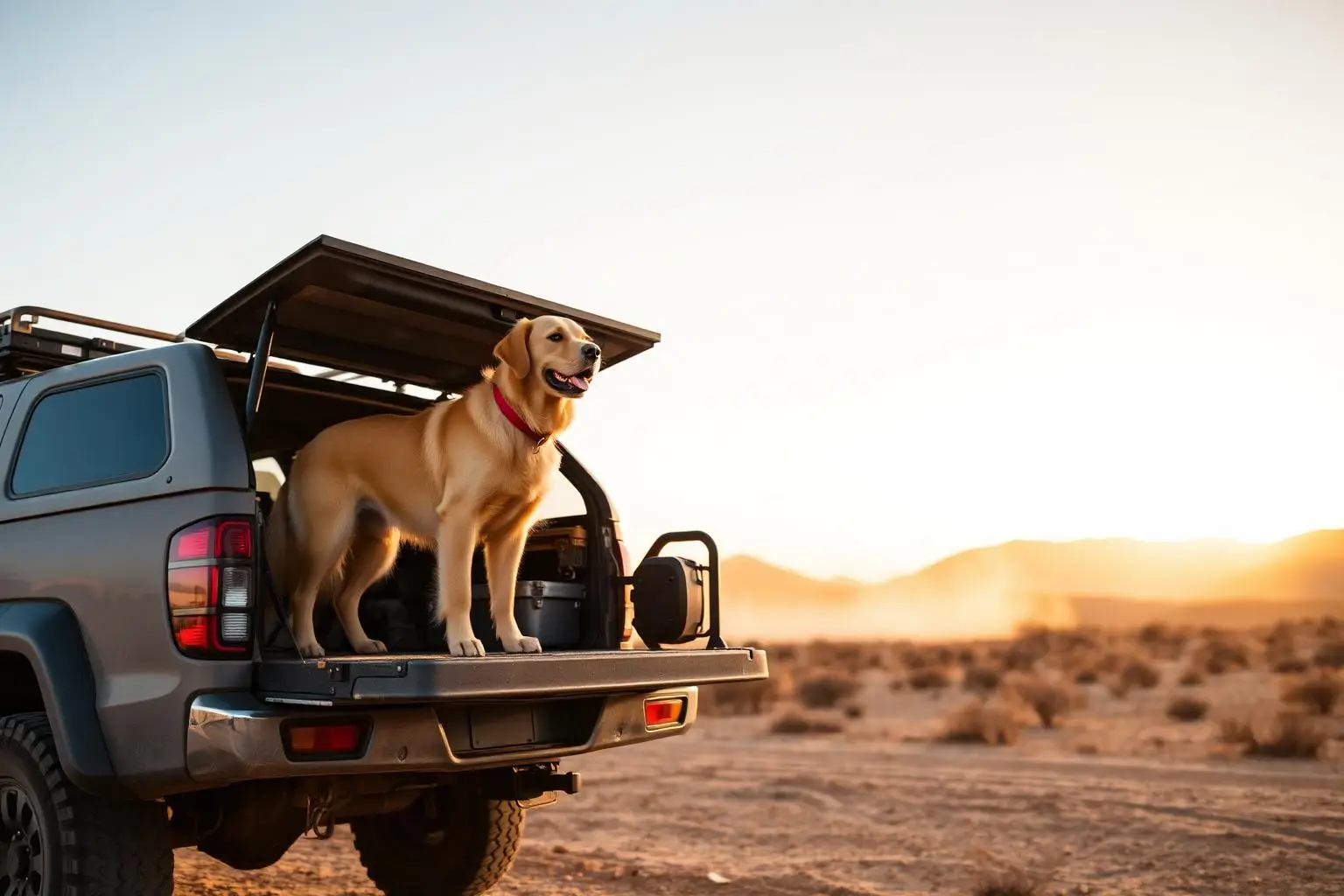
Most overlanders figure out within the first trip that bringing a dog changes everything. The logistics shift, the camp routine changes, and a surprising amount of your planning starts revolving around a creature who cannot tell you when something is wrong until something is very wrong.
The community is large and passionate. The online advice is well-intentioned and frequently incomplete. This guide covers what actually matters: vehicle safety data most pet harness buyers have never seen, the temperature math that makes cracked windows irrelevant, the leash law differences between land types that trip up even experienced overlanders, and a realistic breakdown of what your dog actually needs in a first aid kit versus what sounds good on a product page.
The Vehicle Safety Problem Nobody Addresses Honestly
Ask any overlanding dog owner how they secure their dog in the vehicle and the answers split roughly into three groups: loose in the back, a clip-in tether, and a crate. Only one of those options has meaningful crash test support. The other two have data that most people have never seen.
The Center for Pet Safety has conducted third-party crash testing on dog harnesses, tethers, and crates. The findings are not reassuring for most common setups. Of the harnesses tested, only one, the Sleepypod Clickit Utility, received a passing rating at impact speeds relevant to real accidents. The majority of popular aftermarket harnesses allowed the dog to become a projectile, or the harness itself failed structurally under load. Clip-in tethers performed consistently poorly: rather than restraining the dog, they act as a pendulum under impact forces, with the spine absorbing the terminal load. The Center's language on tethers is direct: they can function as a catapult, and the spine incurs the most damage.
Crash-tested hard crates are the option with the best safety profile. The Gunner Kennels G1 withstood forces equivalent to a 30-MPH barrier collision while containing the test dog. The Rock Creek Crates aluminum crate is the first and only aluminum option to receive a 5-star CPS rating. These crates are not cheap. A Gunner G1 Intermediate runs $450 to $550. A Rock Creek Crate in medium runs $600 to $800. They are sized for specific dogs, they anchor to your vehicle's cargo anchors, and they need to be mounted properly to do what they are designed to do.
The practical reality for most overlanders: you probably cannot afford two safety systems and most overlanders will not run a hard crate for daily driving. The minimum bar for off-road travel, where road surfaces are unpredictable and sudden stops from terrain, ruts, and ledges are common, is a CPS-certified harness with the seatbelt connector or a properly anchored crate. A loose dog in the back of a truck is a projectile on a hard trail hit. That is not opinion. It is physics.
The Hot Car Math That Makes Cracked Windows Irrelevant
The outdoors community has mostly absorbed the message that hot cars are dangerous for dogs. Fewer people have absorbed the specific temperature data that makes cracked windows so meaningless it borders on irrelevant.
At an outdoor ambient temperature of 75°F, the interior of a parked vehicle reaches 94°F in ten minutes and exceeds 109°F within thirty minutes. At 85°F ambient, interior temperatures exceed 102°F in ten minutes. The cracked window reduces this by about two to four degrees over thirty minutes. Not enough to matter.
Dogs are uniquely poor at dissipating heat. Their primary cooling mechanism is panting, which moves air across moisture in the mouth and airway. Unlike humans who sweat across the skin, dogs have sweat glands only on their paw pads. In a hot, still environment with no air movement, panting becomes progressively less effective as the inhaled air itself warms. Heat stroke in dogs begins around 104°F body temperature. Brain damage is possible at 106°F. Death occurs well before the exterior of the vehicle feels uncomfortable to a human hand.
The practical rule for overlanding: if you would not lock a toddler in a parked vehicle in the sun for twenty minutes, do not leave your dog there. This applies even at temperatures that feel mild to you standing outside in the shade.
For time away from the vehicle when you cannot bring your dog, the solutions are a roof-mounted fan or ventilation system (FantasticFan and similar 12-volt roof fans move enough air to hold interior temperatures near ambient even on hot days), a MaxxAir Ventilation Cover that allows ventilation with the window cracked securely, or a buddy system where someone stays with the dog. The "my dog loves the truck" framing does not change the temperature math.
The Temperature Reality
Leash Laws on Public Land: What Actually Applies Where
This is the most consistently misunderstood part of overlanding with dogs, and the confusion gets compounded by the fact that well-intentioned fellow overlanders repeat incorrect information constantly.
Here is what the rules actually say, organized by land type:
BLM (Bureau of Land Management) land, dispersed camping: Dogs do not need to be on a leash in open, dispersed areas. The BLM requires that you maintain control of your dog at all times, which is a meaningful distinction from a leash requirement. In practice, this means your dog cannot be running into other campsites, harassing wildlife, or being a nuisance to other users. A voice-controlled dog who stays in your camp has no leash requirement. The leash requirement kicks in when you are in a developed BLM campground or a designated recreation area, where a six-foot maximum leash is typically required.
National Forest (USFS) land: Most national forest land is similar to BLM in dispersed areas: no leash required, control required. Specific wilderness areas within national forests may have different rules. Check the specific ranger district regulations for the forest you plan to use, as they vary.
National Parks: Dogs are almost universally required to be on a six-foot leash at all times in national parks, including on designated trails. Many national park trails prohibit dogs entirely. If you are camping in a national park, research the specific dog rules before you arrive, because they vary dramatically by park and by area within the park.
State Parks: State park rules vary enormously by state and by individual park. Many require leashes on all trails. Some prohibit dogs from certain areas. Always check the specific state park's regulations before arrival.
Private land: Whatever the landowner says.
The overlap that trips people up: a camping trip might move from dispersed BLM land (no leash required) to a national forest trailhead (leash required for day use) to a state park campground (leash required) in a single weekend. Managing a dog across multiple land types is a specific logistics task that is worth thinking through in advance rather than discovering when a ranger explains it to you.
An important wildlife note that applies everywhere regardless of leash laws: dogs chase wildlife. Even well-trained dogs have prey instinct, and wildlife on BLM and forest land includes rattlesnakes, coyotes, porcupines, and in some areas, bears and mountain lions. Keeping your dog close regardless of the leash law is a safety decision, not just a courtesy.
Water, Food, and Nutrition on Trail
Dogs need more water than most people account for, and the consequences of dehydration show up faster than you expect. A rough baseline is one ounce of water per pound of body weight per day for a dog at rest. Active dogs in warm conditions need two to three times that. A 60-pound Labrador on a warm trail day should be drinking 120 to 180 ounces of water, which is nearly a full gallon.
Carry a collapsible silicone water bowl. They weigh almost nothing, fit in any pocket, and are the only way to give a dog water on trail without wasting it. Offer water frequently on warm days, not just when your dog is visibly panting. By the time a dog pants heavily, they are already well behind on hydration.
Food logistics are simpler than water. Most dogs do fine on their regular food while overlanding, and maintaining a consistent diet reduces the risk of digestive issues that are genuinely unpleasant in a remote camp setting. Bring slightly more than you need, store it in a hard container that bears cannot breach, and do not feed your dog immediately before or after significant exercise in hot weather, which can contribute to bloat in deep-chested breeds.
Bear canisters and vehicle storage: in bear country, dog food counts as attractant. Store it in your vehicle at night, not in a tent or on the ground.
Heat, Altitude, and Paw Protection
Heat Management on Trail
Dogs regulate temperature through panting and ground contact with cool soil. When the ground itself is hot, that second mechanism fails. On desert trails and exposed rock, pavement or rock surfaces can reach 140°F to 160°F in direct sun while the air temperature is a manageable 90°F. If you cannot hold your palm flat on the surface for seven seconds comfortably, it is too hot for your dog's paw pads.
Signs of heat exhaustion in dogs progress quickly: heavy panting and drooling, bright red gums, slowed movement, and stumbling. If you see these, move your dog to shade immediately, apply cool (not ice cold) water to the belly, paws, and groin where blood vessels are close to the skin, and get them to a vet as soon as terrain allows. Do not use ice water, which can cause blood vessels near the skin to constrict and actually trap heat in the core.
A small pump garden sprayer filled with cool water is the most useful dog cooling tool for overland travel. It delivers fast, broad cooling to the belly and inner legs without requiring a water source nearby.
Altitude
Dogs can develop altitude sickness just as humans do. Symptoms above 8,000 feet include lethargy, loss of appetite, vomiting, and labored breathing. The time course is similar to humans: symptoms typically appear six to twelve hours after reaching altitude. If you are going from sea level to 10,000 feet in a single day of driving, plan a rest day before pushing higher. Descend if symptoms persist or worsen. There is no altitude medication approved for dogs equivalent to acetazolamide for humans.
Paw Protection
Rough volcanic rock, granite with sharp edges, hot desert sand, and salt flats all damage paw pads. The damage is often invisible until the dog stops walking. Signs of paw pad injury are limping, licking the paw, and visible raw or bleeding tissue on the pad surface.
Musher's Secret or similar paw wax creates a protective barrier before exposure and aids healing after. For sustained rocky or abrasive terrain, dog boots are the correct solution. Most dogs resist boots initially and adapt within one or two sessions. Practice at home before the trip. The Ruffwear Grip Trex is the most field-tested overland boot with a Vibram sole. Fit matters: measure your dog's paw width at the widest point with weight on it.
Dog First Aid Kit: What Actually Belongs In It
A dog first aid kit for overland travel is different from a basic pet first aid kit because the injury scenarios are different. Paw wounds on sharp rock, porcupine quill encounters, snake strikes, and heat emergencies are the realistic risks. Prepare for those specifically.
The kit that makes sense for a truck or SUV-based overland setup:
Wound care: gauze pads, self-adhering vet wrap (which sticks to itself and not fur), antiseptic wipe packets, and styptic powder for bleeding control on small cuts and broken nails. A pair of bandage scissors with a blunt tip that cannot stab the dog if they move.
Tick management: a dedicated tick removal tool (Tick Twister or equivalent metal hook), not tweezers. The hook removes ticks cleanly without crushing them. After every night in tick habitat, run your hands through the dog's coat thoroughly, paying attention to ears, groin, armpits, and between the toes.
Paw gear: vet wrap to bandage a torn pad, one pair of Ruffwear boots in the correct size, Musher's Secret paw wax.
Gastrointestinal: activated charcoal for potential poison ingestion (consult a vet before using), and hydrogen peroxide for inducing vomiting if directed by a vet or poison control (3% solution, not higher). Know the ASPCA Animal Poison Control hotline number before you leave: 888-426-4435.
Emergency evacuation: a dog litter or rigid stretcher for moving an injured dog who cannot walk. For larger dogs, a human backpacking frame with a modified bag attachment works. For smaller dogs, a structured pet carrier.
Temperature management: a Mylar emergency blanket for hypothermia (it works for dogs), a small spray bottle for cooling, and a digital thermometer for checking body temperature rectally. Normal dog body temperature is 99.5°F to 102.5°F.
The thing most dog first aid kits are missing: a way to move an injured dog who cannot walk. Plan this before you need it.
Know the Nearest Vet Before You Go
Breed Reality: Who Thrives and Who Struggles
No breed is permanently excluded from overlanding, but some breeds face specific challenges on certain terrain and climate types that owners should plan around honestly.
Dogs that do very well on most overland trips: Labrador and Golden Retrievers, German Shepherds, Australian Shepherds, Vizslas, Weimaraners, Border Collies, and Rhodesian Ridgebacks. These are working-lineage dogs with strong cardiovascular systems, good heat regulation relative to body size, and the mental temperament to handle novel environments without anxiety.
Dogs that need careful management in heat: Brachycephalic breeds (French Bulldogs, English Bulldogs, Pugs, Boston Terriers, Boxers to a lesser extent) have anatomically compromised airways that make panting inefficient. In desert or summer conditions above 80°F, these dogs are at genuine risk of heat stroke during moderate activity. They overheat faster than any other type and cool down slower. If you have a flat-faced dog, overland in the shoulder seasons, camp at elevation, and plan your activity for before 9am and after 5pm.
Dogs that need careful management in heat for a different reason: Northern breeds with heavy double coats, Huskies, Malamutes, Samoyeds, Great Pyrenees, are engineered for cold. Many owners do not shave these dogs in summer for legitimate reasons (the coat also insulates from heat), but these dogs should not be pushed on long trail days when temperatures are above 75°F. They do exceptionally well on winter overland trips that would be challenging for a short-coated dog.
Older dogs and puppies: Both need more care than healthy adult dogs. Puppies under one year should not do repetitive long hikes on hard terrain because their growth plates are still developing. Dogs over ten years should have a vet check before demanding trips, and should be watched for fatigue and joint stiffness that they will not show you until they cannot walk.
Quick-Reference Gear List
A functional overlanding dog kit does not require a dedicated bag if you organize it into your existing setup. These are the essentials, not the wish list.
In the vehicle: crash-tested crate or CPS-certified harness, MaxxAir ventilation cover or 12V roof fan for temperature management, collapsible water bowl, dedicated water supply (minimum one gallon per day per large dog), regular food plus 20% extra, hard-sided food storage for bear country.
On trail: collapsible water bowl, paw wax, spare leash, poop bags, tick removal tool, a small bandaging kit (gauze and vet wrap).
First aid kit: wound care supplies, tick remover, styptic powder, activated charcoal, hydrogen peroxide 3%, Mylar emergency blanket, digital thermometer, emergency vet contact saved on your phone and written on paper.
Dog Safety Quick-Reference Table
| Scenario | Risk | Action |
|---|---|---|
| Parked vehicle, 75°F ambient | Interior hits 94°F in 10 min | Never leave alone; use roof vent or buddy system |
| Parked vehicle, 85°F ambient | Interior hits 102°F in 10 min | Same as above, no exceptions |
| Trail in direct sun, rock surface | Ground 140°F+ when air is 90°F | Seven-second palm test; use boots or stop |
| Altitude above 8,000 feet | Canine AMS risk | Acclimate; watch for lethargy, vomiting |
| BLM dispersed camping | No leash required | Control required; keep dog in camp |
| National park, any trail | Leash required | Six-foot max; check trail-specific rules |
| Snake strike | Immediate veterinary emergency | Do not tourniquet; get to a vet |
| Heat exhaustion symptoms | Progressive to fatal | Shade, cool water on belly, vet ASAP |
The Bottom Line
Overlanding with a dog is genuinely excellent. The camp routine improves, the experience of moving through remote country with an animal who processes it completely differently than you do is one of the better things about being outside. The community is welcoming, the logistics are manageable, and most dogs take to trail life faster than their owners expect.
The things that go wrong are almost always the things nobody told you to think about: the vehicle heat on a quick trailhead stop, the leash law you did not check, the paw damage on the third day of a rocky trail, the first aid kit that has everything except what you actually need. This guide is the pre-trip conversation you should have before none of those things happen to you.
Your dog cannot tell you what is wrong until the situation is already serious. Plan like that matters. It does.