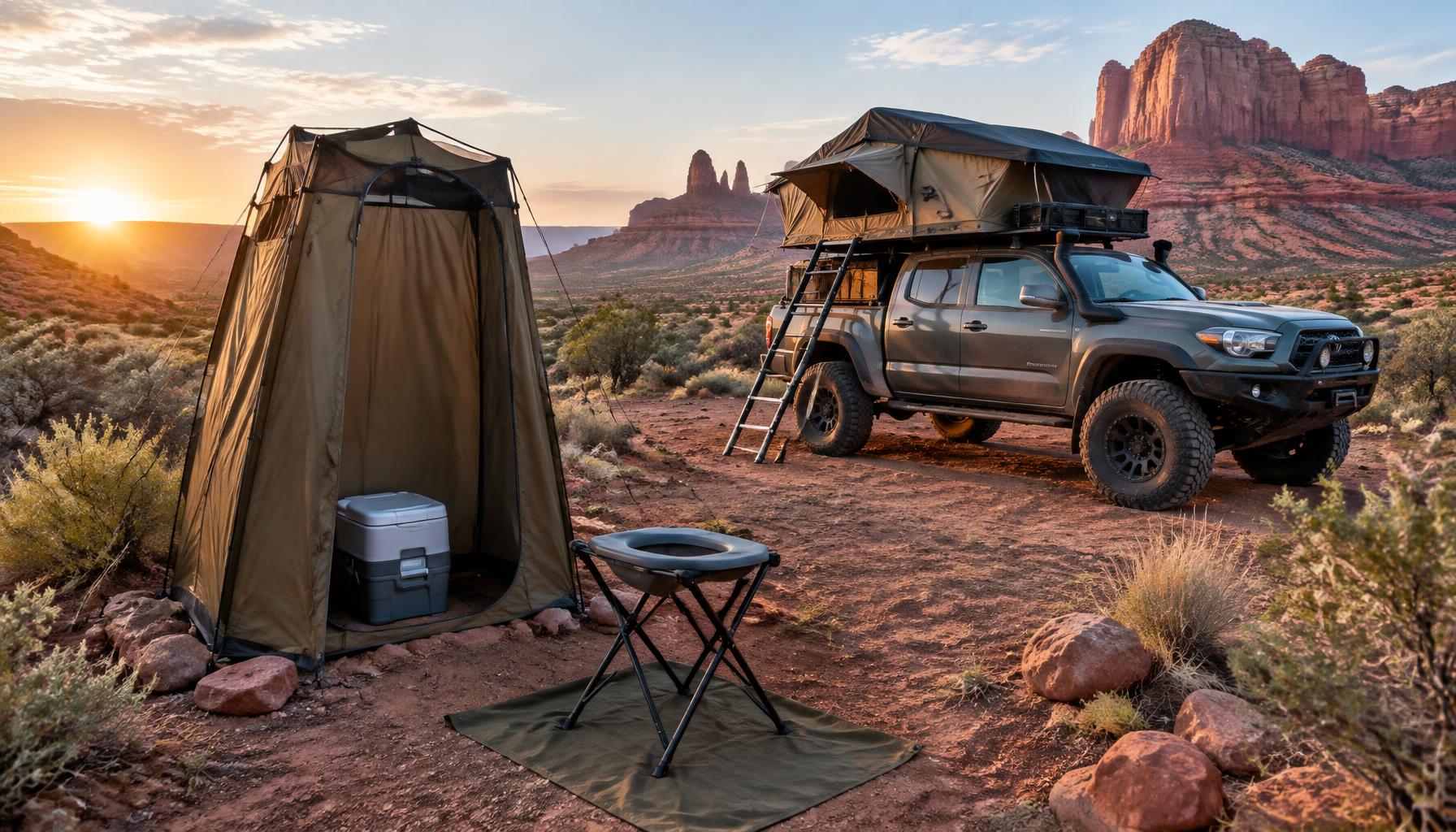
Not a bathroom remodel. The pack-out, dump-station, and odor reality for dirt camps.
You wake up at a dirt pullout before the coffee water boils. The vault toilet at the trailhead is four miles back and already overflowing. Your partner is doing the polite tent dance. Somebody in the group starts talking about a thousand-dollar composting toilet like it is the missing piece of the overlanding camp toilet puzzle. Maybe it is. Maybe you are about to buy a permanent box that needs a vent hole, a urine bottle schedule, and a place to empty solids, when a twelve-pack of wag bags and a folding seat would have solved this weekend for less than a tank of gas.
For most overlanders, start with Cleanwaste-class wag bags plus a folding seat (about $80 for the seat, roughly $2.50 per use). Smart default when dump stations sit on your route: a cassette-style Porta Potti (Thetford 365 ~$140 to $155, Camco 5.3 gal ~$100 to $115). Trap: buying a composting toilet before you know disposal geography and odor discipline.
Why an Overlanding Camp Toilet Matters Going Into Fall 2026
Shelter, fridge, recovery, and water still come first. Our essential overlanding gear guide never lists a toilet as day-one kit, and that is correct. The DIY overland water system already covers handwashing and dishes. Hot water got its own honesty pass yesterday. Human waste is the piece Instagram skips until Moab, the Utah desert, or a ranger with a clipboard shows up.
What changed is not plumbing physics. It is enforcement and traffic. Grand County, Utah requires packing out solid human waste on public lands and treating a portable toilet or approved bag system as the tool, not a cathole fantasy. White Wash Sand Dunes has carried a portable-toilet rule for vehicle camping for years. Leave No Trace still says dig a 6 to 8 inch cathole at least 200 feet from water, camp, and trails where burial is allowed, and pack out toilet paper when locals say so. Desert soils do not compost your mistakes. They archive them.
Fall multiplies the awkwardness. Colder mornings mean longer mornings in camp, and vault toilets get slammed on holiday weekends. Affiliate roundups mash wag bags, cassette toilets, and composting units into one cart called "best portable toilet." They are different tools with different empty rituals.
The Honest Truth: Disposal Geography Beats Brand Hype
This is the sentence the product page hopes you skim.
Your overlanding camp toilet is only as good as where you can legally empty it. A composting toilet that never needs a dump station still needs a plan for urine every couple of days and solids every few weeks. A cassette toilet that feels like a house toilet is useless if your route has no dump points and you refuse to carry a full tank. A wag bag that solves pack-out still needs a trash pathway that accepts it. In Moab, that often means designated WAG bag bins, not the nearest gas-station can or the pit toilet.
Do the napkin math before you cut a vent hole in the roof:
| System | Empty ritual | Typical cycle (2 adults) | Failure mode |
|---|---|---|---|
| Cathole (where legal) | Dig, bury, disguise | Per use | Illegal or ineffective in desert / high-use zones |
| Wag bag + seat | Seal bag, pack out to proper trash | Per use or shared bag (3 to 4 uses class) | Running out of bags, wrong trash can |
| Cassette / Porta Potti | Carry tank to dump station or approved toilet | Every 2 to 5 days | Full tank weight, chemical smell, no dump nearby |
| Composting (urine divert) | Empty urine bottle often; solids every weeks | Urine 1 to 3 days; solids 2 to 5 weeks | Fan failure, wet solids, "compost" that is just a dry bin |
If your next three trips are Moab-adjacent desert, a cassette without a dump plan is cosplay. If your trips are forest service roads with soft soil and low traffic, a toilet is optional and a trowel plus wag bags for sensitive days is enough. Match the empty ritual to the map, not the Instagram bathroom.
Capability Breakdown: Four Classes, One Decision Tree
What "good" looks like for overlanding
You want privacy without a remodel, odor control without lying to yourself, and a disposal path you will actually follow at 6 a.m. Permanent van bathrooms are a different article. This guide is for trucks, SUVs, and weekend builds that still leave cargo space for recovery boards.
Class 1: Wag bag systems (the honest default for many)
Cleanwaste GO Anywhere kits (the original WAG BAG class) run about $29 to $35 for a 12-pack, roughly $2.40 to $2.90 per kit. Each gels up to about 32 oz and includes paper plus a wipe. Multiple uses per bag are possible once liquid activates the gel. Cleanwaste still suggests about two kits per person per day for maximum convenience. That is planning math, not physics.
A Cleanwaste folding seat sits around $68 to $80 (500 lb class). A Reliance Luggable Loo seat is about $16 to $22 on a five-gallon bucket if you want cheaper and uglier. The seat is reusable. The bags are the consumable.
Napkin math, two adults, three nights: convenience plan at 2 kits per person per day burns one 12-pack (~$30 to $35). A disciplined shared-bag plan might use 6 to 8 kits. Seat plus first 12-pack lands near $100 to $115. Weight stays friendlier than a half-full cassette. The warts are social (you are packing waste) and local (some towns want special bins). Never put bags in vault toilets. Never bury "biodegradable" bags.
Class 2: Cassette / portable flush toilets
This is the familiar flush-feel option. Thetford's Porta Potti 365 uses a piston flush and a 5.5 gal waste tank. Street prices in Sept 2026 land near $140 to $155. The 565E adds electric flush, a taller seat, and level indicators (~$190 to $260). Camco's 5.3 gal travel toilet (41541) often street-sells near $100 to $115, with a 2.5 gal fresh tank and bellows flush.
Translate the brochure gallons. Camco publishes about 11.7 lb empty and about 56 lb full for the 5.3 gal unit. That is a bowling-ball suitcase walk to the dump. A 5.5 gal class tank is often framed around 15 to 20 uses, which for two adults is a long weekend to about four days. Push it and the smell teaches humility. Chemicals run roughly $10 to $20 per bottle across multiple dumps. A dry seal that sits open smells.
Cassette wins on campground-heavy routes and travel-center dump culture. It loses on week-long boondocking, desert pack-out mandates, and anyone who will not carry a 40-plus lb tank across gravel.
Class 3: Composting / urine-diverting toilets
Nature's Head lists the standard unit at $965 with a 2.2 gal urine bottle and about 60 to 80 solid uses (roughly a month for two people in their framing). Marine kits with vent hardware land near $1,060. Air Head Classic sits around $1,095. OGO Origin lists about $985 with an electric agitator in a tighter footprint.
These are waterless and dump-station independent for solids. That is the real win. The honest bill is different: roughly $950 to $1,100 before cabinetry, vent hose, and a spare urine bottle (~$30 to $60); a small 12V fan that only matters when it dies; coco coir or peat at a few dollars per fill (Nature's Head notes about 1.5 to 2 lb of peat); urine empties every 1 to 3 days for two people; solids every few weeks. Solids are not magic garden compost on empty day. Follow local disposal rules. Never invent a "scatter it in the bushes" plan on public land.
If dump visits cost $10 to $25 and you were dumping a cassette twice a month, composting can look cheap after a couple of years. If you camp eight weekends a year and hate vent installs, it pays in dump independence only, not dollars.
Class 4: No dedicated toilet (still a system)
Public restrooms, vault toilets, and legal catholes are still valid. Carry a trowel, bags for paper where required, and a spare wag bag when the ground is rock or the signed rule says pack it out. That is matching effort to trip style, not failure. Our camp kitchen guide already treats gray water as a plan. Human waste deserves the same honesty.
Decision tree in plain English
- Pack-out land? Start with wag bags and a seat. Add cassette only if dumps also exist on route.
- Most nights near dump stations? Cassette is the comfort pick under $200.
- Living in the vehicle weeks off-grid? Composting earns the money and the vent hole.
- Still unsure? Bags and a seat first. Upgrade from pain, not from a wishlist.
Capacity and Cost Math You Can Argue With
| Setup | Approx. street (Sept 2026) | Ongoing | Payload hit | Best trip shape |
|---|---|---|---|---|
| Wag bags only | $30 to $35 / 12-pack | ~$2.50 / use | Low | Desert pack-out, short trips |
| Folding seat + bags | $100 to $115 first weekend | Bags | Low | Most weekend overlanders |
| Camco 5.3 gal cassette | ~$100 to $115 | Chemicals + dump fees | Medium; ~56 lb full class | Dump-station routes |
| Thetford Porta Potti 365 | ~$140 to $155 | Chemicals + dump fees | Medium; 5.5 gal waste | Couples who want flush feel |
| Thetford 565E | ~$190 to $260 | Chemicals + batteries + dump | Medium | Tall seat / electric flush preference |
| Nature's Head / OGO / Air Head | ~$965 to $1,095 | Coir + spare bottle | High install; ~27 lb empty class + cabinetry | Full-time / long boondock |
Two-adult weekend cost if you own nothing: wag path ~$110 first trip then ~$30 in bags; cassette ~$150 hardware plus chemicals and dump fees (cheaper per use once dumps are easy); compost ~$1,000 day one (wins on remote weeks, loses on three-trip hobby math). Payload reminder from our payload and GVWR guide: a full cassette is not "just plastic." Weigh it once.
Honest Warts (Read Before You Cut a Hole)
Odor is chemistry plus discipline. Cassettes smell when seals dry, chemicals run low, or the unit bakes in a closed canopy. Composting smells when urine and solids mix, the fan dies, or the medium stays wet. Wag bags smell when seals get lazy.
Space is politics. A Porta Potti in a 4Runner cargo area fights the fridge for real estate. Composting wants a locked cabinet and a vent. A folding seat disappears when you do not need it. Pick the wart you will live with. Emptying a cassette or carrying sealed bags past a packed trailhead is not glamorous. Both beat a cathole in the wrong geology. "Biodegradable" is not permission. When in doubt, pack it out.
Verdict Table
| Priority | Pick | Why |
|---|---|---|
| Learn the habit / pack-out land | Wag bags + folding seat | Cheapest compliance, lowest payload, no dump dependency |
| Best flush feel under $200 | Camco 5.3 or Thetford 365 | Normal toilet ritual when dumps exist on route |
| Comfort upgrade | Thetford 565E | Taller seat, electric flush, level indicators |
| Long-term off-grid | Nature's Head / OGO / Air Head | Dump independence; pay for venting and urine cadence |
| Skip for now | Permanent compost install on a weekend truck | Pain without the nights-per-year to justify it |
Who Should Buy Which Overlanding Camp Toilet
Buy wag bags and a seat if you run desert or high-use public land, camp under ten nights a year, or still share the vehicle with grocery runs. That is the smart default for most readers.
Buy a cassette if dumps sit on your routes and you want guests to stop asking about "the bucket." Practice one water empty at home first.
Buy composting if you live weeks off-grid, will install a real vent, and accept urine-bottle chores as normal life. Do not buy it for Instagram.
Walk away if vault toilets and legal catholes already cover your trips. Spend the money on recovery gear or a fridge.
Bottom Line
Buy the empty ritual, not the brochure bathroom. For most overlanders in 2026, that means wag bags and a seat until dump geography or full-time living forces an upgrade. A cassette toilet is the comfort pick when dump stations are part of the route. Composting is the long-game tool when you will actually service a urine bottle and a vent fan. Practice once at home. Label a dedicated dry bag. Keep human waste out of the places that close trails.
Go first. Upgrade with purpose.
Related reading: DIY overland water system · Overlanding camp kitchen setup · Essential overlanding gear guide 2026 · Payload and GVWR guide
Tools: Run your build weight and kit priorities in 4x4 Playground Tools before you dedicate cargo space to a toilet you will not empty.