Quick Answer
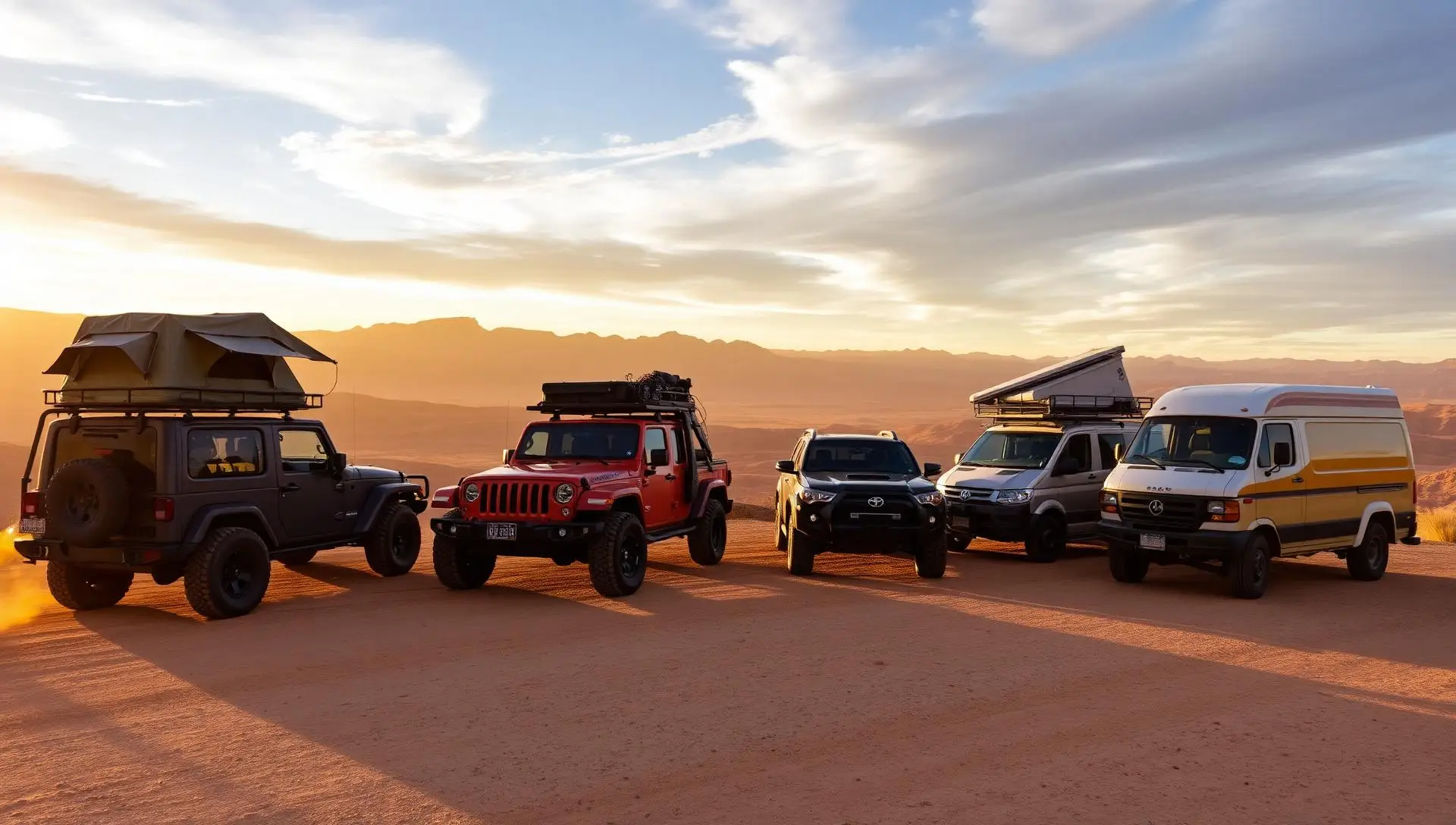
Overlanding is self-reliant travel where the journey is the point and your vehicle doubles as transportation and a place to live. That changes the math compared to ordinary off-roading. Range, storage, payload, and comfort matter as much as how big a rock you can crawl over. This guide breaks down all six options so you can match a rig to the way you actually travel.
Overlanding vehicle comparison at a glance
| Vehicle type | Best for | Trail capability | Payload (approx.) | Daily-driver friendly | Sleep setup |
|---|---|---|---|---|---|
| Jeep Wrangler | Maximum trail access, mods | Excellent | ~1,300 lbs | Moderate | Rooftop tent or ground |
| Ford Bronco | Capability with comfort | Excellent | ~1,370 lbs | Good | Rooftop tent or ground |
| Jeep Gladiator | Gear hauling plus trail | Very good | Up to ~1,720 lbs | Moderate | Bed rack, RTT, or camper |
| Mid/full-size truck | Payload and bed builds | Good to very good | 1,500 to 3,000+ lbs | Good | Bed camper, RTT, topper |
| Traditional SUV (4Runner, Land Cruiser) | Reliability and comfort | Good | ~1,500 lbs | Excellent | Interior or rooftop tent |
| 4x4 van (Sprinter, Transit) | Living space and range | Limited to moderate | 3,000+ lbs | Fair | Full interior buildout |
Use this as a shortlist, not a verdict. The sections below explain when each one is the right call.
What actually matters when choosing an overlanding vehicle
Before comparing nameplates, get clear on the fundamentals. These four factors decide more than the badge on the hood.
Daily driver or dedicated rig
This is the first fork in the road. If the vehicle has to commute, run errands, and haul kids during the week, you want something comfortable, fuel-efficient, and easy to park. That points toward a mid-size SUV or truck. If it is a weekend-and-vacation machine only, you can prioritize capability and living space and accept worse mileage and a rougher ride.
Payload, not just towing
Payload is how much weight your vehicle can safely carry, including passengers, fuel, water, recovery gear, a fridge, a rooftop tent, and everything else. Overlanders pack heavy, and it is easy to exceed a stock payload rating once a rack, tent, drawers, and full water tanks go on. A higher payload number gives you headroom to build without overloading axles and brakes. For reference, a four-door Jeep Wrangler Rubicon carries roughly 1,300 pounds, while a Jeep Gladiator can be configured for up to about 1,720 pounds.
Ground clearance and 4WD
A common rule of thumb is that serious overlanding wants at least 8.5 inches of ground clearance so you can clear rocks, ruts, and debris without scraping. Four-wheel drive is not mandatory for every trail, but 4WD or capable AWD dramatically widens where you can safely go and how confidently you get back out. The 2026 Wrangler Rubicon offers about 10.8 inches of clearance and the Bronco Sasquatch reaches roughly 11.6 inches, both well above that floor.
Reliability and parts availability
When something breaks far from pavement, you need a proven platform and parts you can actually find. A simple, well-supported vehicle beats a complicated, rare one every time. This is why Toyota and Jeep dominate trailheads: deep aftermarket support, common parts, and a huge community that has already solved most problems you will hit.
Jeep Wrangler: the benchmark for trail access
The Wrangler is the reference point every other overlanding vehicle gets measured against. Solid front and rear axles, available locking differentials, a disconnecting sway bar, and removable doors and roof make it extraordinarily capable and fun. The 2026 Rubicon runs a 3.6L V6 making 285 horsepower, returns about 16/22 mpg city/highway, and tows up to 5,000 pounds in four-door automatic form.
Its real superpower for overlanding is the aftermarket. Almost any part, rack, bumper, suspension kit, or storage solution you can imagine already exists and bolts on. That makes the Wrangler the easiest platform to build exactly the way you want.
The trade-offs are a firm on-road ride, modest cargo room inside, and fuel economy that trails a car-based SUV. A four-door (Unlimited) is strongly preferred over a two-door for the extra wheelbase, interior space, and payload.
Choose a Wrangler if
Ford Bronco: capability with more comfort
The Bronco brought a genuine Wrangler rival back to the market, and it splits the difference between hardcore and livable nicely. With the Sasquatch package you get 35-inch tires, front and rear lockers, and around 11.6 inches of ground clearance. It rides and handles a little more composed on-road than a Wrangler, and standard models return roughly 18 to 22 mpg, with hybrid configurations able to top 30 mpg.
For overlanding, the Bronco offers similar trail access to the Wrangler with a slightly more modern interior and driving feel. Payload sits around 1,370 pounds, comparable to the Jeep. The aftermarket is younger than Jeep's but has grown quickly, so racks, bumpers, and tents are readily available.
The trade-offs: removable tops and doors are heavier and fussier than the Jeep's, and long-term reliability data is still thinner because the platform is newer.
Choose a Bronco if
Jeep Gladiator: the do-it-all overland truck
The Gladiator is what happens when you give a Wrangler a five-foot bed. You keep the open-air doors and roof, the solid axles, and the Rubicon or Mojave off-road hardware, and you add real truck utility. That bed is the headline for overlanders: it carries a bed rack, rooftop tent, or slide-in camper, plus a payload that can reach about 1,720 pounds and towing up to roughly 7,700 pounds.
The longer wheelbase makes it more stable on washboard roads and at speed, and it gives you a place to mount gear without cramming the cabin. The five-foot bed pairs cleanly with folding rooftop tents sized to fit the bed footprint.
The trade-offs are real, though. The long wheelbase reduces breakover clearance on steep, tight obstacles, it is harder to park and maneuver on narrow trails, and fuel economy is nothing to brag about. It is also pricier than a comparable Wrangler.
Choose a Gladiator if
Pickup trucks: maximum payload and build flexibility
Step outside the Jeep and Ford halo and the broader truck category opens up. Mid-size trucks like the Toyota Tacoma, Ford Ranger, and Chevrolet Colorado balance capability, payload, and maneuverability, and the Tacoma's Trailhunter trim is about as close to a factory overland build as you can buy. Full-size half-tons like the Toyota Tundra, Ford F-150, and Ram 1500 add payload and interior space, and heavy-duty 2500-class trucks carry the most and tow the most for those running big campers.
Trucks shine because of the bed. You can run a slide-in truck camper, a bed rack with a rooftop tent, a topper with a sleeping platform, or a full flatbed build, and you can change your mind later. Payload ranges from around 1,500 pounds in a mid-size up past 3,000 pounds in a heavy-duty.
The trade-offs scale with size. Full-size and heavy-duty trucks get unwieldy on tight trails and thirsty at the pump, while mid-size trucks give up some interior and payload to stay nimble. For most beginners, a mid-size truck is the sweet spot of fuel economy, trail access, and capability.
Choose a truck if
Traditional SUVs: comfort, reliability, and stealth capability
Body-on-frame SUVs like the Toyota 4Runner, Toyota Land Cruiser, Lexus GX, and Toyota Sequoia are the quiet favorites of long-distance overlanders. You get enclosed, lockable, climate-controlled cargo space, car-like comfort on long highway stretches, and in the Toyota family, legendary reliability and a worldwide parts network.
For overlanding, the enclosed cargo area is underrated. Gear stays dry, secure, and dust-free, and you can build a drawer system and even sleep inside on a platform in some models. These SUVs handle rough roads and moderate trails confidently, with around 8 to 9 inches of clearance stock and roughly 1,500 pounds of payload.
The trade-offs: they are not as trail-extreme as a Wrangler or Bronco on hardcore obstacles, and the most reliable options like the Land Cruiser carry premium prices, new or used.
Choose a traditional SUV if
4x4 vans: living space first, trail access second
A 4x4 or AWD van like the Mercedes Sprinter, Ford Transit, or a converted box truck is a different philosophy entirely. The point is the interior: a real bed, a kitchen, a bathroom in some builds, standing room, and the range to stay out for weeks. For couples or remote workers who treat the rig as a rolling home, nothing else competes on livability.
The trade-offs are equally clear. A van is large, heavy, and limited on technical trails. It will handle graded forest roads, beaches, and many established overland routes, but it cannot follow a Wrangler down a tight, rocky shelf road. Builds are expensive, and the size makes some destinations simply off-limits.
Choose a van if
How to pick the right one: a simple decision framework
Run yourself through these questions in order. Each one narrows the field.
First, will it be your daily driver? If yes, lean toward a mid-size SUV or truck, or a Wrangler or Bronco you can live with. If no, you can consider a van or a dedicated full-size build.
Second, how technical are your trails? For rock crawling and tight, rugged routes, a Wrangler or Bronco leads, with a Gladiator close behind. For forest roads and moderate trails, almost anything on this list works, including a traditional SUV. For maintained dirt and established routes only, a van or full-size truck is fine.
Third, how much gear and how many people? Two people traveling light fit a Wrangler or 4Runner easily. A family, a big fridge, lots of water, and a camper push you toward a Gladiator, a truck, or a van for the payload and space.
Fourth, what is your budget, including the build? The vehicle is only the start. A rooftop tent, recovery gear, suspension, storage, and a fridge add up fast. A used mid-size truck or SUV leaves more budget for the build, while a new van or loaded Gladiator concentrates the spend in the vehicle itself.
Best advice for first-timers
The bottom line
There is no single best overlanding vehicle, only the best one for how you travel. Match the rig to your trails, your gear, your daily-driver needs, and your budget, and you will be happier than if you chase the most extreme or most expensive option. For the largest number of first-time overlanders, a capable mid-size SUV or truck, or a Wrangler or Bronco you can comfortably daily drive, hits the sweet spot. Start with short trips in what you have, learn how you actually like to travel, then build toward the rig that fits.