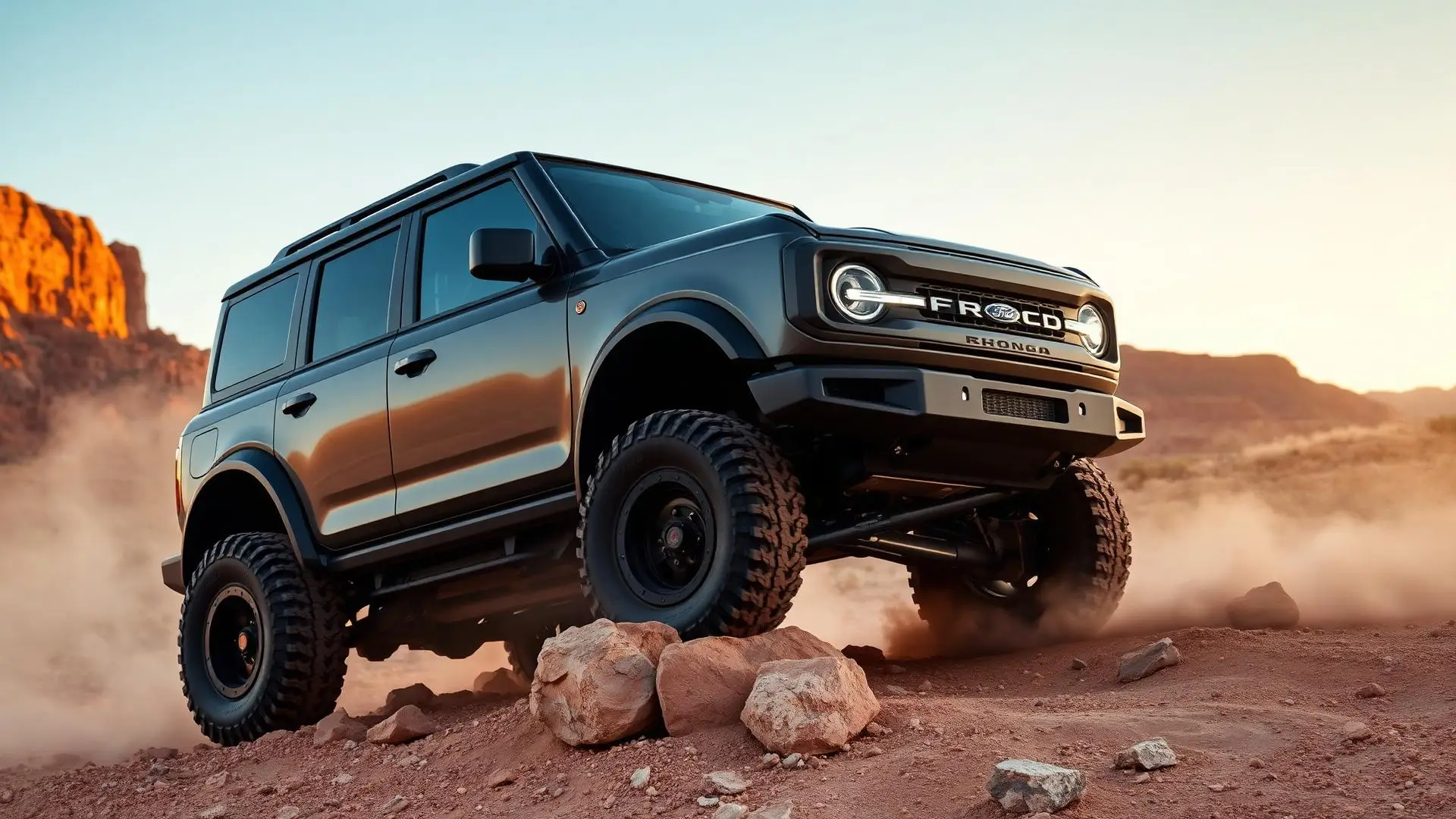
The 6th-gen Ford Bronco is one of the easiest modern 4x4s to lift, and one of the easiest to over-lift. Ford engineered enough factory clearance and articulation into the platform that a 2 inch level plus 35s covers 90 percent of what most owners actually do off-road, and going bigger without addressing geometry is how you end up with vague steering, chewed CV boots, and a $3,000 shopping list you didn't plan for. This guide covers what each lift height actually gets you, what breaks if you skip the fundamentals, and what a real Bronco lift build costs by 2026.
Why the Bronco Is Different From a Wrangler or a Truck
The Bronco uses an independent front suspension (IFS) with coilovers and long upper control arms, not the solid-axle-with-coils setup of a Wrangler. That means lifting a Bronco is less about "add taller springs" and more about "reset the suspension geometry at a new ride height." Every inch of lift changes caster, camber, CV axle angle, and where the upper control arm sits relative to the coilover body. Ignore that math and the truck fights you on the highway and eats parts on the trail.
The good news: because Ford knew people would lift these, factory clearance is generous. Sasquatch trims already run 35s, HOSS-equipped Broncos come with wider track and taller shocks, and Ford Performance sells a factory-backed 4 inch lift that clears 37s and preserves the powertrain warranty. You have more legitimate options than any 4x4 in this class.
The Four Bronco Lift Tiers
Tier 1: Leveling Kit (0.75 to 1.5 inches)
A leveling kit uses coilover spacers or preload adjustment on the factory shocks to raise the front and match the rear rake. Cost is $200 to $500 in parts. It fits 33s on any trim and 35s on a Sasquatch with minor trimming. No geometry correction needed at this height, and stock alignment specs stay in range.
Who it's for: owners who bought a non-Sasquatch Bronco, want it to look level, and plan to stay on 33s. Do not use a spacer level on a Sasquatch, the truck is already leveled from the factory, and adding preload just kills ride quality.
Tier 2: 2 to 2.5 Inch Coilover Lift
This is the sweet spot. Replacement coilovers from Eibach Pro-Truck, ICON Stage 2, Fox 2.0 IFP, or Bilstein 6112 give you 2 to 2.5 inches of lift, better damping than stock, and clear 35s on any trim with light fender liner trimming. Rear shocks and often rear coil spacers are included.
What to add: adjustable upper control arms to restore caster (Ford recommends UCAs above 2 inches), extended sway bar end links, and a fresh alignment (our guide to alignment for lifted trucks covers the specs). Skip the UCAs and your ball joints wear out in 20,000 miles.
Cost: $2,500 to $4,500 in parts, $800 to $1,500 installed. Add $600 to $1,200 for quality adjustable UCAs. Daily driving is nearly identical to stock, MPG drops by 0.5 to 1, and off-road capability jumps significantly.
Tier 3: 3 to 3.5 Inch Lift (Ford Performance HOSS 4.0 territory)
At this height you're into serious hardware. The Ford Performance HOSS 4.0 kit (Fox 3.1 Live Valve internal-bypass shocks) is the benchmark: about 3.5 inches of lift, 37 inch capable, dealer-installable, and it preserves powertrain warranty coverage. Third-party equivalents from ICON (Stage 5 to 7) and Fox Factory Race Series deliver similar performance at similar prices.
What you'll also need: long-length upper control arms (not just adjustable), differential drop brackets to keep CV angles safe, extended brake lines, extended sway bar end links, and, if you're on 37s, a driveshaft spacer or replacement. Steering angle needs a look with an alignment shop that has a Bronco-specific spec sheet.
Cost: $6,000 to $9,000 parts, $1,500 to $2,500 install. Add $1,800 to $2,500 for re-gearing to 4.70 or 4.88 if you want your MPG, throttle response, and towing capacity back with 37s.
Why re-gearing matters on 37s
Going from stock 33s to 37s is a 12 percent increase in tire diameter. Your effective final drive ratio drops by the same amount, which means the truck accelerates like it lost a cylinder, downshifts constantly on hills, and loses 1 to 3 MPG. Re-gearing from the factory 4.27 to 4.70 (or 4.88 on 37s) restores stock behavior. On the 2.7L EcoBoost especially, skipping this makes the truck feel broken.
Tier 4: 4 to 5 Inch Long-Arm Builds
Above 4 inches you're rebuilding the front end, not lifting it. A true 5 inch Bronco lift requires long-arm conversion kits from companies like Zone Off-Road or SuperLift, custom-valved coilovers or bypass shocks, extended CV axles or a mid-travel kit, a full driveshaft, relocated bump stops, and rear axle relocation brackets. Steering geometry has to be corrected with a drop pitman-equivalent (Bronco-specific solution) or your bump steer will be violent.
Realistic use case: dedicated trail rigs, competition prerunners, or 37 to 40 inch tire builds where clearance is the whole point. If this is your daily driver, you're going to regret it in six months.
Cost: $8,000 to $15,000+ in parts alone, plus 20 to 40 hours of skilled labor. Search volume for "ford bronco 5in lift" is high because people want to know it exists, most of them should stop at 3.5.
Geometry Correction: What Actually Matters
Every Bronco lift over 2 inches changes four critical angles. Ignore them and the truck will still drive, for a while.
- Caster. Lifting rotates the upper control arm forward, dropping caster. Low caster makes the truck feel light and wandery on the highway. Adjustable UCAs restore 5 to 7 degrees of positive caster.
- CV axle angle. The half-shafts run from the differential to the front hubs. Lift raises the hub relative to the diff, steepening the CV angle. Above 3 inches you need differential drop brackets to keep the angle under about 22 degrees, or CV boots tear and joints wear out fast.
- Sway bar preload. A lifted Bronco with stock sway bar end links carries preload on the bar at ride height, which limits articulation and stresses the bar. Extended end links (adjustable is best) fix this in 30 minutes.
- Steering angle. The tie rods sit at an angle when the front is lifted, which causes bump steer (the wheel jerks over bumps). Bronco-specific tie rod correction kits exist above 3.5 inches of lift.
Tire Fitment by Lift Height
- Stock (base trims): 32 inch tires factory. 33s fit with no lift on most trims with mild fender liner trimming.
- Stock (Sasquatch/Wildtrak/Badlands Sasquatch): 35s factory. 35s stay stock at any wheel offset within factory spec.
- Leveling kit or 1.5 inch lift: 33s any trim, 35s Sasquatch, 35s base with trimming.
- 2 to 2.5 inch lift: 35s any trim, 37s Sasquatch with fender trimming (not recommended without UCAs).
- 3 to 3.5 inch lift: 37s any trim with UCAs, drop brackets, and trimming.
- 4 to 5 inch lift: 37s comfortably, 40s with long-arm kits and further clearance work.
Daily Driving Trade-Offs
The Bronco's 2.7L EcoBoost and 10-speed automatic are surprisingly tolerant of small changes, and less tolerant of large ones. A 2 inch lift with 35s costs about 1 MPG combined and adds a barely-noticeable half second to 0-60. A 3.5 inch lift with 37s and no re-gear will drop you 2 to 4 MPG, add over a second to 0-60, and make the transmission hunt on hills. Re-gearing restores most of it, factor $2,000+ into any 37 inch build.
Highway crosswind sensitivity increases noticeably above 3 inches of lift. The Bronco's boxy shape is already a sail; raise it and widen the track and you'll be actively steering it in 25+ mph gusts. This is the single most common regret from owners who went to 5 inch lifts.
Death wobble is real on lifted Broncos
The Bronco has fewer death wobble reports than a solid-axle Wrangler, but they exist, almost always on lifts above 3 inches where the owner skipped UCAs, kept stock tie rods, or has worn ball joints. If you feel a rhythmic front-end shake above 45 mph after a bump, stop driving and diagnose it. Our death wobble guide covers the systematic check.
What Lift You Should Actually Buy
- Non-Sasquatch daily driver, occasional trail use: 2 inch coilover kit + 35s + adjustable UCAs. About $4,500 all-in.
- Sasquatch or Wildtrak wanting a real upgrade: ICON Stage 5 or Fox Factory 2.5 with 35s. About $6,000 to $8,000.
- Serious trail build, 37s, warranty peace of mind: Ford Performance HOSS 4.0. About $10,000 installed. Add re-gear.
- Dedicated trail/comp rig: long-arm 4 to 5 inch conversion with 37s or 40s. $15,000+ and a truck you'll dread driving to work.
The Bottom Line
The Bronco is the rare modern 4x4 where the factory did the geometry math for you, up to a point. Stay at or below 3 inches with proper UCAs and you have a truck that daily drives well and handles anything short of Rubicon rocks. Go beyond that and you're signing up for a real build with real trade-offs. Know which one you're doing before you buy the kit, not after the first alignment shop tells you your caster is 2 degrees and your CV boots are torn.