Disclosure: 4x4Playground participates in affiliate programs. If you buy through the links below we may earn a commission at no extra cost to you. We only recommend gear we've tested or would use ourselves.
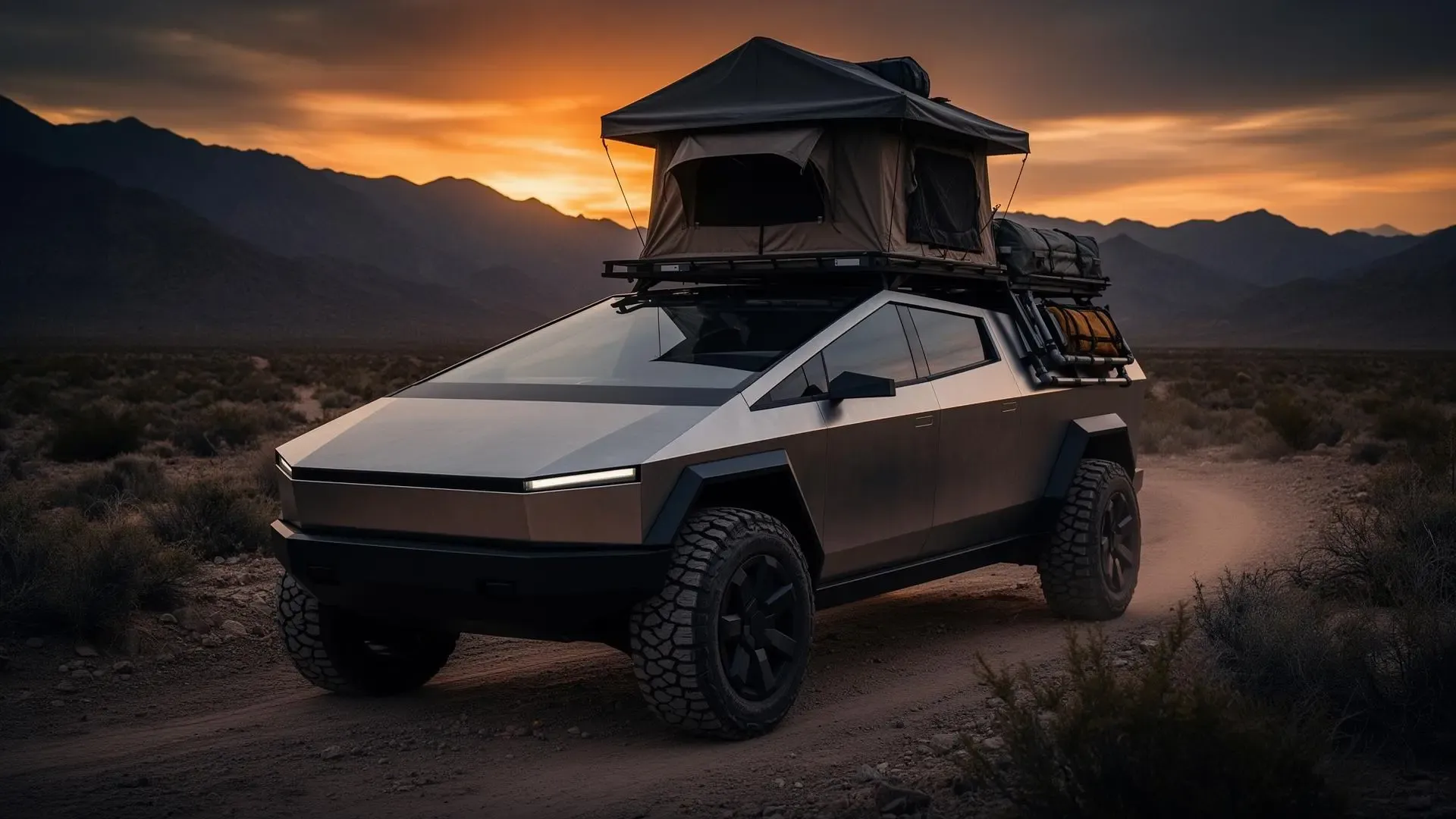
The Cybertruck is a strange beast in the overlanding world. It rolls off the line with 17.4 inches of ground clearance, mechanical locking differentials front and rear, and a battery that can run your whole campsite for days. It also weighs nearly 7,000 pounds and lives or dies by where you can plug it in. Love it or roll your eyes at it, the truck has become a real platform that real people are taking into the backcountry, and the aftermarket has caught up fast.
This guide walks through how to outfit one properly. We will cover what the truck already does well, where it needs help, and the specific gear that turns a stock Cybertruck into a capable overland rig. If you are weighing whether this thing belongs on a trail or just in a parking lot, this should give you a clear picture before you spend a dollar.
Quick Answer
A stock Cybertruck is already a strong base for weekend basecamp and trail-run overlanding within a few hundred miles of reliable charging. The build order is simple: protect the underside, add traction, set up sleeping, then add sliders and a winch-ready bumper as trails get harder. Save the lift and beadlocks for last. Deep remote expeditions are still a stretch because you cannot carry spare battery the way a gas truck carries fuel.
Start With What the Truck Already Gives You
Before bolting anything on, it helps to understand the foundation, because the Cybertruck arrives with hardware most trucks charge extra for.
The AWD and Cyberbeast trims sit on adaptive air suspension that delivers up to 17.4 inches of ground clearance, which is genuinely best in class. For context, a Jeep Wrangler Rubicon offers around 10.8 inches and a Ford Raptor about 13.1 inches. The air suspension also drops the truck to roughly 9.5 inches at highway speed to claw back efficiency, then lifts back up when you need it. Approach angle is 35 degrees and departure is 28 degrees, both strong numbers for a full-size truck.
Underneath, you get dual-motor all-wheel drive with mechanical front and rear locking differentials. That is the part traditional off-roaders tend to underestimate. The front motor can also send all of its torque to a single wheel, which helps when you are crawling with a tire in the air. There is a dedicated Off-Road Mode with Overland and Baja settings, adjustable stability assist down to a near-off "Min" setting, and a Wade Mode that raises ride height and pressurizes the battery pack for water crossings. Four-wheel steering with up to 10 degrees at the rear tightens the turning circle on switchbacks, and Tesla damps it at speed so it does not dart around on rough ground.
The two specs that matter most for trip planning are range and payload. The AWD trims carry an EPA-estimated range around 320 to 325 miles from a 123-kWh structural pack. Payload lands at roughly 2,500 pounds on the Premium AWD and about 2,000 pounds on the Standard AWD. Towing is rated up to 11,000 pounds. Keep those payload and range numbers in mind, because every accessory you add eats into both.
The Range Reality You Have to Plan Around
Here is the honest part. Off-road driving and a loaded rig will cut deeply into that 320-mile figure. Crawling, sand, low-range-style torque demands, roof racks, rooftop tents, and a bed full of gear all drag efficiency down. A realistic trailhead-to-trailhead expectation for a built truck is closer to 200 to 280 miles, and towing anything substantial can halve your range to the 130-to-180-mile band.
This single fact shapes the entire build. Traditional overlanders carry jerry cans and stretch a tank across hundreds of remote miles. You cannot strap an extra battery to the roof and refuel from it. So the smart Cybertruck overlander plans routes around charging the same way a backpacker plans around water sources. That means mapping Superchargers and Level 2 chargers before departure, accepting that remote charging infrastructure is thin and sometimes broken, and treating big-mile remote expeditions as a stretch goal rather than the daily reality. Where the truck shines is the long weekend loop, the basecamp trip, and the trail run within a few hundred miles of reliable charging. Build for that and you will be happy. Build expecting to cross the Mojave on a whim and you will be stranded.
Range Planning Rule
Never plan a Cybertruck trip using the EPA range. Use 60 to 75 percent of it for mixed driving, 40 to 55 percent if towing, and always leave a 15 percent reserve for cold weather, detours, and the climb back to pavement.
Protection First: Armor, Bumpers, and Sliders
The smartest first dollars go into protection, because the Cybertruck's stainless exoskeleton looks tough but the vulnerable bits live underneath.
Underbody armor is the priority. The battery pack is structural and sits low, and while Tesla armored it from the factory, dedicated skid plates add a meaningful layer between several thousand pounds of lithium and the rocks. Companies including Unplugged Performance and T Sportline now sell purpose-built skid systems.
From there, heavy-duty steel bumpers and rock sliders round out the package. Sliders protect the lower body and double as a step for roof access, which you will appreciate once a tent is up top. A proper front bumper gives you a recovery point and a place to mount a winch, which the stock truck lacks in usable form. Carbon fiber and steel body panels exist for those who want extra fender and corner protection, though most builders treat those as cosmetic insurance rather than essentials.
Gear pick: Underbody armor and sliders. Start with a dedicated skid plate set and rock sliders that bolt to factory points. Shop Cybertruck armor and sliders.
Wheels, Tires, and Lift
The stock all-season tires are the first thing serious trail users replace. The factory wheel is large, so all-terrain options have grown to fit, and the aftermarket now offers a purpose-built beadlock wheel that lets you air down safely for traction in sand and over rock without rolling a bead.
If you want more clearance than the air suspension provides, a 2.5-inch lift kit runs around $9,995 and pushes ground clearance to roughly 19.5 inches. That is a serious number, but it is also a serious price, and the truck is already tall. Most owners get what they need from airing down to good all-terrains and using the suspension's max-height setting. Reserve the lift for builds chasing extreme clearance or fitting oversized tires.
Gear pick: Beadlock wheels and all-terrains. Purpose-built beadlocks let you air down hard without rolling a bead. Shop Cybertruck wheels and lift kits.
Recovery Gear Is Non-Negotiable
A 7,000-pound electric truck that gets stuck is a 7,000-pound problem, and you cannot exactly push it. Recovery gear matters more here than on a lighter rig.
Build a kit around a rated front recovery point, a winch if your bumper supports one, kinetic recovery rope sized for the truck's weight, rated soft shackles, traction boards, and a quality shovel. Recovery points need to be properly rated, since the truck's mass puts more load on every component than a half-ton gas truck would. T Sportline and others stock Cybertruck-specific recovery accessories that bolt to factory mounting locations, which saves you from improvising.
The good news is that the truck's torque and locking diffs mean you can often self-recover before you need a strap, especially in sand and mud, by airing down and letting the lockers work.
Gear pick: Recovery kit. Build around a rated recovery point, a heavy-duty kinetic rope, soft shackles, and traction boards sized for a 7,000-pound truck. Shop Cybertruck recovery gear.
Sleeping and Camp Setup
This is where the Cybertruck quietly excels, and it comes down to two features: the bed and the battery.
The vault bed measures about 6 feet long and 4 feet wide between the wheel wells, which is enough for two adults to sleep flat with a proper pad or air mattress. The powered tonneau cover turns it into a weather-sealed, lockable space. Tesla sells a CyberTent accessory that pitches over the bed for stand-up-ish shelter, and the broader aftermarket has gone further with full overlanding kits.
The MARS Cyberlanding kit is the standout system here. It includes a versatile roof rack, a telescoping crossbar setup, accessory mounts, a sidebar, ditch light mounts, a tire rack, and leveling bars, all designed to carry gear and mount a rooftop tent without fighting the truck's angular body. If you want to sleep up top instead of in the bed, a rooftop tent on that rack is the cleanest path. MOLLE panels, bed storage systems, and tire carriers from various makers handle the rest of the gear-management problem.
Gear pick: Overlanding rack and tent system. The MARS Cyberlanding kit and a rooftop tent are the cleanest way to sleep up top. See the Cyberlanding kit.
The Killer Feature: Power
If there is one area where the Cybertruck embarrasses a diesel overland rig, it is power at camp. The truck delivers up to 9.6 kW through five outlets, two in the cabin and three in the bed, including a 240-volt NEMA 14-50 outlet rated for 50 amps.
That is not "charge your phone" power. That is "run the whole campsite" power. Owners have run multiple air conditioners, microwaves, induction cooktops, fridges, lights, and entertainment off the truck at once, no generator required. It can even power a travel trailer's systems directly. For a basecamp setup, this changes the calculus entirely. You can bring an electric fridge and never think about ice, run a heated tent in the cold, or power tools at a worksite. The same battery that limits your range becomes your single greatest camp asset once you stop moving.
The trade-off, of course, is that every watt you pull at camp is range you are not driving on the next day. Powershare lets you set a reserve so you never drain below what you need to reach the next charger, and using that reserve setting religiously is the difference between a great trip and a tow truck.
A Sensible Build Order
If you are starting from a stock truck and want to spend in the right sequence, this is a reasonable path.
- Recovery gear and underbody protection, keep you and the truck safe from day one.
- All-terrain tires, traction does more for real capability than almost anything else.
- Sleeping and camp setup, bed mattress or rooftop tent on a rack.
- Rock sliders and a front bumper, as your trails get harder.
- Lift kit and beadlocks, last, if at all, since they are the most expensive and least necessary for most trips.
Throughout, weigh everything against payload and range. It is easy to bolt on 1,500 pounds of gear and steel and then wonder why your range collapsed and your ride got harsh. Discipline about weight is its own upgrade.
Cybertruck vs the Overland Field
Cybertruck vs Comparable Overland Rigs
How a built Cybertruck stacks up against the rigs an overlander would actually consider.
| Spec | Tesla Cybertruck AWD | Jeep Wrangler Rubicon | Ford Raptor | Rivian R1S |
|---|---|---|---|---|
| Ground Clearance | Up to 17.4" | 10.8" | 13.1" | Up to 14.9" |
| Approach Angle | 35° | 43.9° | 33.1° | 35.8° |
| Departure Angle | 28° | 37° | 24.4° | 34.4° |
| Locking Diffs | Front + rear | Front + rear | Rear | Front + rear |
| EPA Range | 320-325 mi | ~440 mi | ~450 mi | ~410 mi |
| Payload | 2,000-2,500 lb | 1,351 lb | 1,400 lb | 1,764 lb |
| Camp Power | 9.6 kW | None | None | 1.5 kW |
| Spare Fuel |
So, Is the Cybertruck a Real Overlander?
It depends entirely on your overlanding. For weekend trips, basecamp adventures, and trail runs within reach of charging, a properly built Cybertruck is not just viable, it is excellent. The clearance, lockers, torque, and onboard power genuinely outclass a lot of traditional rigs once you are at camp. For deep, multi-day, far-from-anywhere expeditions where refueling means a jerry can rather than a charger, the truck still asks you to plan around its limits, and sometimes those limits will say no.
Build it for what it is. Protect the underside, give it traction, set up the bed or a tent, and lean hard on that incredible power system. Do that, and you will have one of the most capable and comfortable basecamp vehicles money can buy, even if it will never be the truck you take to the ends of the earth.
Bottom Line
The Cybertruck is already one of the most capable basecamp platforms from the factory. Its weakness is not trail geometry or power; it is charging infrastructure. Build within that constraint and it excels. Ignore it and you become the cautionary story.