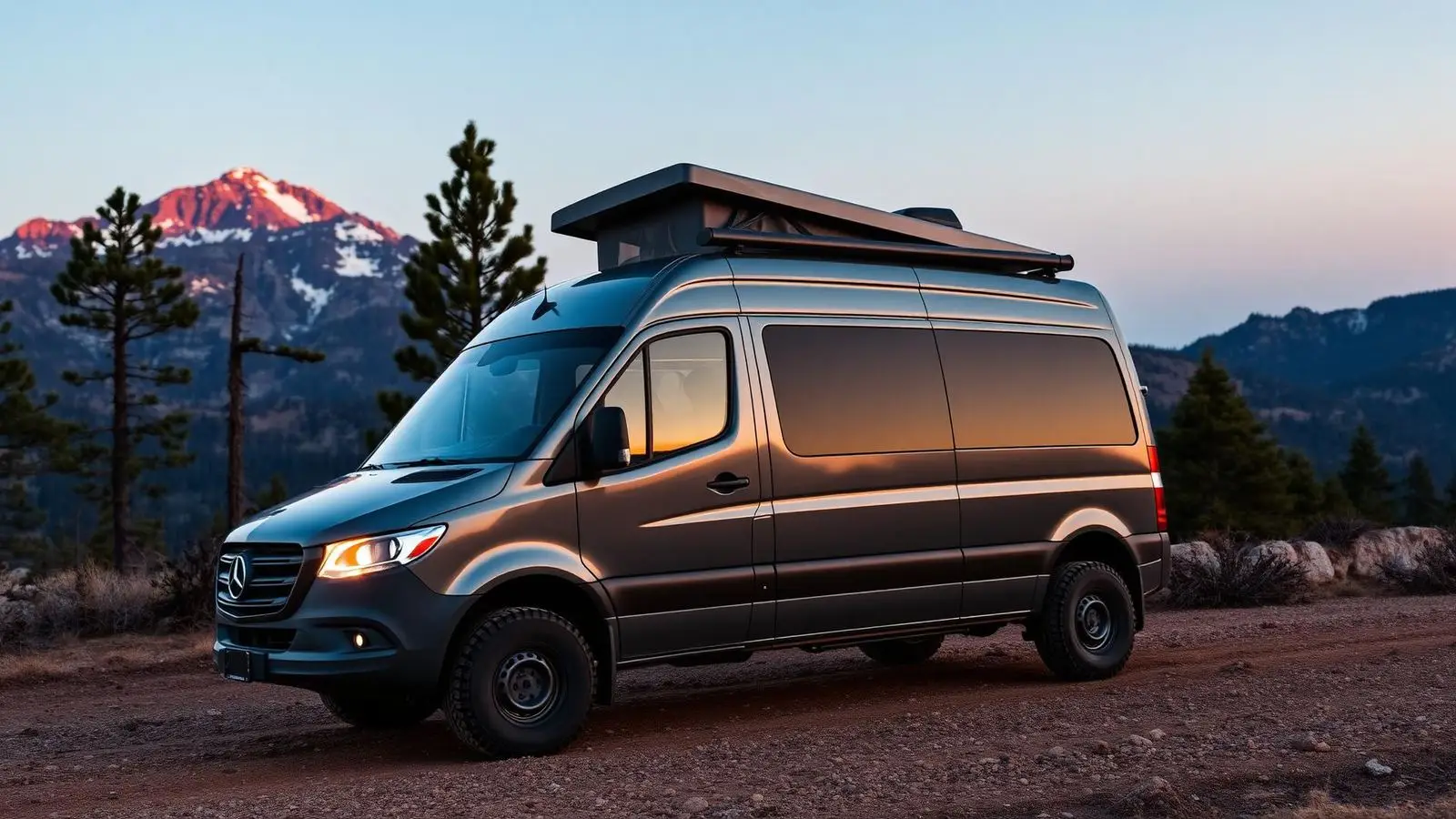
You can tell what kind of van owner someone is by what they pack first.
Some pack the espresso setup. Some pack the toolkit. The seasoned ones pack a recovery board and a spare serpentine belt before anything else, because they have already learned what a van really is. A van is a house with a steering wheel, and at the end of every glamorous photo there is a long, washboard road that the algorithm refused to show you.
The question of which van to drive into that picture is the best overland van question, and in North America in 2026 it has only three honest answers. The Ford Transit AWD. The Mercedes-Benz Sprinter 4x4. The Ram ProMaster. Everything else is a one-off, a discontinued chassis, or a build so far outside the cargo van segment that the comparison stops making sense.
If you have spent any time on YouTube, in forums, or watching the wrong people argue at trailheads, you already know the noise around this question is enormous. Brand loyalists treat it like a religious war. Conversion shops have a financial stake in your decision. Dealers want one of three things from you, and only one. The SERP is full of people answering the wrong question, or answering it for someone who is not you.
Let's do the boring, honest version.
Why This Comparison Looks Different in 2026
The best overland van for an American buyer in 2026 is the one whose strengths line up with the trips you will actually take, the budget you actually have, and the service network you can actually reach. That sentence is unsatisfying, but it is correct. The Sprinter is not better than the Transit. The Transit is not better than the ProMaster. They are different tools that solve different problems, and the brochures will never tell you which one solves yours.
This pillar pulls together what we have learned across our long-form reviews of the Ford Transit AWD and the Mercedes-Benz Sprinter AWD, layers in the ProMaster as the third real option, and ranks them across the dimensions that matter for overlanding rather than the ones that matter for a parking lot photo.
The Three Vans, Side by Side
| Spec | Ford Transit AWD | Mercedes Sprinter 4x4 | Ram ProMaster |
|---|---|---|---|
| Drivetrain | Intelligent AWD (front-bias) | Torque-on-demand or part-time 4x4 with low range | FWD only (factory) |
| Engine | 3.5L EcoBoost V6 gas, ~310 hp / 400 lb-ft | 2.0L turbodiesel I4, ~211 hp / 332 lb-ft | 3.6L Pentastar V6 gas, ~276 hp / 250 lb-ft |
| Transmission | 10-speed automatic | 9G-TRONIC 9-speed automatic | 9-speed TorqueFlite automatic |
| Payload (max) | Up to ~4,560 lbs | Up to ~3,800 lbs | Up to ~4,820 lbs |
| Ground clearance (stock) | ~6.8 to 7.5 in | ~7.5 in | ~6.9 in |
| Wheelbase options | 130", 148", extended 148" | 144", 170" | 136", 159", 159" extended |
| Interior width (cargo) | ~70 in | ~70 in | ~75 in |
| Fuel | Regular gasoline | Diesel + DEF | Regular gasoline |
| Real-world fuel economy | 15 to 19 mpg | 18 to 24 mpg | 14 to 17 mpg |
| Service network | Every Ford dealer in the country | Limited Sprinter-certified dealers | Every Ram/Chrysler dealer |
| Starting MSRP (AWD/4x4 cargo) | $47,000 to $53,000 | ~$65,000 | $48,965 (FWD only) |
| Factory off-road option | Transit Trail trim | 4x4 with low range available | None |
The first thing the table makes obvious is that one of these vans is not playing the same game. The ProMaster is FWD only, period. There is no factory AWD or 4x4 option, never has been, and Stellantis has not signaled one is coming. Every 4x4 ProMaster you see on Instagram is an aftermarket conversion. We will get to what that means in a minute.
The Honest Truth About the Best Overland Van
Here is the part most comparison articles skip.
None of these vans is a 4x4 truck. Not the Sprinter. Not the Transit Trail. Not even the Quigley-converted 4x4 Transit with knobby tires and a roof rack covered in lights. Every van in this comparison is a full-size, long-wheelbase, top-heavy passenger vehicle that weighs four tons when it is built out, and physics decides the ceiling of where it can go.
The relevant question is not which van is the most capable. The relevant question is which van keeps you moving on the eighty percent of overland terrain that is actually washboard, gravel, sand two-track, snow-covered forest road, wet meadow access, and the long unpaved miles between you and a campsite. On that terrain, the differences between these three vans matter a lot. On hard 4x4 trails, you should be driving something else.
The second honest truth: the Sprinter's reputation for off-road capability is partly true and partly a marketing artifact. The 4x4 system with low range is genuinely useful. But several long-time owners have pointed out that a lifted Sprinter does not actually have a meaningfully higher critical-component clearance than a stock AWD Transit once you fix the Transit's rear shock mount geometry. Approach and departure angles favor the Sprinter. Underbody clearance is closer than the badge would suggest.
The third honest truth: the ProMaster's FWD layout is not a death sentence for overlanding. It is a different tool for a different mission. The FWD makes it easier to maintain, cheaper to buy, dramatically easier to convert into a livable interior, and surprisingly capable on packed gravel and snow when the front tires have weight on them. Where it falls apart is wet grass on a slight incline at a forest campsite, deep sand, and any meaningful unpaved climb with a loaded chassis.
What the Drivetrains Actually Do
The Transit AWD runs front-bias. Under dry conditions, torque emphasizes the front axle, and the system sends progressively more to the rear as the front tires lose grip. The transition is automatic and the driver never thinks about it. For overland use, the Transit AWD keeps the van moving in conditions that would have stranded a RWD cargo van of the same size. Wet camp entries. Snow-covered forest roads. Washboard. Loose gravel. The kind of weather that arrives thirty minutes after a sunny morning at altitude. It is not a low-range 4x4 system. It does not need to be.
The Sprinter 4MATIC operates rear-bias, splitting up to 50 percent of torque to the front when sensors detect slip. The more capable trim is the part-time 4x4 with mechanical low range, which is a genuinely different animal. Low range is the feature that separates the Sprinter from the Transit functionally. On a loaded climb on a soft surface, the ability to multiply torque without smoking the clutch matters. Most owners never use low range. The ones who do are the ones who needed it.
The ProMaster is FWD with no factory all-wheel-drive option. The aftermarket has filled the gap. Shops like OZK Customs perform full 4x4 conversions on ProMasters using transfer cases, custom subframes, front and rear differentials, and re-engineered electronics. The work is closer to a powertrain redesign than a bolt-on upgrade. Costs run roughly $8,000 to $15,000 on top of the van, and the resulting system does not match the engineering integration of a factory unit. Quigley and Quadvan, the two established Transit converters, do not do ProMasters. There is no factory warranty on the new drivetrain. For most ProMaster overlanders, the right move is to accept the FWD and build the trip plan around its limits, not against them.
The Real Cost of Ownership
Purchase price is only the beginning. Five-year, hundred-thousand-mile cost of ownership is where the gap opens up.
A new Transit AWD cargo van starts around $47,000 to $53,000 depending on options. A new ProMaster runs $48,965 base in the FWD configuration. A Sprinter 4x4 cargo van starts around $65,000 and climbs quickly once high roof, long wheelbase, and the 4x4 system with low range are checked.
Maintenance is where the Sprinter charges its tax. A five-year, hundred-thousand-mile prepaid maintenance plan for a Sprinter costs roughly $10,340. The equivalent Transit plan runs about $5,625. Over 200,000 miles the gap widens significantly, with Sprinter service estimates running $8,900 to $14,200 against $2,500 to $3,250 for the Transit. The diesel particulate filter and DEF system on the Sprinter are reliability variables that can produce four-figure repair bills with little warning. The Transit's EcoBoost has its own quirks, but they are quirks any Ford dealer can address.
Diesel offers a fuel economy advantage. The Sprinter returns 18 to 24 mpg in real-world driving against 15 to 19 for the Transit and 14 to 17 for the ProMaster. Over the life of the vehicle, this offsets some of the maintenance premium, but not all of it.
Resale is where the Sprinter pulls its money back. A well-maintained Sprinter holds value better than the other two, and high-mileage Sprinters with documented service still command real prices. The Transit depreciates more steeply after the hundred-thousand-mile mark. The ProMaster depreciates most steeply of the three.
Conversion, Layout, and Living In It
The ProMaster has the conversion advantage and it is not close. The cargo box is roughly four inches wider than the Sprinter's and six inches wider than the Transit's. The walls are nearly vertical. The roof is flat. The load floor is the lowest in the segment at 21 inches. For DIY conversions, the ProMaster's geometry means a transverse bed fits cleanly across the back, leaving more usable length for galley, seating, and storage. For a couple who wants to build a livable interior on a moderate budget without learning compound carpentry, the ProMaster is the friendliest van on the market.
The Sprinter offers the best feel and the highest ceiling on the high-roof model. Premium build quality, premium finish, and the resale tail give the Sprinter a long-term ownership profile that the other two cannot match. The cost of that profile is the cost of admission.
The Transit splits the difference. Interior width is narrower than the ProMaster but layouts work. The shared platform with Ford trucks means parts and service are everywhere. The Transit Trail trim adds factory off-road appearance and underbody protection, but the AWD system underneath is the same as the standard Transit AWD.
Where Each Van Disappoints
The Transit AWD's worst-kept secret is that the rear suspension geometry, specifically the stock rear shock mount placement, drags critical components closer to the ground than the spec sheet implies. Fixing this is a known modification and a cheap one. The EcoBoost burns regular gas and burns a lot of it under load.
The Sprinter 4x4's worst-kept secret is that the diesel emissions system is the maintenance liability nobody talks about until it stops working. Remote travel in the U.S. requires planning around DEF refills and diesel availability in a way the brochures never mention. Sprinter-certified service is concentrated in major metros, which is exactly where you are not when something goes wrong.
The ProMaster's worst-kept secret is that the FWD will let you down on a wet uphill at exactly the moment you cannot afford it, and that the aftermarket 4x4 conversion solves the drivetrain problem without solving the build-quality and weight-balance problems that come with adding a transfer case to a chassis that was not engineered for one.
Best Overland Van Verdict: Who Should Buy Which
| Buyer profile | Best choice | Why |
|---|---|---|
| First-time overland van buyer in the U.S. | Ford Transit AWD or Transit Trail | Lowest service friction, lowest fuel friction, AWD covers ~80% of real overland terrain |
| Couple building a budget DIY interior | Ram ProMaster | Widest, boxiest, lowest load floor, cheapest to convert |
| Long-distance traveler with money and standards | Mercedes Sprinter 4x4 | Best resale, best fuel economy, low range available, premium ownership |
| Full-time remote work and frequent boondocking | Sprinter 4x4 with low range | Capability tail matters when help is far away |
| Light off-road, mostly forest service roads and snow | Transit AWD | Right tool, right price, right service network |
| Tight budget, urban-based, light dirt road use | ProMaster FWD | Affordable, easy to live in, can handle gentle terrain |
| Serious off-road ambitions with a van | Reconsider the category | A midsize truck with a rooftop tent is the better answer |
If we had to name one van as the right starting answer for the average American buyer asking the best overland van question for the first time, it is the Ford Transit AWD. Not because it is the most capable van on the list. Because the cost of ownership, the service network, the fuel network, and the payload all stay quiet and let you focus on the trip. The Sprinter is the right answer for the buyer who already knows the cost and signs up for it anyway. The ProMaster is the right answer for the buyer who is honest about staying on packed surfaces and wants the most house for the money.