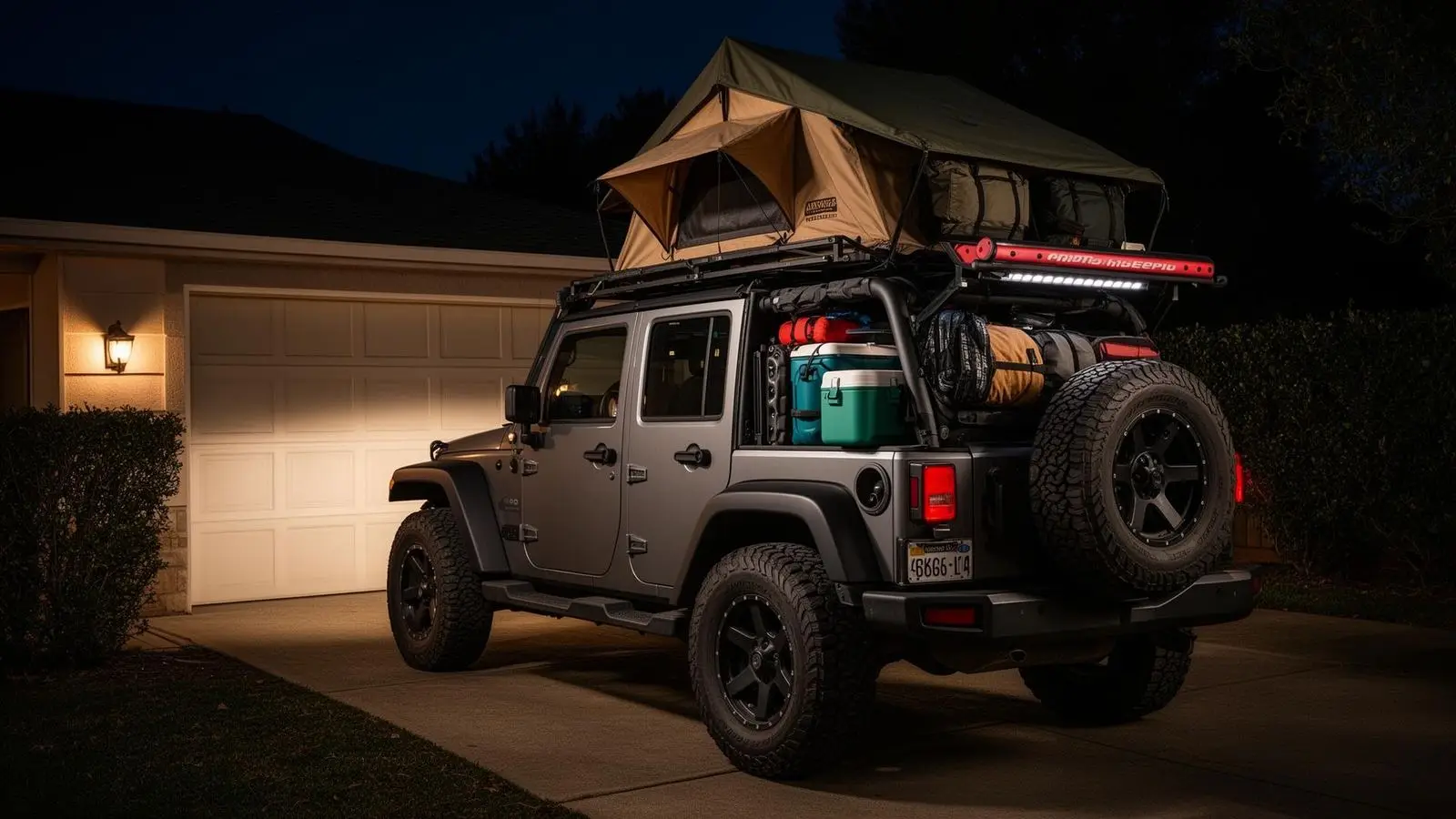
The overlanding market tells you that you need a $3,000 roof top tent and a $2,500 fridge to go "overlanding." For most weekend trips, you don't.
What an $8,400 Setup Looks Like
Add up a typical "complete" overlanding kit and it looks like this: a roof top tent, a fridge and slide, recovery boards, traction mats, a compressor, a 47-piece tool kit, a kitchen box, a water tank, a propane tank, and a shower system. At full retail, that is about $8,400.
On a two-door Wrangler, all of that fills the cargo area before you've packed food or clothes. And the trip it is packed for is often a 3-hour drive to a campsite with a bathroom.
What Overlanding Marketing Leaves Out
Overlanding brands sell the feeling of adventure, and feelings are expensive.
Look at any overlanding Instagram account. You'll see the same shot: truck on a ridge, tent popped, person holding coffee, mountains behind them.
What you don't see:
- The time it takes to level the truck
- The broken zipper on the $800 tent
- Climbing a ladder every time you need to get down in the night
That doesn't sell. What sells is the promise that gear equals experience.
A $127 Weekend Kit
Here is a minimal kit that covers most two-night weekend trips.
A $40 cooler
Not a fridge. A basic hard cooler typically holds ice for about 2 days, which covers a standard weekend.
A $60 sleeping bag
Not a $400 down quilt. A synthetic bag keeps insulating when it's wet and is cheap to replace.
A $15 headlamp
Not a $200 camp lighting system. One headlamp covers camp chores and nighttime walks.
A $0 ground tent
Borrow one before you buy one. You'll learn what you actually want in a tent.
A $12 camp chair
It does the same job as a $300 ultralight chair at a drive-up campsite.
Total cost: $127, versus about $8,400 for the full expedition list.
The Real Divide in This Community
There are two kinds of overlanders, and they need different gear.
On one side: People who camp 40+ nights a year. Who sleep in their rig because they're actually moving across states, chasing hunting permits, following weather. For them, the gear makes sense. The $3,000 tent pays for itself in hotel savings.
On the other side: People who go out 6 to 8 times a year. Weekend warriors. Their "overlanding" is really car camping with better marketing.
Most buyers are in the second group but shop like the first.
What Actually Matters: The 5% Rule
It's not the tent. It's not the fridge. It's not the kitchen setup. It's five things:
- Tires that don't suck. Everything else is optional. Good tires are mandatory. Spend your money here first.
- A way to sleep. Ground tent, RTT, hammock, back seat. Doesn't matter. Just have a plan that works for you.
- Water. A jug. Any jug. Refill it when you get to camp.
- Recovery gear you know how to use. Not the $800 kit with every attachment. A strap. Maybe a shovel. And the knowledge to use them.
- The willingness to be uncomfortable. This is the one no one sells. And it's free.
The One Question That'll Save You Thousands
Before you buy anything, ask yourself this:
"Am I solving a real problem I've actually had, or am I buying a feeling?"
If you've never once wished you had a fridge on a trip, you don't need a fridge.
If you've never been stuck and needed traction boards, you don't need traction boards.
If you've never thought "I wish I had a shower" instead of "I'm dirty and I don't care," you don't need a shower system.
Buy the problem. Not the fantasy.
Where to Start
You don't need to optimize for the Alaska trip you're not taking.
You need to optimize for the weekend you're actually doing.
The best overlanding setup isn't the one that looks good on Instagram. It's the one that gets you out there more often. With less hassle. And more money left over for gas.
Start with the $40 cooler. Upgrade when you have a reason. Not a fantasy.