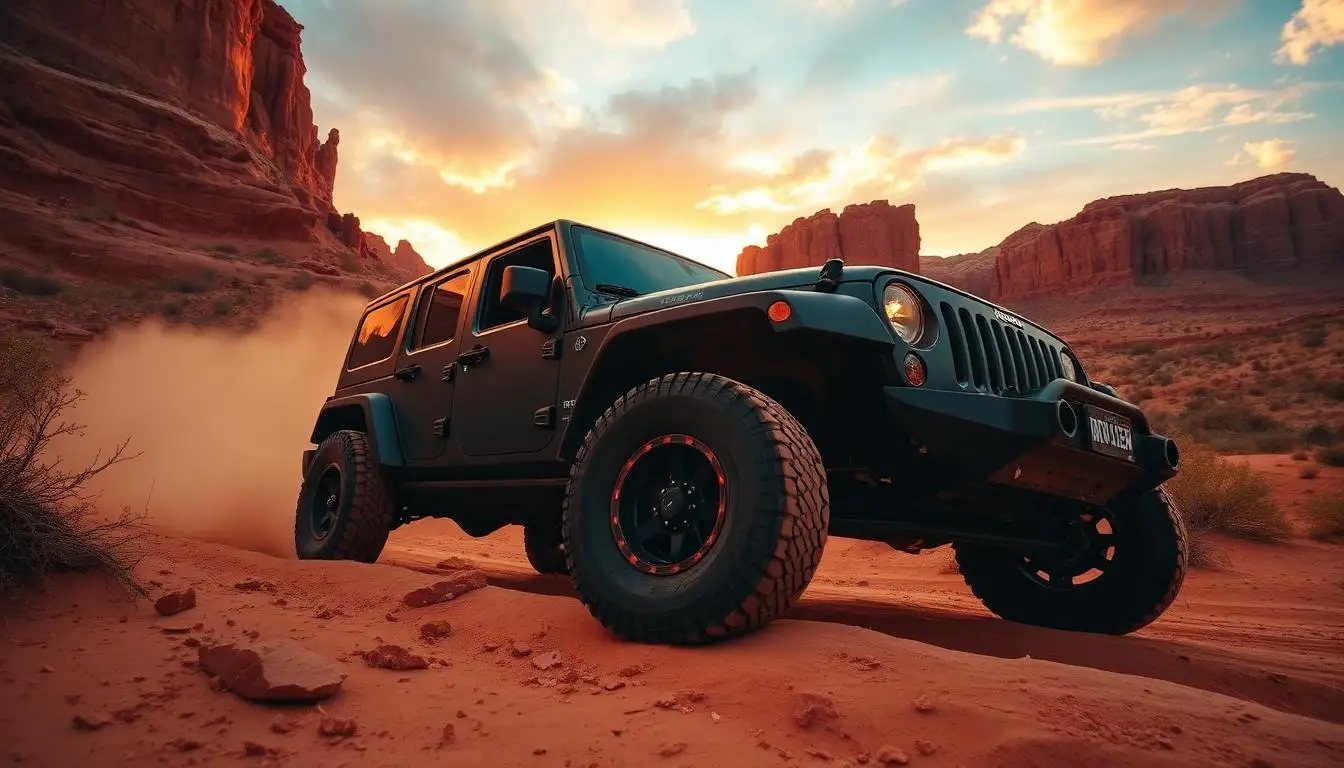
The trails are harder. The scenery is more dramatic. The culture runs deeper. Here's why serious wheelers keep coming back to the West Coast, and why first-timers never look at off-roading the same way again.
If you've ever pointed your rig toward a rocky horizon somewhere west of the Mississippi and felt your pulse spike just a little, that nervous-excited feeling right before a gnarly line, then you already understand something that can't really be put into words. But we're going to try anyway.
West Coast off-roading isn't just a hobby. It's not a weekend activity you check off a list. It's a culture with its own language, its own legendary landmarks, its own heroes and horror stories, and its own kind of obsession that tends to get very expensive very quickly. It's the kind of thing that starts with a stock Jeep and ends with a fully caged rock buggy, a parts collection spread across three garages, and a long-suffering spouse who has come to accept that vacations will now permanently involve "trail time."
We're here for it. Every single bit of it.
The West Coast has earned its reputation as the undisputed Mecca of off-road culture. From the high granite walls of the Sierra Nevada to the burnt-orange sandstone of Moab, from the punishing desert floors of Johnson Valley to the terrifying shelf roads of Colorado's San Juan Mountains, this region is a masterclass in what happens when geology and adventure collide. No other part of the country, arguably no other part of the world, can offer the sheer diversity of terrain, the volume of accessible public land, and the concentration of legendary trails that the American West puts on the table.
Let's break it all down.
BLM Land and Public Access: The Freedom That Makes West Coast Off-Roading Possible
Here's something that people in the off-road community sometimes take for granted, especially those who grew up out West: the fact that you can simply go.
Grab your keys. Load the rig. Drive to a trailhead, a dry lakebed, a canyon wash, or a boulder field. Camp. Wheel. Explore. Come back when you feel like it.
That freedom is not the default everywhere.
In the Eastern United States, the majority of off-road destinations are privately owned or operate under strict permitting systems. The trail systems that do exist are often managed by clubs, have limited access, and require memberships or fees. It's not a bad system, the trails are often well-maintained and the communities around them are tight-knit and passionate, but it is, by definition, a narrower experience.
The West Coast operates on a different model. Vast stretches of land fall under the jurisdiction of the Bureau of Land Management, better known simply as the BLM. These are tens of millions of acres of federally managed public land, and much of it is open to the kind of recreation that off-road enthusiasts live for. You can camp dispersed, meaning literally anywhere within the permitted area, rather than being funneled into designated campgrounds. You can explore two-tracks, fire roads, and canyon routes that have never appeared on a trail map. You can find solitude in places that feel genuinely untouched.
Note
National Forest access adds another layer. The Western states are home to enormous national forests, the Angeles, the San Bernardino, the Inyo, the Shoshone, the Manti-La Sal, each with its own character, its own trail networks, and its own seasonal quirks. In winter, some of these close under heavy snow. In summer, fire closures can reshape access overnight. Part of the skill of wheeling the West is learning to read land status maps, check closure notices, and plan with flexibility baked in. It keeps you on your toes. It also rewards people who put in the homework.
The sheer scale of accessible terrain out West is not an accident. It's a product of history, settlement patterns, and federal land policy that took shape over more than a century. Whatever the politics around BLM land management, the practical reality for off-road enthusiasts is that the West offers a canvas for exploration that simply doesn't exist in quite the same way anywhere else.
Off-Road Terrain Types: A Geology Lesson You'll Never Forget
Ask any experienced wheeler what makes West Coast trails different and the answer almost always comes back to the same thing: rock.
Not mud. Not roots. Not the soft, churned-up clay trails that dominate the Southeast and Pacific Northwest. Hard rock. Ancient, weathered, high-friction, wheel-eating, skid-plate-grinding, portal-axle-justifying rock.
The American West sits on some of the most geologically dramatic real estate on the planet. The Colorado Plateau, a massive elevated region covering parts of Utah, Colorado, Arizona, and New Mexico, is a cross-section of geological time. Layer after layer of sandstone, limestone, and shale, laid down over hundreds of millions of years and then uplifted, eroded, and sculpted by wind and water into formations so extreme they look digital. The stuff is grippy, too. Colorado Plateau sandstone is famous among rock crawlers for its traction. You can run surprisingly aggressive angles on dry rock without slipping because the surface bites back.
The Sierra Nevada, by contrast, is granite country. Ancient, crystalline, brutally hard granite that has been cracked and fractured by millennia of freeze-thaw cycles into a puzzle of boulders ranging from car-sized to house-sized. The famous Rubicon Trail runs through this landscape, and the difference in character from the sandstone Southwest couldn't be more pronounced. Where Moab rewards methodical line selection and patience, the Rubicon rewards sheer ground clearance, approach and departure angles, and the willingness to accept that your sheet metal is going to see some stress.
Then there's the California desert, the high Mojave, the Coachella, the Anza-Borrego, where the geology shifts again. Here you're dealing with decomposed granite, dry washes, hardpan lakebed surfaces, and the occasional volcanic field. It's different from both Sierra granite and Colorado sandstone, with its own tire-swallowing soft spots and its own brand of beauty.
Tip
The limited rainfall in most of the Western off-road zones matters, too. Mud season is not really a West Coast thing. Out West, the concern is dust, heat, flash floods in canyon systems, and the occasional unexpected snowstorm at elevation. But the trails stay largely intact year-round in the drier zones. There's no "spring thaw" that turns every trail into a rutted mess for three months. You don't have to wait. The terrain is there, and it's mostly rideable whenever you're ready to show up.
Moab, Utah: The Best Off-Road Destination in the World
There are off-road destinations, and then there is Moab.
To say Moab is famous in the wheeling world is an understatement on the level of saying the Grand Canyon is "a decent-sized hole." Moab is the reference point. It's the benchmark by which other destinations are measured. When people who have never seriously wheeled before decide they want to get into off-roading, "going to Moab someday" is almost always the first dream they articulate.
Located in southeastern Utah against the backdrop of the La Sal Mountain range, Moab sits at the heart of some of the most spectacular red rock country on earth. Arches National Park and Canyonlands National Park bookend the town on either side. The Colorado River winds through the canyon below. And spreading out from this little desert community in every direction are some of the most technically demanding, visually stunning, and historically storied off-road trails on the planet.
The trail variety alone is mind-bending. Hells Revenge. Fins and Things. Slickrock. The Golden Crack. Metal Masher. Potato Salad Hill. These aren't just funny names. Each one represents a distinct character of terrain, a different challenge level, a different kind of test. Beginners can find trails that introduce them to the experience without destroying their rigs on the first run. Experts will find trails that humble them regardless of build level or experience. For a deeper look at specific Moab trail ratings and what to expect, check out our trail guides.
The Easter Jeep Safari, hosted annually by the Red Rock 4-Wheelers club, has been running since 1967. That's not a typo. This event has been drawing wheelers to the Moab desert for decades, and it remains one of the single largest and most celebrated off-road events in the world. During Safari week, the population of Moab swells dramatically. Trails that are normally quiet fill up with rigs of every description, from bone-stock daily drivers to purpose-built competition crawlers that look like they were designed by someone with a deep personal grievance against the laws of physics.
The social dimension of Moab is also part of what makes it special. There's a genuine community culture here. People run in groups, help each other through difficult sections, share camp spots, and swap trail intel freely. For newcomers, running Moab with an experienced group is one of the fastest ways to level up. For veterans, coming back year after year is about the ritual as much as the terrain.
If you have not been to Moab, stop delaying. It belongs on every four-wheeler's bucket list, not as a maybe, but as a must.
King of the Hammers and the Hammer Trails: Where the Best Come to Suffer
If Moab is the holy grail, Johnson Valley is the crucible.
Located in the high desert of San Bernardino County in Southern California, Johnson Valley is home to what many serious off-road enthusiasts consider the hardest recreational wheeling terrain on the continent. The Hammer Trails, Ultra4, Chocolate Thunder, Wrecking Ball, Backdoor, and others, are a different category of challenge from what most people encounter at organized trail runs. These are not trails designed to be fun. They are trials designed to break things. Your gear. Your rig. Your ego. Your faith in your own builds.
The terrain combines desert washes, deep sand, and technical rock sections in a way that demands a vehicle prepared for everything. A rig that kills it on pure rock might bog in the sand. A dedicated desert runner might catch a rock and fold an axle it would have cleared on a dedicated crawler. Johnson Valley doesn't reward specialists. It rewards well-rounded builds and drivers who can adapt.
Note
Watching KOH in person is a genuinely surreal experience. You're standing in the middle of the desert with tens of thousands of other off-road fanatics, waiting for a purpose-built race rig to come screaming out of a wash and onto a rock section where the driver will have maybe three inches of clearance on either side. When it goes wrong, and it regularly, spectacularly does, the crowd groans. When it goes right, the crowd loses its mind.
For the average enthusiast, Johnson Valley isn't just about watching the race. The public land opens up for recreational wheeling outside of the designated military training periods, and running the Hammer Trails on your own rig is both humbling and unforgettable. It's the kind of place you come back from with a list of upgrades you suddenly can't live without.
Rubicon Trail, California: The Most Iconic Off-Road Trail in America
Of all the legendary trails in the American West, none carries quite the same weight of history, reverence, and reputation as the Rubicon Trail.
At just over 22 miles, it's not particularly long. It doesn't top out at extreme elevation. There are no shelf roads that will give you vertigo. And yet, the Rubicon Trail is considered the single most iconic off-road trail in the United States, and one of the most celebrated in the world. It's the trail that other trails get compared to. It's the benchmark for a reason.
Running through the Sierra Nevada between Loon Lake and Lake Tahoe along the California-Nevada border, the Rubicon has been drawing wheelers since the post-war era when Jeep CJs first started appearing in the mountains. The Jeep Wrangler Rubicon, arguably the most recognized off-road nameplate in the world, takes its name from this trail. That's not marketing fluff. That's a genuine acknowledgment of a place that shaped the hobby.
Warning
The camping along the Rubicon is spectacular. Pulling off the trail for the night, cooking over a camp stove at elevation with the Sierra Nevada spread out around you, hearing nothing except wind and maybe a distant trail rig working through a section. It's a different kind of quiet than anything you find in the city. It's restorative in a way that's hard to explain to people who haven't experienced it.
Running the Rubicon should be considered a rite of passage. Not because it will necessarily humble you, though it might, but because it connects you to decades of off-road history, to a community of people who have made the same run, and to a landscape that makes everything else feel small in the best possible way.
Black Bear Pass, Colorado: The Most Dramatic Off-Road Drive in the Rockies
Leave the desert behind for a moment. Head east into Colorado, into the San Juan Mountains, and find a trail that trades red rock for alpine drama.
Black Bear Pass sits above Telluride, Colorado, and tops out at a lung-testing 12,840 feet above sea level. The approach is stunning. The summit views are legitimately jaw-dropping. And the descent, a series of switchbacks carved into a shelf road that drops into the Telluride valley, is one of the most technically demanding and psychologically intense sections of four-wheeling you will find anywhere.
The trail is rated only moderately difficult for most of its length. Modern, well-built four-wheel-drive vehicles can handle the terrain with careful driving and a healthy respect for the mountain. But "moderately difficult" does not mean "risk-free," and the shelf road section above Telluride is not a place for overconfidence. The road is one lane. There are no guardrails. The dropoff is measured in hundreds of feet. Getting it right demands focus, patience, and genuine respect for the mountain.
Warning
The trail is a one-way descent from the top. You come up via Ophir Pass or from the Telluride side on 4WD-accessible roads, then work your way down the pass. It's a one-way run that makes the experience feel more committed. You're going over the edge, and finishing is the only real option.
What Black Bear Pass does better than almost any other trail is remind you that off-roading is not just about rock crawling and flex tests. It's about wild places. It's about going somewhere that most vehicles and most people will never go, standing at 12,840 feet above sea level with nothing between you and the horizon, and feeling very small and very alive at the same time.
Ghost Towns and Desert History: Off-Roading as Time Travel
One of the West's most underrated gifts to the off-road community isn't terrain at all. It's history.
The arid climate of the American Southwest is an extraordinary preservative. Structures and artifacts that would rot, rust, or be swallowed by vegetation in wetter climates survive almost indefinitely in the desert. You can drive deep into a Southern California or Nevada desert, follow a rutted mining road for ten miles, and find yourself walking through a ghost town that looks like it was abandoned last decade, except the calendar on the wall says 1923.
California alone has hundreds of ghost towns, remnants of the mining booms that drew fortune seekers to the desert in waves throughout the 19th and early 20th centuries. Gold, silver, borax, tungsten, and other minerals pulled towns out of nothing. When the ore ran out, the towns collapsed just as fast, leaving behind wood-framed saloons, collapsed headframes over mine shafts, rusted stamp mills, and the strange intimacy of abandoned personal effects left exactly where they fell.
Calico Ghost Town in San Bernardino County is one of the most accessible and well-preserved examples, but it barely scratches the surface. Get into the Mojave's back country, the areas that require genuine four-wheel drive to access, and you'll find sites that feel genuinely forgotten. No interpretive signs. No gift shops. Just history sitting in the desert under the sun.
The Nevada ghost towns are even more sprawling. Virginia City. Rhyolite. Belmont. Berlin. Each one a snapshot of a particular moment in American westward expansion, each one accessible only to those willing to put in the miles on dirt roads. Off-roading gives you access to these places in a way nothing else can. The machine that gets you over the boulder also gets you to the door of the saloon.
For history enthusiasts who happen to wheel, or wheelers who happen to love history, this aspect of West Coast off-roading adds a layer of richness that pure terrain challenge can't provide. The desert preserves. The four-wheel drive delivers. The combination is remarkable.
Overlanding the West Coast: More Than Just Getting There
Somewhere in the last decade, overlanding went from a niche pursuit to a full-blown cultural phenomenon. Roof tents. Vehicle-mounted camp kitchens. Drawer systems and Maxtrax boards and dual-battery setups and Starlink dishes. The Instagram off-road build was born, peaked, and is now being gently mocked by the veterans who were doing this before anyone was filming it.
But underneath the gear culture and the social media aesthetic, overlanding's real appeal is something the West Coast has always offered: the ability to go far and stay long.
Because of the BLM land access described earlier, the West is uniquely suited to extended overland trips. You can plot a route that covers a thousand miles of dirt road, camps in new locations every night, and never repeats itself. You can traverse multiple ecosystems, Joshua Tree desert to pine forest to alpine meadow to volcanic high desert, without ever seeing a paved road unless you choose to. That kind of freedom exists almost nowhere else, and the off-road community knows it.
The overland community that has grown up around the West Coast is a particular subculture within the broader four-wheel-drive world. It skews toward vehicles that can carry more: full-size trucks, larger SUVs, Sprinter vans with four-wheel drive. It prioritizes self-sufficiency over raw rock-crawling capability. It attracts people who want to spend four days in the backcountry more than people who want to spend four hours on a technical trail. Neither is better. They're just different answers to the same question: what do you want from wild places?
The West Coast serves both communities. The technical trail networks serve the crawlers. The open land and long dirt roads serve the overlanders. And the geography often mixes them in the same locations. A high-desert overland camp at the foot of a technical rock trail is not an unusual setup. It's actually kind of the ideal setup. Our essential overlanding gear guide covers equipment for extended West Coast trips.
West Coast Rig Builds: How the Terrain Shaped the Aftermarket
It would be impossible to talk about West Coast off-roading without talking about the hardware. Southern California in particular has been the epicenter of aftermarket four-wheel-drive development for decades.
The rock crawling demands of the Sierra Nevada and Moab drove innovations in suspension design, axle strength, and tire technology that have filtered down into every segment of the market. Long-travel suspension, the setup used on desert racing prerunners and high-speed desert trucks, was largely developed in Southern California for the punishing conditions of the Baja Peninsula and the Mojave. Portal axles, which lift the axle's differential above the wheel centerline to gain ground clearance, became a serious option for extreme crawlers largely because the Rubicon and Hammer trails demanded clearances that conventional setups couldn't provide.
The tire industry responded to West Coast demands as well. The aggressive mud terrain and rock terrain tire compounds and tread patterns that dominate the off-road market today were shaped in large part by what the California, Utah, and Nevada terrain required. High-traction, heat-resistant compounds for desert use. Self-cleaning tread designs for the rare mud encounters. Sidewall reinforcement for the abrasive granite of the Sierra.
Tip
How to Start Off-Roading: A Beginner's Guide to West Coast Wheeling
Here's the real talk that nobody's guide gives you up front.
You don't need a built rig to start. The single biggest misconception about off-roading, West Coast or otherwise, is that you need a full build before you can participate. You do not. A stock Jeep Wrangler, a stock Toyota 4Runner, a stock Land Cruiser, a stock Tacoma, all of these will get you into beginner and intermediate trails without modification. The trail systems in Moab alone have dedicated easy-to-moderate runs that a completely stock vehicle handles just fine. Start there. Not sure which platform to pick? Our Jeep Wrangler vs Ford Bronco comparison breaks down the two most popular choices.
Join a club or run with experienced people first. This cannot be overstated. The off-road community is exceptionally welcoming to newcomers, but the learning curve on technical terrain is steep and the consequences of getting it wrong can be expensive or dangerous. Running with experienced people means you get coached on line selection, recovery techniques, and trail etiquette. Knowledge that would take years to develop on your own gets transferred in a single weekend.
Carry recovery gear before you carry upgrades. A good high-lift jack, a kinetic energy recovery rope, D-rings rated for your vehicle's weight, and a quality air compressor are worth more than any suspension lift in the situations that matter. Tires matter more than almost any single upgrade you can make. If you're going to spend money before anything else, spend it on tires appropriate for your terrain. See our recovery gear guide for specific product recommendations.
Know your land. Download the appropriate apps for checking BLM land status, trail closures, and weather. Gaia GPS is essential. Check it before you go. Conditions change. Closures happen. A quick five-minute check before leaving the house has saved more trips than any piece of hardware.
Don't go alone when you're learning. The trails are wild. Recovery from a bad situation is dramatically easier with two rigs than one. The West Coast gives you incredible access to wild places; it just also reminds you, occasionally and firmly, that those wild places don't particularly care about your timeline.
Why the West Coast Off-Road Community Is Different
The community that has grown up around West Coast wheeling has a specific character worth talking about.
There's a legacy culture here. The Easter Jeep Safari has been running since 1967. King of the Hammers, while younger, has become one of the most watched off-road events in the world. The Jeep Jamboree, which takes groups over the Rubicon Trail, has been connecting families and enthusiasts to the Sierra Nevada since 1953. These aren't new traditions. They're deeply rooted, and the sense of continuity they provide gives the West Coast off-road scene something intangible but real: weight.
There's also a generational aspect. Plenty of the people running the Rubicon today have fathers and grandfathers who ran it before them, in smaller and considerably more fragile vehicles, with far less information and far more improvisation. The old-timers have stories. The good ones share them freely.
The diversity of the West Coast builds reflects the diversity of the terrain. You'll find rock crawlers running portal axles and 40-inch tires. Desert prerunners on long-travel suspension at the other extreme. Tastefully built overlanders splitting the difference. This is not a monoculture. The common thread is a respect for the terrain and a genuine love for the act of going somewhere a normal vehicle cannot.
The Bottom Line: Why the American West Still Sets the Off-Road Standard
We live in an era where off-roading has become globally popular. Overland routes in Iceland, Morocco, Namibia, and the Australian Outback command social media attention. International trail systems in places like New Zealand and Peru attract dedicated pilgrimages from American wheelers. The hobby has globalized.
And yet, the American West remains the standard.
It's not nostalgia. It's not regional pride. It's the honest acknowledgment that no single region on earth combines the volume of accessible public land, the diversity of technical terrain, the depth of trail culture, the proximity of aftermarket support, and the concentration of legendary destinations the way the American West does.
The Rubicon Trail. Moab. King of the Hammers. Black Bear Pass. The Mojave Road. Dumont Dunes. The sand dunes of Glamis. Ouray. Telluride. The list goes on longer than any single article can do justice to.
If you're just getting started in four-wheeling, the West Coast is where you need to go. If you've been doing this for years, you already know: it keeps calling you back. The trails change with the seasons, the light changes with the hours, and the terrain has a way of making every run feel at least a little like the first time.
Note