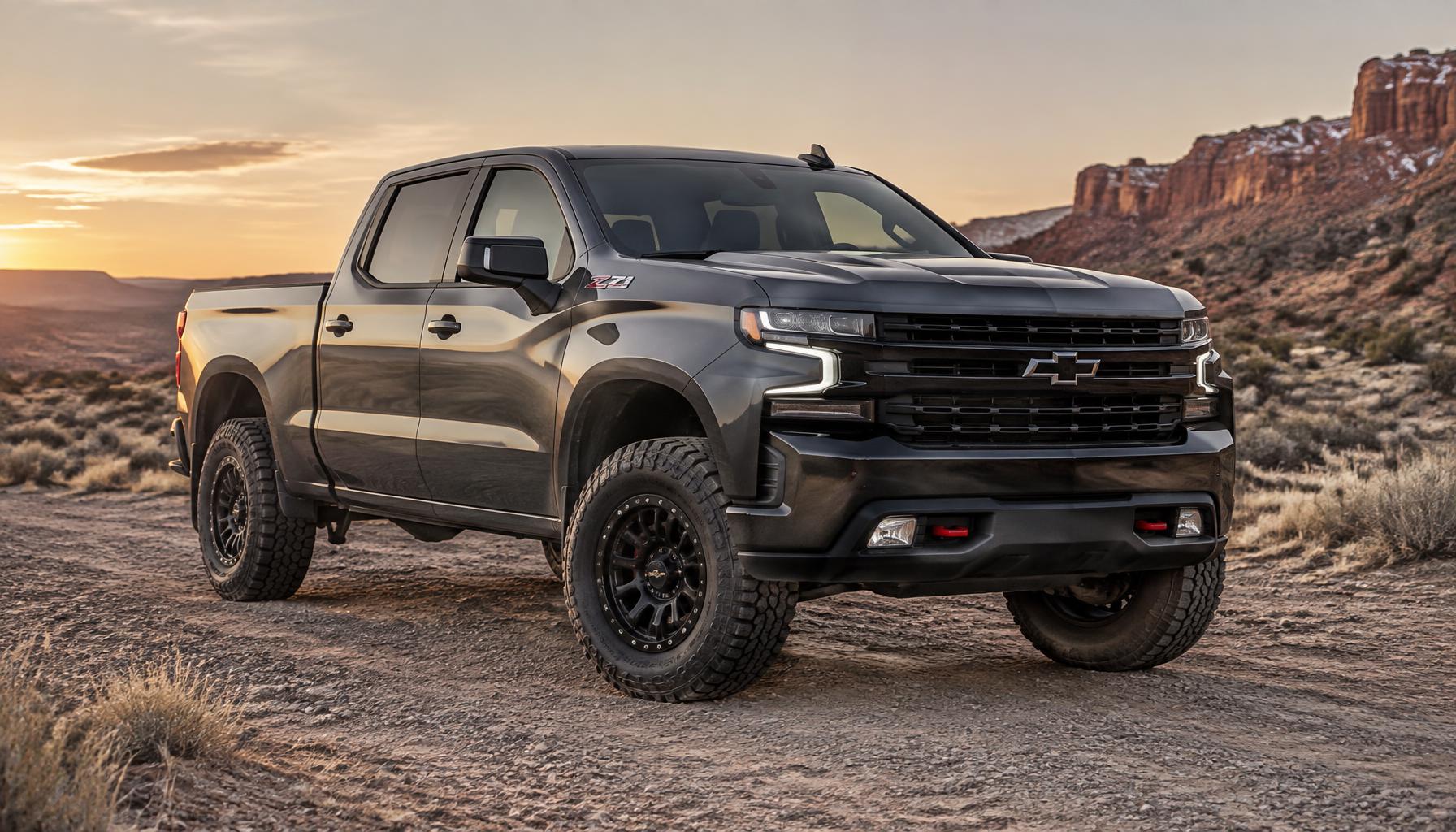
Trim, lift, and wheel offset decide whether 35-inch tires on a Chevy Silverado 1500 clear or chew plastic.
The tire shop already has the 35x12.50s on the hoist. The leveling kit is in a box in the bed. Full lock left, and the tire kisses the crash bar. Full lock right over a driveway lip, and the liner folds. That is the moment most Chevy Silverado 1500 owners discover that "35s with a 2 inch level" was a forum headline, not a fitment plan.
Why Silverado 35s Fitment Matters on the T1XX
The 2019 and newer T1XX Chevy Silverado 1500, and the matching GMC Sierra 1500, is the platform this guide is built around. Wheel wells look generous. Trail Boss and AT4 already wear factory 33s on a roughly 2 inch factory lift. None of that means every trim clears a true 35x12.50 without work.
This piece follows the same chassis as our F-150 35s fitment guide, then gets more honest about GM trim splits and crash-bar contact. The house tire fitment guide charts Silverado lift height against max tire; here we dig into the build decisions that chart cannot carry.
A short K2XX note keeps the charts clean: 2014 to 2018 Silverado 1500 trucks share the same 6x139.7 bolt pattern and roughly 78.1 mm hub, but fender openings, crash bars, and kit part numbers differ. Do not copy a T1XX recipe onto a K2XX without checking that generation's gallery.
A Leveling Kit Is Not a Free Pass to True 35s
On most WT, Custom, and LT Chevy Silverado 1500 trucks, a 2 inch leveling kit is a path to clean 33x12.50 or a trimmed 35x11.50, not a guarantee of clean 35x12.50. The house fitment chart says the same thing: stock clears about 33x11.50 clean; a 2 inch level reaches 33x12.50 clean and 35x11.50 with trimming; the sweet spot for 35x12.50 is a 3 to 4 inch lift.
Custom Offsets' 4th-gen Silverado fitment matrix lands in the same neighborhood. Aggressive leveled builds commonly stop at 33x12.50 on 20x10 wheels in the negative-offset range. True 35x12.50 shows up as an aggressive 4 inch lift combo, usually with trimming. AmericanTrucks' 35s write-up is blunter: stock height is roughly a 32 to 33 inch world, and a 4 inch lift is the practical starting point many owners land on for 35s, with trimming still common if you want full lock and articulation.
Trail Boss and AT4 change the starting line, not the physics. They already sit taller and wear factory 33s. A Trail Boss-specific level (commonly about 1.75 inches) plus careful offset can clear some 35-class tires, especially narrower 35x11.50 or 295/65R20 packages. ReadyLIFT rates its Trail Boss 1.75 inch kit for a 295/65R20 on a 20x9 with 0 mm offset on Trail Boss, and notes AT4 fender openings are not identical. That is not the same job as stuffing a wide 35x12.50 behind a stock-height WT with a cheap spacer kit.
ZR2 is its own lane. Multimatic DSSV shocks and a taller stance help, and some owners clear a narrow ~35 (for example LT285/75R18 on OEM 18s) with little or no trim. A true 35x12.50 still usually wants Multimatic-compatible lift hardware, liner work, and patience at full lock.
The expensive trap is buying four 35x12.50s and a cheap level first, then discovering the crash bar, air dam, liner, or pinch weld still touches at lock or compression. Tire brands also do not measure the same, so test fit before you commit the weekend.
Trim Splits That Actually Change the Build
Treat trim as load-bearing, not badge theater.
WT, Custom, and LT (standard height). Volume trucks. Factory rubber is often in the low-33-inch class. For clean 35x12.50, plan on roughly 3 to 4 inches of lift, UCAs when the kit calls for them, and crash-bar or liner clearance. A 2 inch level alone is the 33s path.
Trail Boss and AT4 (factory ~2 inch + 33s). Best factory starting point for a half-ton Chevy Silverado 1500 or GMC Sierra 1500 that wants taller rubber without a full long-travel build. Many owners add a package-specific level, stay near 0 to +12 mm offset on 18x9 or 20x9 for wide 35s, and tuck liners. Deep negative offset on a wide 35x12.50 is how these builds cut more plastic than expected.
ZR2 (and Sierra AT4X cousins). DSSV dampers and factory tires around 275/70R18 (~33 inch). Narrow 35-class tires can work with less drama than a stock-height LT; wide 35x12.50 still needs Multimatic-compatible kits.
GMC Sierra 1500 follows the same T1XX rules where suspension and fender opening match. AT4 tracks Trail Boss; AT4X tracks ZR2. When a kit says it will not fit Trail Boss, AT4, or ZR2, believe the label.
Lift Height to Max Tire (T1XX Silverado 1500)
| Lift height | Max tire (clean) | Max tire (with trimming) | Notes |
|---|---|---|---|
| Stock (WT/Custom/LT) | 33x11.50 | 33x12.50 | Trail Boss/AT4 already on 33s |
| 2 inch level | 33x12.50 | 35x11.50 | Crash bar / air dam / liner work common |
| 3 to 4 inch lift | 35x12.50 | 35x12.50 | Sweet spot for true 35s on standard trims |
| 4 to 6 inch lift | 35x12.50 | 37x12.50 | UCAs usual; geometry changes |
| 6 to 8 inch lift | 37x12.50 | 40x13.50 | Full build territory |
Zone Offroad's 3.5 inch Adventure Series kit for 2019 to 2024 4WD Silverado/Sierra 1500 (excluding Trail Boss, AT4, Denali/High Country ARC, and untested ZR2) is a mid-height example with combination strut spacers, UCAs, optional steering stops, and clearance marketed for up to 35 inch tires. Backspacing is capped around 5.5 inches to protect UCA clearance. Preload-correct or coilover kits cost more and usually treat ball-joint angle with more respect.
Wheel Specs for 35s: Pattern, Offset, and Poke
Chevy Silverado 1500 and GMC Sierra 1500 use a 6x139.7 mm (6x5.5 inch) bolt pattern with a hub bore of about 78.1 mm. Ford F-150 uses 6x135 mm with a larger ~87.1 mm hub. The patterns are not interchangeable. Hub-centric rings matter if you want the truck to stop vibrating after the first highway on-ramp.
Factory offsets commonly sit around +24 to +28 mm. Aftermarket 35s builds usually move toward 0 to -18 mm on 9 to 10 inch wheels.
| Wheel size | Common offset range for 35s | Real-world note |
|---|---|---|
| 17x9 | +1 to -12 mm | Best sidewall for trails; lighter |
| 18x9 | +1 to -12 mm | Strong daily / trail balance |
| 20x9 | 0 to -12 mm | Popular street look; watch caliper clearance |
| 20x10 | -12 to -25 mm | Aggressive stance; more liner and fender work |
Trail Boss owners chasing 35x12.50 often report better luck near 0 to +1 mm than deep negative offsets. Width and offset move the tire toward the UCA inside and the fender lip outside, so mock it up before you buy.
Tires, Crash Bars, and Clearance Honesty
Common sizes: 35x12.50R17 for max sidewall, 35x12.50R18 for daily/trail balance, 35x12.50R20 for street look, and narrower 35x11.50 or 295/65R20 / 285/75R18 options that clear earlier. Measure the tire you buy; load range and shoulder block swing clearance more than marketing admits.
Even with the right lift height, expect contact at the crash bar or lower valence, air dam, soft liners at lock, mud flap brackets, and the pinch weld with poke. Articulation off-road needs more clearance than a parking-lot lock-to-lock test.
Regear, Speedo, and MPG Napkin Math
T1XX Chevy Silverado 1500 trucks commonly ship with 3.23 gears, with 3.42 and 3.73 available depending on engine and Max Trailering. The 8-speed and 10-speed automatics mask tall tires better than old transmissions did. They do not repeal math.
| Stock gear | With true 35s | Recommendation |
|---|---|---|
| 3.23 | Feels tall; towing suffers | Strongly consider 4.56 class (4.10 minimum for light use) |
| 3.42 | Usable daily; soft when loaded | 4.56 preferred for tow / dirt; 4.10 for light duty |
| 3.73 | Best factory starting point | Optional 4.10 to 4.56 for heavy use |
| 4.10 | Already in the window | Keep, or nudge to 4.56 for 37s later |
A jump from about 33 inches to 35 inches makes effective gearing on a 3.42 axle feel like roughly 3.22. Front and rear must match on 4WD. Budget about $1,600 to $2,800 for both axles. See regearing 101.
The same jump makes the speedometer read about 6 percent slow: at an indicated 70 mph, true speed is near 74 mph. Fix it with a tuner, dealer programming, or a GPS cross-check (speedometer calibration). Expect about 1 to 3 mpg down; run the MPG calculator before you blame the truck.
Supporting Path: 33s With a 2 Inch Level
If the goal is stance and fewer plastic surgeries, 33x12.50 on a quality 2 inch level is the honest daily path for WT, Custom, and LT. Trail Boss and AT4 already live here from the factory. Order of operations still matters: lift or level first, then wheels and tires, then regear. See lift vs bigger tires.
37s: Short Reality Check
37x12.50 on a T1XX Chevy Silverado 1500 is not this article with a bigger number. Plan on roughly 4 to 6 inches of lift for trimmed fitment, UCAs, clearance work, and a near-mandatory regear into the 4.56 to 4.88 class from tall factory gears. If 35s already stretch the budget, stay on 35s.
Total Build Cost
| Component | Budget | Mid | Premium |
|---|---|---|---|
| Level or lift | $150 to $400 (level) | $800 to $1,800 (3 to 4 inch) | $2,000 to $5,000 |
| Wheels (4) | $600 to $1,000 | $1,200 to $2,000 | $2,500 to $4,000 |
| Tires (4) | $1,000 to $1,400 | $1,400 to $1,900 | $1,900 to $2,600 |
| Install + alignment | $250 to $500 | $500 to $900 | $900 to $1,500 |
| Regear (both axles) | n/a | $1,600 to $2,200 | $2,200 to $2,800 |
| Trim / crash bar / misc | $0 to $200 DIY | $200 to $600 | $600 to $1,200 |
| Typical total | $2,000 to $3,500 | $5,700 to $9,400 | $10,100 to $17,100 |
Budget assumes a level plus 33s or a trimmed narrow 35. Mid is the realistic clean 35x12.50 path. Premium is coilovers, nicer wheels, aggressive tires, and gears done once.
Honest Warts
Cheap strut spacers can clunk and leave you buying UCAs later. Extreme negative offset eats wheel bearings. Skipping alignment discovers inner shoulder wear early. Uncalibrated speedometers write tickets and fake MPG. Trail Boss fender openings are not AT4 openings, and ZR2 is not a Trail Boss with different badges. Check the spare well before the first nail.
Verdict: Fitment Path by Goal
| Goal | Smart default on Chevy Silverado 1500 | Trap |
|---|---|---|
| Daily stance, minimal drama | 33x12.50 + quality 2 inch level (WT/Custom/LT) | Buying 35x12.50 first, then discovering the level is not enough |
| Clean true 35x12.50 | 3 to 4 inch lift, 18x9 or 20x9 near 0 to -12 mm, plan liner/crash-bar work | "35s on a level, no cut" as a blanket claim |
| Trail Boss / AT4 35s | Package-specific level, cautious offset (often 0 to +12), measure the tire | Deep negative offset on a wide 35x12.50 with no test fit |
| ZR2 35s | Narrow 35-class on OEM wheels, or Multimatic-compatible lift for wide 35s | Generic lift kits that fight DSSV hardware |
| Towing / sand / hills | Regear from 3.23 / 3.42 into 4.56 class with 35s | Trusting the 10-speed to hide tall gears forever |
| Budget under ~$3,500 | Level + 33s, or narrow trimmed 35 and accept limits | Premium tires on a spacer kit you will replace |
Who Should Run 35s (and Who Should Stay on 33s)
Run 35s if you want real clearance and will fund the lift height the trim needs, plus gears and speedo when the truck starts living in lower gears. Stay on 33s if the truck is a pavement hauler, you tow weekly on tall factory gears, or the budget dies after the tire package.
Bottom Line
Most WT, Custom, and LT Chevy Silverado 1500 owners who want clean 35x12.50 tires should budget a 3 to 4 inch lift, sane wheel offset, and time for crash-bar or liner work. Trail Boss and AT4 start closer; ZR2 still asks for work on wide 35s. A leveling kit is not a free pass to true 35s. Buy clearance first, measure the tire you mounted, then fix gears and calibration.