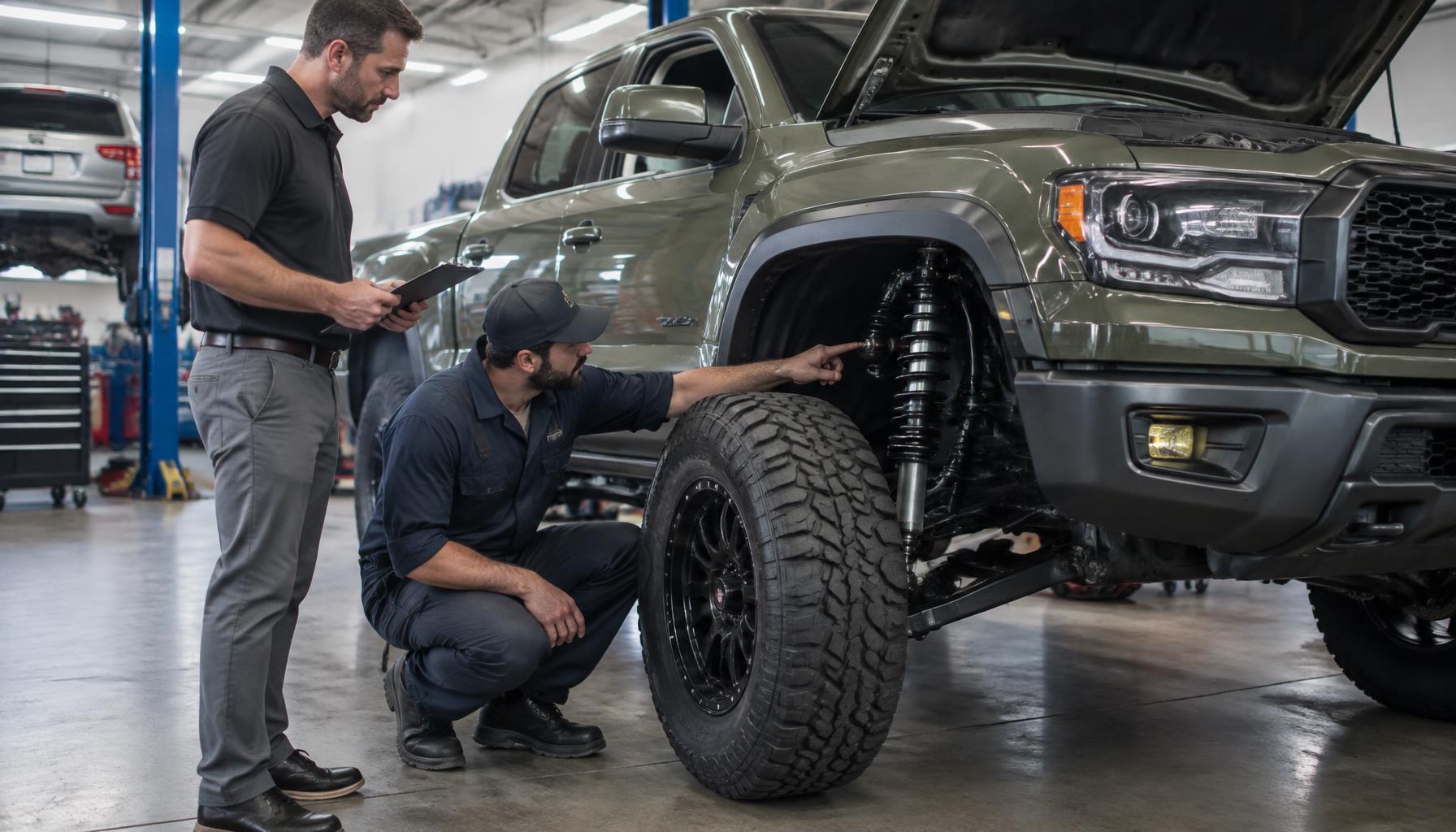
Not a scare story from a service desk. What the Magnuson-Moss Warranty Act actually protects, which claims a dealer can deny, and why the uninsured build is the expensive mistake.
Quick Answer: Do off-road mods void your warranty? No. Off-road mods do not void your whole factory warranty under the Magnuson-Moss Warranty Act; dealers can deny a specific claim only if they can show that specific mod caused that failure. The expensive miss is usually insurance: a $15,000 to $25,000 build against a ~$1,000 default aftermarket limit. Add custom parts and equipment coverage before the first dirt weekend.
Two things happen when someone starts modifying a new 4x4. The first is that someone at a dealership says the warranty is gone. The second is that the owner quietly assumes the policy covers the $14,000 in parts bolted to the truck. Both beliefs are wrong, and the second one is the expensive mistake.
Do off-road mods void your warranty? No. Not the whole thing. Federal consumer warranty law already answered that. The useful questions are narrower: which claims become deniable, and is the build even on the policy when a tree lands on it.
Why Warranty Scare Stories Still Work on New Trucks
Lift kits, larger tires, bumpers, winches, racks, and tunes are normal on weekend 4x4s. Service advisors still reach for "Anything aftermarket voids the warranty." That sentence is wrong as a blanket rule, and it never mentions the policy that pays after a total loss. A new truck under bumper-to-bumper coverage is exactly when people start building. The fear of losing coverage stalls useful mods. The fear of an uninsured parts pile usually waits until an adjuster quotes stock actual cash value.
Warranty Gets the Argument. Insurance Takes the Money.
Warranty is the fight everyone rehearses. Insurance is where modified 4x4 owners actually lose money.
Your standard auto policy insures the vehicle as it left the factory. Many carriers cap aftermarket parts at around $1,000 by default, and some exclude custom equipment unless it is listed. If the truck is totaled, the payout is the actual cash value of a stock version of that truck.
Run the numbers on a typical weekend build. Suspension, wheels, tires, bumper, winch, roof rack, rooftop tent, drawers, dual battery, lighting, and armor easily hit $15,000 to $25,000. In a total loss, a default policy hands you the stock truck plus maybe $1,000. The rest evaporates.
Against that, custom parts and equipment coverage is cheap. Call it $50 to $250 a year for a $10,000 limit, or $120 to $500 for a $20,000 limit, depending on carrier. A $20,000 build with a $250 endorsement is a 1.25 percent annual premium on the parts. A $20,000 build with no endorsement is a $19,000 hole the first time a tree, a fire, or a roll-over collects.
Magnuson-Moss will not write that check. Only the policy will, and only if the parts are on it.
Do Off-Road Mods Void Your Warranty Under Magnuson-Moss?
The Magnuson-Moss Warranty Act, explained in plain language by the FTC, is why a warranty survives the first lift kit. A manufacturer cannot cancel your entire warranty because you installed aftermarket parts, and it cannot condition coverage on branded parts or dealer-only service unless those are provided free of charge.
The burden of proof sits with them. If a dealer wants to deny a repair, they have to show your aftermarket part caused the failure. FTC consumer guidance is blunt: your warranty stays in effect if you use aftermarket or recycled parts, and the manufacturer or dealer must prove the part caused the damage before denying coverage for that damage. Most denials still happen verbally at a service desk. Knowing the rule changes that conversation.
Coverage is claim-by-claim, not all-or-nothing. A denied front wheel bearing on a lifted truck does not touch infotainment, paint, emissions, or unrelated powertrain coverage. Manufacturer booklets say the same thing in warranty-speak. Toyota's guides note that Toyota may deny coverage if a vehicle or part failed due to abuse, neglect, improper maintenance, or unapproved modifications. That is causation language, not a whole-warranty kill switch. If a 6 inch lift genuinely destroyed a CV axle, the denial is legitimate. The law protects you from arbitrary denial, not from physics.
Do Off-Road Mods Void Your Warranty on a Claim-by-Claim Basis?
Off-road mods create a causal chain. Parts downstream of the build become deniable. Everything else stays on the original warranty. Owner threads repeat the pattern: unrelated systems usually sail through, while suspension-adjacent hardware gets the hard look (r/4Runner lift warranty thread).
| Modification | What it actually changes | Claims that get easier to deny | What usually stays covered |
|---|---|---|---|
| Lift or leveling kit | Geometry and load angles | CV axles and boots, ball joints, wheel bearings, tie rods, control arm bushings, driveshaft U-joints and carrier bearing | Infotainment, paint, emissions, unrelated powertrain |
| Larger tires | Unsprung weight, rotating mass, speed signal | Wheel bearings, ball joints, brakes, transmission and t-case under load, sometimes EPS racks | Same as above, unless shift logic is in the failure story |
| Aggressive-offset wheels | Load center moved outboard of the bearing | Wheel bearings and hub assemblies | Unrelated systems |
| Heavy bumper and winch | Mass ahead of the front axle | Front springs, shocks, bearings; airbag or SRS claims if crash pulse changes | Cabin electronics, most powertrain |
| Electrical accessories | Extra load, splices, grounds, CAN | Anything tied to a factory circuit or a body-panel ground | Factory systems on their own circuits |
| Tune or throttle controller | Powertrain software; flash counters persist | Powertrain claims, often correctly | Non-powertrain |
On IFS trucks, CV axle angle is the most common flashpoint after a lift. Taller-than-stock tires also throw off the speed signal and can affect shift logic. That is one reason people regear after bigger tires: to restore the powerband and take the overloaded-drivetrain argument off the table.
Safer territory: roof racks within rating, rooftop tents, drawers, awnings, recovery gear, radios on their own fused circuit, and bolt-ons that leave geometry alone. Tunes are the highest-risk item. Modules log flashes, and the counter does not reset when you return to stock. Treat a tune as a powertrain-warranty decision, not a harmless app.
How Dealers Actually Handle Warranty Claims on Modified Rigs
A 2 inch level with 33s on a half-ton is invisible at most service desks. A 6 inch lift on 37s with a tune is not. Some truck-market dealers install lifts and stand behind them. Ask before you buy if you already plan to build. Factory-backed accessories that carry the remainder of the vehicle warranty are a real reason to prefer a factory lift when warranty risk is the primary concern. For Jeep owners comparing kits, start with the Jeep lift kit guide and treat warranty as one input, not the whole decision.
If a claim gets denied and you believe the mods did not cause it: get the denial in writing with the technical reason, open a manufacturer case above the dealer, then if needed get an independent shop to document the failure mode. Most disputes resolve at step two.
Protect Yourself Before You Wrench
The people who win warranty disputes have paperwork. Keep receipts and install records. Shop installs with documentation help when a dealer claims improper installation. DIY is fine if you photograph the process. Shoot before and after, wide and close, odometer visible, so you can prove when a mod went on. Keep factory service intervals at a dealer or documented shop. Save takeoff parts so you can return the truck to stock for a major unrelated claim if needed. Tunes are the exception. The module remembers. Get dealer promises in writing. A salesperson's "you're covered" is worth nothing at the service desk two years later.
Insurance for a Modified 4x4: Custom Parts and Equipment Coverage
Warranty got the argument. This is the check.
The fix is an endorsement, usually called custom parts and equipment coverage, sometimes custom equipment coverage. CPE coverage extends comprehensive and collision to a stated dollar amount of aftermarket equipment. Typical limits run from $5,000 to $30,000 or more. Standard policies often leave only a small aftermarket sublimit, so the endorsement is how a modified 4x4 stops paying out like a stock one.
| Coverage | Typical annual cost | What it actually buys |
|---|---|---|
| Default auto policy | $0 extra | Stock ACV, often about $1,000 of aftermarket if anything |
| $5,000 custom parts | About $20 to $120 | A bumper or a tent, not a full build |
| $10,000 custom parts | About $50 to $250 | Weekend-wheeler basics |
| $20,000 custom parts | About $120 to $500 | A serious weekend build |
| Stated or agreed value | Quote-dependent | Locks the number so depreciation cannot eat the rig after a loss |
Against a $20,000 parts pile, the expensive path is skipping the endorsement. The cheap path is adding it before the first dirt weekend.
When you add custom parts and equipment coverage, ask four questions. Does the limit pay replacement, or depreciated actual cash value on old tires and used steel? Is removable camping gear covered, or only permanently installed equipment like a bolted rooftop tent? Do exclusions hit organized events or rock parks even if dirt roads are fine? Does liability while towing cover you, knowing the trailer itself still needs its own physical-damage policy?
For heavily built rigs, ask about stated amount or agreed value. Stated amount pays the lesser of actual cash value or your declared number. Agreed value locks the insured value up front. Not every carrier offers agreed value on a modified daily driver. Specialty insurers do. Get a quote if the build is serious money.
Document the Build for the Adjuster and the Service Desk
One file serves warranty and insurance. Keep a spreadsheet of part, brand, date, price, and installer. Save receipts as PDFs. Photograph the finished build from all four corners every year. Appraise expensive fabrication. An adjuster with a receipt and a photo pays the number. An adjuster with your word pays stock actual cash value.
Honest Warts: What Still Goes Wrong
Magnuson-Moss does not make every denial illegitimate. A CV that lived at a steep angle and failed is physics with a legal label. Expect to own suspension-adjacent wear on a tall IFS lift. Verbal "you're covered" is not coverage. Returning a tune to stock does not erase the flash log. CPE limits can still pay depreciated value, so a $20,000 limit on five-year-old parts is not a $20,000 check. Failing to disclose ride-height or value changes can still sink a claim. The endorsement only helps if the carrier knows the build exists.
Verdict: Warranty Myth vs Insurance Reality
| Question | Smart default for off-road mods | Trap |
|---|---|---|
| Do off-road mods void your warranty? | No whole-void under Magnuson-Moss; denials are claim-by-claim if the mod caused the failure | Believing a service advisor who says "anything aftermarket voids everything" |
| Lift kit / larger tires | Expect deniable risk on CVs, joints, bearings, steering; keep unrelated systems covered | Skipping regear on a big tire jump, then fighting drivetrain denials |
| Tune | Treat as a powertrain-warranty decision; flash logs persist | Flashing "just for the weekend" and assuming stock ECU = clean slate |
| Build documentation | Receipts, install photos, odometer shots, service history | Relying on verbal promises and email receipts you cannot find |
| Insurance for a modified 4x4 | Add custom parts and equipment coverage sized to replacement cost | Assuming a $15,000 to $25,000 build rides on a ~$1,000 default aftermarket limit |
| Cost math | ~$120 to $500/yr for a $20,000 CPE limit vs a $19,000 hole with no endorsement | Skipping the endorsement because "I drive careful" |
Who Should Care (and Who Should Skip the Anxiety)
This is for the person with a new 4x4, a lift in the cart, and a policy unopened since signing day. Read Magnuson-Moss once. Call the carrier once. Put custom parts and equipment coverage on. Then wrench.
This is not for hiding a tune, or for skipping insurance because you drive careful. Trees do not care. Do not turn a mild 2 inch level into a multi-year research project. Sequence low-risk bolt-ons first if powertrain coverage still matters, then accept that suspension-adjacent parts on a tall lift are often on you.
Bottom Line
Do off-road mods void your warranty? No. They make some claims deniable, claim by claim, if the dealer can show the part caused the failure. The Magnuson-Moss Warranty Act already wrote that rule. Paperwork, service history, and a refusal to take a verbal scare story as law keep the rest of the coverage intact.
Then call your insurer. Custom parts and equipment coverage is the actual protection on a modified 4x4. The factory warranty will not pay for a totaled bumper, tent, and armor pile. The policy will, if the parts are on it.
This article is general information, not legal or insurance advice. Warranty terms, policy language, and state law vary. Read your own warranty booklet and policy documents, and talk to your carrier or an attorney about your specific situation.
Updated September 19, 2026 (PT)
Keep Building (Internal Links + Tools)
- Re-Gearing 101: when bigger tires need new gears, and how that helps drivetrain claims stay honest
- Jeep lift kit guide: kit types, heights, and what changes on the trail
- Weekend wheeler cost: what a real bolt-on build actually spends before insurance math
- First-party tool: Gear Ratio Calculator (no cart)