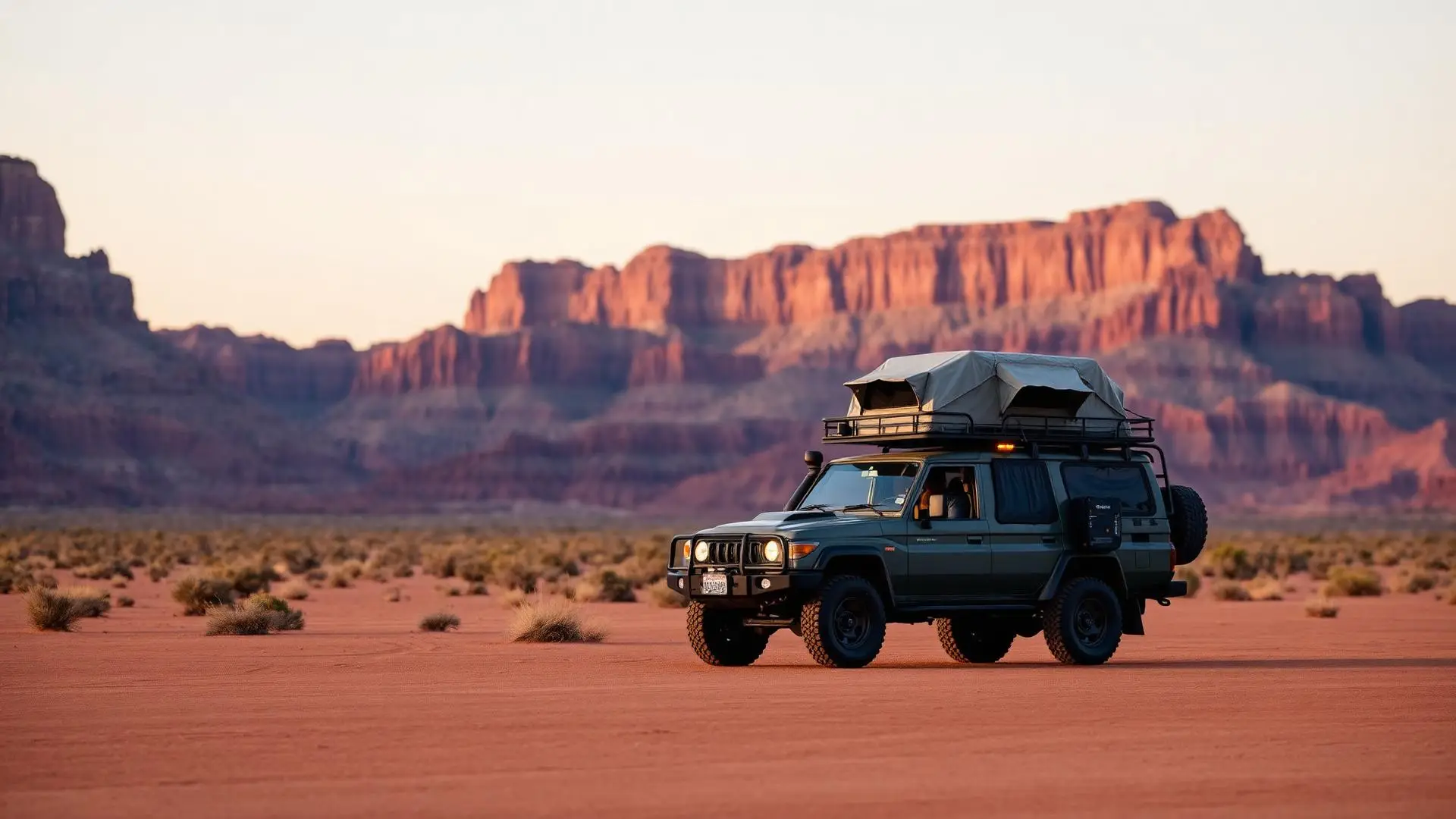
It is Friday afternoon before Memorial Day and there are two versions of you. One is sitting on Interstate 70 west of Denver, or I-15 north out of Vegas, watching a brake-light river crawl toward the same campground that booked out in March. The other version aired down two hours ago, is parked on a flat bench of BLM land with no neighbor in sight, and is deciding whether to set up camp now or push another ten miles up the road just to see what is around the bend.
Memorial Day weekend overlanding rewards a different kind of plan. The difference between those two versions of you is not luck and it is not a better truck. It is understanding one thing the beach-and-cabin crowd never figures out: the busiest travel weekend of the year is only crowded if you go where the reservations are.
This year that gap is wider than usual, and the reasons are worth understanding before you point the truck anywhere.
What Is Actually Happening This Weekend
Roughly 45 million Americans are expected to travel over the Memorial Day window, a record, and the vast majority of them are driving to a handful of saturated destinations. Beaches first, then cabins, then the marquee national parks. That is the river you do not want to be in.
The weather is quietly handing overlanders a gift this year. The persistent storms are parked over the South and Northeast, in a soggy zone running from eastern Texas and Louisiana up through the lower Mississippi Valley. The West and desert Southwest, by contrast, are dry and mild, with Arizona, Nevada, and most of California holding seasonable late-May temperatures and sunshine. The Rockies get scattered afternoon thunderstorms, which is normal and not a reason to cancel anything.
Read that map the way an overlander should: the part of the country where dispersed camping is easiest is also the part with the best forecast. If you have ever wanted a reason to drive away from the coasts and toward public land, the sky is providing one.
One regional caveat matters for route planning: the Sierra high country is not fully open yet. Sonora Pass reopened April 30 and Ebbetts Pass on May 6, both after a late-season storm cycle dumped fresh snow into spring. High roads in the Central Sierra open late and can re-close on a single storm, so if your plan depends on a specific pass, confirm it is open the day before you leave. Lower elevations and the desert do not have this problem.
The Honest Truth Nobody Tells You About Holiday Weekends
Here is the thing the travel roundups will never say, because it does not sell hotel packages: last-minute is not a disadvantage for overlanders. It is an advantage.
The entire reservation economy that makes holiday weekends miserable, the booked-out campgrounds, the six-weeks-ahead deadlines, the refresh-the-page-at-midnight ritual, applies to developed sites. Dispersed camping does not work that way. On BLM land and most National Forest land, dispersed camping requires no reservation and usually no permit at all. It is first-come, first-served, it is generally free, and a stay of under 14 days needs no paperwork. There is no booking window to miss because there is no booking.
That single fact flips the weekend. The person who tried to reserve a spot in April and got shut out is not better positioned than you. They are worse positioned, because they built their plan around a system that punishes latecomers. Yours does not care what day you decided to go.
The second honest truth is about where the crowds actually cluster. They do not spread evenly across public land. They pile up at the dozen or so places that show up when someone searches "off-road camping near me" or scrolls an Instagram geotag. Moab. Alabama Hills. Goblin Valley. Little Wild Horse. These spots are spectacular and they will be a circus this weekend. The land two valleys over, reached by a road that does not photograph as well, will be nearly empty. The skill is not finding a beautiful place. It is finding a beautiful place nobody bothered to make famous.
Where to Actually Go This Weekend
The strategy below is organized by what you are driving toward, not by a top-ten list of places that will all be full. For each region the rule is the same: name the obvious spot, then go past it.
The Desert Southwest (Best Weather, Easiest Camping)
This is the call this year if you can reach it. Utah, Nevada, and Arizona have the dry forecast and the highest concentration of accessible BLM land in the country. The mistake is driving straight to Moab. The fix is driving south of it. The country around Cedar Mesa, Beef Basin, the Bears Ears benches, and the Hovenweep and Cortez corridor sees a fraction of Moab's Memorial Day traffic while offering the same red-rock terrain and far better solitude. Cedar Mesa in particular is a reliable Memorial Day option precisely because it asks a little more of you to get there.
The trade-off is heat once June arrives, but late May in the canyon country is close to ideal: warm days, cool nights, and runoff mostly past.
The Rockies and High Plains (Scenic, Some Afternoon Storms)
Colorado, Wyoming, and northern New Mexico are in play, with the understanding that you will trade a little weather risk for scenery. Afternoon thunderstorms are part of the deal in the high country, so camp early and avoid exposed ridgelines after noon. Skip the obvious San Juan tourist towns at peak weekend and look at the southeast Colorado desert and dune terrain instead. The Medano Pass Primitive Road at Great Sand Dunes is a legitimate Memorial Day route that combines a sand-and-creek-crossing 4WD road with dispersed camping and a national park backdrop, and it sits far enough from the I-70 mountain corridor to dodge the worst of the traffic. Northern New Mexico around the Bandelier area is another quiet option that almost nobody puts on a holiday list.
The Sierra and California (Check Before You Commit)
The Eastern Sierra is the classic California overland destination and Alabama Hills is its poster child, which is exactly why Alabama Hills will be packed. If you want the Sierra this weekend, go lower or go obscure. The Monterey Ranger District of Los Padres National Forest along the Big Sur coast still offers dispersed camping without a reservation, with the caveat that the roads are rough enough to genuinely require high-clearance four-wheel drive and that fire rules there are strict. Forum regulars point to spots like Coyote Flats and Diggins in the Sierra as quieter alternatives. Just remember the passes: the high stuff is only now opening and can shut again, so keep your plan flexible and your elevation modest.
Stay Closer Than You Think
The best Memorial Day trip is often the one within a tank of fuel. The math is simple and brutal. If you leave Friday at noon you get roughly three nights and the better part of four days. If you leave Saturday morning you have already burned a third of the weekend and arrived into peak Saturday traffic. Two hours of driving on Friday afternoon buys more solitude than six hours on Saturday, because most of the crowd has not left yet on Friday and all of it is on the road Saturday. Pick a closer destination, leave earlier, and you will out-camp the people who drove twice as far.
For a deeper regional breakdown beyond the holiday weekend, our best states for overlanding guide ranks the whole country on land access, camping rules, and terrain.
How to Find Last-Minute Dispersed Camping
The reservation systems are full. Good. You do not need them. Here is how to find a legal, free, no-reservation site even on the Friday of the busiest weekend of the year.
Start with the BLM interactive map on blm.gov, which marks whether an area is dispersed or developed and gives the local rules. BLM dispersed camping is first-come, free, and capped at 14 days within a 28-day period in a given area. Most field offices require nothing more than that you pack out what you pack in and camp on already-disturbed ground rather than crushing new vegetation.
For the off-pavement side specifically, the most useful tool right now is the onX Offroad dispersed camping layer. It maps roughly 140,000 miles of National Forest roads and trails where dispersed camping is permitted, with USFS-verified data across eleven western states. Toggle on the layer, look for corridors highlighted in yellow, and tap any segment to see how far off the road you can camp. BLM areas show as tan with their own detail. It is a Premium feature starting around $35 a year, and on an improvised holiday weekend it pays for itself the first night.
The field method still matters once you arrive. Drive past the first cluster of pullouts near the trailhead, because that is where everyone stops. The good empty sites are almost always a mile or two further in, past the point where the casual crowd loses patience. Have a backup in mind before dark, because chasing one perfect spot until sunset is how people end up setting up in a ditch with a headlamp.
If this is your first time relying on dispersed camping instead of a reserved site, read our how to plan your first overlanding trip guide before you go. It covers the water, waste, and navigation basics that a campground normally handles for you.
Fire Restrictions Are Already In Effect. Plan Around Them.
This is the part of holiday weekend planning people skip and then regret at the worst moment. Fire restrictions are not a midsummer problem this year. They are already here.
The La Pine Basin in central Oregon went under a campfire ban on May 1. The BLM Bakersfield Field Office in California issued seasonal fire restrictions effective May 15, and the Deschutes National Forest followed on May 18. Officials are openly warning that 2026 could rival the driest, hottest years on record in parts of the West.
What that means for your trip is concrete. Do not assume you can have a campfire. Check the specific field office or ranger district for the land you are camping on, the day before you leave, because restrictions are being added week by week. Even where open fires are banned, most restrictions still allow a commercially manufactured propane or liquid-fuel stove with a shutoff valve. That makes a canister or dual-fuel stove the single most reliable piece of cooking gear you can bring this weekend. If your whole camp plan depends on a fire ring, you may arrive to find the fire ring is illegal. The propane stove never is.
In California specifically, even where fires are allowed you generally need a free California Campfire Permit to use a stove or fire on public land. It takes a few minutes online. Get it before you leave.
The Memorial Day Weekend Overlanding Verdict
| Region | Weather This Weekend | Crowd Level | Camping Type | Verdict |
|---|---|---|---|---|
| Desert Southwest (UT, NV, AZ) | Dry, sunny, mild | Low if you skip Moab | BLM dispersed, no reservation | Best overall call this year |
| Rockies / High Plains (CO, WY, NM) | Scattered PM storms | Moderate | Dispersed + some developed | Great scenery, camp early |
| Eastern Sierra / California | Dry low, unsettled high | High at the famous spots | Dispersed, fire-restricted | Go obscure, check passes |
| Sierra high country | Snow lingering, passes iffy | Low (because closed) | Limited until roads open | Confirm access day-of |
| Within 2 hours of home | Varies | Lowest if you leave Friday | Whatever is local | Underrated, highest fun-per-mile |
Who This Weekend Is For, and Who Should Stay Home
This trip is for the person who can leave by Friday afternoon, who is comfortable with first-come dispersed camping, and who would rather drive an extra hour of dirt than share a fire ring with strangers. If that is you, this is the best weekend of the early season to be out.
It is not for the person who needs a reserved site, flush toilets, and a guaranteed spot, on the one weekend when those are hardest to get. If that describes your group this time, there is no shame in booking a developed campground close to home and saving the backcountry push for a non-holiday weekend in June when the high country is fully open and the crowds have gone back to work. A miserable, over-planned, traffic-soaked trip teaches people to dislike overlanding. A relaxed local one teaches them to love it.
Whatever you decide, treat the land like you want it open next year. Access is not guaranteed, and every closed road started with someone cutting a new track or leaving a mess. Our piece on why trail access is disappearing explains exactly what is at stake when dispersed camping gets abused on big weekends like this one.