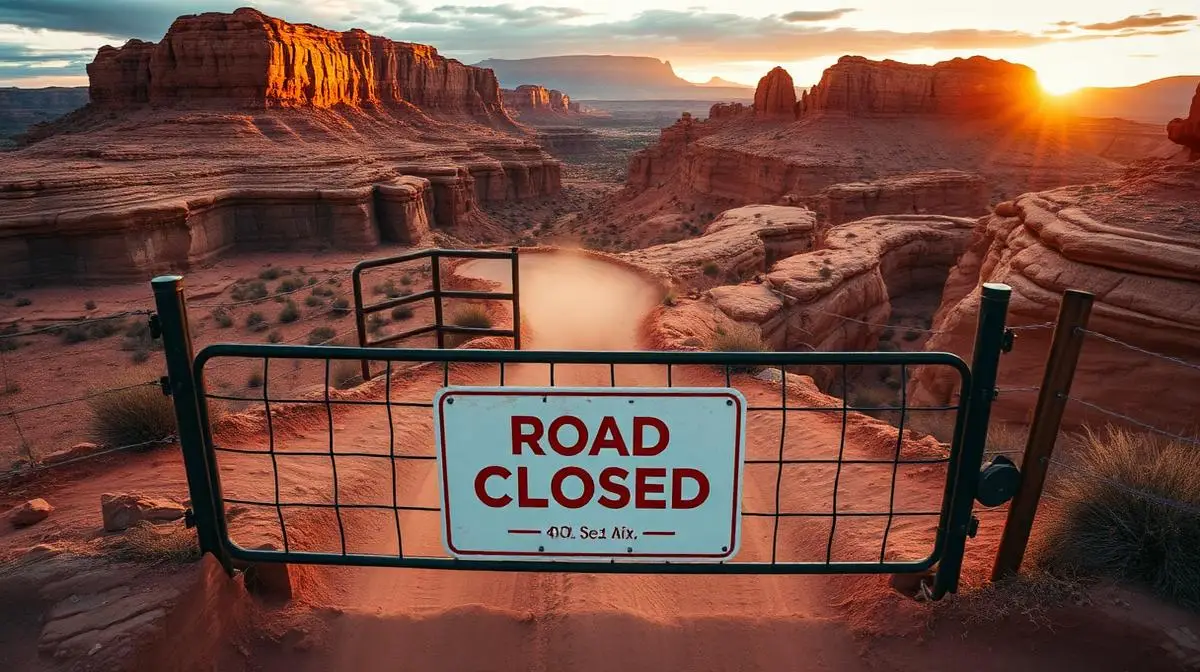
In late September 2023, the Bureau of Land Management finalized a plan that off-road communities are still reeling from. With a single decision, 317 miles of truck trails around Moab, Utah, one of the most iconic off-roading destinations on the planet, were permanently closed to motorized recreation.
Patrick McKay of Colorado Off-Road Trail Defenders put it bluntly on social media: "This travel plan is the worst defeat motorized recreation has suffered in decades. SUWA won. Moab is lost. Almost every major trail west of Moab is closed."
That is not hyperbole. Some of those trails had been driven by families for generations. Some were used during the annual Easter Jeep Safari. And with a stroke of a pen, they were gone.
But here is the part nobody wants to talk about at the trailhead: this did not come out of nowhere. The closure was the result of a 2008 lawsuit against the BLM for mismanaging public land access, a lawsuit that succeeded, in part, because there was real, documented evidence of resource damage. And the Moab closures are not an isolated incident. They are part of a trend that is accelerating across the American West, and the off-road community cannot afford to keep treating it like something that is only happening to them.
This Is Not About Giving Up Your Trails
How Much Access Have We Already Lost?
The Moab closures got the headlines, but they are just one piece of a much larger picture.
In the Bears Ears National Monument area, over 591,000 acres have been closed outright to OHV use, with another 483,000 acres moved to limited access. On Forest Service land within the same region, an additional 46,000 acres went fully closed, with 242,000 more restricted. These are not small numbers. These are roughly the size of Rhode Island.
The Labyrinth Rims and Gemini Bridges area alone saw 28% of its total inventoried OHV routes erased, 317 miles out of 1,128 total, with an additional 18 miles closed to trucks specifically. In the San Rafael Swell, the BLM proposed closing 665 more miles of routes. In the Henry Mountains and Fremont Gorge area, 612 miles of roads and trails were closed in a plan finalized in the final hours of the Biden administration in January 2025.
Eight More Revisions Are Coming
The closures are not limited to Utah. BLM travel management plans are reshaping access across Nevada, California, Colorado, Idaho, and beyond. The BlueRibbon Coalition, the country's largest motorized recreation advocacy organization, is currently fighting closure actions in multiple states simultaneously, calling 2025 a year focused on the "Grand Reopening" of public lands. That framing alone tells you how much ground has already been lost.
Why Trails Close: The Honest Version
When trails close, the off-road community tends to frame it one of two ways: either as a government overreach issue or as an environmentalist attack. Sometimes that framing is accurate. The closure battles in Utah have real legal complexity, and there are legitimate arguments that the BLM's process violated NEPA and failed to adequately weigh economic and recreational impacts.
But those legal arguments do not explain why the trails got into this position in the first place. For that, you need the honest version.
Environmental Damage from Irresponsible Use Is Real
The Sierra Forest Legacy, American Hiking Society, and multiple USDA Forest Service publications document the same pattern: high-powered vehicles with aggressive tires strip vegetation, compact soil, and accelerate erosion at rates that pedestrian trail use does not approach. Damaged riparian areas, the zones along streams and rivers that are among the most biologically productive on public land, take decades to recover when they recover at all. The BLM cited riparian habitat protection and watershed damage directly in its Moab closure justification. Those citations were backed by monitoring data.
In Michigan, the Department of Natural Resources issued a public report in 2025 acknowledging it could not keep up with the pace of off-trail ORV damage to ecosystems, not because the trails were poorly designed, but because a portion of users were consistently driving off designated routes. In the Sierra Nevada, documented ORV activity has caused erosion, stream sedimentation, and habitat fragmentation.
The Numbers That Matter in Court
User Conflict Drives Closures
BLM land is multiple-use land. Hikers, mountain bikers, equestrians, and motorized users are all supposed to share it. When the noise, dust, and physical impact of OHV use consistently degrades the experience for every other type of visitor, land managers face political and legal pressure to separate uses, which usually means restricting motorized access to fewer, better-defined routes.
This is not inherently unfair. It is the predictable result of years of inadequate investment in user education, inconsistent self-policing by clubs and organized groups, and a culture in some corners of the off-road world that treats "no signs" as permission and "it's public land" as an all-purpose justification for any behavior.
The Litigation Pipeline Is Well-Funded and Patient
The Southern Utah Wilderness Alliance has been pursuing its 2008 lawsuit for over 15 years. Environmental groups are organized, legally sophisticated, and willing to play a long game. The settlement that spawned the Moab and Utah closures was not a sudden ambush. It was the result of a decade and a half of documented monitoring, legal filings, and waiting for a sympathetic administration to finalize travel management plans.
Off-road advocates have matched this with legal action of their own, the BlueRibbon Coalition's federal court challenges, SEMA's support for the IBLA appeal, the Texas Public Policy Foundation's involvement. But the off-road community started this fight at a deficit, because the damage documentation already existed.
Both Things Are True
The Uncomfortable Middle Ground
Here is where this conversation usually breaks down: the people who care most about trail access tend to be the same people who get most defensive when the community's behavior comes up. That is understandable. Nobody wants to feel like they are being lumped in with the guys running ruts through a meadow or ignoring closure signs.
But here is the thing: you are being lumped in with them. By the BLM, by federal courts, by environmental organizations, and by every hiker who posts a photo of tire tracks through a protected riparian zone. Land managers do not distinguish between the responsible majority and the destructive minority when they write a travel management plan. They respond to documented patterns, and the pattern is being set by the worst actors.
Responsible off-roaders who stay quiet when they see someone cutting across closed land, who do not bother to report ongoing damage, who skip the public comment period because it feels like bureaucratic theater, those people are not neutral. They are, functionally, ceding ground.
The community that will keep its trails is the one that polices itself, shows up when it matters, and makes the positive case loudly enough to compete with the negative documentation.
Who Is Actually Fighting for Your Access
There are organizations doing serious, sustained work to protect off-road trail access. If you care about this issue and are not involved with at least one of them, you are leaving leverage on the table.
BlueRibbon Coalition
BlueRibbon Coalition is the most prominent national advocate for motorized recreation access on public lands. They file legal challenges, submit comments in federal land management processes, and maintain active campaigns in the areas facing the most aggressive closure actions. Their current focus includes challenging the Henry Mountains closures, opposing the San Rafael Swell plan, and pushing the BLM to reconsider Moab route designations.
Their tagline, "protecting public lands for the public, not from the public", captures the core argument. BRC's membership directly funds their legal work. If you drive on public land and you are not a member, that is a simple thing to fix.
Tread Lightly!
Tread Lightly! takes a different approach. Founded as a USDA Forest Service program in 1985, Tread Lightly! focuses on education and stewardship. Their T.R.E.A.D. principles, Travel Responsibly, Respect the Rights of Others, Educate Yourself, Avoid Sensitive Areas, Do Your Part, are the closest thing the off-road community has to a shared ethical code.
Tread Lightly! also leads over 500 trail maintenance and stewardship projects annually. This is the work that builds the strongest possible case for keeping trails open: organized, documented, volunteer-led restoration that demonstrates to land managers that the off-road community is a net positive for public lands.
SEMA and Local Clubs
SEMA (Specialty Equipment Market Association) fights for motorized recreation access from the industry side, supporting legal challenges and engaging in federal regulatory processes. Their involvement in the Moab IBLA appeal brought national industry attention and resources to a fight that otherwise would have been left to underfunded local groups.
Local clubs and trail associations are where most of the real work happens. The organized 4x4 clubs that do trail maintenance days, that coordinate with local BLM field offices, that show up at public meetings in force, these groups are building the kind of relationship with land managers that makes a difference when a travel management plan comes up for revision. A hundred organized, consistent, constructive voices from a local club carry more weight in a BLM field office than ten thousand angry comments from strangers.
The Public Comment Process: Why It Matters More Than You Think
The Moab closures came partly from a lawsuit, but they were finalized through the federal travel management planning process, and that process includes mandatory public comment periods. These are not formalities. They are legally required steps in federal rulemaking, and the record created during public comment directly influences what land managers can and cannot do.
When the BLM proposed the Labyrinth Rims closures, the environmental groups that supported the closures submitted detailed, organized comments. The motorized recreation community submitted comments too, but in smaller numbers, with less coordination, and with less documentation. The final plan reflected that imbalance.
How to Stay Plugged In
As of late 2025, the BLM opened a new comment window on the Moab closures, reconsidering some of the route designations after significant community backlash. This is the process working.
The difference between a trail that stays open and one that closes is often not a court case. It is whether the right people showed up during the right 60-day window.
What Responsible Access Actually Looks Like
Beyond the policy fights, there is the daily, unglamorous work of being the kind of user that justifies keeping the trails open.
Stay on Designated Routes. Always.
This sounds obvious, but off-trail driving is one of the primary documented reasons for route closures, and it happens constantly. "There was no sign" is not a defense. Motor Vehicle Use Maps (MVUMs) are available for free from every BLM field office and on the BLM's website. Download the map for wherever you are going before you leave home. Know which routes are open. Ride those routes.
When conditions are wet, this matters more. Tire tracks through saturated soil and vegetation cause far more damage than the same tracks in dry conditions. The damage from a single wet-weather shortcut through a meadow can take years to restore, and it creates exactly the kind of photographic evidence that ends up in federal court filings.
Pack Out More Than You Pack In
Trash left at trailheads and campsites is not a small thing. It shows up in land manager reports. It shows up in public comment periods. It is used as documentation for restricting access. Pick up what you bring. Pick up what you find.
Don't Create New Routes
If you end up in a situation where your planned route is blocked and you need to turn around, turn around. A "shortcut" that becomes a rut that becomes a new unauthorized trail is a problem for everyone who rides that area after you. Land managers track new unauthorized routes as evidence of uncontrolled motorized use. Every new route is ammunition.
Show Up for Stewardship
Trail maintenance days organized by local clubs and Tread Lightly! accomplish two things at once: they improve the physical condition of routes, and they create documented evidence that the off-road community is a responsible steward. Land managers notice. It changes conversations. Find your local club. Show up.
Educate, Don't Lecture
When you see someone doing something that is going to get a trail closed, driving off-route, ignoring closure signs, cutting vegetation, you have a choice. Leading with "hey, that route is closed and here is why" goes better than a confrontation. Most people who make mistakes on the trail do it because they did not know. A brief, respectful conversation is worth more than a complaint filed after the fact.
The Economic Argument Nobody Should Ignore
The trail access fight is often framed as an environmental debate, but there is an economic dimension that deserves more attention.
Moab's economy is built around motorized recreation. The Easter Jeep Safari alone brings tens of millions of dollars to the region every year. When the BLM closed 317 miles of trails, local businesses, hotels, gear shops, guide services, gas stations, took a direct hit. The community backlash was not just from off-road enthusiasts. It came from the mayor's office, from the local Chamber of Commerce, from small business owners who watched their shoulder-season bookings collapse.
This is the argument that land managers and elected officials in rural districts respond to most directly. Federal land management decisions are made in Washington, but they are implemented by field offices whose relationships with local communities matter. When those local communities, including their economic leadership, are aligned with the recreation advocacy position, it changes the political calculus.
The Economic Case Belongs in the Legal Record
What Comes Next
Eight more travel management plan revisions are still pending under the 2008 Utah settlement. Each one covers tens or hundreds of miles of routes. Each one will go through a public comment process. Each one represents both a threat and an opportunity.
The off-road community has the numbers. There are tens of millions of registered OHV users in the United States. The industry that supports them generates over $800 billion in economic activity annually. The community has the resources, the passion, and, when it is at its best, the values to make a compelling case for responsible motorized recreation on public land.
What it has historically lacked is coordination, patience, and a willingness to hold its own members to a higher standard.
The closures that are happening right now are in large part the result of decisions made, and not made, over the past 15 to 20 years. The closures that happen 15 years from now will be the result of decisions being made today. Those decisions include whether you stay on the designated route when you could cut a corner. Whether you submit a comment when the public comment period opens. Whether you join a local club and show up for a trail maintenance day. Whether you support the organizations doing the legal work on your behalf.
The Land Is Worth It
What You Can Do Right Now
You do not have to wait for the next closure announcement to start making a difference. Here are specific actions worth taking this week:
- Join the BlueRibbon Coalition, their membership directly funds legal challenges to unjust closures, and their action alerts tell you when public comment periods open.
- Download the Motor Vehicle Use Map for wherever you ride and get familiar with which routes are designated open. The BLM makes these available free at blm.gov.
- Find your local 4x4 or OHV club and ask when their next trail maintenance day is. If they do not have one scheduled, offer to help organize one.
- Review Tread Lightly!'s T.R.E.A.D. principles and think honestly about where your own habits could improve.
- Tell people about the access fight. Share this article. Talk about it at the trailhead. Every person who shows up to a public comment meeting is one more voice on the right side of a fight that is very much still winnable.
Trail Matchmaker
Match your skill level and rig to the perfect 4x4 trail from our 260+ trail database
The land is public. The access is worth defending. But defending it means showing up, not just when the closure is announced, but every single time you are out there.
Sources and further reading: BlueRibbon Coalition | Tread Lightly! | BLM Motor Vehicle Use Maps | The Drive: Moab Trail Closures