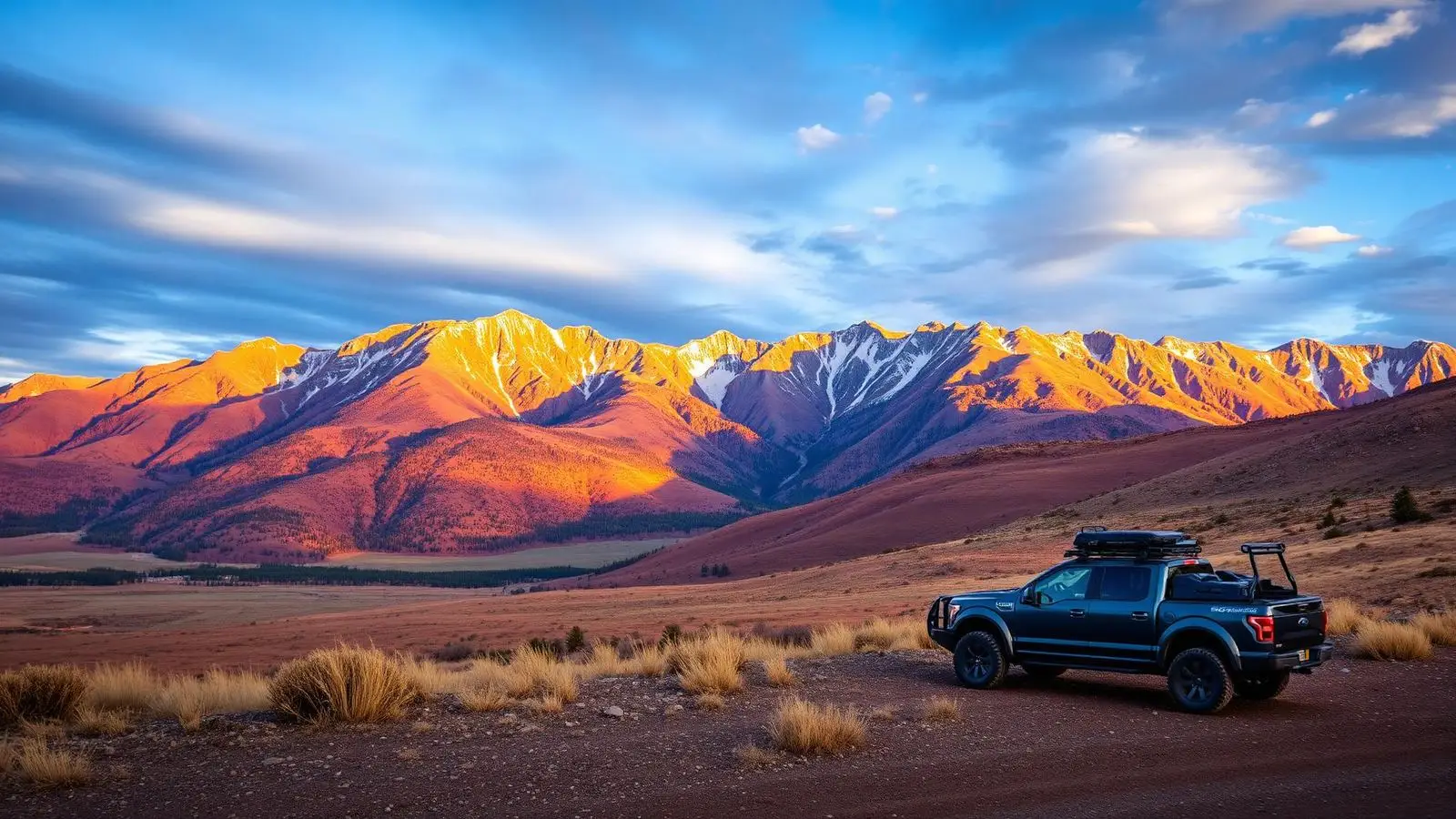
Ask a room full of overlanders which state is best for overlanding and you will get a room full of different answers, most of them shaped by where the person happens to live or where they first got hooked. The Colorado crowd will say Colorado. The Arizona crew will say Arizona. The person who drove Utah for the first time six months ago will not stop talking about Utah.
The honest answer is more useful than loyalty to a home state. The best states for overlanding can be evaluated on the same criteria regardless of geography: how much public land is accessible by 4WD, how liberal the dispersed camping rules are, how varied the terrain is, and whether the experience holds up across different seasons.
Ten states, ranked and explained without boosterism.
How These Were Evaluated
1. Colorado, The Benchmark
Public land: 36% | Season: June, October at altitude; year-round at lower elevations
Colorado is the closest thing to a consensus best overlanding state in the US, and the consensus is earned. The San Juan Mountains alone contain more 4WD route miles than most states have in total. Ophir Pass, Engineer Pass, Imogene Pass, Alpine Loop, Owl Creek Pass, each one a legitimate overlanding route with distinct character, accessible from Ouray, Silverton, or Lake City within 30 minutes.
Add the canyon country around Grand Junction (Rattlesnake Canyon, Kokopelli's Trail, the Uncompahgre Plateau), the desert terrain in the southeast (Medano Pass Primitive Road at Great Sand Dunes), and the north (Steamboat and the Routt National Forest), and you have a state where a 10-day overlanding trip can cover terrain no two days of which feel similar.
The honest limitation: altitude. High-country routes above 10,000 feet are inaccessible from November through May in most years. Afternoon summer thunderstorms are a real hazard on exposed mountain routes.
Recommended base areas: Ouray, Moab-adjacent (Dolores/Cortez), Lake City, Gunnison.
2. Utah, The Scenery Champion
Public land: 67% | Season: Year-round at lower elevations; spring and fall are peak
Utah has more accessible BLM land than any contiguous US state, and the terrain that land contains, red rock canyon systems, sandstone formations, salt flats, and desert plateaus, is unlike anywhere else in the world. The Moab area alone (Sand Flats, Gemini Bridges, Moab Rim, the White Rim Road in Canyonlands) could absorb a month of overlanding without repeating a route.
Beyond Moab: the Escalante Grand Staircase corridor for desert flats and canyon slot access, Cedar Mesa for remoteness and cultural history, the Paria Plateau for dunes and wind-carved geology, and the Bear Lake / Logan Canyon area in the north for forest and mountain terrain.
The honest limitation: summer heat in the canyon country is intense from June through August. The White Rim Road in Canyonlands requires an advance permit that books out months ahead.
Recommended base areas: Moab, Kanab, Escalante, Monticello.
3. Arizona, The Year-Round State
Public land: 43% | Season: October, May in the desert; June, September at higher elevations
Arizona is the answer to the question every overlander eventually asks: where do I go when the mountain states are snowed in? The Sonoran Desert provides overlanding terrain from October through May. Schnebly Hill Road outside Sedona. The Oatman Highway and surrounding BLM land. The Cabeza Prieta National Wildlife Refuge for serious remote desert travel. The Kofa Mountains. The Apache Trail.
At elevation, the Apache-Sitgreaves and Tonto national forests provide forest and mountain terrain accessible through summer when the desert is too hot to visit. The Mogollon Rim corridor connects forest service roads for hundreds of miles.
The honest limitation: summer desert temperatures are genuinely dangerous (110+ degrees). Heat management is not optional from June through September in the desert.
Recommended base areas: Sedona, Show Low, Tucson, Kingman.
4. Montana, The Most Remote
Public land: 29% | Season: June, September reliably
Montana does not have the dramatic canyon country of Utah or the dense high-route network of Colorado. What it has is something those states have largely lost: space. The Bob Marshall Wilderness complex, the Beartooth Plateau, the Big Belt Mountains, the Pryor Mountains, these are places where you can drive a forest service road for two days and not see another vehicle.
The honest limitation: the season is compressed. Many high-country routes are inaccessible before late June. Grizzly bear country requires a different level of camp security awareness. Cell coverage is scarce outside of I-90 and I-15 corridors.
Recommended base areas: Missoula, Billings (Beartooth access), Lewistown (Missouri Breaks), Dillon.
5. Nevada, The Underrated Middle Ground
Public land: 87%, the highest of any state | Season: Year-round at lower elevations
Nevada is the most underrated overlanding state in America. Eighty-seven percent of Nevada is BLM or federal land, and almost all of it allows dispersed camping. The road network is dense, mostly unmapped by casual tourists, and genuinely remote despite being within a few hours of Las Vegas.
The Black Rock Desert playa is one of the most expansive flat surfaces on Earth. The Extraterrestrial Highway corridor offers desert route access and BLM land that sees almost no off-pavement traffic. The Toiyabe and Humboldt national forests provide mountain terrain that rivals Colorado in character.
The honest limitation: the terrain is largely basin-and-range desert. It lacks the dramatic canyon systems of Utah. Many routes require significant navigation skill because there is so much road that route-finding requires offline maps and careful planning.
Recommended base areas: Winnemucca, Ely, Fallon, Reno.
6. New Mexico, The Overlooked South
Public land: 34% | Season: Year-round in the south; spring/fall at altitude
New Mexico sits between Arizona and Colorado and gets overlooked by overlanders heading to both. That oversight is an opportunity. The Lincoln National Forest, the Gila National Forest (the country's first designated wilderness area), the Jemez Mountains, and the BLM land around the Organ Mountains-Desert Peaks National Monument all offer terrain that sees a fraction of the traffic of adjacent states.
The Gila is the specific recommendation: hundreds of miles of forest service roads through the most remote mountain terrain in the lower 48, documented hot springs, and dispersed camping throughout.
Recommended base areas: Silver City (Gila access), Taos, Alamogordo.
7. Oregon, The Pacific Northwest Entry
Public land: 53% | Season: May, October at altitude; year-round in the south
Oregon offers terrain categories that no other state matches. The central Oregon lava fields (Newberry National Volcanic Monument, the Cascade Lakes Highway corridor) provide volcanic terrain unlike anything in the Southwest. The Wallowa Mountains in the northeast are Colorado-quality high country with a fraction of the traffic. The Oregon Outback, a high desert plateau in the southeast, is one of the most underused overlanding regions in the country.
The honest limitation: western Oregon is wet, and forest service roads can be impassable mud from October through May. Permit systems are increasingly common for popular corridor access.
Recommended base areas: Bend, La Grande (Wallowas), Lakeview (outback).
8. Texas, The Biggest Surprise
Public land: Less than 4%, but what exists is exceptional | Season: October, April in the west
Texas has almost no public land relative to its size, which should disqualify it from this list. It doesn't, because the public land that exists is exceptional. Big Bend Ranch State Park alone is 311,000 acres of Chihuahuan Desert with 70+ miles of unmaintained 4x4 roads, two of the best overland routes in the country (Fresno Canyon Road, Los Alamos Loop), and genuine remoteness.
Add Big Bend National Park, the Guadalupe Mountains, and the BLM land around the Monahans Sandhills corridor and you have a legitimate overlanding region, just geographically concentrated rather than spread statewide.
Recommended base areas: Alpine, Marfa, Presidio.
9. Idaho, The Mountain State Nobody Talks About
Public land: 63% | Season: June, October at altitude
Idaho consistently appears on "best kept secret" overlanding lists, which means it is no longer a secret, but the traffic on its routes has not caught up to the hype yet. The Payette River Mountains between Boise and McCall contain one of the densest networks of forest service roads in the Northwest. The Owyhee Desert in the southwest is a high desert plateau with canyon topography and almost no traffic. The Salmon River corridor is the access road for the Frank Church Wilderness, the largest roadless area in the contiguous US.
Recommended base areas: Boise, McCall, Salmon.
10. North Carolina, The Best Eastern State
Public land: 14% | Season: Year-round with seasonal closures after heavy rain
The eastern US is not the western US. That is true and also not the insult it sounds like. North Carolina's Uwharrie National Forest is a legitimate off-road destination with connected 4x4 routes, creek crossings, and forest terrain that puts skill to work. The Nantahala and Pisgah national forests in the western mountains provide Appalachian terrain with forest service road networks that see low off-road traffic.
For overlanders east of the Mississippi who want real terrain without a two-day drive to Colorado, North Carolina is the honest answer.
Recommended base areas: Troy (Uwharrie), Brevard (Pisgah), Murphy (Nantahala/Tellico).
State Rankings at a Glance
| State | Public Land | Season Length | Terrain Variety | Crowding | Overall |
|---|---|---|---|---|---|
| Colorado | High | Medium (6 mo.) | Excellent | Moderate | 1 |
| Utah | Very High | Medium-Long | Excellent | High | 2 |
| Arizona | High | Long (9+ mo.) | Very Good | Moderate | 3 |
| Montana | Medium | Short (4 mo.) | Good | Low | 4 |
| Nevada | Highest | Long | Good | Very Low | 5 |
| New Mexico | Medium | Medium-Long | Good | Very Low | 6 |
| Oregon | High | Medium | Very Good | Low | 7 |
| Texas | Very Low | Medium | Good (concentrated) | Low | 8 |
| Idaho | Very High | Medium | Very Good | Low | 9 |
| North Carolina | Low | Long | Moderate | Low | 10 |