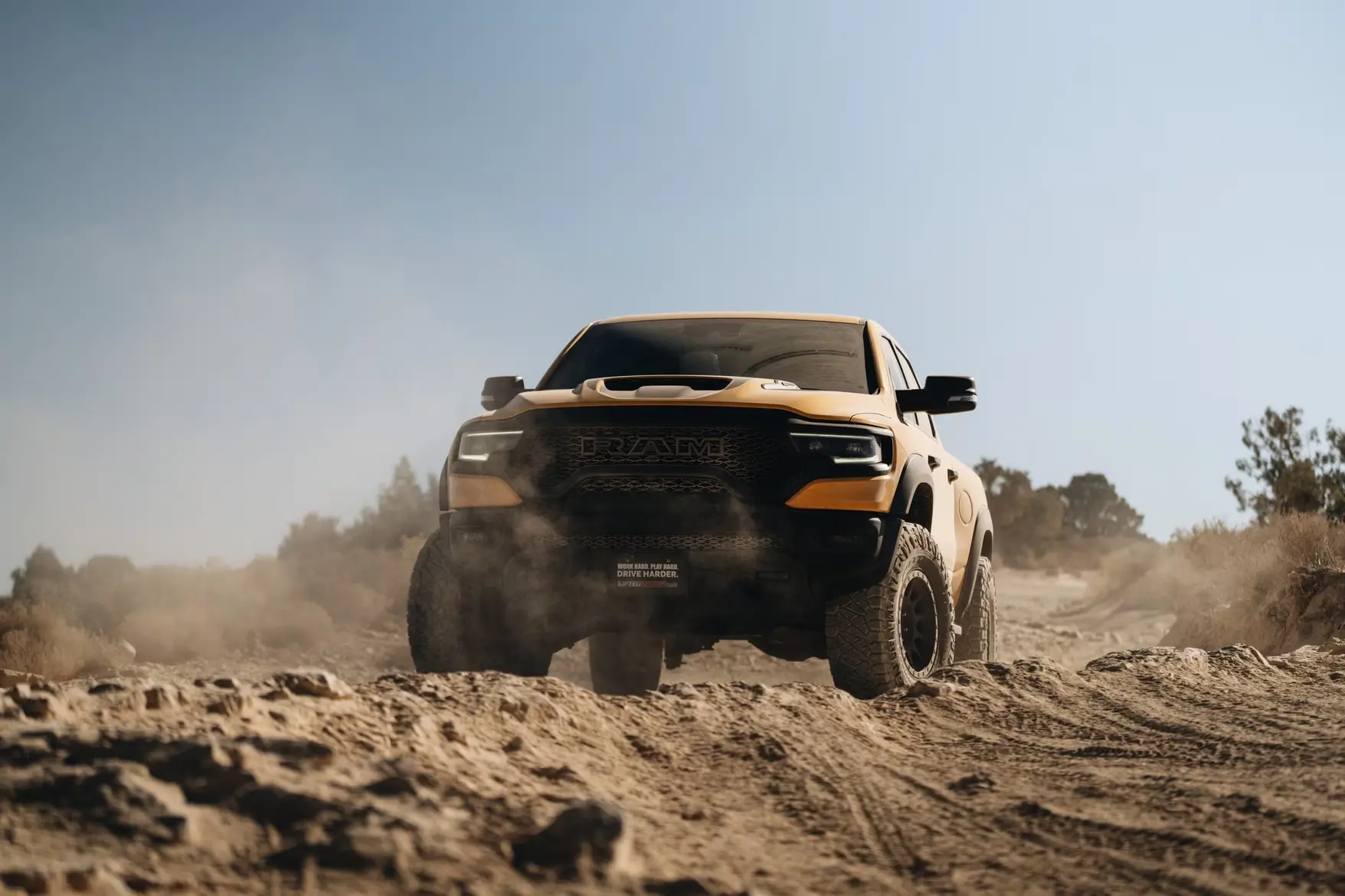
Every rig at the trailhead got there one of two ways. Somebody built it, one paycheck and one skinned knuckle at a time, or somebody bought it already done and spent those weekends driving instead of wrenching. Thirty years ago, on a rooftop lot in the Scottsdale Airpark, a father and daughter bet their savings that the second group was bigger than anyone realized.
This guide covers how Lifted Trucks grew from five trucks to America's largest custom truck dealer, what that history means for the rig you drive off their lot, and the honest math on buying pre-built versus building your own.
How Did Lifted Trucks Start?
Lifted Trucks started in 1995 as a family operation in Phoenix, Arizona. According to the company, Dan Miller and his daughter Jae Halland opened with exactly five trucks at the Scottsdale Airpark, focused entirely on lifted and customized builds at a time when most dealers treated a lift kit as somebody else's problem.
Mike Halland joined shortly after and made the move that mattered most. He built LiftedTrucks.com. This was the late 90s, when most dealerships barely had a working phone system, and a custom truck lot with a real web presence pulled in buyers from well outside Arizona. The family grew into their first full dealership on Bell Road in Phoenix while the website did quiet work in the background. Halland is still with the company today, per Lifted Trucks, running its digital advertising and creative content.
If you have ever found your next rig, trail, or campsite in a browser tab at midnight, you already understand why that early bet paid off. This community has always lived online first and on dirt second.
In 2014, the founding family handed the wheel to a new ownership group led by James Pillor and Dustin Desmarteau, ASU fraternity brothers who rebranded the company around one idea: build the highest quality vehicles possible and let the trucks do the talking. Today the two are the owners of Lifted Trucks LLC, still leading the company they reshaped. Under their direction it has grown to more than a dozen locations across Arizona, Texas, Oklahoma, Tennessee, and Alabama, plus Lift Shop customization facilities in Alabama, Arizona, and Texas, with nationwide shipping. The company points to over 10,000 five-star reviews.
Big numbers. But numbers are not why this story belongs here.
What a Custom Truck Dealer Actually Does
A shop like Lifted Trucks buys the vehicle, engineers the build, and sells you the finished product with the suspension, wheels, and tires already sorted. The company says every vehicle carries name-brand components with manufacturer warranties and passes an 82-point inspection by veteran mechanics before it reaches the lot. If the exact spec you want is not in inventory, the Lift Shop division builds to order and rolls the parts into the vehicle loan.
That last sentence is the part driveway builders cannot replicate. You cannot finance a lift kit bolted on at home. Whether that is smart money depends on your rate and your patience, but it is an option only the dealer path offers.
Buy vs Build: The Honest Math
Here at 4x4 Playground we spend most of our time on the build side. Choosing tires. Mounting tents. Learning recovery the hard way, usually in sand, usually at dusk. That process teaches you your rig. It is also slow, expensive in drips, and full of mistakes you only get to make once.
Run the numbers on a typical mid-size build and the gap is smaller than the forums admit. Say you buy a used 4Runner and build it yourself: a quality 3-inch lift with real shocks runs roughly $2,000 to $4,000 in parts, a set of 33s another $1,200 to $1,800, wheels $800 to $1,500, then $300 to $600 for the alignment and install tools, assuming your first attempt goes clean. Call it $4,300 to $7,900 on top of the truck, spread across months, with your labor free and your mistakes not. A pre-built rig prices that same work into one number on one window sticker, backed by an inspection and parts warranties, and you drive to the trailhead that weekend.
Neither path is wrong. They fit different people at different points in life.
| Build It Yourself | Buy Pre-Built | Custom Order (Lift Shop) | |
|---|---|---|---|
| Upfront cost | Lowest entry, highest drift | Highest entry, known total | High entry, controlled total |
| Time to trail-ready | Months to years | Days | Weeks |
| Knowledge of your rig | Deepest | Shallowest at first | Moderate, you spec it |
| Warranty coverage | Piecemeal, part by part | Bundled per dealer terms | Bundled per dealer terms |
| Financing the mods | Rarely possible | Built into the loan | Built into the loan |
| Mistake risk | On you | On the builder | Shared |
Choose the dealer path if your time is the scarce resource, you want warranty coverage on day one, or you would rather learn your rig on the trail than under it. Stick with the driveway if the wrenching is the hobby, your budget arrives in drips, or you already know exactly what you want bolted where. And if your loaded weight, tire size, and terrain are still question marks, sort those first with our build budget planner before either path gets your money.
What If Your Rig Is Not a Truck?
You are still in the right place, because Lifted Trucks builds far more than the name suggests. The inventory runs across customized trucks, SUVs, Jeeps, and Broncos, which maps almost perfectly onto what you actually see at a trailhead on a Saturday morning.
That matters. Plenty of our readers will never daily a full-size pickup. They run a Wrangler because it fits the garage and the Rubicon in the same week, a 4Runner because the kids and the dog come along, or a Bronco because they watched it earn its place on desert routes. Lifted Trucks applies the same standard across the lineup, per the company: name-brand parts, manufacturer warranties, and the 82-point inspection before anything hits the lot. The Jeep and Bronco inventory deserves particular mention here, because those are the platforms where the line between mall build and trail build gets blurriest, and where a builder that understands articulation, gearing, and tire fitment earns its keep.
So read every "truck" in this story as shorthand. If it has four-wheel drive and a trail in its future, it is in their wheelhouse.
Shopping the Lot Like an Overlander
Walk in with a different checklist than the average buyer. Ask what suspension components are under the rig, not just how tall it sits. Check tire load ratings against your loaded camping weight. Think about how a taller center of gravity behaves with a rooftop tent up top, which is exactly what our roof load capacity guide walks through.
The advantage of a shop with these roots is that those questions get real answers. The Lift Shop techs spec and install this equipment every day, so put them to work: bring your loaded weight, your typical routes, and your honest skill level, and let them build around all three. Thirty years of doing exactly this is why the enthusiasts are still running the floor.
And whatever you drive off the lot, break it in gently. Air down, tread lightly, and pack out what you pack in. A 33-inch tire does not come with permission to cut a new line through the desert. Trail access dies one bad decision at a time.
The Bottom Line
The Lifted Trucks story is simple: a family bet in 1995 that people wanted their trucks built right before the lot, and thirty years later that bet spans five states and every 4x4 platform your trailhead crew actually drives. Whether you buy pre-built, custom order through the Lift Shop, or keep wrenching in the driveway comes down to your time, your money, and how you like to learn. Just remember the part no dealer can sell you. The rig gets you to the trailhead. What happens after that is still on you.