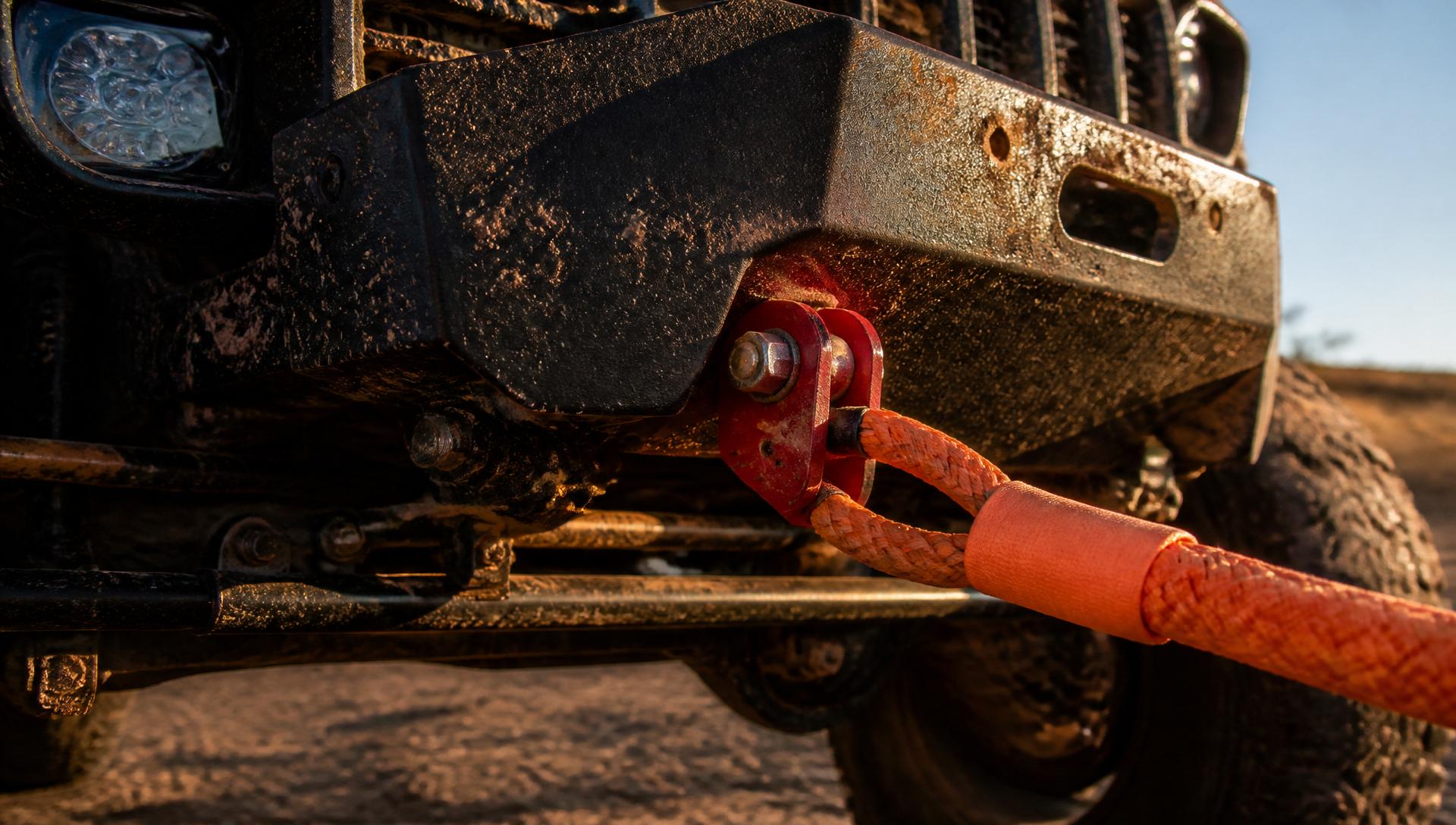
The winch line is stretched, the snatch strap is buried in the mud you are trying to escape, and your buddy has his shackle hooked to that painted loop hanging off the front of your bumper. Everyone is standing where they think is safe, which is usually a lot closer than it should be. The driver spins up the tires, the strap snaps taut, and for a second nothing moves. Then something lets go.
If that something is a factory tow hook or the thin bracket behind it, you now have a two-pound steel projectile leaving the truck at a speed nobody in the group is prepared for. This is not a rare freak event. It is the single most common way people get seriously hurt or killed during vehicle recovery, and it almost always traces back to the same mistake: someone assumed the hook on the truck was a recovery point. It was not.
This guide covers what actually separates a rated recovery point from a tow hook, how to read the numbers that matter, and how to set your rig up so the day you get stuck is annoying instead of dangerous.
The Short Version
Factory tow hooks and tie-down loops are usually rated for slow, flat-ground towing, not the shock load of a kinetic snatch. Bolt on a rated recovery point that transfers load into the frame, run a rated shackle (a soft shackle is safer than steel), drape a damper over the strap, and keep bystanders well off the line of pull.
Tow hook, tie-down, recovery point: they are not the same thing
The words get used interchangeably at the trailhead, which is where the trouble starts. They describe three different jobs.
A tie-down point is the loop or slot the factory welds on so the truck can be strapped to a car carrier or a train without sliding around. It is engineered for static load in a controlled direction. It was never designed for a dynamic yank.
A tow hook is the hook some trucks come with from the factory, usually painted red or orange up front. Here is the part that surprises people: on many vehicles that hook is rated only for flat ground, slow speed, straight-line towing of a disabled vehicle. Some are barely more than glorified tie-downs. The owner's manual, if you actually read it, will often tell you in plain language not to use them for extraction or snatch recovery. Almost nobody reads that page.
A recovery point is a purpose-built, rated attachment bolted or welded into the frame or a frame-mounted bumper, engineered to take a hard, sudden, off-axis load without failing. This is the only one of the three you should ever clip a kinetic strap or winch line to.
The honest truth that the accessory aisle does not put on a shelf tag: the fact that a hook exists on your truck tells you nothing about whether it can survive a recovery. Existence is not a rating. You have to know the number, and most factory hooks either do not have one for kinetic loads or have one far lower than the forces a stuck truck generates.
Why recovery loads are so much bigger than they look
People underestimate recovery forces because a truck sitting still looks passive. It is not. Getting it unstuck can take a pull far greater than the vehicle's own weight.
A rough working rule that recovery instructors use: a vehicle stuck to the axles in mud or sand can require a pulling force of two to three times its weight to break free, sometimes more in the worst muck. Take a 6,000-pound truck buried past the hubs. Freeing it can demand 12,000 to 18,000 pounds of force at the recovery point. That is not a typo. The mud does not care what your hook is painted.
Now add a kinetic rope or snatch strap to the picture. A kinetic recovery rope works by stretching, storing energy like a rubber band, and releasing it into the stuck vehicle. That stored and released energy is exactly why they work so well, and it is also why they are so unforgiving. When any link in that chain fails under a stretched kinetic load, all that energy goes somewhere. It goes into whatever broke, and it launches it.
This is the difference between a static winch pull, which builds tension slowly and drops it fast if something slips, and a kinetic snatch, which stores a large amount of energy and dumps it violently on failure. Both need a rated point. The kinetic pull punishes a weak one far worse.
How to read a rating that actually means something
A real recovery point comes with a number, and the number has a name. Learn the two you will see.
Working Load Limit, or WLL is the maximum load the manufacturer says the component should see in normal use. It already has a safety margin baked in.
Minimum Breaking Strength sometimes called breaking strain or MBS, is the load at which the component is expected to actually fail. This is much higher than the WLL.
The gap between them is the safety factor. Quality recovery gear is typically built to a safety factor somewhere in the range of five to one or higher against its working load limit, meaning it will not break until well past the rated number. A shackle marked with a 4.75-ton working load limit is not going to explode at 4.75 tons. That is the whole point of the margin. What matters is that every part of your system, the recovery point, the shackle, the strap, and the point on the other vehicle, is rated for the loads you calculated above with margin to spare.
The chain is only as strong as its weakest link, and that is not a cliche here, it is physics. A 30,000-pound strap clipped to a 3,000-pound tie-down gives you a 3,000-pound system and a false sense of security to go with it.
Bolt-on recovery points and frame-mounted bumpers
For most trucks and SUVs, the fix is straightforward and worth every dollar.
The cheapest legitimate upgrade is a bolt-on recovery point that mounts to your existing frame using the factory holes and hardware the manufacturer already engineered to take load. Good ones are laser-cut steel, come with the correct grade bolts, and list a clear rating. They replace or supplement the flimsy factory hook with something you can trust a kinetic strap to. On many popular platforms these run in the range of a hundred to a couple hundred dollars, which is nothing next to a hospital visit or a cracked windshield on the truck doing the pulling.
The next step up is a frame-mounted steel bumper or a plate bumper with integrated, rated recovery points. If you are already replacing a bumper for approach angle or to mount a winch, getting rated shackle mounts as part of that build is a two-birds move. Just confirm the recovery points are actually rated and tied into the frame, not decorative loops welded to sheet metal. Not every aftermarket bumper gets this right.
Whatever you choose, the rule is the same. The recovery point must transfer load into the frame, not into a bracket, a bumper skin, or a body panel. If you cannot trace the load path back to the frame, treat it as decoration.
Shackles: steel D-rings and soft shackles
The recovery point is only half the connection. The shackle links your strap or winch line to it, and here you have two good options.
A steel bow shackle often called a D-ring, is the traditional choice. It is strong, cheap, and nearly indestructible. Buy rated ones with a stamped working load limit, screw the pin in and then back it off a quarter turn so it does not seize under load, and inspect them for bending or thread damage. The downside is honest: they are heavy chunks of steel, and a heavy chunk of steel is exactly what you do not want flying if something else in the system fails.
A soft shackle is a loop of synthetic rope, usually the same class of material as a synthetic winch line, that does the same job at a fraction of the weight. A good soft shackle can carry a breaking strength well above most steel D-rings while weighing a few ounces instead of a pound and a half. If it does fail, it does not become a steel missile. Soft shackles also flex to fit odd-shaped recovery points and will not chip your paint or rattle on the bumper. The tradeoffs are that they can be cut on a sharp edge and they wear with UV and abrasion, so you inspect them and retire them when they fuzz up. For most people, a soft shackle up front is the safer and more convenient default, with a steel D-ring or two kept in the kit for the jobs that call for it.
The safety habits that matter more than the gear
The best recovery point in the world will not save a group that stands in the wrong place. A few habits do the heavy lifting.
Keep people out of the danger zone. If a line lets go, it and anything attached to it travels roughly along the line of pull. Everyone not driving should be well off to the side and back, ideally farther than the length of the strap or rope, and never straddling the line or standing directly fore or aft of the pull.
Use a line damper. A recovery damper, or even a heavy blanket or a bag with some weight in it, laid over the middle of the strap does two things. It kills some of the energy if the line snaps, and it drives the recoiling line toward the ground instead of into a windshield. It costs almost nothing and it is one of the cheapest pieces of insurance in the kit.
Inspect before every pull. Look at the recovery points on both vehicles, the shackles, and the strap. A frayed strap, a bent shackle, or a recovery point with a cracked weld is a reason to stop, not a reason to hurry.
Never join two straps with a metal shackle. Threading a steel shackle to connect two straps creates the exact projectile you are trying to avoid. If you must extend, use a proper soft link or a rated joining method, never a chunk of metal in the middle of a stretched line.
And read your own owner's manual once, on the couch, before you ever need it. Find out what your factory hooks are actually rated for. You may be pleasantly surprised, or you may find out that the loop you have been trusting is a tie-down. Better to learn that at home than at the bottom of a rutted hill.
The bottom line
Recovery is one of the few things in this hobby where the wrong part does not just disappoint you, it can hurt someone standing next to you. The trap is that a tow hook and a recovery point look close enough to fool a tired crew at the end of a long day. They are not the same. A tow hook is often built for slow flat-ground towing. A rated recovery point is built to take a violent, sudden load and hold. Learn your factory ratings, bolt on real recovery points if yours fall short, run rated shackles, keep people out of the line, and drape a damper over the strap. Do that and the worst part of getting stuck is the story you tell about it later, which is exactly how it should be.