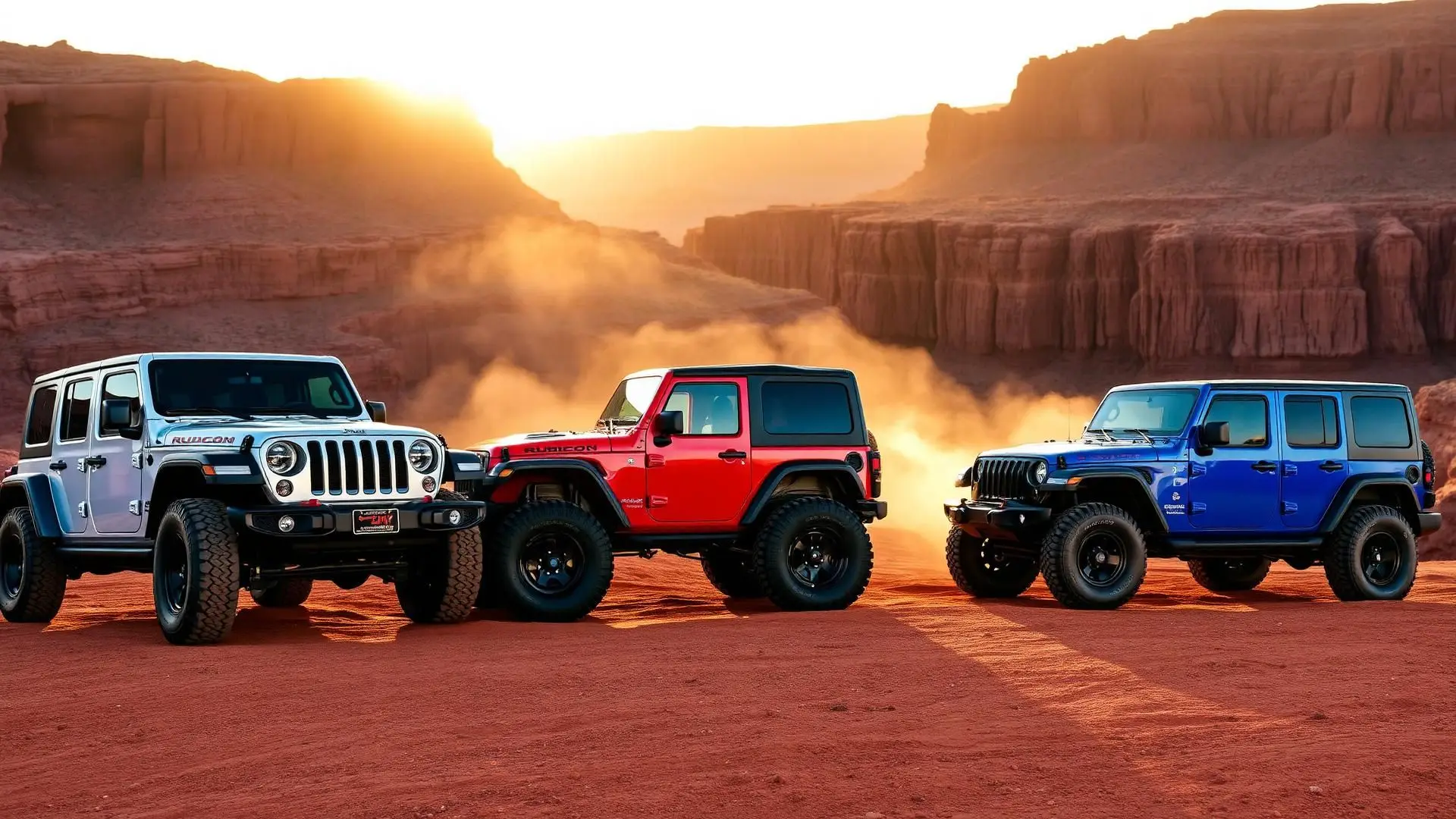
The trail forks at the base of a slickrock ledge. A guy in a Sport S airs down, walks the line, and gets pulled back at the first stair because his open differentials send all the power to the wheel with the least grip. A Rubicon behind him locks both axles, disconnects the front sway bar, and crawls up it like the rock owes him money. Twenty minutes later a Rubicon 4xe climbs the same ledge in pure electric mode, silent except for the crunch of stones under 35s, and parks at the top with 11 miles of battery left. Same nameplate. Three completely different vehicles.
Off-roading with a Jeep Wrangler is sold as a single decision: you buy the Jeep, you go anywhere. The truth is that the trim badge on the back determines which trails you actually finish. This is the honest 2026 comparison of the three Wranglers most people are choosing between, the Sport, the Rubicon, and the 4xe, with the real numbers, the real trade-offs, and the one thing nobody mentions until they are stuck on a hill.
The Question Almost Nobody Frames Correctly
Most Wrangler comparisons rank trims by price and feature lists. That is the wrong axis. The right question for off-roading is what the trim gives you that you cannot bolt on later for less money. By that test, the Rubicon is not the expensive trim. It is the value trim, and the Sport S is the trap.
The Rubicon ships from the factory with Dana 44 heavy-duty axles front and rear, electronic locking differentials at both ends, an electronic front sway bar disconnect, the Rock-Trac transfer case with a 4:1 low range, 4.10 gears, and LT285 off-road rubber on 17-inch wheels. Trying to add lockers, a disconnect, and a 4:1 case to a Sport or Sport S costs more in parts and labor than the price gap between the trims, and the result is still a converted vehicle rather than a factory-engineered one with a warranty. The Rubicon is what a built Sport is trying to become.
The 4xe is a different question. It is a Rubicon underneath, with the same lockers, disconnect, Rock-Trac case, axles, and tire sizes, plus a 17.3 kWh battery, an electric motor, and a 2.0-liter turbo four. You get every piece of factory off-road hardware Jeep sells, plus a powertrain that turns silent crawling into a real party trick and dumps 470 lb-ft of torque on demand. You also gain about 750 pounds of curb weight, lose interior volume, and inherit a regen brake feel that takes getting used to on technical descents.
What Each Trim Actually Gives You On The Trail
The Sport and Sport S are honest entry-level Wranglers. The Command-Trac part-time 4WD case has a 2.72:1 low range, which is fine for forest roads, mild rocks, snow, and the kind of terrain where momentum and ground clearance solve most problems. Approach angle on the Sport sits at 38.7 degrees, departure at 29.1, and ground clearance at 9.7 inches. Those are very good numbers in absolute terms. A stock 4Runner is around 9.6 inches, a Tacoma TRD Pro about 9.4. The Wrangler Sport is more capable in box-stock form than most lifted small SUVs. It just hits its ceiling when open differentials and a 2.72:1 low range stop being enough.
The Willys is the trim Jeep created to bridge that gap. It adds mud-terrain tires, heavy-duty Bilstein shocks, rock rails, a rear locker, and a Trac-Lok limited-slip front, but no front locker, no disconnect, and the same Command-Trac case as the Sport. It looks like a Rubicon at a glance and gives you maybe 70 percent of one until the trail starts asking for the other 30 percent. That last 30 percent is where the broken parts and recovery videos come from.
The Rubicon, in any flavor including the 4xe, is where every Trail Rated number starts working in your favor. Approach climbs to 44 degrees, departure to 37, ground clearance to 10.8 inches, and breakover hits 27.8 on the four-door. Run the factory-available 35-inch tires and breakover jumps to 32.4. The Rock-Trac case drops your crawl ratio down to a 4:1 low range that lets you idle through obstacles instead of riding the throttle, and the lockers do exactly what they sound like, which is force both wheels on an axle to turn together so power goes to the tire with grip instead of the tire spinning in air. The sway bar disconnect lets the front axle articulate roughly 10 inches further at full droop, which is the difference between a tire reaching the ground and lifting helplessly. These are the four upgrades that separate a Wrangler that climbs from a Wrangler that just wishes it could.
The Quick Numbers Table
| Spec | Sport | Sport S | Willys | Rubicon | Rubicon 4xe |
|---|---|---|---|---|---|
| Approach angle | 38.7° | 41.5° | 41.4° | 44.0° | 44.0° |
| Departure angle | 29.1° | 31.6° | 31.4° | 37.0° | 37.0° |
| Ground clearance | 9.7 in | 9.7 in | 9.7 in | 10.8 in | 10.8 in |
| Transfer case | Command-Trac 2.72:1 | Command-Trac 2.72:1 | Command-Trac 2.72:1 | Rock-Trac 4:1 | Rock-Trac 4:1 |
| Front locker | No | No | No | Yes | Yes |
| Rear locker | No | No | Yes | Yes | Yes |
| Sway bar disconnect | No | No | No | Yes | Yes |
| Factory tire size | 245/75R17 | 245/75R17 | LT255/75R17 MT | LT285/70R17 | LT285/70R17 |
| Curb weight (4-door) | ~4,200 lb | ~4,300 lb | ~4,400 lb | ~4,450 lb | ~5,180 lb |
| Water fording | 30 in | 30 in | 30 in | 32.5 in | 30 in |
| Crawl ratio (auto) | 47.9:1 | 47.9:1 | 47.9:1 | 77.2:1 | 77.2:1 |
Read the crawl ratio line twice. A higher number means the engine can multiply torque more aggressively in low range, which is what lets the Rubicon trickle over rocks at idle while the Sport has to ride a throttle and a brake at the same time. That single spec is responsible for more "the Rubicon was easier than I expected" comments than anything else.
The Honest Part Nobody Mentions About The 4xe
The Rubicon 4xe is genuinely magic in three specific situations and quietly compromised in three others. The compromises do not show up on the SERP.
The good first. Silent crawling on slickrock and rock gardens is a real thing, and once you have done it you cannot go back. The electric motor delivers maximum torque from zero rpm, so you can dial in throttle inputs at sub-walking speed without the lurch of a torque converter loading and unloading. On a tight, technical line where every inch of throttle matters, that control alone is worth the price. Stop-and-start trail crawling does not burn gas because you are running on battery for most of it. And in a campground or a national park where engine noise carries, you can move the rig quietly.
Now the parts the dealer page leaves out. First, the curb weight. A Rubicon 4xe lands around 5,180 pounds versus roughly 4,450 for a gas Rubicon. That 730-pound difference is mostly battery, mounted in the floor, and it changes everything from articulation behavior to recovery strap selection to how the rig settles on a sidehill. It also pushes you harder against your axle weight ratings the moment you add a rooftop tent, a bumper, and a winch. Plan the build accordingly.
Second, the regen braking. The 4xe blends regenerative braking and friction braking, and the handoff between the two is famously tricky at low speeds. On technical descents the rig does not coast the way a gas Rubicon does. It grabs, releases, and grabs again as the system switches between regen and pads, and on a steep loose surface that pulse can break traction or upset the line. Owners get used to it. New owners are not warned about it. Plan to learn the pedal on easy descents before you trust it on something exposed.
Third, the electric range claim. EPA says 21 miles of pure electric range. In real off-road use, with the AC running, 35-inch all-terrains, and any throttle aggression at all, plan on roughly 11 to 14 miles before the gas engine kicks in. The 4xe is still a great off-roader after the battery is depleted, just a heavier one.
When The Sport Is Actually The Right Answer
The Sport S is the right Wrangler for someone who wants the look and the open top, drives gravel forest roads, occasional dirt two-tracks, and snow, and does not plan to challenge ledges, big mud, or named-rock crawls. With a decent set of all-terrains, a real tire pressure gauge, a portable compressor, and the basic recovery kit, a Sport S handles everything most owners actually do with their Jeeps. It also accepts a 2.5-inch lift and 33-inch tires cleanly, which is plenty for the trails it belongs on.
The trap is buying a Sport S and then spending two years bolting on upgrades trying to make it a Rubicon. By the time you have added a rear locker conversion, an ARB front locker, a sway bar disconnect, a Rubicon transfer case swap, and the regear that big tires demand, you have spent the difference twice and you still have a converted vehicle. If you know you want lockers and a disconnect, buy the Rubicon. If you genuinely do not need them, buy the Sport S and stop.
When The Rubicon Is The Smart Spend
The gas Rubicon is the right Wrangler for almost everyone who actually off-roads. It earns its premium the first time you put a wheel in the air and the locker keeps you moving. Pair it with a serious tire and recovery setup and you have a rig that can finish named runs without modification, and an upgrade path that scales cleanly from a 2.5-inch lift on 35s to a full 37-inch build with regears. Resale is also better than any other Wrangler trim because every used Rubicon has a buyer waiting.
The honest caveats are that a Rubicon rides slightly stiffer than a Sport, runs aggressive all-terrains stock that hum on the highway, and the door, top, and roof removability that Jeep people love means the cabin will never be as quiet as a 4Runner. None of that is news to anyone shopping a Wrangler, but it is worth saying out loud before the test drive.
For a sense of what a true expert run asks of a rig, our Rubicon Trail (22 miles) guide lists the tire, lift and locker requirements.
When The Rubicon 4xe Earns Its Keep
The 4xe makes sense in three buyer profiles. First, the daily driver who commutes mostly under 21 miles and wants to charge at home, getting an electric-feeling driver for the work week and a serious crawler for weekends. The numbers actually work, and the Wrangler is the only PHEV with this off-road hardware. Second, the technical rock crawler who wants silent, precise throttle control on hard lines and is willing to manage the weight. Third, the buyer who simply wants the most factory-built Wrangler with the most torque and does not want to wait for the 392 to come back. If none of those three profiles fits, the gas Rubicon is the better daily off-road tool for less money.
What To Buy First Regardless Of Trim
Before any performance mods, the same trail gear list applies to all three Wranglers. A real tire pressure gauge with a release valve so you can air down to 18 psi for traction and float. A portable compressor capable of refilling LT-rated tires at the trailhead. A basic recovery kit with a kinetic rope rated for your loaded vehicle weight, a pair of soft shackles, a snatch block, and a set of traction boards. A GMRS or CB radio for group runs. A first-aid kit. Gloves. Boots. Water. Skip the chrome accessories and the LED light bar until you have the recovery gear that gets you home.
The Wrangler's factory tow hooks are real recovery points. The factory winch mount on the Rubicon and 4xe accepts most aftermarket winches with a plate. Plan that build before you spend money on cosmetic upgrades.
Verdict: Which Wrangler For Off-Roading
For the casual off-roader who wants forest roads, mild trails, and a rig that looks the part: the Sport S is the right answer at a fair price.
For the buyer who plans to run named trails, technical lines, ledges, and the kind of terrain where lockers actually matter: the Rubicon is the value trim disguised as the premium one. It is the platform you build on without regretting the foundation.
For the buyer who wants the most capable factory Wrangler with electric-mode crawl precision, can manage the weight, and likes the idea of commuting on the battery: the Rubicon 4xe earns its premium for the specific use case it nails. For anyone else, the gas Rubicon is the better deal.
The Wrangler badge tells the world this is an off-road vehicle. The trim badge below it tells the trail what you can actually finish. Choose accordingly.