"Low or high?"
"Is it slippery, or is it steep?"
"Both?"
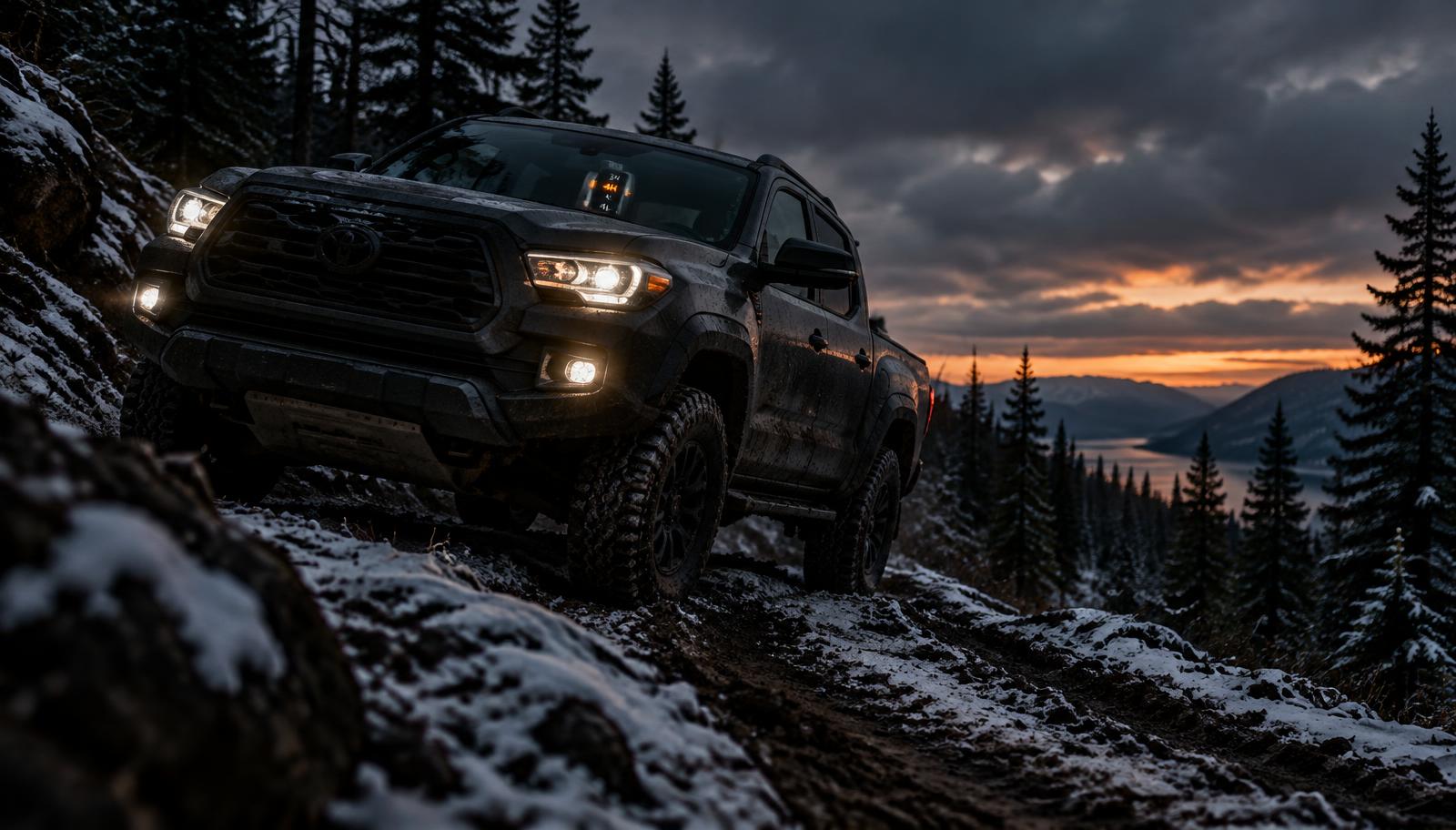
Picture that exchange at the bottom of a forest road after the first storm: a stock half-ton nosed up to a rutted climb, rain-soaked clay shining in the headlights, a second truck idling behind it. The driver has a knob or a row of buttons on the dash marked 2H, 4H, 4L, maybe 4A, and a vague memory that "low is for when it gets serious." He jabs 4L at 20 mph and gets nothing but a message on the dash, because the truck wants 3 mph or less and neutral first. Or he picks 4H on the climb, spins halfway up, and slides back down to try again with more speed, which is exactly the wrong lesson.
The fix is not mysterious. It is printed in the glovebox, and the four manuals we checked agree on the basics.
That knob or button row runs the transfer case, a gearbox behind the transmission that sends power to the front axle. 4H, four-wheel drive high, locks the front and rear driveshafts together at normal gearing. 4L, four-wheel drive low, locks them together and adds a reduction gear, so the wheels turn slower and harder for the same engine speed. Ford calls the F-150's 2-speed transfer case a part-time system, meaning it is built to be in 4WD only part of the time.
Why 4 High vs 4 Low Matters This Winter
Colorado State Patrol says every vehicle under 16,001 pounds on I-70 between Dotsero and Morrison must meet the Passenger Vehicle Traction Law whenever it is active, from September 1 through May 31. A 4WD or AWD vehicle can comply on M+S, mountain-snowflake or all-weather tires with at least 3/16 inch of tread (CSP chain law information), and CDOT's traction law page lists the same 4WD and AWD tire options. The law lets four-wheel drive count. It does not tell you which mode to pick, and that is the question the manuals answer.
The 2025 manuals we read: Ford F-150 (edition 202407), Ford Bronco (edition 202408), Toyota Tacoma (OM04011U) and Jeep Wrangler JL. We tried the 2025 4Runner manual too; Toyota's server refused the download, so it is not in this sample.
The Honest Truth: 4 Low Isn't More Traction, and 4 High Isn't a Safety Button
Here is the part forums blur. In a part-time system, 4H and 4L lock the axles together the same way. Jeep's manual says both modes force "the front and rear wheels to rotate at the same speed" (2025 Wrangler owner's manual, pp. 163 to 164). The difference is gearing. Ford describes 4L as giving "additional gearing for increased torque multiplication" (2025 F-150 owner's manual, p. 270). So 4L does not grip the mud better than 4H. It lets you go slower with more control and more pull, which is often what actually gets you up the hill.
The second truth is worse news for the snowy-highway crowd. Four-wheel drive gets you moving; it does nothing for stopping. Ford's F-150 manual says a four-wheel drive vehicle "won't stop any faster than two-wheel drive vehicles" (p. 266), and the Bronco manual repeats the line (p. 182). Jeep goes further: "Because four-wheel drive provides improved traction, there is a tendency to exceed safe turning and stopping speeds" (Wrangler, p. 164).
And one detail that is easy to miss: on the 2025 Tacoma, shifting to 4L turns stability control off. Toyota: "When the front-wheel drive control switch is shifted to '4L' VSC is automatically turned off" (2025 Tacoma owner's manual, p. 405). VSC is the system that brakes individual wheels to stop a slide. That is fine on a slow rock climb. On an icy paved grade, it means 4L removes a safety net you probably did not know you had.
4 High vs 4 Low in Four 2025 Owner's Manuals
Pages are printed page numbers in each 2025 manual.
| 2025 F-150 | 2025 Bronco | 2025 Tacoma | 2025 Wrangler | |
|---|---|---|---|---|
| 4H is for | "off-road or winter conditions such as deep snow, sand or mud"; "not for use on dry pavement" (p. 270) | "consistently slippery or loose surfaces" (p. 183) | "tracks that permit the tires slide, like off-road, icy or snow-covered roads" (p. 403) | "loose, slippery road surfaces only" (p. 163) |
| 4L is for | "only for off-road conditions such as deep sand, steep slopes, or pulling heavy objects" (p. 270) | consistently slippery or loose surfaces (p. 183); off-road (p. 187) | "climbing or descending steep hills, off-road driving, and hard pulling in sand, mud or deep snow" (p. 404) | loose, slippery surfaces only; "Do not exceed 25 mph" (p. 164) |
| Shift into or out of 4L | 3 mph or less, transmission in neutral (pp. 268 to 269) | "Bring your vehicle to a stop," then neutral or clutch (p. 185) | Stop completely, then N or clutch (p. 404) | Rolling at 1 to 3 mph, transmission in N (p. 164) |
| 2H to 4H | At a stop or while driving (pp. 268 to 269) | See manual for your transfer case | Below 62 mph (p. 404) | Stopped or moving; 0 to 45 mph preferred (p. 164) |
| The detail to know | Has 4A for "varying on-road conditions" where equipped (p. 270) | 4L "could produce some noise, such as occasional clunks" (p. 183) | 4L turns VSC off (p. 405) | 4L engine speed about 3x, or 4x on Rubicon (p. 164) |
Notice the shift procedure is not universal. The Bronco and Tacoma want a full stop for 4L. The Wrangler prefers you rolling at 1 to 3 mph and warns that a shift from a dead stop can take several tries because the gear teeth may not line up. If your buddy's truck does it one way, yours may not.
What 4 Low Does to Your Engine: The Math
Jeep gives the one number that makes 4L click. In 4L, engine speed is "approximately three times (four times for Rubicon models) that of the 2H or 4H positions at a given road speed" (Wrangler, p. 164).
Translate that. At 5 mph in 4L, a non-Rubicon Wrangler's engine is turning as fast as it would at about 15 mph in 4H, and a Rubicon's as fast as at 20 mph. At Jeep's 25 mph cap, that becomes 75 mph and 100 mph worth of engine speed (our math from Jeep's 3x and 4x figures). That is why 4L has a speed limit and why it feels so calm at a walking pace: the engine sits in a useful rpm range while the tires barely creep.
It also explains engine braking. Lift off in 4L on a steep loose descent and the gearing holds the truck back, which is why Toyota lists "descending steep hills" as a 4L job. The catch is ice. The same Wrangler manual warns: "Do not downshift for additional engine braking on a slippery surface. The drive wheels could lose their grip and the vehicle could skid" (p. 163). Loose dirt and glare ice are not the same problem.
Bigger tires change the math. BFGoodrich lists its All-Terrain T/A KO3 in LT265/70R17 at 31.7 inches tall and in 35x12.50R17 at 34.5 inches. Swap one for the other and every gear in the truck, low range included, covers about 8.8 percent more ground per turn and delivers about 8 percent less torque at the tire (our math from BFGoodrich's diameter specs: 34.5 ÷ 31.7 = 1.088; 31.7 ÷ 34.5 = 0.919). Run your sizes through the Tire Size Calculator, then the Gear Ratio Calculator, before blaming the transfer case for a weak low range.
When to Use 4 High vs 4 Low, Surface by Surface
| Surface or situation | Mode | Why |
|---|---|---|
| Dry pavement | 2H (or 4A / 4H AUTO where equipped) | All four reserve part-time 4H and 4L for slippery, loose or off-road use; Ford and Jeep warn of driveline damage on dry pavement |
| Wet pavement, patchy snow, mixed highway | 2H, or 4A / 4H AUTO if your truck has it | Auto modes are built for changing on-road grip; part-time 4H is not |
| Snow-packed or icy road, consistently slippery | 4H | The surface lets tires slip, which is what 4H needs |
| Fast gravel or washboard | 4H | Loose surface at normal speeds |
| Mud or deep snow at a crawl | 4L | Toyota lists both under 4L |
| Steep climb or descent on dirt or rock | 4L | Slow control and engine braking |
| Deep sand | 4H to keep speed, 4L for slow or heavy going | Ford lists sand under both modes |
| Pulling a stuck truck, or being pulled | 4L | Ford: "pulling heavy objects" |
The middle rows are where people get it wrong. Ford's 4A "provides electronically controlled four-wheel drive power to both the front and rear wheels, as required, for increased traction in varying on-road conditions" (F-150, p. 270). The 2025 Wrangler manual describes a five-position transfer case with 4H AUTO on trucks that have it (p. 165), and the Bronco manual covers an Advanced 4x4 with 4A mode (p. 185). If your truck has an auto mode, that is the setting for a highway that goes from slush to bare and back. If it does not, Ford's part-time rule applies: 4H only when the surface is consistently slippery.
Honest Warts
Dry-pavement binding is real. Because part-time 4WD forces both axles to turn together, the tires scrub in turns when they cannot slip. Ford warns that 4H or 4L on dry, hard roads "can produce excessive noise, increase tire wear and can damage drive components" (F-150, p. 266). The Bronco manual adds that the driveline "could become mechanically blocked" when you try to shift out of 4WD on dry pavement (p. 183). If the truck refuses to leave 4H after you hit a dry stretch, that is likely why. Your owner's manual describes how to release it.
Mismatched tires matter. Jeep says proper 4WD operation "depends on tires of equal size, type, and circumference on each wheel" (Wrangler, p. 164). With a dissimilar spare, Ford says do not exceed 50 mph in 4WD and do not engage 4WD unless stationary (F-150, p. 266).
Don't shift with a wheel spinning. Toyota says never shift from 2H to 4H while the wheels are slipping (Tacoma, p. 406). Get to traction, or stop, then shift.
The trucks that sit in 2H all year. Toyota asks owners to drive in 4WD "for at least 10 miles (16 km) each month" to keep the front drive parts lubricated (Tacoma, p. 405). Do it on a dirt road, not the freeway.
Clunks in 4L are sometimes normal. Ford tells Bronco owners that 4L on slippery or loose surfaces "could produce some noise, such as occasional clunks, but should not damage driveline components" (p. 183). A clunk on dirt is not automatically a broken truck.
Verdict Table: 4 High vs 4 Low
| Question | 4 High | 4 Low |
|---|---|---|
| Main job | Slippery or loose surfaces at normal speed | Slow, steep, heavy work |
| Top speed | No cruising limit printed in the 4WD sections we read; shift limits vary (Tacoma 2H to 4H below 62 mph) | 25 mph on the 2025 Wrangler |
| Shift procedure | Usually on the move | Stop or near stop, transmission in neutral |
| Engine speed | Normal | About 3x (4x Rubicon) on the 2025 Wrangler |
| Dry pavement | No (part-time 4H) | No |
| Helps stopping | No | Engine braking on loose descents only |
| Best for | Snowy roads, fast gravel, sand at speed | Mud and deep snow at a crawl, rock, recovery |
Who Should Use Which
New 4WD owners should treat 4H as the default whenever a dirt or snow surface lets the tires slip, and grab 4L the moment the plan becomes "go slow and do not stall." If the instinct is to add speed to make a climb, that is usually the moment for 4L instead.
Commuters on mixed winter roads should look for 4A or 4H AUTO first. If the truck only has part-time 4H, use it on snow-packed stretches and go back to 2H when the pavement goes black. And drive like the 4WD light means nothing for braking, because it doesn't.
Built trucks on 35s should run the tire and gear math before a winter trip. Going from a 31.7-inch to a 34.5-inch KO3 cuts low range's torque at the tire by about 8 percent (our math from BFGoodrich).
FAQ: 4 High vs 4 Low Questions People Type
Can you drive in 4 high on the highway?
Only when the highway is consistently slippery. Ford says 4H is "not for use on dry pavement" (F-150, p. 270), and the Bronco manual limits 4H to consistently slippery or loose surfaces. On mixed roads, use 4A or 4H AUTO if your truck has one.
How fast can you go in 4 low?
On the 2025 Wrangler, no faster than 25 mph, per Jeep's manual. Other manuals we read describe 4L as a low-speed off-road mode; check yours for a printed limit.
Do you have to stop to shift into 4 low?
It depends on the truck. The 2025 Bronco and Tacoma manuals say stop; the F-150 says 3 mph or less; the Wrangler prefers rolling at 1 to 3 mph. All four want the transmission in neutral (or the clutch in).
Is 4 low or 4 high better in snow?
4H for driving on snow-covered roads, 4L for deep snow at a crawl or getting unstuck. Toyota lists icy or snow-covered roads under 4H and deep snow under 4L.
What is the difference between 4 auto and 4 high?
4A sends power to the front wheels as needed and is built for changing on-road conditions; 4H locks the front and rear together for consistently slippery or loose surfaces. Ford's F-150 manual draws exactly that line.
Can driving in 4WD on dry pavement damage my truck?
Yes. Ford warns it can increase tire wear and damage drive components, and Jeep says it "will cause increased tire wear and damage to the driveline components" (Wrangler, p. 164).
Should you use 4 low going downhill?
On steep, loose dirt or rock, yes; Toyota lists descending steep hills as a 4L use. On ice, be careful: Jeep warns against downshifting for engine braking on slippery surfaces because the wheels can lose grip.
Bottom Line
4 High vs 4 Low is not a question of how much traction you want. In a part-time system, both lock the axles together. 4H is for slippery or loose surfaces at normal speeds; 4L is gearing for slow, steep, heavy work, with the 2025 Wrangler capped at 25 mph. In part-time 4WD, neither belongs on dry pavement, neither stops the truck faster, and on a 2025 Tacoma, 4L switches stability control off. Read your manual's shift procedure before the first storm, because the four we checked don't agree.
Internal Links and Tools
- How to Air Down Tires Off-Road: PSI Guide
- Regearing 101
- Locker vs Limited Slip Differential
- Tools: Gear Ratio Calculator, Tire Size Calculator
Sources
- Ford 2025 F-150 Owner's Manual, edition 202407, dealer-hosted copy (four-wheel drive, pp. 265 to 270)
- Ford 2025 Bronco Owner's Manual, edition 202408, dealer-hosted copy (four-wheel drive, pp. 182 to 188)
- Toyota 2025 Tacoma Owner's Manual, OM04011U (four-wheel drive system, pp. 403 to 406)
- Jeep 2025 Wrangler Owner's Manual (four-wheel drive operation, pp. 163 to 165)
- BFGoodrich All-Terrain T/A KO3 size and spec listing (diameters, checked Oct 9, 2026)
- Colorado State Patrol, Chain Law Information (Passenger Vehicle Traction Law, I-70 Dotsero to Morrison, Sept 1 to May 31; checked Oct 9, 2026)
- CDOT Passenger Vehicle Traction and Chain Laws (4WD/AWD tire options; checked Oct 9, 2026)