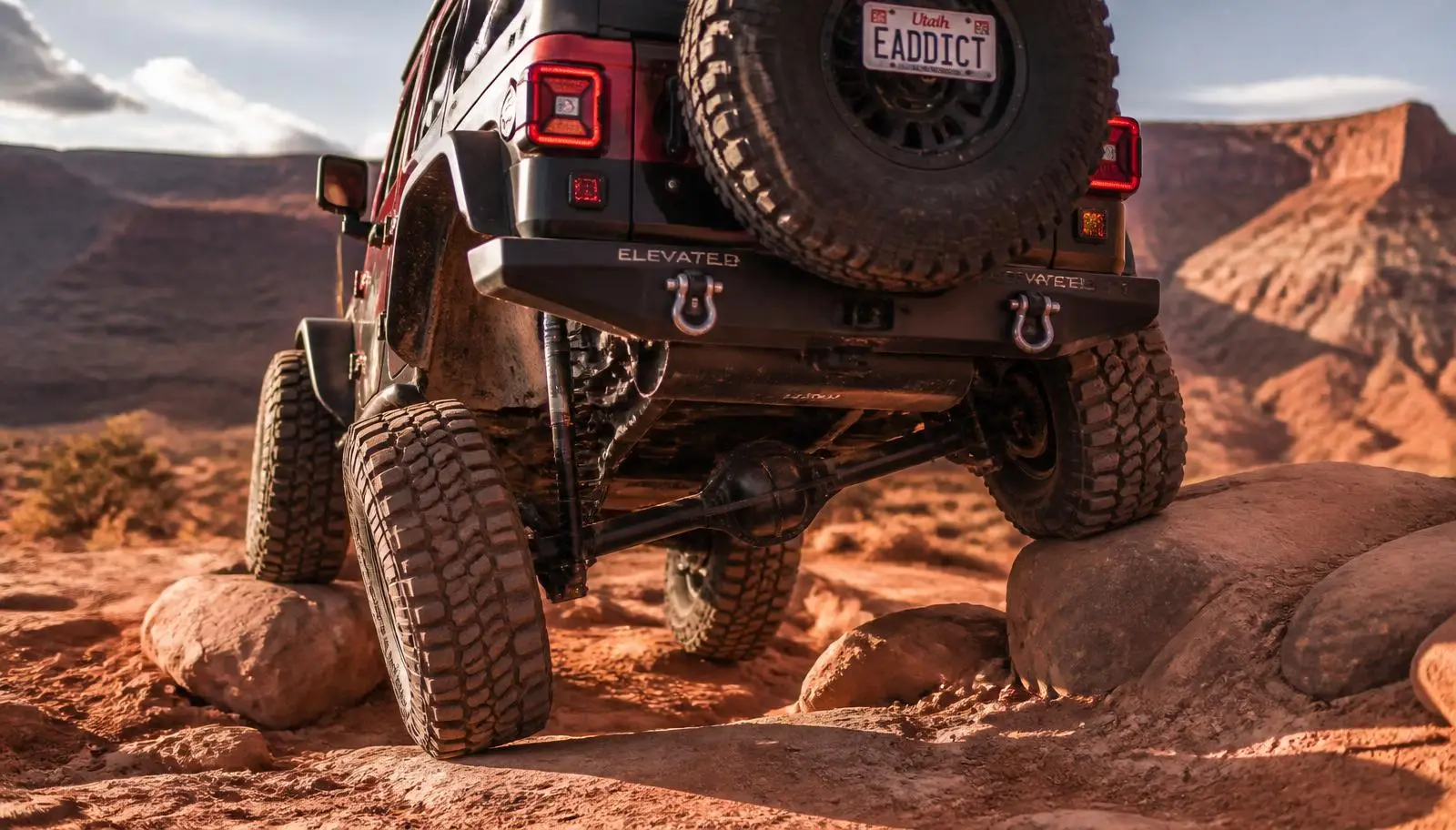
One tire spinning uselessly in the air while its partner sits on solid ground doing nothing: every 4x4 driver meets this moment eventually, and it is the moment differentials stop being an abstract spec-sheet line. The difference between an open diff, a limited-slip, and a locker decides whether that moment is a shrug or the end of your day.
This guide explains what each type actually does, which terrain rewards which choice, and how to shop the aftermarket if your rig came without the traction it needs.
The 30-Second Answer
An open differential sends power to the wheel with the least grip, which is exactly backwards for off-road use. A limited-slip senses slip and biases torque toward the gripping wheel, good for snow, gravel, and mild trails. A locker forces both wheels on an axle to turn together no matter what, which is the only device of the three that keeps you moving when one wheel has zero traction, the defining condition of technical off-roading.
If your wheeling is dirt roads and moderate trails, a limited-slip (or your truck's electronic brake-based traction control) is plenty. If you climb ledges, cross deep ruts, or flex tires off the ground, a rear locker is the single biggest traction upgrade money buys, worth more than a lift and often more than bigger tires.
Why open diffs fail off-road
A differential exists because your wheels travel different distances in a corner, so they must spin at different speeds. The open diff solves this elegantly on pavement and catastrophically off it: it always routes torque along the path of least resistance. Lift one wheel off the ground and the path of least resistance is that airborne wheel, which receives all the power and spins happily while its grounded partner receives essentially none.
This is why a stock open-diff 4x4 can be immobilized with one front and one rear wheel lifted, a state trail drivers call being cross-axled, and why a two-wheel-drive truck with a locker sometimes outclimbs a four-wheel-drive without one.
Limited-slip: the street-friendly middle ground
A limited-slip differential (LSD) uses clutch packs or helical gears to resist the speed difference between wheels, typically biasing torque toward the gripping wheel at up to about a 70/30 split. When one wheel starts to spin, the LSD transfers meaningful power to the other side automatically, with no driver input and no drivability penalty on the street.
Where LSDs shine: snow-covered roads, wet launches, gravel, washboard, sandy two-track, towing on slick ramps, and mild trails where both tires stay loaded. For the truck that is 90 percent street and 10 percent easy dirt, a factory LSD option is quietly one of the best boxes to tick.
Where LSDs quit: the zero-traction case. Clutch-type units need some torque across the axle to work; with a wheel fully airborne, most LSDs behave nearly like open diffs. Worn clutch packs also fade over the years, which is why a ten-year-old "limited-slip" often is not anymore.
Modern electronic traction control complicates the picture in a good way: by braking the spinning wheel, it forces torque across an open diff and mimics an LSD. Current systems on trucks like the 4Runner and Colorado ZR2 are impressively capable on moderate terrain, but they work by burning brakes and interrupting momentum, and they fall behind dedicated hardware as terrain gets slower and more technical.
Lockers: maximum traction, with manners to match
A locking differential mechanically joins both axle shafts so both wheels always turn at the same speed, a true 50/50 split that no traction condition can defeat. One wheel in the air changes nothing; the grounded wheel still receives full drive.
The cost is cornering behavior. Locked wheels fight turns, which on grippy pavement means hopping, pushing wide, and drivetrain stress, the same physics that keeps part-time 4WD off dry asphalt (covered in our 4 high vs 4 low guide). This is why lockers come in two philosophies.
Selectable lockers (ARB Air Locker, Eaton ELocker, most factory units like the Rubicon's) run as open diffs until you flip a switch, giving you pavement manners and trail traction in one axle. This is the right answer for almost every dual-purpose rig.
Automatic lockers (Detroit Locker, lunchbox lockers like the Aussie Locker) are always engaged and unlock momentarily to allow cornering. They are cheaper and simple, but they clunk, influence handling in the rain, and demand respect on ice. Best reserved for dedicated trail rigs.
Air locker vs e-locker
The two dominant selectable designs differ mainly in how they engage.
ARB Air Lockers engage pneumatically, which requires an onboard air compressor. The mechanism is famously durable under extreme load, and the compressor pulls double duty airing your tires back up, a genuine bonus if you air down properly on every trip. Expect roughly $1,100 to $1,300 per axle in parts, plus $300 to $500 for a compressor if you lack one, plus installation.
Eaton ELockers engage electromagnetically, needing only a wire, which makes installation simpler and removes air lines and seals from the failure list. Parts run a comparable $1,200 to $1,400 per axle.
Both are excellent. Choose ARB if you want the compressor anyway; choose the ELocker for simplicity. Either way, budget $800 to $1,500 for professional gear setup on top of parts, because differential installation is precision work with expensive consequences when rushed.
What should you actually buy?
Mostly street, occasional easy dirt: factory LSD or just good traction control. Spend the locker money on tires.
Regular moderate trails: a rear selectable locker transforms the rig. Rear first, always, because the rear axle stays loaded on climbs, where you need traction most.
Technical rock, deep ruts, serious flex: front and rear selectable lockers. A Wrangler Rubicon's twin lockers are the reason it embarrasses more expensive hardware; see our Sport vs Rubicon comparison for how much that matters at the trailhead.
Before any of it: tires and tire pressure. A locker cannot create grip the rubber does not have, and an aired-down set of the right tires solves many problems drivers try to buy their way out of with drivetrain parts. Our all-terrain vs mud-terrain guide is the honest place to start.